





KYB vs KYC: How They Differ in the US, EU, and India (2026)

 Open in ChatGPT
🗒️ Key Highlights
- KYC verifies individual customers; KYB verifies business customers and identifies the people who own and control them, known as ultimate beneficial owners (UBOs).
- KYB usually includes KYC on a company's directors and beneficial owners, so it is the wider process.
- Beneficial ownership thresholds differ by country: 25% in the US under FinCEN's CDD Rule, generally 25% in the EU, and more than 10% for companies in India since March 2023.
- The EU's AML Regulation applies from July 10, 2027, and since February 2026 US banks no longer have to re-verify an existing business customer's owners every time it opens a new account.
Quick answer: KYC (Know Your Customer) verifies that an individual customer is who they claim to be. KYB (Know Your Business) verifies that a business customer is real and legally registered, and identifies the people who own and control it, known as beneficial owners or UBOs. Because KYB usually includes KYC on those people, it is the wider process.
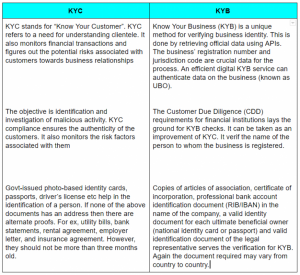
| KYC | KYB | |
|---|---|---|
| Who is verified | Individual customers | Companies, merchants, partners, and vendors, plus their directors and owners |
| Typical checks | Government ID, selfie and liveness, address, sanctions and PEP screening | Business registration, tax ID, directors, beneficial owners, sanctions and adverse media screening |
| Key documents | Passport, driver's license, national ID | Registry extract or certificate of incorporation, tax ID (EIN, GSTIN, RFC), ownership records |
| Main risk addressed | Identity fraud and money laundering by individuals | Shell companies, hidden ownership, and fraudulent merchants |
This guide also covers the "where": how beneficial ownership rules differ in the US, the EU, and India. For a broader comparison, see our complete KYB vs KYC guide.

Banks, payment processors, marketplaces, and B2B platforms run KYB when they onboard merchants, corporate clients, and suppliers. Digital KYB tools cut cost and manual work by pulling registry, tax, and ownership data through APIs instead of collecting it on paper.
KYC To KYB — How One Led To The Other
US anti-money laundering law goes back to the Bank Secrecy Act of 1970. After 2001, the USA PATRIOT Act added the Customer Identification Program (CIP) rule, which made identity verification at account opening mandatory. That worked well for individuals, but banks weren't required to look through a business customer to the people behind it, so shell companies could hide who really controlled the money.
FinCEN closed that gap with the Customer Due Diligence (CDD) Rule, published in May 2016 and applicable from May 11, 2018. It requires covered financial institutions to identify and verify the beneficial owners of legal entity customers, which is the core of what is now called KYB. Our guides to the Customer Identification Program and customer due diligence explain both rules.
Talking About KYB Terminology
Ultimate Beneficial Owner | UBO
A UBO, or ultimate beneficial owner, is the natural person who ultimately owns or controls a business. The ownership threshold depends on the jurisdiction:
- US: each individual who owns 25% or more of a legal entity customer, plus one individual with significant control, under the FinCEN CDD Rule.
- EU: generally 25% of the shares or voting rights, or control by other means, under the AML directives and the AML Regulation.
- India: for companies, more than 10% ownership or entitlement to profits, or control, under the Prevention of Money Laundering Rules as amended in March 2023.
Customer Due Diligence | CDD
Customer Due Diligence is a KYC process. It involves conducting background checks on clients. This helps in risk mitigation before further dealings. Business relationship risks may root from many factors in the finance factor. These may have financial crime, creditworthiness and inefficient AML/CFT policies.
Enhanced Due Diligence | EDD
Enhanced Due Diligence applies to higher-risk customers, whether individuals or businesses. It adds steps such as checking source of funds and wealth, senior management approval, and closer ongoing monitoring.
Simplified Due Diligence | SDD
Simplified Due Diligence is a lighter level of checks allowed where the risk of money laundering or terrorist financing is demonstrably low. It reduces the depth of checks but doesn't remove the need to identify the customer and monitor the relationship.
EU Rules: From AMLD5 to the AML Regulation
The Fifth Anti-Money Laundering Directive (AMLD5), which member states had to apply from January 2020, required national registers of beneficial owners and asked firms to report discrepancies between what customers tell them and what the registers show.
The EU is now replacing the directives with a single rulebook. The AML Regulation, Regulation (EU) 2024/1624, applies from July 10, 2027, and the new EU AML Authority (AMLA) is drafting detailed customer due diligence standards.
A solid KYB process in the EU covers:
- Collecting information on the business, its beneficial owners, and the intended nature of the relationship.
- Checking beneficial ownership against central registers and other reliable sources, and reporting discrepancies.
- For higher-risk customers, establishing source of funds and wealth and getting senior management approval.
Need For KYB In Businesses
KYB is part of AML compliance worldwide. In India, business-level fraud is a major driver: KYC on an individual doesn't show whether the company they represent is real. Three common patterns:

Money Laundering Through Shell Companies
A common method of money laundering is through the establishment of fake companies. These are also called shell companies. Most of these appear compliant with the Government of India. However, these companies do not really exist. Shell companies sell no goods or services. They exist only on paper, not in reality.
Indian tax and enforcement authorities have repeatedly uncovered networks of dummy entities used to move money through layered bank accounts. Checking registration records, directors, and beneficial owners at onboarding makes these shells much easier to spot.
Chit Fund Scams
In India, chit fund scams go back to several decades. In such cases, a registered organization looks authentic. But it mainly just cheats people with lucrative offers. The customers end up providing money. Then the company disappears without a trace.
KYB checks on an entity's registration, directors, and beneficial owners help expose collection schemes run through companies or societies with no real business behind them.
Bank Loan Frauds
These schemes use a bogus organization registered to look like a genuine service company, then collect payments in cash or through accounts set up for the fraud.
Verifying the business's registration, its directors, and the documents it pledges, such as property records, helps lenders catch fake entities before money is disbursed.
Challenges associated with manual business verification
Businesses are required to verify customers, corporate clients, and other critical information under the KYB guidelines. Some of the major challenges for this process are are:
Time taking manual onboarding process
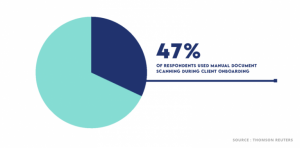
Manual KYB is slow. Collecting registration documents, ownership charts, and director IDs by email and checking them by hand can take days, and every handoff adds room for error.
The conventional method leads to a frustrating customer experience. Customers are probable to abandon the account creation process. Moreover, the chances of errors and mistakes when done manually are higher.
High compliance cost
Tracing beneficial ownership by hand, especially for companies with layered or overseas ownership, takes specialist time, which makes manual KYB expensive.
Complex ownership structure
Ownership is often spread across holding companies, trusts, and overseas entities. Regulators expect firms to trace it to the natural persons at the top, which is hard to do accurately from forms the customer fills in.
Data inconsistencies
Companies can afford manual data retrieval. But the problem of data verification remains. There are multiple sources for collecting companies’ data. Sometimes the information can be defunct or invalid.
Technology To The Rescue — Areas To Address For Automating KYB
With an increase in regulatory requirements, the above points clearly state the need to automate the current process. Here are some solutions that could help businesses:
Automated KYB onboarding
AI-powered verification opens an opportunity to increase the efficiency of the onboarding process. It also reduces the cost and speeds up the process.
Retrieving UBO information can be automated in a similar way to KYC, using registry data and APIs instead of manual collection.
Access to authentic business registries
Companies must have access to the properly updated business registries. This is valuable and will make business compliance an easy task. Signzy’s proprietary APIs that can easily retrieve company information. This can be done from reliable sources like from the Registrar Of Companies (ROC) database
API integrated KYB solutions
Advanced API integrated solutions can be designed to aggregate data from various sources. Businesses only need to enter the required details to retrieve data. For ex, business registration number and the jurisdiction code where the business is operating.
Signzy provides a host of microservices involve unique APIs that can extract and verify the UBO data in a matter of hours as opposed to days. Our APIs are also capable of cross referencing data across multiple govt. Databases and sanction lists.
Virtual Identification Using VideoKYC
Businesses are now turning towards automated software. This is due to increasing compliance costs. Software helps conduct checks for everything. This includes from basic forgery attempts to advanced negative checks. The data is cross-referenced against sanction lists across the world.
With Signzy’s VideoKYC, the entire process can be completed in a matter of 2–3 minutes. Our unique video conferencing tool can also allow officials to interact and verify the credibility of the data. This is done while maintaining KYB compliance as well as data accuracy.
KYB Rules by Region
KYB in the US
Under FinCEN's CDD Rule, covered financial institutions (banks, brokers or dealers in securities, mutual funds, futures commission merchants, and introducing brokers) must identify and verify the beneficial owners of legal entity customers when they open an account. Since a FinCEN order in February 2026, they no longer have to repeat this each time an existing business customer opens another account, unless they have reason to doubt the information on file or their risk procedures call for it.
Beneficial ownership reporting to FinCEN under the Corporate Transparency Act no longer applies to US companies: an interim rule exempted them in March 2025, and a final rule effective August 14, 2026 made that permanent. Banks still collect beneficial ownership from their own customers, and they screen business customers against OFAC sanctions lists, where entities 50% or more owned by blocked persons are themselves blocked.
KYB in the EU
The EU section above covers AMLD5 and the AML Regulation that applies from July 2027.
KYB in India
KYB is well established in Indian financial regulation. Under the RBI's KYC Master Direction and the Prevention of Money Laundering Rules, regulated entities must identify the beneficial owners of companies, partnerships, and trusts and verify the people who act on their behalf. Since March 2023, a company's beneficial owner is anyone with more than 10% ownership or control. KYB matters especially in these sectors:
Banking
With money coming in from all corners of the globe, banks must be able to perform Know Your Business (KYB) checks on a client base that may be moving money all around the world. In addition, a “beneficiary owner”, which is a derivative of KYC, must be a present as a priority before financial transactions take place.
Fraudsters have even set up fake bank branches to collect deposits, which shows why the business behind any financial service needs to be verified.
Lending
Digital lending to micro, small, and medium enterprises (MSMEs) has grown fast in India, and lenders onboarding business borrowers online need to confirm that the business, its directors, and its owners are real.
Assessing the integrity and ability of a borrower can be difficult — despite assets backing the loan, making it rock-solid. Unfortunately, there is no stereotypical “fraudster”. There is no scam artist who can be profiled or categorized. A polished CEO with an impressive background can look the same as every other swindler. Lenders need to be particularly mindful of who the borrower is and this means conducting proper due diligence. KYB in lending can help assess:
- The background of the directors and the organization
- Past offences/lawsuits/ criminal cases registered
- Any other controversial data which may harm future business
SMEs/Merchant Onboarding
KYB (know your business) checks are crucial to help businesses verify customer identification by gathering and verifying important documents. It should be mandatory for most financial companies to conduct KYB on their customers/businesses to protect against money laundering, identity theft and fraud. KYB can be incorporated at the time of onboarding to minimize risks as well as mitigate potential frauds.
A lot of companies adhere the use of time-consuming manual KYB processes due to:
- Need for complete checks and collect signatures from multiple directors
- The applicant is not always the director
- The application can quickly become a complex journey if there is overseas ownership or beneficial ownership
Insurance
Insurance fraud through bogus or inflated claims is a persistent problem in India, and it can involve intermediaries or people posing as them.
As India’s insurance industry continues to grow, fraud management is now a major concern for insurers and business leaders. Fraud risk in the insurance value chain can originate from internal as well as external factors. There is also the risk of employees misusing confidential information. Colluding with fraudsters is on the rise. Insurers must install internal checks and balances to rectify such issues.
KYB can also contribute by providing the list of people who have access to sensitive client information as well as conduct checks against the background and history of the organization as well as the people involved.
Conclusion
The global business markets are growing at a rapid pace. Companies must tighten customer due diligence for clients. The KYB processes and checks defined above can take hours to days without a platform with automation capabilities. However, cutting corners to achieve faster onboarding without proper controls increases the risk. It exposes the business to fraudulent actors and their illicit activities. Therefore while complete automation remains a challenge, care must be taken to improve KYB to match the levels of KYC automation that has already been achieved.
Signzy's KYC Solutions
Signzy provides KYB and KYC APIs that verify businesses against official registries, identify directors and beneficial owners, and screen them against sanctions, PEP, and adverse media data. Explore our KYB verification solutions, or read how to verify a business step by step.
Visit www.signzy.com for more information about us.
You can reach out to our team at reachout@signzy.com


FAQ
What is the difference between KYB and KYC?

Why do businesses need both KYB and KYC checks?
What documents are required for KYB vs KYC?
What is the beneficial ownership threshold for KYB?
When should KYB be used instead of KYC?
Gaurav Gupta
Gaurav Gupta is the Global Product Head at Signzy, leading the strategy and development of the company’s KYC, KYB, AML, and digital onboarding products used by banks, fintechs, and financial institutions across global markets. He specializes in building scalable compliance and verification platforms, transforming complex regulatory and risk workflows into seamless, automated product experiences. Gaurav works at the intersection of product, engineering, and AI.

Related Blogs
View all

KYB vs KYC: What Are the Key Differences? Complete 2026 Guide

How to Verify a Business: The Complete KYB Verification Process Guide [2026]

What Is Customer Due Diligence (CDD)? Requirements and Process (2026)

What Is a Customer Identification Program (CIP)? Requirements (2026)
The best in business


The global API marketplace for KYC, KYB, & AML
Explore the end-to-end verification stack trusted by 1,000 businesses.
Get in touch