





Roblox's Kansas Settlement Requires Age Assurance for All Users: What Gaming Platforms Should Build

 Open in ChatGPT
Key Highlights
- On September 29, 2026, Kansas Attorney General Kris Kobach announced a settlement that requires Roblox to put every user through age-assurance measures. The goal is that users can only reach content suited to their age.
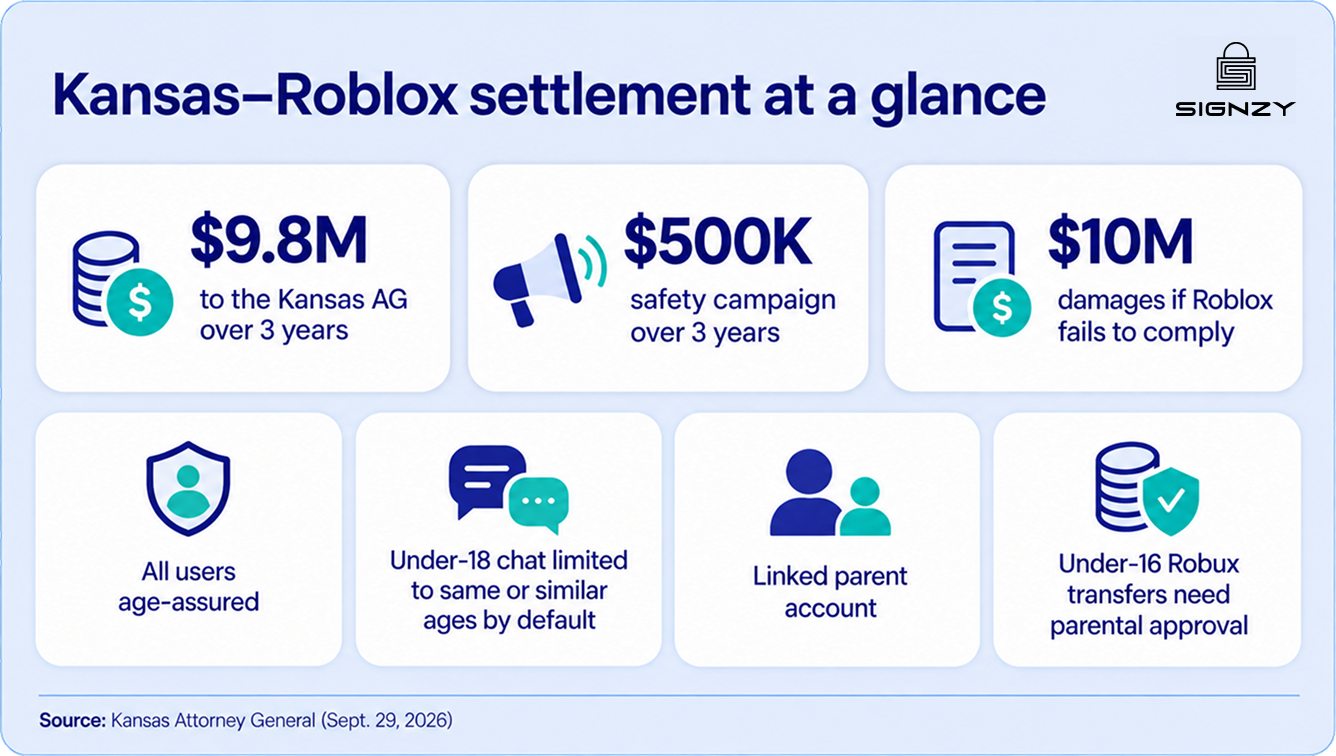
- Roblox will pay $9.8 million over three years and fund a $500,000 safety campaign. If it breaks any term, it owes another $10 million in damages.
- Other terms include: chat limited to similar-age users by default for anyone under 18; a linked parent account; parental approval before users under 16 can send or receive Robux.
- Kansas follows earlier 2026 settlements with Roblox in other states, including Alabama and Nevada. Across these settlements, age checks now control which features a user can access, not just whether they can sign up.
- The engineering challenge is to confirm the age of an entire user base while adding as little friction and storing as little data as possible.
What did Roblox agree to in Kansas?
The Attorney General's announcement was republished by Kansas media. It says the settlement includes more than $10 million in financial commitments:
- $9.8 million paid to the Attorney General's office over three years
- a $500,000, three-year public awareness campaign on online child safety, aimed at a Kansas audience
- The settlement includes a conditional $10 million damages provision for non-compliance
The safety reforms include, among others:
- Age assurance for all users, so users can only access content suited to their age
- Expanded parental controls through a linked parent account
- Default chat limits. Users under 18 can chat only with users in the same or a similar age group by default, which keeps them away from unknown adults.
- Measures against moving children off the platform. Roblox will strengthen chat moderation and act to stop users from being steered to other apps, such as Discord.
- Limits on virtual currency. Users under 16 cannot send or receive Robux without parental approval.
- Local law-enforcement support through a Kansas-based law-enforcement specialist
"Age assurance, default age-grouped chat, stronger parental locks, and limits on Robux transfers are practical steps," Kobach said.
The public announcement does not set a separate deadline for putting these measures in place.
Why does this settlement matter beyond Roblox?
Kansas is not the first state to reach a settlement like this. In April 2026, Roblox settled with Alabama for $12.2 million, and it reached a settlement with Nevada that same month. Signzy covered the UK side of this trend in age assurance for gaming and livestreaming platforms.
The Kansas terms carry three lessons for any platform with a young audience.
- Age now controls features, not just signup. Enforcement is moving past a one-time age gate. Age now decides who can chat with whom, who can trade in-game currency, and what content each user sees.
- The rules cover every user. "All users" includes people who signed up years ago, not only new accounts.
- The penalty is set in advance. A $10 million damages clause turns an engineering backlog into financial exposure.
What changes when you move from an age gate to age-based permissions?
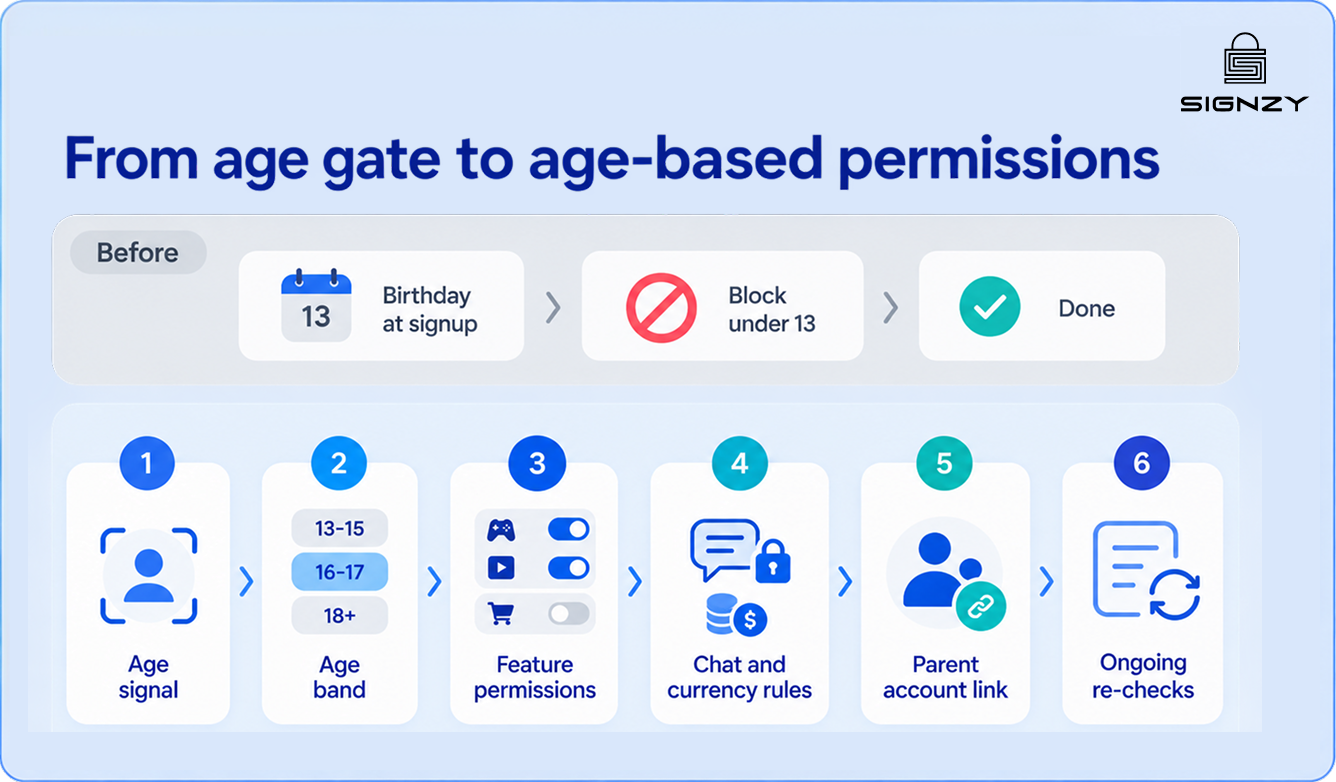
In the old model, a platform asked for a birthday at signup, blocked users under 13, and stopped there.
The new model is a chain of steps:
age signal → age band → feature permissions → chat and currency rules → parent account link → ongoing re-checks
Each step needs its own design decision. The rest of this article works through them.
What should gaming and UGC platforms build?
1. Age bands, not a yes-or-no check
The Kansas terms use at least two age cutoffs: under 18 for chat and under 16 for Robux transfers. Most platforms will need several bands, such as under 13, 13 to 15, 16 to 17, and 18+, matched to the laws in each market.
2. Tiered age checks across the whole user base
Asking every user for an ID is expensive and makes many people abandon signup. A tiered approach works better:
- Facial age estimation as the default for most users. Pair it with a liveness check to block photos, screen replays, and masks.
- A safety margin around each cutoff. If an estimate lands close to the edge of a band, ask for a stronger check instead of guessing.
- ID or database verification for those stronger checks, for disputes, and for adult-only features.
3. A permissions matrix
Map each age band to the features it unlocks. For example:
| Feature | Under 13 | 13–15 | 16–17 | 18+ |
|---|---|---|---|---|
| Chat with unknown users | Off | Same or similar age only | Same or similar age only | Configurable |
| Send or receive in-game currency | Parent approval | Parent approval | Allowed within limits | Allowed |
| Mature content | Blocked | Blocked | Blocked | Only after 18+ is verified |
| Linked parent account | Required | Offered | Offered | Not applicable |
This matrix is an illustration, not the exact rules in the Kansas settlement. Set the bands and defaults for each jurisdiction you operate in.
4. Verified parents
Parental controls are only as strong as the check on the parent. If a 14-year-old can link a second account of their own as the "parent," the control is only for show. Confirm that the linked parent is an adult.
5. A plan for existing users
When a settlement covers all users, platforms have to check the ages of accounts that already exist. The best moment is when an existing user first tries to use a gated feature, such as chat or currency transfers. This spreads the workload over time and puts the friction where the user is getting something in return. Also set a firm deadline for users who never try a gated feature.
6. Proof without hoarding data
You need to prove that each user's age was checked, without keeping a selfie of every child. Store the result instead: the age band, the method used, a confidence score, and a timestamp. Delete biometric images once the check is complete, where the law and your policies allow.
7. Re-checks when risk signals appear
A check at signup cannot catch someone who later shares their account. Run a new check when signals change. Examples include behavior that doesn't match the user's age band, reports from other users, a new device, or an attempt to change the date of birth.
How does Signzy support age assurance at scale?
Signzy's age-assurance API covers each of the tiers above:
- AI facial age estimation that returns an over-or-under result against a chosen age cutoff in under a second
- liveness detection that flags photo attacks, deepfakes, and mask-based spoofs
- government ID verification across more than 14,000 supported documents
- database verification for instant onboarding
Cutoffs and rules for stronger checks can be set by jurisdiction, risk level, and industry. That lets platforms check the age of their whole user base while saving document checks for the cases that need them.
Related reading: How online age verification works, Minor KYC compliance guide, and Signzy age verification.
Related Solution

Sources
- Newstalk KZRG, "Kobach announces $10 million settlement with Roblox to strengthen online child safety" (republished Attorney General release), Sept. 29, 2026: https://www.newstalkkzrg.com/2026/09/29/kobach-announces-10-million-settlement-with-roblox-to-strengthen-online-child-safety/
- KCTV5, "Roblox settles with Kansas," Sept. 29, 2026: https://www.kctv5.com/2026/09/29/roblox-settles-with-kansas-10m-agreement-strengthen-online-child-safety/
- KSL / KMBC, "Roblox to pay Kansas AG's office $10M," Sept. 29, 2026: https://www.ksl.com/article/51630275/roblox-to-pay-kansas-ags-office-10m-as-part-of-online-child-safety-settlement
- Alabama Attorney General, Roblox settlement announcement: https://www.alabamaag.gov/attorney-general-marshall-announces-12-2-million-settlement-with-roblox-to-ensure-child-safety/
- Nevada Attorney General, "Attorney General Ford Announces Legal Agreement with Roblox," Apr. 15, 2026: https://ag.nv.gov/News/PR/2026/Attorney_General_Ford_Announces_Legal_Agreement_with_Roblox/


FAQ
Does the Kansas settlement require ID verification for every Roblox user?

What happens if Roblox doesn't comply?
Is there an implementation deadline?
Saurin Parikh
Saurin is a Sales & Growth Leader at Signzy with deep expertise in digital onboarding, KYC/KYB, crypto compliance, and RegTech. With over a decade of professional experience across sales, strategy, and operations, he’s known for driving global expansions, building strategic partnerships, and leading cross-functional teams to scale secure, AI-powered fintech infrastructure.

Related Blogs
View all
![Minor KYC Compliance: Verify users under 18 legally [2026]](https://cdn.sanity.io/images/blrzl70g/production/98a6ef4fe9940ed0f34a35a61522f93326c6d420-2846x667.png)


The best in business


The global API marketplace for KYC, KYB, & AML
Explore the end-to-end verification stack trusted by 1,000 businesses.
Get in touch