





Business Registration Lookup: How to Check if a Company Is Registered (2026)

By Agrima Dwivedi
 Open in ChatGPT
🗒️ Key Highlights
- In the US, businesses register with the state where they were formed, so a registration lookup starts with that state's Secretary of State (or equivalent) business search. There is no single public federal registry of all businesses.
- Federal sources fill specific gaps: SEC EDGAR for public companies and SAM.gov for federal contractors. There is no public IRS tool to look up another company's EIN.
- Outside the US, check the national register: Companies House in the UK, the MCA portal in India, Corporations Canada or provincial registries, and the EU's BRIS search.
- For onboarding at scale, verification APIs query official registries automatically and keep an audit trail.
Quick answer: To check whether a business is registered, search the official business registry of the place where it was formed. In the US, that means the Secretary of State (or equivalent) business entity search in the state of formation, plus any state where the company is registered to do business. Confirm the legal name, entity type, file number, status, formation date, and registered agent. For other countries, use the national register, such as Companies House in the UK or the Ministry of Corporate Affairs in India.
This guide covers state-level searches, federal sources, international registries, and automated options for checking many businesses at once.
Business Registration Lookup, A Quick Definition
A business registration lookup confirms that a company legally exists in a given jurisdiction and shows its current standing. Before you pay, contract with, or onboard a business, it is the simplest check that the business is real.
Small oversights in verification can lead to big problems down the road. That’s why understanding what registration lookup actually shows makes such a difference. Here’s the full picture of what a careful verification lookup reveals:
- Official business name and any “doing business as” (DBA) names
- Current registration status and important dates
- Business structure (LLC, Corporation, Partnership)
- Names and addresses of registered agents
- Complete filing history
💡 Related Blog:

When is Business Registration Lookup Required?
Registration verification becomes absolutely essential during several key business moments:
- When bringing new clients aboard
Those exciting moments of business growth need proper verification. Nothing dampens enthusiasm faster than discovering a potential client isn’t properly registered – after contracts are signed.
- During vendor selection
Finding the perfect supplier feels great, until registration issues cause supply chain disruptions. Thorough checks prevent those mid-contract surprises that no one wants to deal with.
- Before signing partnership agreements
Strong partnerships build on trust, and trust starts with verification. Making sure potential partners have their registration in order saves countless future headaches.
- During compliance reviews
Staying on top of compliance might not be thrilling, but it’s far better than facing penalties. Regular registration checks keep everything running smoothly.
4 Ways to Perform a Business Registration Lookup
Here are the most reliable ways to check whether a company is legally registered, in the US and elsewhere.
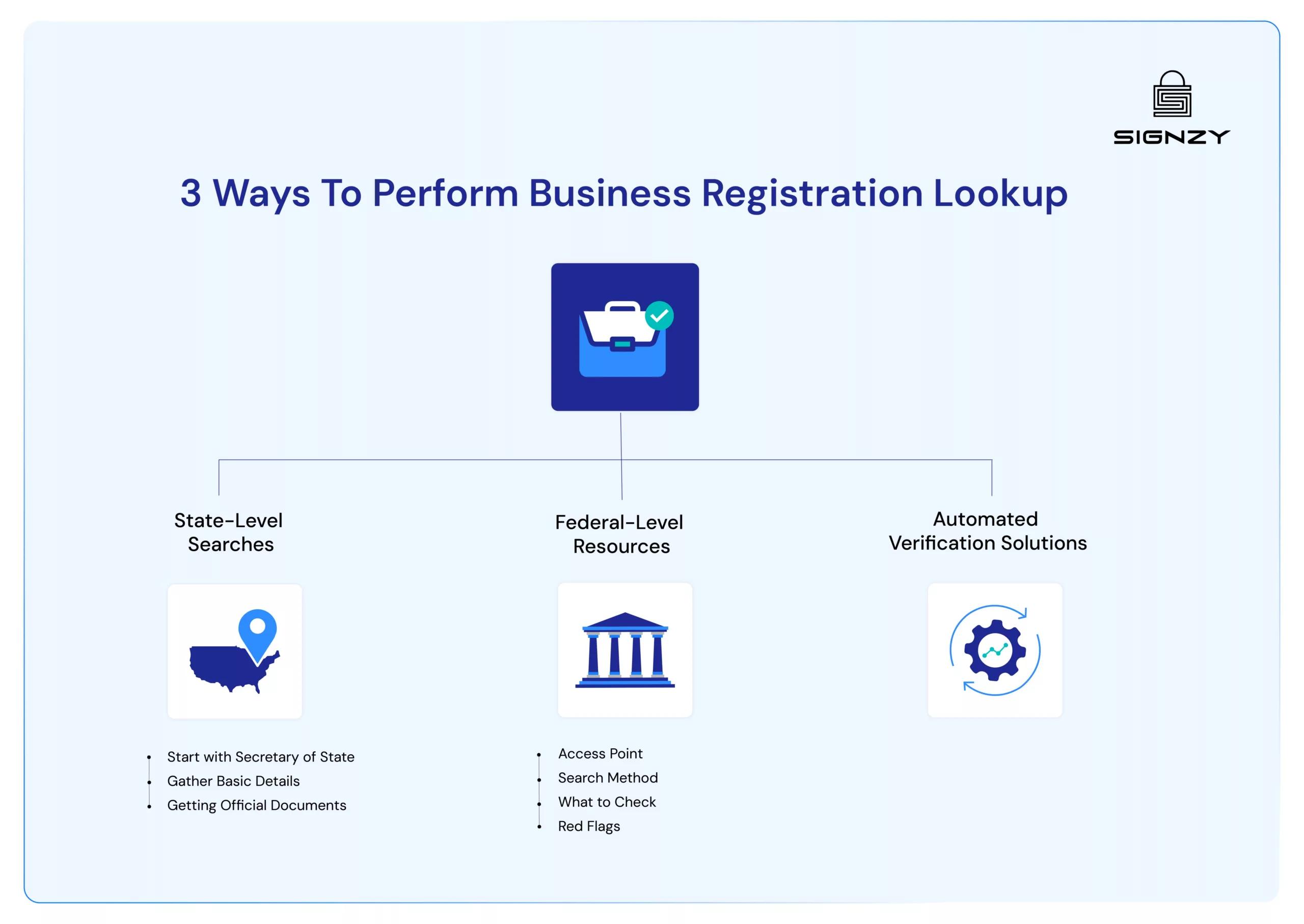
1. State-Level Searches
Each state runs its own registry. A company formed in Delaware won't appear in New York's search unless it has also registered to do business in New York, so search the state of formation first, then any state where the company operates. The SBA keeps an official directory of state business registration lookups.
If you want to give it a try, here are the exact steps to conduct state-level searches for business registration number lookup.
Step 1 – Search the state's business registry: Go to the Secretary of State (or equivalent) website and search by business name or file number. Start with an exact match, then try variations. Official searches for some common states:
- Virginia State Corporation Commission Business Entity Search
- Rhode Island Secretary of State Business Services Division
- Pennsylvania Department of State Business Search
- New York Department of State Corporation and Business Entity Database
- Wyoming Secretary of State Business Entity Search
- Washington Secretary of State Corporations and Charities Filing System
- New Jersey Division of Revenue and Enterprise Services Business Name Search
- Delaware Division of Corporations
- Florida Division of Corporations
- California Secretary of State
- Illinois Secretary of State
Step 2 – Gather Basic Details: Pull the registration number and status first. Note filing dates and registered agent details. Look for any name changes or DBAs – they often hide in a separate tab called “filing history” or “amendments.”
Step 3 – Get official documents if you need them: Order a certificate of good standing (also called a certificate of status or existence) and review recent annual reports, which show whether the company keeps its filings current. Fees and formats vary by state.
Well, there’s more. There are some more challenges coming your way. Common state-level challenges include:
- A company may be registered in several states, with a different file number in each
- Search rules differ: some states need exact names, others allow partial matches
- Records and documents come in different formats from state to state
- Basic searches are usually free, but some states charge for documents or detailed records
- Search results can lag behind recent filings, so confirm important details with official documents
2. Federal-Level Resources
Federal sources don't register businesses, but they fill specific gaps, especially for public companies and government contractors.
- SEC EDGAR: shows filings for companies that report to the SEC, mainly public companies. Private companies and most LLCs won't appear.
- SAM.gov: lists entities registered to do business with the US federal government, identified by a Unique Entity ID (UEI), which replaced the DUNS number in April 2022. It also shows exclusion records.
- IRS: an EIN is a tax ID, not a registration number, and the IRS has no public tool for looking up another company's EIN. Businesses that file information returns, such as Forms 1099, can confirm a name and EIN match through IRS TIN Matching, and the IRS Tax Exempt Organization Search lists nonprofits by name or EIN.
How to use each source:
| Step | SEC EDGAR | SAM.gov | IRS TIN Matching |
|---|---|---|---|
| Access | Free company search on sec.gov, no login | Free entity search; an account is needed for some features | Only for eligible payers, through an IRS e-Services account |
| Search by | Company name, ticker, or CIK | Legal business name or UEI | The name and EIN you received, for example on a Form W-9 |
| What to check | Recent annual and current reports, business address, name changes | Active or inactive registration, expiration date, exclusion records | Whether the name and EIN match IRS records |
| Red flags | Missing or late filings, frequent name changes | Expired registration, exclusions, mismatched address | No match, or a name that doesn't fit the documents you were given |
Each source covers a different slice of businesses, so use the ones that fit the company you are checking.
3. International Registries
- United Kingdom: search the free Companies House register by company name or number. Since November 18, 2025, directors and people with significant control must verify their identity with Companies House, with existing companies phased in over the year to November 2026.
- India: use the Ministry of Corporate Affairs master data search to look up a company by CIN or an LLP by LLPIN. GSTIN and Udyam (MSME) numbers are separate tax and small-business registrations with their own search tools.
- Canada: Corporations Canada covers federal corporations; provincially incorporated companies are in the provincial or territorial registry. The CRA Business Number is a tax identifier, not a corporation number.
- European Union: the European e-Justice Portal's company search queries connected national business registers through BRIS. Beneficial ownership is held in separate national registers, where public access has been restricted since a 2022 Court of Justice ruling.
4. Automated Verification Solutions
Checking registries one by one doesn't scale when you onboard many businesses. Automated verification tools query multiple official sources at once and return the results in a consistent format.
These systems typically offer:
- Centralized access to multi-state registration data
- Standardized formats across different jurisdictions
- Regular updates on registration status changes
- Batch processing for multiple verifications
- Integration capabilities with existing business systems
Here is how they typically fit into business processes.
Modern Solutions for Registration Lookup
Here’s where things get really practical.
Most connect through APIs, so teams can run checks without switching between tools.
The best part? Modern verification solutions can plug right into the following:
- Customer relationship systems (no more switching between programs)
- Contract management platforms (automatic checks before signing)
- Compliance tracking tools (instant alerts if something changes)
API Solutions
Think of APIs as digital assistants that do all the heavy lifting. Instead of manually checking each state’s website, these systems talk directly to government databases. Type in a business name once, and the API checks everywhere that matters.
Instead of searching each state's portal by hand, an API sends the query to several registries at once and returns structured results, which are easier to store and review than screenshots or PDFs.
Automated Platforms
These platforms build on API capabilities by adding user-friendly interfaces and extra features. Think of them as the business equivalent of a credit check website – but for company verification.
They handle the full verification cycle, from initial checks to ongoing monitoring, and can alert you when a business's registration status changes. They also keep a record of every check for audits.
Signzy's business verification APIs check company registrations, identify directors and beneficial owners, and screen them against watchlists. For related checks, see our guides on how to look up a business registration number, how to check if a company is legitimate, and how to look up a company's EIN. Book a demo to see it in action.


FAQ
How do I check if a business is registered?

Is there a national US business registry?
Can I look up a company's EIN on the IRS website?
What if a business is registered in multiple states?
How much does a business registration lookup cost?
How reliable are automated verification results?
Agrima Dwivedi
Agrima is an Associate Product Marketer at Signzy, currently working in the B2B fintech space. She brings over two years of experience in copywriting and content writing, which laid the foundation for product marketing. Today, she leverages both creative and strategic skills to drive go-to-market efforts and build user-focused marketing strategies.

Related Blogs
View all

How to Look Up a Business Registration Number? Methods and Tools

How to Check if a Company is Legitimate - Complete Business Verification Guide 2026
![How to Verify a Business: The Complete KYB Verification Process Guide [2026]](https://cdn.sanity.io/images/blrzl70g/production/6383af30b009a4e1389b5aaac8c5f6b1ba89e064-2560x600.webp)
How to Verify a Business: The Complete KYB Verification Process Guide [2026]
![How to Lookup a Company's EIN Number? [2026 Guide]](https://cdn.sanity.io/images/blrzl70g/production/3ceee4c0b2fac3923bd2303cd5b313631bea7258-2560x600.webp)
How to Lookup a Company's EIN Number? [2026 Guide]
The best in business


The global API marketplace for KYC, KYB, & AML
Explore the end-to-end verification stack trusted by 1,000 businesses.
Get in touch