





KYB vs KYC: What Are the Key Differences? Complete 2026 Guide

 Open in ChatGPT
Key Highlights
- KYC verifies individuals; KYB verifies businesses — KYC confirms a customer's personal identity, while KYB confirms a company's legal existence, ownership structure, and the identities of its ultimate beneficial owners (UBOs).
- KYB is inherently more complex than KYC — a single KYB check often requires multiple KYC checks on directors, shareholders, and UBOs, plus verification of corporate documents, registration status, and cross-border regulatory compliance.
- Global enforcement is intensifying for both — with nearly $4 billion in AML fines in 2025, the EU's AMLR applying from 2027, and FinCEN's CTA narrowing beneficial ownership reporting to foreign entities, the compliance burden on financial institutions has never been higher.
- Platforms like Signzy unify KYC and KYB workflows — from individual identity verification and liveness detection to business entity verification, UBO identification, sanctions screening, and continuous monitoring — enabling compliance teams to meet 2026 regulatory demands through a single API-first platform.
- What is KYC (Know Your Customer)?
- What is KYB (Know Your Business)?
- What are the key differences between KYB and KYC?
- How do the KYC and KYB processes work?
- Why do regulated institutions need both KYC and KYB?
- What are the global regulations governing KYC and KYB in 2026?
- What are the biggest challenges in KYC and KYB compliance?
- How Signzy streamlines KYC and KYB compliance
- FAQ
Every regulated financial institution — whether a bank, fintech, payment processor, or insurance company, must verify who it does business with. For individual customers, that process is called KYC (Know Your Customer). For business entities, it is called KYB (Know Your Business). Both are mandatory components of anti-money laundering (AML) compliance, and both are enforced by regulators worldwide.
Yet the two processes are fundamentally different in scope, complexity, and operational execution. KYC confirms a person's identity. KYB confirms a company's legal existence, ownership structure, and the identities of the people who ultimately control it — a far more layered task that often involves multiple KYC checks nested within a single business verification.
Getting this distinction right matters. In 2025, global AML fines totaled nearly $4 billion, with single institutions like TD Bank ($3.09 billion) demonstrating that regulators treat verification failures — whether of individuals or businesses — as existential risks. The FATF's updated Recommendation 24 now requires jurisdictions to ensure accurate, up-to-date beneficial ownership data for all legal persons, and the EU's AML Regulation (AMLR) — applying from July 10, 2027 — introduces a single rulebook that will harmonize both KYC and KYB requirements across all 27 member states.
This guide breaks down the difference between KYC and KYB, explains how each process works, covers the regulatory frameworks governing both, and shows how compliance teams can implement them effectively in 2026.

What is KYC (Know Your Customer)?
KYC refers to the process by which financial institutions verify the identity of their individual customers, assess their risk profile, and establish that they are who they claim to be. KYC is performed at the start of a business relationship — account opening, loan application, insurance onboarding — and periodically thereafter, depending on the customer's risk level.
The core objectives of KYC are:
- Identity verification — confirming the customer's legal identity through government-issued documents (passport, national ID, driver's license), biometric checks, and database cross-referencing.
- Customer understanding — collecting information about the customer's source of funds, expected transaction patterns, and financial background.
- Risk assessment — classifying the customer as low, medium, or high risk based on their profile, jurisdiction, and activity.
- Ongoing monitoring — continuously screening customer activity against sanctions lists, PEP databases, and suspicious transaction patterns.
A typical KYC check collects the customer's full legal name, date of birth, residential address, government ID details, and proof of address. For higher-risk customers — such as Politically Exposed Persons (PEPs) or individuals from high-risk jurisdictions — Enhanced Due Diligence (EDD) adds requirements like source-of-wealth verification and senior management approval.
KYC is mandated globally by frameworks such as the FATF's 40 Recommendations, the US Bank Secrecy Act (BSA), the EU's AML Directives, and the UK's Money Laundering Regulations. For more on the end-to-end KYC process, Signzy's dedicated guide covers each phase in detail.
What is KYB (Know Your Business)?
KYB — Know Your Business — is the process by which financial institutions verify the identity and legitimacy of a business entity before establishing a commercial relationship. Where KYC asks "who is this person?", KYB asks a more complex set of questions: "Is this company legally registered? Who owns it? Who controls it? And are any of those individuals connected to financial crime?"
KYB emerged as a distinct compliance discipline because criminals frequently use shell companies, nominee structures, and complex corporate hierarchies to launder money, evade sanctions, and commit fraud. A 2016 loophole in the US allowed shell companies to pass through standard KYC checks by presenting legitimate-looking corporate documentation — a gap that KYB processes are specifically designed to close.
The core objectives of KYB are:
- Entity verification — confirming that the business is legally registered, holds valid licenses, and is in good standing with the relevant Secretary of State, Companies House, or equivalent registry.
- Ownership structure analysis — mapping the company's shareholders, directors, officers, and corporate hierarchy to understand who has control.
- Ultimate Beneficial Owner (UBO) identification — identifying the natural persons who ultimately own or control 25% or more of the entity, even through layered ownership structures or nominee arrangements.
- Risk assessment — evaluating the business based on its industry, jurisdiction, corporate structure complexity, and the risk profiles of its UBOs and directors.
- Ongoing monitoring — tracking changes in registration status, ownership, sanctions exposure, and adverse media throughout the business relationship.
KYB is inherently more complex than KYC because a single business verification often requires multiple individual KYC checks — on each director, each significant shareholder, and each identified UBO. For a multinational corporation with subsidiaries across multiple jurisdictions, this can mean dozens of individual verifications nested within one KYB process.
For a detailed explanation of what KYB verification involves and why it matters, Signzy's guide covers the full scope.
What are the key differences between KYB and KYC?
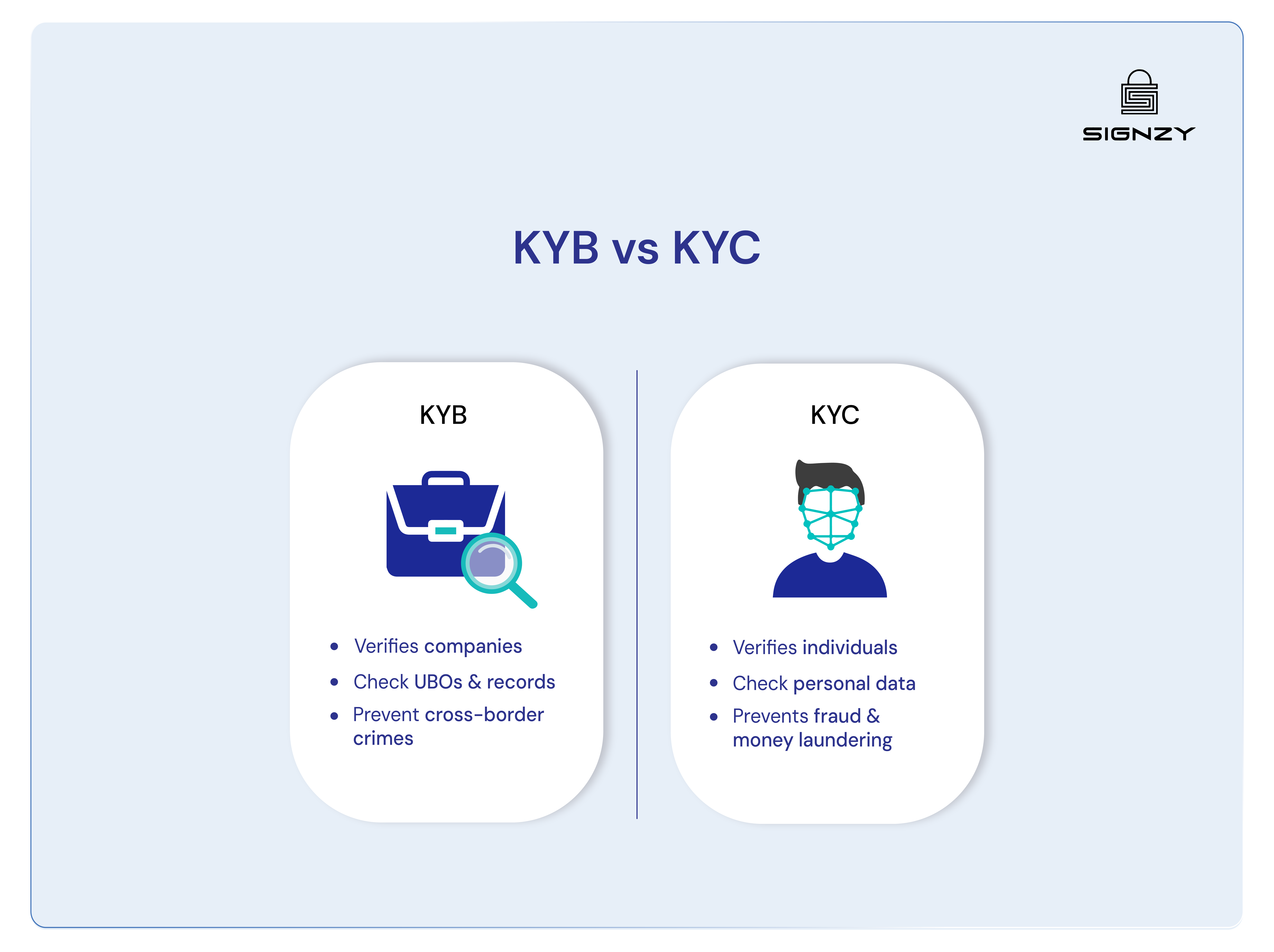
While KYC and KYB share the same underlying goal — preventing financial crime by verifying who you are doing business with — they differ significantly in scope, complexity, data requirements, and operational execution.
KYB vs KYC: at a glance
| Dimension | KYC (Know Your Customer) | KYB (Know Your Business) |
|---|---|---|
| Target | Individual customers (natural persons) | Business entities (companies, partnerships, trusts) |
| Primary Question | "Who is this person?" | "Is this company legitimate, and who ultimately owns and controls it?" |
| Core Data Collected | Name, DOB, address, government ID, biometrics | Registration documents, corporate structure, UBO identities, tax IDs, licenses |
| Verification Scope | Single individual | Entity + multiple individuals (directors, shareholders, UBOs) |
| Complexity | Standardized, single-layer verification | Multi-layered; often requires KYC on multiple individuals within one KYB check |
| Key Risk Addressed | Identity fraud, sanctions evasion, money laundering by individuals | Shell companies, nominee structures, corporate money laundering, UBO concealment |
| Timing | At individual onboarding + periodic reviews | At business onboarding + ongoing entity monitoring |
| Regulatory Basis | FATF Recommendation 10, BSA CIP, EU AMLD/AMLR, UK MLRs | FATF Recommendation 24, BSA CDD Rule, Corporate Transparency Act, EU AMLR |
| Typical Industries | Banking, fintech, crypto, insurance, lending | B2B payments, merchant acquiring, trade finance, lending, partnerships, vendor onboarding |
| Outputs | Verified identity, risk rating, screening results | Verified entity status, ownership map, UBO identities, screening results, compliance certificate |
The critical distinction is depth. KYC verifies one person. KYB verifies an entity — and then verifies the people behind it. A KYB check on a mid-sized company with three layers of corporate ownership might involve verifying the entity's registration in two jurisdictions, identifying four UBOs across three countries, running KYC on each UBO, screening all parties against sanctions and PEP databases, and confirming the registered agent and annual filing compliance. That is fundamentally different from verifying a single individual's passport and address.
This is why KYB is often described as "KYC's more complex sibling" — it encompasses individual verification but extends it to the corporate layer where financial crime is most effectively hidden.
How do the KYC and KYB processes work?
Both KYC and KYB follow structured verification workflows, but the depth and number of steps differ significantly.
The KYC process
A standard KYC verification follows four core steps:
Step 1 — Customer Identification. The customer provides personal information: full legal name, date of birth, residential address, and a government-issued ID. This is the Customer Identification Program (CIP) — the mandatory minimum under the US Bank Secrecy Act and equivalent global regulations.
Step 2 — Document and Biometric Verification. Submitted documents are verified for authenticity using OCR extraction, template matching, and database cross-referencing. A selfie or live video is captured and matched against the ID photo. Liveness detection — both active and passive — ensures the person is physically present and not using a deepfake or spoofed image.
Step 3 — AML Screening and Risk Scoring. The customer's identity is screened against global sanctions lists (OFAC, EU, UN), PEP databases, adverse media sources, and law enforcement watchlists. An automated risk score classifies the customer as low, medium, or high risk. High-risk customers trigger Enhanced Due Diligence (EDD), which may include source-of-funds verification and senior management approval.
Step 4 — Ongoing Monitoring. KYC is not a one-time event. Continuous monitoring flags unusual activity — sudden spikes in transaction volume, transfers to high-risk jurisdictions, or patterns consistent with money laundering typologies. Customer profiles are periodically refreshed based on risk tier.
The KYB process
KYB verification follows a more layered workflow, reflecting the complexity of verifying a legal entity and the people behind it:
Step 1 — Business Information Collection. The institution collects the company's legal name, registration number, jurisdiction of incorporation, registered address, tax identification number, and corporate documents (articles of incorporation, certificates of formation, operating agreements).
Step 2 — Entity Verification. The company's legal existence and current status are confirmed against official registries — Secretary of State databases in the US, Companies House in the UK, commercial registers in the EU. Key signals include active vs. dissolved status, annual report compliance, and registered agent information. Signzy's KYB Secretary of State solution automates this verification across all 50 US states.
Step 3 — Ownership Structure and UBO Identification. The institution maps the company's corporate hierarchy — shareholders, directors, officers, and any parent or subsidiary entities. Ultimate Beneficial Owners (UBOs) are identified: the natural persons who ultimately own or control 25% or more of the entity. For complex structures with layered ownership across multiple jurisdictions, this can be the most time-consuming step. Each identified UBO then undergoes individual KYC verification.
Step 4 — Screening and Risk Assessment. The entity, its directors, and its UBOs are all screened against sanctions lists, PEP databases, adverse media, and criminal watchlists. The business is assessed for industry risk (e.g., high-risk sectors like gambling, crypto, or cannabis), jurisdictional risk (e.g., FATF grey-list countries), and structural risk (e.g., unusually complex ownership or nominee directors).
Step 5 — Ongoing Monitoring. Business circumstances change — ownership shifts, directors are replaced, registration lapses, or new adverse media surfaces. Continuous monitoring tracks these changes and triggers re-verification when material events occur, rather than relying solely on periodic review cycles.
For a comprehensive guide on how to verify a business through the KYB process, Signzy's walkthrough covers each step in operational detail.
Why do regulated institutions need both KYC and KYB?
A common question from compliance teams — particularly at institutions that primarily serve either retail or commercial customers — is whether they can rely on one process alone. The short answer: no. Regulators expect both, and the risks each addresses are distinct.
KYC without KYB leaves a shell company gap
An institution that verifies individuals rigorously but does not verify business entities is exposed to one of the oldest money laundering techniques: the use of shell companies and nominee structures. A criminal can create a legally registered company, present clean corporate documentation, and pass superficial business checks — while the UBOs behind the entity are sanctioned individuals, PEPs, or criminal actors. Without KYB's ownership-layer analysis, this risk is invisible.
KYB without KYC leaves an identity gap
Conversely, verifying a company's registration and ownership structure is meaningless if the individuals identified as directors and UBOs are not themselves verified. A fraudster can list fabricated or stolen identities as beneficial owners. KYC on each individual is what closes this gap.
The risk-based approach: six dimensions
The London Stock Exchange Group's (LSEG) compliance framework identifies six types of risk that apply to both individual and business relationships:
- Identity risk — Is this person or entity who they claim to be?
- Integrity risk — Could this relationship be exploited for money laundering, terrorism financing, or sanctions evasion?
- Financial risk — What is the creditworthiness and financial stability of this customer or entity?
- Operational risk — Does the business have a legitimate operational footprint, customer base, and affiliates?
- ESG-related risk — Are there connections to environmental crime, human rights violations, or conflicts of interest?
- Cyber risk — Does online due diligence confirm identity and legitimacy during onboarding?
Addressing all six dimensions requires both KYC (for individuals) and KYB (for entities). Neither alone provides a complete risk picture. The FATF's risk-based approach mandates that institutions calibrate their verification intensity to the risk level — and risk can only be accurately assessed when both individual and entity verification are in place.
What are the global regulations governing KYC and KYB in 2026?
KYC and KYB regulations are set by international bodies and implemented by national regulators. The 2026 landscape is defined by three major developments: the FATF's strengthened beneficial ownership standards, the EU's unified AML framework, and the narrowing of the US Corporate Transparency Act.
Global regulatory framework comparison
| Jurisdiction | Key Framework | KYC/KYB Requirements | 2026 Status |
|---|---|---|---|
| International | FATF Recommendations 10 & 24 | Risk-based CDD for individuals (Rec. 10) and legal persons (Rec. 24); beneficial ownership transparency | October 2025 update emphasizes effectiveness over technical compliance |
| European Union | AML Regulation (AMLR, 2024/1624); AMLA | Single EU rulebook; harmonized CDD and KYB; UBO registers; eIDAS Digital Identity Wallet | AMLA issuing guidelines throughout 2026; AMLR applies from July 10, 2027 |
| United States | Bank Secrecy Act (BSA); CDD Rule; Corporate Transparency Act (CTA) | CIP for individuals; CDD/EDD; beneficial ownership verification; SAR filing | CTA narrowed to foreign entities (March 2025 Interim Final Rule); UBO verification responsibility returned to financial institutions |
| United Kingdom | Money Laundering Regulations (MLRs); Proceeds of Crime Act | CDD, EDD, ongoing monitoring for individuals and legal persons | FCA becomes sole AML supervisor for legal/accountancy sectors from January 2026 |
| India | PMLA; RBI KYC Master Direction; [FIU-IND Guidelines](https://www.signzy.com/blogs/signzy-for-fiu-aml-cft-compliance-india) | Biometric KYC; real-time sanctions screening; 5-year audit trails | 2026 RBI update mandates enhanced CDD for business relationships |
| Singapore | MAS AML/CFT Notice; Payment Services Act | CDD, ongoing monitoring, Travel Rule | Strict enforcement; MAS digital asset licensing active |
| UAE | UAE AML Law; VARA (Dubai) | CDD, EDD, VASP-specific KYB rules | Emerging as regulated fintech hub with clear licensing |
The Corporate Transparency Act: what changed in 2025
The most significant US development for KYB teams was FinCEN's March 2025 Interim Final Rule, which suspended beneficial ownership information (BOI) reporting requirements for domestic US companies. Only foreign entities registered to transact business in the US still file BOI with FinCEN.
This does not reduce KYB obligations — it shifts them. Financial institutions are now the primary responsible party for identifying and verifying the UBOs of domestic business customers. State-level registries (Secretary of State databases) have become the operational foundation for entity verification, but they do not include UBO data, sanctions screening, or continuous monitoring. Third-party enrichment is required to close these gaps.
The EU's AMLR: a single rulebook
The EU's AML Regulation represents the most comprehensive reform in a decade for both KYC and KYB. Key implications:
- Harmonized CDD/KYB rules across all 27 member states — ending fragmented national interpretations
- Expanded beneficial ownership transparency — centralized registers with defined access
- Lower thresholds for occasional transactions triggering CDD
- EU Digital Identity Wallet — mandatory per member state by 2026, enabling "verify once, use everywhere" onboarding for both individuals and businesses
For institutions operating across jurisdictions, this means KYC and KYB systems must handle multiple regulatory regimes simultaneously during the transition period.
For broader AML context, Signzy's complete guide to AML screening covers how KYC and KYB feed into the full AML compliance lifecycle.
What are the biggest challenges in KYC and KYB compliance?
Despite mature frameworks and advancing technology, financial institutions continue to face distinct challenges in each process — and some challenges are shared across both.
KYC challenges
Identity fraud and deepfakes. AI-generated synthetic identities and deepfake technology have made traditional document-based verification increasingly unreliable. Passive liveness detection and multi-modal biometrics are now essential countermeasures, but adoption remains uneven.
Onboarding friction. Document-heavy KYC processes cause 30–50% customer drop-off. Biometric face verification achieves 98% completion rates, but many institutions still rely on manual document collection.
False positive overload. Legacy AML screening systems generate 90%+ false positive rates on sanctions and PEP checks, overwhelming compliance analysts. Machine learning models can reduce false positives by 40–70% while improving detection of true positives.
KYB challenges
Lack of standardization. Unlike KYC — where document types and verification methods are relatively consistent globally — KYB has no universal standard. Corporate registration formats, ownership disclosure requirements, and registry accessibility vary dramatically across jurisdictions. What works for verifying a Delaware LLC does not work for a Dubai FZCO or a UK LLP.
Ownership structure complexity. Shell companies, nominee directors, layered corporate hierarchies, and cross-border ownership structures are specifically designed to obscure UBOs. Tracing beneficial ownership through three or four layers of corporate entities across different countries remains one of the most operationally difficult tasks in compliance.
Fragmented data sources. A complete KYB check may require data from state registries, federal tax databases, sanctions lists, PEP databases, adverse media, court records, UCC filings, and bankruptcy records. Stitching these together from separate vendors creates integration overhead, inconsistent data quality, and gaps in coverage.
No continuous monitoring at registries. State and national business registries show a snapshot in time. Without continuous monitoring, material changes — ownership transfers, status lapses, new adverse media — go undetected between periodic reviews.
In a 2025 ADVANCE.AI analysis of KYC fragmentation, one compliance head described their process as "a patchwork of disconnected KYC APIs," noting that customers were being lost during onboarding because they had to re-upload documents across different systems — a problem that compounds when KYB checks add entity-level verification on top of individual KYC.
Shared challenges
Multi-jurisdictional complexity. Institutions operating across borders must navigate different KYC and KYB rules in every jurisdiction — different document requirements, different UBO thresholds, different reporting obligations. A unified compliance platform with jurisdiction-aware rule engines is increasingly a practical necessity.
Cost of compliance. Global AML/KYC spending continues to rise faster than revenue. Automation — through AI-powered verification, no-code workflow builders, and consolidated vendor platforms — is the primary lever for controlling costs without compromising compliance quality.
How Signzy streamlines KYC and KYB compliance
Meeting 2026 KYC and KYB requirements demands infrastructure that handles both individual and business verification in a single, unified workflow. Signzy provides this infrastructure through an API-first platform purpose-built for regulated industries across 180+ countries.
One Touch KYC
Signzy's KYC Suite bundles document OCR, biometric face matching, active and passive liveness detection (anti-deepfake, anti-mask, anti-spoofing), AML screening, and consent capture into a single API call. Verification completes in 5–12 seconds with zero manual intervention — addressing the onboarding friction that causes 30–50% drop-off on document-only flows.
KYB and business verification
Signzy's KYB suite delivers real-time entity verification across all 50 US states and global registries. A single API call returns entity status, registration details, directors and officers, NAICS codes, and filing history — enriched with UBO identification, EIN verification, sanctions and PEP screening, bankruptcy checks, UCC filings, and address classification. Typical response times are under 3 seconds.
AML screening
Real-time screening against global sanctions lists (OFAC, EU, UN, HMT), PEP databases, adverse media, and law enforcement watchlists — for both individuals and entities. The screening engine handles onboarding checks and continuous ongoing monitoring, with configurable rule sets for jurisdiction-specific requirements. The KYC/AML screening use case covers the full capability set.
Transaction monitoring
AI/ML-powered detection of suspicious transaction patterns using dynamic rules and scoring. Transaction Monitoring suite analyzes 200+ risk signals from device, transaction, and identity data to detect account takeover and transaction fraud — one of the fastest-growing financial crime vectors affecting both individual and business accounts.
No-code compliance workflows
Signzy's drag-and-drop platform enables compliance teams to build and iterate custom KYC and KYB verification journeys as regulations change — without engineering resources. Under the EU's AMLR rollout through 2027 and ongoing AMLA technical standards, this adaptability is a practical necessity for institutions operating across multiple jurisdictions.
For institutions operating under India's evolving FIU-IND guidelines, Signzy's compliance stack is specifically designed to meet the 2026 AML/CFT requirements — including real-time sanctions screening, biometric KYC, and the 5-year audit trail mandate.


FAQ
What is the main difference between KYB and KYC?

Is KYB required by law?
What is a UBO and why does it matter for KYB?
How does the Corporate Transparency Act affect KYB in 2026?
Can a company pass KYC but fail KYB?
How long does KYB verification take compared to KYC?
Do fintech companies need to perform both KYC and KYB?
What is the difference between KYB and AML?
Saurin Parikh
Saurin is a Sales & Growth Leader at Signzy with deep expertise in digital onboarding, KYC/KYB, crypto compliance, and RegTech. With over a decade of professional experience across sales, strategy, and operations, he’s known for driving global expansions, building strategic partnerships, and leading cross-functional teams to scale secure, AI-powered fintech infrastructure.

Related Blogs
View all![10 Best KYC Software Providers of 2026 [US Guide]](https://cdn.sanity.io/images/blrzl70g/production/008b1ea8636a5a1febcd10331269d51c5c29090e-3985x933.jpg)

10 Best KYC Software Providers of 2026 [US Guide]

10 Best KYB Verification Services in 2026 | Complete Comparison Guide

Signzy vs Persona - Which Identity Verification Platform Wins in 2026?

Signzy vs Middesk Comparison - Which Verification Platform Wins in 2026
The best in business


The global API marketplace for KYC, KYB, & AML
Explore the end-to-end verification stack trusted by 1,000 businesses.
Get in touch