





How to Verify a Business: The Complete KYB Verification Process Guide [2026]

 Open in ChatGPT
Key Highlights
- Business fraud is scaling faster than defences: Identity fraud losses hit $27.3 billion in 2025 with new-account fraud up 31%, while deepfake usage in biometric fraud attempts surged 58% year-over-year — making multi-layered business verification essential for every regulated institution.
- KYB verification is both a regulatory mandate and an operational necessity: FATF Recommendation 24 now requires verified, up-to-date beneficial ownership data; the EU's AMLD6 is harmonising UBO registers across member states by 2027; and FinCEN's CDD Rule mandates that financial institutions identify beneficial owners at 25%+ ownership plus one control person for every legal entity customer.
- Manual KYB takes 2–20 business days depending on complexity; automated KYB can complete standard verifications in minutes: The gap between manual and automated timelines is the single biggest driver of onboarding friction, customer abandonment, and compliance cost — making technology adoption a competitive imperative.
- Platforms like Signzy automate end-to-end KYB verification across 180+ countries, connecting to official registries, tracing UBO chains, screening against 1,000+ global watchlists, and completing business verification with 97% API accuracy across 160M+ businesses — reducing what once took weeks to minutes.
- What Is KYB (Know Your Business) Verification?
- Why Does KYB Verification Matter in 2026?
- What Information Is Required for KYB Verification?
- How Does the KYB Verification Process Work? (Step-by-Step)
- What Are the Global KYB Regulatory Requirements?
- What Are the Most Common KYB Challenges — and How Do You Solve Them?
- How Signzy Helps Organisations Automate KYB Verification
- FAQ
In 2025, traditional identity fraud losses reached $27.3 billion, with new-account fraud victims surging 31% to 5.4 million — driven in large part by synthetic identities, shell company abuse, and AI-assisted business impersonation. At the same time, regulators responded with record enforcement: FinCEN imposed a $1.3 billion penalty on TD Bank — the largest civil money penalty ever assessed against a depository institution — for willful failures in its anti-money laundering program, including inadequate identification of beneficial owners behind suspicious corporate transactions.
The message from both sides is unmistakable: criminals are getting better at creating convincing but fraudulent business identities, and regulators are getting more aggressive at punishing institutions that fail to catch them.
KYB — Know Your Business — is the structured verification process that stands between these two forces. It is how banks, fintechs, payment processors, and other regulated organisations confirm that a business entity is legitimate, that its ownership structure is transparent, and that neither the entity nor its controlling individuals pose unacceptable financial crime risk.
This guide covers everything compliance teams, product managers, and fintech decision-makers need to know about KYB verification in 2026: what it is, how it differs from KYC, the step-by-step verification process, what documents and data are required, global regulatory requirements across major jurisdictions, common failure points, and how technology is solving the operational challenges.

What Is KYB (Know Your Business) Verification?
KYB — Know Your Business — is the due diligence process through which regulated organisations verify the identity, legitimacy, ownership structure, and risk profile of a business entity before establishing a commercial relationship. It is the business-to-business counterpart of KYC (Know Your Customer), but significantly more complex because verifying a company requires investigating not just the entity itself, but the entire chain of individuals who ultimately own or control it.
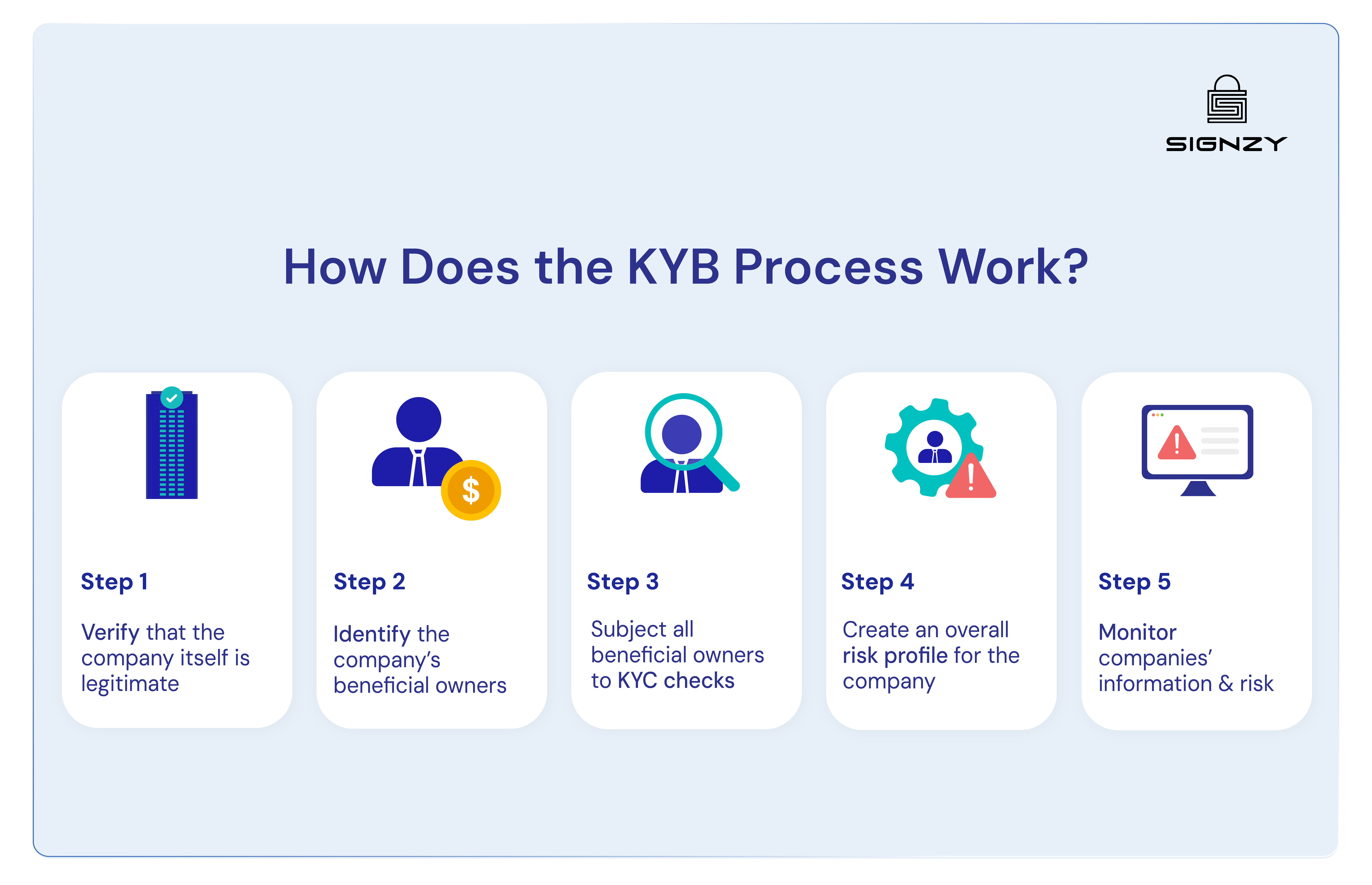
At its core, KYB answers three questions:
- Is this business real? — Does it exist as a legally registered entity in its claimed jurisdiction, with valid registration, active status, and legitimate operations?
- Who really controls it? — Who are the natural persons (Ultimate Beneficial Owners) who ultimately own or control the entity, traced through any intermediary corporate structures?
- Is it safe to do business with? — Do the entity, its directors, or its UBOs appear on sanctions lists, PEP databases, or adverse media sources that would indicate financial crime risk?
KYB is not optional. Under FATF Recommendation 24, FinCEN's CDD Rule (31 CFR 1010.230), and the EU's Anti-Money Laundering Directives, financial institutions and other regulated businesses are legally required to perform KYB before onboarding corporate customers — and to maintain that verification on an ongoing basis.
How Is KYB Different from KYC, CDD, EDD, and CIP?
These terms are often used interchangeably, but they describe distinct — and complementary — layers of the compliance verification process. Understanding the differences is essential for building an effective programme.
| Term | Full Name | What It Verifies | Scope |
|---|---|---|---|
| KYC | Know Your Customer | Identity of individual persons | Individual customers (natural persons) |
| KYB | Know Your Business | Identity, ownership, and risk profile of business entities | Corporate/business customers (legal entities + their UBOs) |
| CIP | Customer Identification Programme | That a customer (individual or entity) is a real, unique entity | First layer: confirms existence and collects basic identifying data |
| CDD | Customer Due Diligence | Ownership, control, business purpose, and risk profile | Standard verification level for all customers; includes UBO identification |
| EDD | Enhanced Due Diligence | Deeper investigation for high-risk relationships | Applied when CDD reveals elevated risk (PEPs, complex structures, high-risk jurisdictions) |
| SDD | Simplified Due Diligence | Reduced checks for clearly low-risk entities | Applied to regulated institutions, listed companies, or government entities in low-risk jurisdictions |
In practice, KYB encompasses CIP + CDD for business entities, with EDD triggered when the initial verification reveals elevated risk indicators. Think of it as a layered system: CIP establishes that the entity exists, CDD investigates who owns and controls it and what risk it presents, and EDD digs deeper when something warrants closer scrutiny.
For a detailed comparison of KYB and KYC processes and when each applies, see this guide on KYB vs KYC.
Why Does KYB Verification Matter in 2026?
Financial Crime Is Escalating — and Getting Smarter
The scale and sophistication of business-related fraud has reached levels that make robust KYB verification a survival requirement, not just a compliance checkbox.
| Threat | 2025–2026 Data | Source |
|---|---|---|
| Traditional identity fraud losses | $27.3 billion (2025) | Javelin Strategy & Research |
| New-account fraud victims | 5.4 million (+31% YoY) | Javelin 2026 Identity Fraud Study |
| Deepfake usage in biometric fraud | +58% year-over-year | RegTech Analyst |
| Injection attacks on verification systems | +40% year-over-year | RegTech Analyst |
| Synthetic identities in first-party fraud | 21% of detected cases | SentiLink 2H 2025 Report |
| Global estimated money laundering | $800 billion–$2 trillion annually | UNODC |
Criminals are no longer just stealing individual identities — they are constructing convincing business identities by combining real registration data (valid EINs, state filings) with fabricated details (fake addresses, nominee directors, manufactured operational histories). These synthetic business entities are designed to pass initial verification checks, build credibility over time, and eventually be used to access financial services, launder funds, or facilitate sanctions evasion.
Regulatory Penalties Are at Record Levels
Regulators globally are making clear that inadequate KYB controls carry severe consequences:
| Case | Year | Penalty | KYB-Relevant Failure |
|---|---|---|---|
| TD Bank (FinCEN) | 2026 | $1.3 billion | Failed to identify high-risk customers and beneficial owners; unfiled SARs on $1.5B+ in suspicious transactions |
| Global Broker-Dealer (FinCEN/SEC/FINRA) | 2026 | $80 million | Chronic AML underinvestment; 160+ unfiled SARs; customers with ties to Russia and Venezuela traded undetected |
| Brink's Global Services (FinCEN) | 2025 | $37 million | Failed to register as MSB; no effective AML programme |
These cases share a common thread: institutions failed to adequately verify who was really behind the business entities and accounts they served. KYB verification is the first line of defence against this failure.
For a deeper understanding of how money laundering exploits weak business verification, see this guide on the 3 stages of money laundering.
The Compliance Landscape Is Tightening Globally
2025–2026 has brought significant regulatory developments that directly affect KYB programmes:
- FATF Recommendation 24 has been revised to require that beneficial ownership information be not just collected but verified through independent sources and maintained as adequate, accurate, and up-to-date — self-declaration alone is no longer sufficient.
- The EU's AMLD6, with member-state transposition deadlines of July 2026 (partial) and July 2027 (full), is creating a unified AML rulebook with harmonised CDD/EDD rules and interconnected UBO registers across the bloc.
- FinCEN's CDD Rule continues to require financial institutions to identify beneficial owners at ≥25% ownership plus one control person. While the Corporate Transparency Act's BOI reporting enforcement has been significantly curtailed for domestic entities, the underlying KYB obligation for banks and regulated firms remains fully in force.
- India's RBI KYC Directions and the Significant Beneficial Owner (SBO) Rules set a notably lower threshold — 10% ownership — making UBO identification mandatory for a wider range of stakeholders.
For a comprehensive overview of AML compliance frameworks, see this guide on AML compliance and the 5 pillars.
What Information Is Required for KYB Verification?
The specific documents and data points required vary by jurisdiction and the risk profile of the entity, but every KYB verification programme must collect and verify information across five core categories.
| Category | Key Data Points | Why It Matters |
|---|---|---|
| Business Registration & Legal Status | Legal entity name, registration/incorporation number, entity type (LLC, Corp, LLP), jurisdiction of incorporation, registered address, date of incorporation, current status (active/dissolved) | Confirms the business legally exists and is authorised to operate |
| Tax Identification | EIN (US), VAT number (EU), PAN/GSTIN (India), TRN (UAE) | Validates the entity with tax authorities; cross-references with registration data |
| Ownership Structure & UBOs | Shareholder register, ownership chart, identity of all natural persons with ≥25% ownership (or jurisdiction-specific threshold), identity of individuals exercising significant control | Reveals who ultimately profits from and controls the entity |
| Licensing & Regulatory Registrations | Industry-specific licenses (MSB, PSD2, NBFC, broker-dealer), regulatory body registrations | Confirms the entity is authorised to operate in its claimed industry |
| Sanctions, PEP & Adverse Media Status | Screening results against OFAC, UN, EU sanctions lists; PEP database checks; adverse media search results | Identifies whether the entity or its controllers pose financial crime risk |
Documents Required by Jurisdiction
The specific documentation package varies significantly across markets. Here are the standard requirements for the three largest regulatory environments:
United States
- Articles of Incorporation / Certificate of Formation
- Good standing certificate or Secretary of State registry extract (≤90 days)
- EIN confirmation letter (IRS Form CP 575 or 147C)
- Shareholder/member register or cap table
- Government-issued photo ID for each UBO (≥25% ownership) and one control person
- Proof of business address (utility bill, lease, or bank statement ≤3 months)
European Union
- National business register extract (e.g., Handelsregister, RCS, Registro Mercantil) ≤3 months
- Articles of Association / Memorandum of Association
- UBO register extract or UBO declaration
- VAT registration certificate
- Government-issued ID (passport, national ID, or residence permit) for directors and UBOs
- Proof of registered and operational address (≤3 months)
India
- Certificate of Incorporation
- Company PAN card
- Memorandum of Association (MOA) and Articles of Association (AOA)
- Board resolution authorising the relationship
- GST registration certificate (if applicable)
- Shareholding pattern and UBO declaration form
- Aadhaar, PAN, passport, or voter ID for directors and UBOs
For a detailed guide to checking company legitimacy across jurisdictions, see Signzy's guide on how to check if a company is legitimate.
How Does the KYB Verification Process Work? (Step-by-Step)
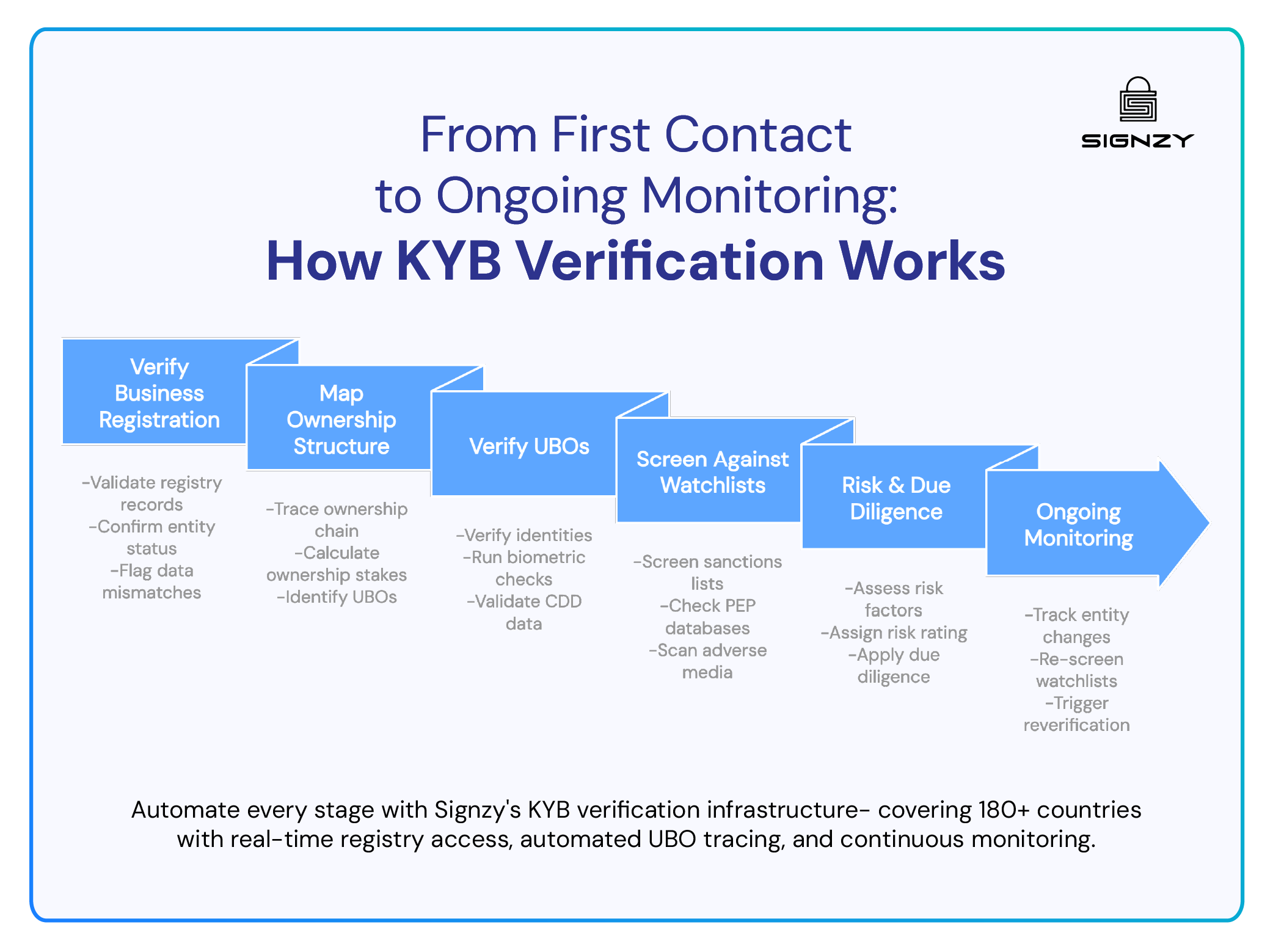
KYB verification follows a structured, six-step workflow that moves from basic entity validation through ownership mapping, individual verification, risk assessment, and ongoing monitoring.
Step 1: Collect and Verify Business Registration Data
The first step confirms the business entity legally exists and is authorised to operate in its claimed jurisdiction.
What to verify:
- Legal name, registration number, and entity type against official government registries
- Current status (active, dissolved, suspended, struck off)
- Registered address and registered agent
- Date of incorporation and filing history
Key registries by jurisdiction:
| Jurisdiction | Primary Registry | What You Can Verify |
|---|---|---|
| United States | Secretary of State (state-level: Delaware, California, New York) | Incorporation status, registered agent, filing history, good standing |
| United Kingdom | Companies House | Directors, shareholders, PSCs, accounts, filing history |
| European Union | BRIS — Business Registers Interconnection System | Cross-border company searches across EU member states |
| India | MCA — Ministry of Corporate Affairs | CIN, company status, directors, registered address, charges |
| Singapore | ACRA BizFile | Registration, directors, shareholders, financial summaries |
| UAE | Dubai Economic Department / VARA (for crypto) | Trade license validity, business activity codes, ownership |
Red flags at this stage: Entity not found in any registry; dissolved or suspended status; recently registered despite claims of long operational history; registered address is a virtual office or residential property inconsistent with claimed operations.
Step 2: Identify and Map the Ownership Structure
This is the most complex and operationally challenging step. It requires tracing the ownership chain from the entity under verification upward through any intermediary companies, trusts, or holding structures until you reach the natural persons who ultimately own or control the business.
What to do:
- Identify all shareholders and their ownership percentages from the shareholder register or registry filings
- For each shareholder that is a corporate entity (not a natural person), trace through to its shareholders
- Continue tracing through each layer until you reach natural persons
- Calculate both direct and indirect ownership percentages
Example: If Person A owns 60% of Holding Company X, and Holding Company X owns 50% of Target Company Y, then Person A's indirect ownership of Target Company Y is 30% (60% × 50%).
Cross-border ownership chains add significant complexity. A UK company may be owned by a BVI holding company, which is owned by a Singaporean trust, whose settlor is a natural person in India. Each layer may require accessing different registries, in different languages, with different data formats and access restrictions.
For a comprehensive guide to UBO identification across 15+ jurisdictions, see Signzy's guide on UBO verification.
Step 3: Verify Ultimate Beneficial Owners (UBOs)
Once UBOs are identified, each must undergo individual KYC verification. Under FinCEN's CDD Rule (31 CFR 1010.230), financial institutions must collect and verify the following for each beneficial owner (≥25% ownership) and one control person:
| Data Element | Requirement |
|---|---|
| Full legal name | Must match government-issued ID |
| Date of birth | Verified against ID document |
| Residential address | Current address; APO/FPO permitted for military |
| Identification number | SSN for US persons; passport number + country of issuance for non-US persons |
| Government-issued photo ID | Passport, driver's license, or national ID |
Verification methods include documentary (reviewing government-issued identification) and non-documentary (database checks, credit bureau verification, public records searches). Institutions may rely on information provided by the legal entity customer — such as a certification form — unless there are red flags that call reliability into question.
Global UBO ownership thresholds vary significantly:
| Jurisdiction | Ownership Threshold | Control Criteria |
|---|---|---|
| FATF (global standard) | ≥25% (recommended maximum) | Control by other means |
| United States (CDD Rule) | ≥25% equity interests | One person with "significant responsibility to control, manage, or direct" |
| European Union (AMLD6) | ≥25% shares or voting rights; potentially 15% for high-risk sectors | Control via other means; senior managing official fallback |
| United Kingdom | >25% shares or voting rights | Right to appoint/remove board majority; significant influence or control |
| India (SBO Rules) | ≥10% shares, voting rights, or right to dividends | Significant influence or control |
| South Africa | ≥5% beneficial ownership | Control via voting rights, board appointment, or significant influence |
This jurisdictional variation means a structure that doesn't trigger UBO identification in the US (25% threshold) may require it in India (10%) or South Africa (5%).
Step 4: Screen Against Sanctions, PEP, and Adverse Media
Both the entity and all identified UBOs must be screened against:
- Global sanctions lists: OFAC SDN List (US), EU Consolidated List, UN Security Council Consolidated List
- PEP databases: Politically Exposed Persons at all levels — heads of state, senior officials, their family members and close associates
- Adverse media sources: News coverage related to financial crime, fraud, corruption, regulatory enforcement, or sanctions violations
- Criminal databases: Where legally permitted and available
Screening must account for name variations, transliterations, aliases, and misspellings through fuzzy logic matching — exact-match systems miss a significant proportion of real hits.
Critical point: Sanctions lists are updated frequently. Screening must be performed not just at onboarding but on an ongoing basis, with daily or real-time list updates.
For a detailed guide to AML screening methods and best practices, see Signzy's guide on AML screening.
Step 5: Assess Overall Risk and Apply Due Diligence
Once verification and screening are complete, the institution must assess the overall risk the business relationship presents and apply proportional due diligence.
Risk factors to evaluate:
| Risk Dimension | Low Risk Indicators | High Risk Indicators |
|---|---|---|
| Jurisdiction | Domestic entity in well-regulated market | Entity or UBOs in FATF grey/black-listed countries |
| Ownership structure | Simple, transparent; UBOs easily identified | Multi-layered, cross-border; nominee arrangements; trusts |
| Industry | Standard commercial activity | Crypto, gambling, arms, high-cash businesses |
| PEP/sanctions exposure | No hits | UBOs are PEPs or have close PEP associations |
| Adverse media | No negative coverage | Coverage of fraud, corruption, or regulatory enforcement |
| Financial profile | Revenue consistent with business type | Revenue inconsistent; source of funds unclear |
Due diligence levels:
- Standard CDD: Applied to most business relationships. Includes all six steps with standard documentation and periodic review.
- Enhanced Due Diligence (EDD): Triggered when risk indicators are elevated. Includes deeper source-of-funds/source-of-wealth investigation, senior management approval, more frequent reviews, and additional documentation.
- Simplified Due Diligence (SDD): Applied to clearly low-risk entities such as regulated financial institutions in low-risk jurisdictions, publicly listed companies with strong disclosure, or government entities.
Step 6: Ongoing Monitoring and Periodic Review
KYB is not a one-time event. A company that is legitimate and low-risk today may not remain so. Ongoing monitoring must cover:
- Ownership changes: M&A activity, capital raises, share transfers that change UBO composition
- Legal status changes: Dissolution, suspension, name changes, address changes
- Sanctions and PEP updates: Daily re-screening against updated watchlists
- Adverse media: Continuous monitoring for negative news about the entity, its directors, or UBOs
- Transaction behaviour: Monitoring for activity inconsistent with the stated business profile
Review frequency should be risk-based: annually for standard-risk relationships, quarterly or semi-annually for high-risk ones, and event-driven re-verification whenever material changes are detected.
FATF's revised Recommendation 24 explicitly requires that beneficial ownership information be maintained as adequate, accurate, and up-to-date — making ongoing monitoring a regulatory expectation, not just a best practice.
What Are the Global KYB Regulatory Requirements?
KYB requirements are not standardised globally. Each jurisdiction has its own regulatory framework, UBO thresholds, and enforcement posture. Here are the key frameworks compliance teams must navigate:
| Regulatory Framework | Jurisdiction | Key KYB Requirements | 2025–2026 Status |
|---|---|---|---|
| FATF Recommendation 24 | Global (195+ jurisdictions) | Risk-based UBO identification; multi-source verification; timely access by authorities; international cooperation | Revised to require verified (not just declared) BO data; implementation pressure increasing through mutual evaluations |
| FinCEN CDD Rule (31 CFR 1010.230) | United States | Identify UBOs at ≥25% ownership + 1 control person; verify identity; risk-based ongoing monitoring | Fully in force. CTA/BOI reporting enforcement softened for domestic entities, but CDD obligations for FIs unchanged |
| EU AML Package (AMLD6 + AMLR) | European Union | Harmonised CDD/EDD rules; interconnected UBO registers; ≥25% threshold (potentially 15% for high-risk sectors) | AMLD6 partial transposition: July 2026. Full AMLR effect: July 2027. AMLA established in Frankfurt |
| RBI KYC Directions + SBO Rules | India | Mandatory KYC for all FIs; UBO identification at ≥10% ownership; risk-based CDD for corporate accounts | Updated digital KYC guidelines; expanded requirements for fintechs and payment aggregators |
| UK PSC Regime + ECCTA | United Kingdom | PSC disclosure at >25%; identity verification for directors and PSCs at Companies House | ECCTA 2023 reforms rolling out: stronger ID verification, better data quality, enforcement against false filings |
| UAE Cabinet Resolution + VARA | UAE | UBO identification at ≥25%; VARA registration for crypto platforms | Saudi Arabia UBO Register enforcement from January 2026; UAE tightening enforcement |
Key insight: The global trend is unmistakably toward lower thresholds, stricter verification (not just declaration), and continuous monitoring. Institutions that build their KYB programmes to the highest common standard — rather than the minimum in any single jurisdiction — are best positioned for both compliance and operational efficiency.
For a detailed breakdown of AML policy requirements for fintechs, see Signzy's guide on AML policy for fintechs.
What Are the Most Common KYB Challenges — and How Do You Solve Them?
Multi-Layered Corporate Structures
Real-world ownership structures can span 5–10+ entities across multiple jurisdictions, each with its own registry format, access rules, and language. Research by Shufti Pro (2025) found that 68% of identified money laundering schemes use multi-layered account and entity structures — structures specifically designed to obscure beneficial ownership.
Solution: Automated UBO discovery tools that trace ownership chains across jurisdictions, calculate indirect ownership percentages, and flag discrepancies between declared and registry-sourced data.
Cross-Border Registry Fragmentation
Data availability ranges from open, searchable digital registries (Companies House, Delaware SOS) to paywalled, paper-based, or practically inaccessible records. Even within the EU, where UBO registers are being interconnected through BRIS, data quality and format vary significantly between member states.
Solution: Platforms with pre-built integrations to registries across multiple jurisdictions, enabling automated data retrieval without manual searches across individual databases.
Document Mismatches and Data Quality Issues
Industry data indicates that only 3% of business data meets basic quality standards. Common failure points include outdated documents (>3 months old), company name mismatches between submitted documents and registry records, address discrepancies, and director/UBO information that doesn't match latest filings.
Solution: AI-powered document verification that cross-references submitted documents against multiple authoritative sources in real-time, flagging inconsistencies automatically.
Balancing Onboarding Speed with Verification Depth
Manual KYB for a straightforward domestic entity typically takes 2–5 business days. For complex, cross-border, high-risk entities requiring EDD, timelines extend to 2–4 weeks. This creates a fundamental tension between the speed customers expect and the depth regulators require.
| Scenario | Manual Timeline | Automated Timeline |
|---|---|---|
| Simple domestic entity (low risk) | 2–5 business days | Minutes to hours |
| Complex cross-border entity (standard risk) | 5–10 business days | 1–3 business days |
| High-risk entity requiring EDD | 2–4 weeks | 3–5 business days |
Solution: Automated KYB platforms that handle standard verifications in near real-time while routing complex cases to compliance analysts with pre-enriched data, reducing manual investigation time significantly.
How Signzy Helps Organisations Automate KYB Verification
For organisations that need to verify business legitimacy at scale — whether onboarding hundreds of merchants, screening vendors across borders, or maintaining compliance with evolving AML regulations across multiple jurisdictions — manual verification is simply not sustainable.
Signzy provides an AI-powered business verification and compliance platform trusted by over 1,000 financial institutions, banks, and fintechs globally — including Fortune 500 companies like Microsoft, Meta, FedEx, Citi, and Mastercard. Here is how Signzy's capabilities map to each stage of the KYB process:
- Real-Time Registry Verification: Signzy connects directly to official corporate registries and government databases across 180+ countries and all 50 US states, enabling instant verification of company registration, legal status, and filing history — eliminating the need for manual searches across individual databases.
- Automated UBO Discovery: AI-powered analysis of business shareholding patterns traces complex ownership chains across jurisdictions, calculating direct and indirect ownership percentages and flagging structures that require enhanced scrutiny. Signzy reports 97% API accuracy across 160M+ businesses verified.
- Integrated KYC for UBOs: Once UBOs are identified, Signzy's One Touch KYC performs identity verification in under 5 seconds — running document OCR, facial biometric matching, liveness detection, and deepfake detection simultaneously across 14,000+ document types in 50+ languages.
- Comprehensive AML Screening: Screens companies, directors, and UBOs against 1,000+ global sanctions and watchlists including OFAC, UN, EU, and FinCEN databases, with daily updates and fuzzy logic matching for name variations, transliterations, and aliases.
- Fraud Prevention: Signzy's MuleShield analyses 200+ risk signals to detect potential mule accounts, having identified 400,000+ mule accounts to date. Deepfake detection catches AI-generated synthetic identities that increasingly target business onboarding workflows.
- 340+ Modular APIs: The entire KYB verification workflow — from registry checks through UBO tracing, document verification, AML screening, and ongoing monitoring — is available through 340+ REST API endpoints that can be deployed in 48 hours to 4 days.
- No-Code Workflow Builder: Compliance teams can configure jurisdiction-specific KYB workflows, adjust risk thresholds, and deploy onboarding journeys without developer resources using Signzy's no-code platform.
To learn more about Signzy's business verification capabilities, visit the KYB solution page or explore the API marketplace.


FAQ
What is the difference between KYB and KYC?

What regulations require KYB verification?
What documents are needed for KYB verification?
How long does KYB verification take?
What is the UBO ownership threshold for KYB?
What happens if a UBO cannot be identified?
What triggers Enhanced Due Diligence (EDD) in KYB?
How often should KYB verification be updated?
Can KYB verification be fully automated?
What is the cost of implementing KYB compliance?
Shivam Agarwal
Shivam heads the go-to-market strategy at Signzy. He holds the CFA charter and a strong background in financial operations, PE analysis and strategy. His prior roles include business strategy and private-equity analysis in the financial services and fintech domain, giving him deep insight into client needs, risk-adjusted economics and monetisation models for compliance & identity verification platforms.

Related Blogs
View all



![UAE KYB Documents Requirements [Take-Home List Inside]](https://cdn.sanity.io/images/blrzl70g/production/544d434c34d12f9580fd9f8fbc736de22a07d613-2560x600.webp)
The best in business


The global API marketplace for KYC, KYB, & AML
Explore the end-to-end verification stack trusted by 1,000 businesses.
Get in touch