





Automate FIU‑IND’s 2026 AML/CFT Compliance for VDA SPs with Signzy

 Open in ChatGPT
Key Highlights
- FIU-IND's January 2026 guidelines place crypto platforms under the same AML and CFT standards as banks, requiring income verification, biometric checks, bank validation, periodic KYC updates, multi-stage sanction screening, and five-year audit trails for all Virtual Digital Asset Service Providers.
- Manual compliance processes break down at crypto scale when platforms handle thousands of daily signups, 24/7 trading activity, and cross-border transactions that demand real-time verification without creating user friction or operational bottlenecks.
- Signzy's API infrastructure automates every FIU-IND mandate through direct government database integration, providing income checks, liveness detection, penny drop validation, CKYC monitoring, AML screening, and audit-ready dashboards with pay-as-you-go pricing that scales with platform growth.
FIU-IND released new AML and CFT guidelines on January 8, 2026, that apply to all Virtual Digital Asset Service Providers operating in India. These rules cover crypto exchanges, wallet providers, custodians, and NFT marketplaces, putting them under the same regulatory standards as traditional financial institutions.

Platforms now need to verify customer income through government databases, capture live biometric data, validate bank accounts, conduct periodic KYC updates, screen against global sanctions lists, and keep audit-ready records for years.
Doing this manually does not scale when you are onboarding hundreds or thousands of users daily. This is where Signzy comes in. Our APIs automate each FIU-IND requirement, so your platform stays compliant without building everything from scratch or hiring large teams.
Below, we’ll cover what these regulations require, how Signzy’s technology handles each piece, and why crypto platforms are choosing this approach.

What do crypto platforms need to comply with under the FIU-IND new AML/CFT guidelines?
The 2026 guidelines bring Virtual Digital Asset Service Providers under the full regulatory umbrella of India's anti-money laundering framework. Specifically, the Prevention of Money Laundering Act, 2002 (PMLA) and the Prevention of Money Laundering (Maintenance of Records) Rules, 2005 (PMLR) now apply directly to crypto businesses. This is the same legal framework that governs banks, NBFCs, and payment companies.
Who exactly needs to comply with FIU-IND 2026 guidelines?
The definition is deliberately broad and activity-based. If your platform facilitates any of the following, you're a regulated Reporting Entity:
- Exchange between virtual digital assets and fiat currencies
- Exchange between one or more forms of virtual digital assets
- Transfer of virtual digital assets between wallets or accounts
- Safekeeping or administration of VDAs or private keys
- Participation in and provision of financial services related to VDA issuance or sale.
This covers crypto exchanges, custodial wallet providers, NFT marketplaces, peer-to-peer trading platforms, and even offshore platforms serving Indian users. The guidelines explicitly state that compliance obligations are activity-based, not location-based. If you're facilitating VDA activity linked to India, these rules apply to you.
How can Signzy help VDA SPs with AML/CFT compliance?
Signzy provides APIs that handle each FIU-IND requirement for crypto platforms. Instead of building separate connections for employment checks, income validation, bank verification, or various sanction list providers, you work with a single API layer. Each verification completes in real time, usually within seconds, which keeps your user onboarding process moving while meeting regulatory standards.
Signzy’s infrastructure processes millions of verifications monthly for regulated financial institutions in India, with the same availability and response time requirements that crypto platforms need. Whether you are onboarding 100 users a day or 100,000, the APIs scale automatically. This way, you can focus on your core crypto platform while we manage the compliance infrastructure that keeps you operational and inspection-ready.
Here is a more specific look at each solution in Signzy's compliance toolkit for VDA SPs.
Signzy's Toolkit for VDA SPs
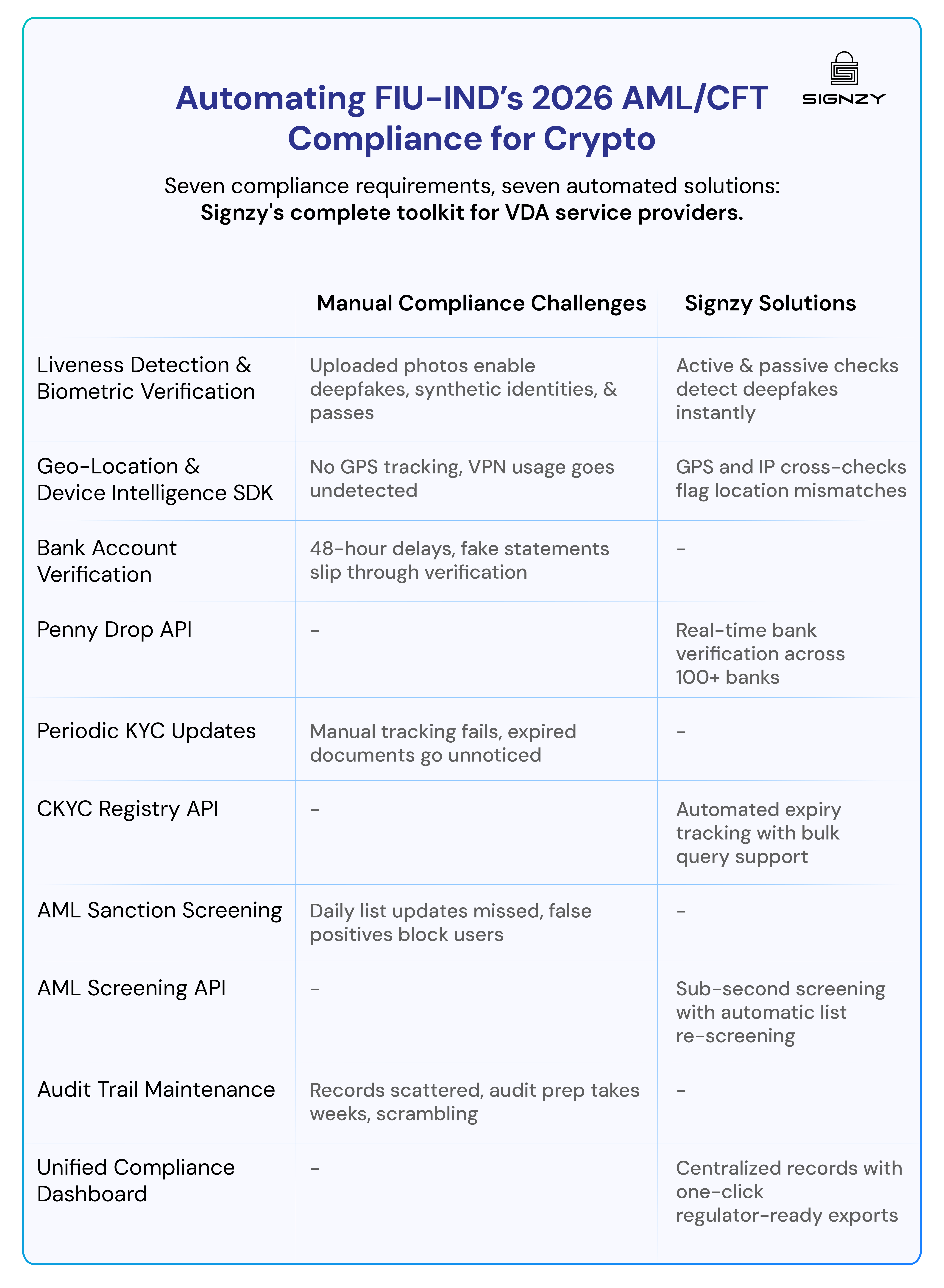
Meeting FIU-IND's AML/CFT compliance mandates requires specialized technology at every step of the user journey. Here's how Signzy's APIs handle each requirement, from the moment someone signs up to ongoing monitoring and audit readiness.
↪ Liveness detection and biometric verification
FIU-IND mandates live selfie capture with liveness detection to prove a real person is present during account creation. This stops synthetic identities, deepfakes, and account takeovers that crypto platforms face constantly.
Signzy’s liveness check API uses active challenges like blinking or turning your head, while passive analysis runs in the background, detecting replay attacks, masks, and deepfakes. Once liveness passes, face matching links the live photo to the government ID. The whole thing takes 8 to 12 seconds and creates a verification report with confidence scores.
This blocks fraud upfront and gives you solid proof of compliance when regulators come asking about your identity checks.
↪ Geo-location and device intelligence
FIU-IND requires GPS coordinates and an IP address at account creation. This builds a geographic fingerprint that helps catch fraud patterns and enforce location-based rules.
Signzy captures exact GPS coordinates and cross-checks them against IP location. When someone claims they live in Mumbai but signs up from a Dubai IP while GPS shows Bangalore, that mismatch gets flagged.
Device fingerprinting adds another layer by creating a unique profile based on hardware and software attributes. If the same device shows up across 50 account attempts in one day, you are looking at bots or promotional abuse.
↪ Penny Drop API for bank account verification
FIU-IND mandates verification of bank account ownership before enabling withdrawals. The account holder's name must match KYC records, and the account needs to be active. Here's how the Signzy’s Penny Drop Verification API works:
- Signzy’s Penny Drop Verification API sends a small deposit (usually Re 1) to the user's account through IMPS or NEFT
- Transaction pulls the registered name directly from the bank
- Fuzzy matching handles spelling variations and initial differences
- System confirms account is operational, not dormant or closed
- Returns verification status with transaction reference for audit trail
The whole verification finishes within seconds across 100+ banks and UPI accounts. Users can start withdrawing almost immediately through your platform, you avoid sending money to dead accounts, and Signzy helps you build an audit trail showing every bank link was verified in real time.
Integration is one API endpoint that usually takes 48 hours.
Signzy's penny drop API eliminated our biggest operational bottleneck. Users can now link bank accounts and start withdrawing funds within minutes instead of waiting 48 hours for manual verification. This dramatically improved our user experience while ensuring every linked account is verified and operational before processing transactions.
— Operations Manager, P2P Crypto Platform

↪ CKYC registry API for periodic KYC updates
FIU-IND requires KYC updates every six months for high-risk users and yearly for everyone else. Manually tracking renewal dates across thousands of users does not work.
Signzy’s CKYC Registry API checks the government database to see if documents are current and valid. When something is expiring or already expired, it flags the account and kicks off automated reminders through email or SMS. Bulk queries let you check 10,000 records at once, which matters when you need to audit your entire user base.
Set your refresh cycles once, and the system handles the rest.
↪ AML sanction screening API
FIU-IND mandates screening at account creation, KYC changes, list updates, and before wallet transfers. With over 3,000 global watchlists updating daily, manual screening falls apart fast. Signzy's AML sanction screening API covers OFAC, UNSC, EU, FATF, plus Indian lists like UAPA and WMDA. Results come back in under a second with fuzzy matching that catches name variations without drowning you in false positives.
When the sanctions list updates, Signzy’s AML screening API triggers automatic re-screening of your user base. A platform with 500,000 users can re-screen everyone in minutes through batch calls. You integrate screening at signup, transfers, and in your compliance dashboard, building the audit trail regulators expect.
↪ Unified compliance dashboard and audit trail
FIU-IND requires five years of tamper-proof records that let you reconstruct any transaction. When audits happen without warning, having everything organized matters.
Signzy’s dashboard stores every verification from all Signzy APIs in one place. Income checks, liveness results, penny drops, and screening reports all link to user profiles with timestamps and response data. Search by user, date range, or verification type, then export reports as PDFs for regulators. These reports get stored in a secure manner for the sole access of the VDA.
Transaction linkage connects verification data to wallet addresses and transaction hashes. The append-only architecture means nothing gets edited or deleted once logged, just annotated.
During inspections, your compliance team works from one dashboard instead of scrambling across multiple systems.
Why do VDA SPs choose Signzy for AML/CFT compliance?
Crypto platforms operate in a uniquely demanding environment: 24/7 trading, rapid user growth, cross-border transactions, and intense regulatory scrutiny. Compliance infrastructure needs to match that pace without creating friction or requiring massive teams.
Signzy's platform is built for exactly these conditions, delivering speed, accuracy, and scalability that manual processes cannot match.
🟢 Built for crypto-scale operations
Most compliance tools are designed for traditional banking workflows with predictable business hours and steady growth. Crypto does not work that way. Signups spike during bull runs, withdrawal requests flood in during crashes, and trading never stops.
Signzy's infrastructure handles millions of verifications monthly without breaking a sweat. APIs respond in under three seconds regardless of load, keeping onboarding smooth when thousands of users hit your platform simultaneously.
Auto-scaling adjusts capacity on the fly. There are no manual bottlenecks where compliance teams become the growth limiter.
Your platform scales, and compliance scales with it.
🟢 End-to-end compliance capabilities
Crypto platforms typically juggle multiple vendors to meet FIU-IND requirements: one for identity verification, another for sanctions screening, a third for income checks, and separate systems for audit trails. Managing these integrations, tracking API changes, and reconciling data across providers creates operational overhead that slows you down during audits and platform updates.
Signzy provides the complete compliance stack in one place:
- Identity verification with liveness detection and document checks
- Bank account validation via penny drop
- Sanction screening across global watchlists
- Periodic KYC monitoring and document expiry tracking
- Centralized compliance dashboard with audit-ready records
Start with what you need today, add capabilities as you grow, all through a single integration. Your compliance infrastructure scales without complexity
🟢 Pay-as-you-go pricing without feature lock-in
Signzy charges for actual usage. Running 10,000 penny drops and 50,000 sanction screens means your bill reflects exactly that. No base subscription fees, no feature tiers forcing you to buy bundled modules, no paying for capabilities that sit unused. Pricing scales with consumption, volume discounts apply automatically as usage grows, and you can track costs per verification type.
We scaled from 10,000 to 200,000 users in six months without adding compliance headcount. Signzy's APIs handled the verification volume increase seamlessly with consistent response times. Our unit economics improved because compliance costs grew linearly with users rather than requiring stepped increases in team size.
— CPO, Leading Crypto Platform
🟢 Proven regulatory track record
New compliance vendors are a gamble. You need technology that works under pressure and holds up when regulators show up for inspections.
Signzy powers compliance for RBI-regulated fintechs, NBFCs, and banks. The same infrastructure handling KYC for traditional finance now serves crypto platforms. This matters when banking partners evaluate your compliance setup and when FIU-IND conducts audits. You are running proven technology, not an experiment.
As regulations change, the platform updates continuously to stay aligned, so you are not rebuilding compliance infrastructure every time guidelines shift.
If you are preparing for rapid user growth, launching new products that increase compliance complexity, or expanding to markets with stricter KYC requirements, book a demo here to understand how Signzy's infrastructure handles volume spikes and adapts as regulations evolve without requiring platform rebuilds.


FAQ
What are the new FIU-IND guidelines for crypto platforms?

Who needs to comply with FIU-IND's VDA regulations?
When do the FIU-IND guidelines come into effect?
What are the penalties for non-compliance with FIU-IND guidelines for crypto platforms?
Do offshore crypto exchanges need to comply if they serve Indian users?
How often should crypto platforms update their AML policies?
Yashdeep Agarwal
Yashdeep is the product lead for Signzy’s flagship KYC Suite (One Touch KYC) and the governance, risk, and compliance product suite at Signzy, building 0-to-1 global platforms that handle identity verification, beneficial-owner discovery, regulatory screening and ongoing monitoring across fintech and banking clients. Previously a founder and engineer with 5+ years of experience, he now brings product-engineering and compliance-workflow expertise together to scale secure, audit-ready onboarding systems internationally.

Related Blogs
View all

Cryptocurrencies: The journey from a ban to tight regulations
FIU-IND new KYC & AML Guidelines for VDASPs: Jan 2026
![Cryptocurrency in India: KYC and AML Regulations [2026 Guide]](https://cdn.sanity.io/images/blrzl70g/production/18545a41d280d59abb7e03914da49843c1606b4e-2821x663.jpg)
Cryptocurrency in India: KYC and AML Regulations [2026 Guide]

Complete FIU-IND Reporting Guide: What You Need to Know
The best in business


The global API marketplace for KYC, KYB, & AML
Explore the end-to-end verification stack trusted by 1,000 businesses.
Get in touch