





How to Verify a Government-Issued Identification Number?

 Open in ChatGPT
🗒️ Key Highlights
- Government identification numbers serve as unique digital fingerprints, enabling citizens to access essential services and verify identity for financial transactions.
- Beyond national IDs, governments issue specialized numbers for businesses, professionals, marriages, passports, and military service for distinct administrative purposes.
- Identity fraud is intensifying — synthetic identity fraud surged 8x in 2025, US lenders face over $3.3 billion in exposure from synthetic identities in new accounts, and regulators have imposed $3.8 billion in AML-related penalties globally in 2025 — putting ID verification infrastructure under new scrutiny.
- Automated verification platforms like Signzy enable real-time validation of government ID numbers across 150+ countries, reducing fraud and streamlining compliance through unified API infrastructure.
- What is a government-issued identification number?
- How many types of government identification numbers are there?
- Government-issued Identification numbers by region
- How are government issued identification numbers used?
- How to verify government-issued identification numbers?
- How to automate government ID verification with APIs?
- How can Signzy APIs automate your ID checks?
- FAQ
Ever wondered about that mysterious string of numbers the government assigns you? Whether it's your Social Security Number, your driver's license number, or another official ID number, these digits follow you throughout your entire life.
But what exactly are these numbers for, and why does every government agency — and every regulated business — seem obsessed with them? If you've ever filled out a job application, filed taxes, or applied for benefits, you've encountered government identification numbers.
The truth is, these numbers are way more important than most people realize — and increasingly vulnerable to misuse. In Q1 2025 alone, synthetic identity document fraud surged 311% in North America, with deepfake fraud attempts rising 1,100% year-over-year. That's why understanding how these numbers work — and how to verify them correctly — matters more than it used to.
By the time you finish reading, you'll know exactly which numbers matter most, which authoritative systems verify them, and what regulated institutions need to get right.

What is a government-issued identification number?
A government-issued identification number is your official "ID code" that the government gives you to keep track of who you are in their system. Think of your Social Security Number if you're in the US, your Aadhaar number in India, or your National Insurance Number if you're in the UK.
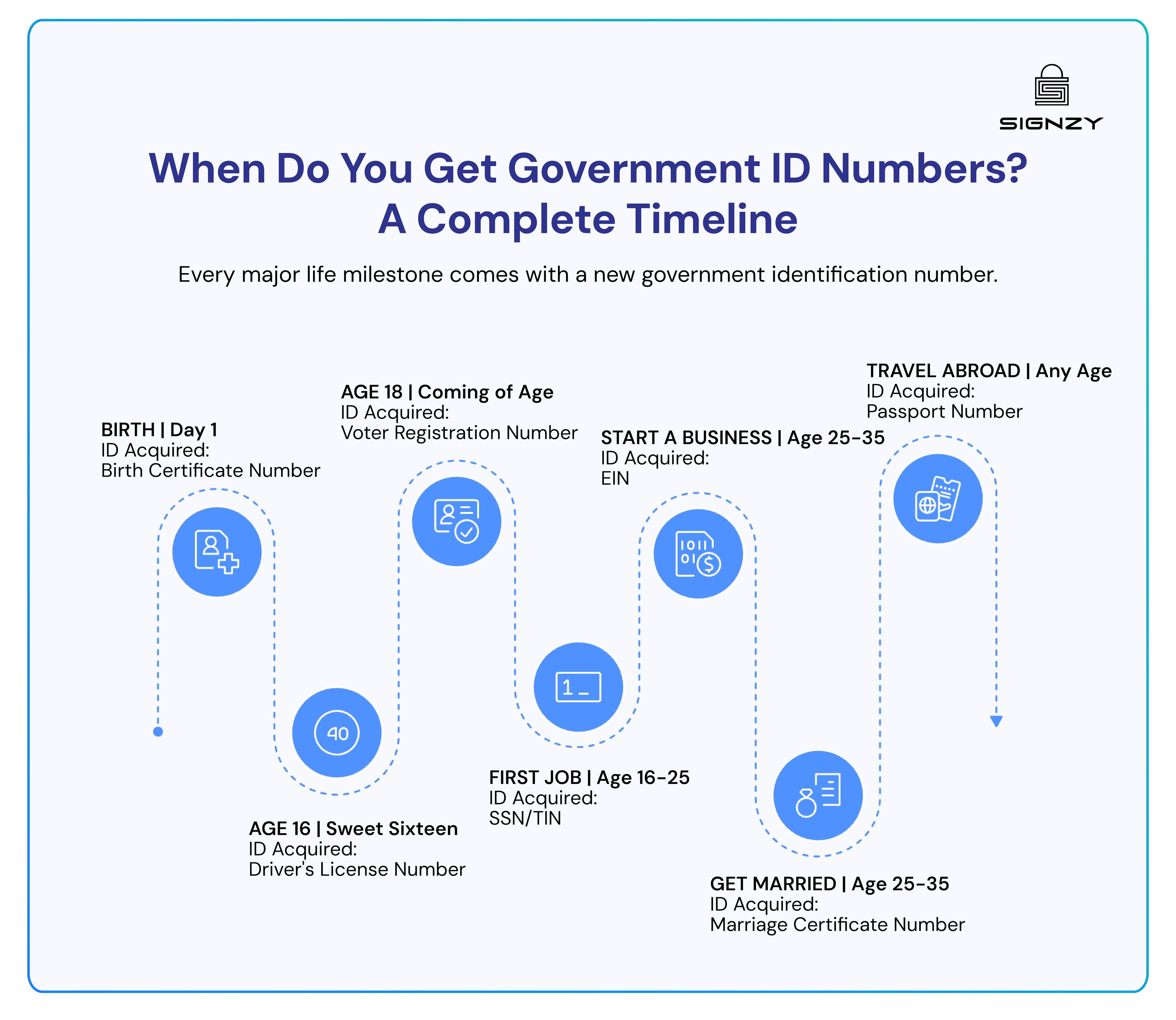
How many types of government identification numbers are there?
Giving an exact number of how many types of government identification numbers exist is hard since there are plenty of countries, and each uses its own methods to assign identification numbers to citizens.
There are three main umbrellas that cover most government-issued identification numbers worldwide.
Federal (National) government ID numbers
Different countries have their own ways of giving ID numbers to people. But to keep things simple, let's take the United States as an example. The federal government uses a few main ID numbers for both individuals and businesses.
- Social Security Number (SSN): The Social Security Administration hands out these nine digits to track your work earnings. When retirement rolls around, they look at this record to calculate your monthly check. The same goes for disability payments.
- Individual Taxpayer Identification Number (ITIN): The IRS has created ITINs for immigrants, foreign workers, and their children who need to file returns. No SSN? No problem — you still have to pay taxes.
- Employer Identification Number (EIN): Think of this as your business's Social Security Number. Every company needs one for tax filings. Companies with employees need one. So do partnerships, nonprofits, and trusts.
- Passport Number: Every passport gets its own number that links to your travel records at the State Department. Get a new passport? You get a completely different number.
- Military ID Numbers: Service members get ID numbers that stick with them forever, even after they leave the service. The VA and Pentagon use these to track benefits, medical care, and service records.
While these federal ID numbers apply nationwide, some forms of identification are managed at the state level.
State and local government ID numbers
States and local governments run their own ID systems, too.
- Driver's License Numbers: Every state does this their own way. California might give you a simple sequence of numbers; Florida builds your birth year right into the license number. Some states even code your gender or which DMV office issued your license. There's no standard format anywhere in the US.
- Professional License Numbers: Want to practice medicine in Texas? You need a Texas medical license with a specific number. Move to Ohio? You start the licensing process all over again. Lawyers, real estate agents, accountants — they all go through the same thing.
- Voter Registration Numbers: Sign up to vote, and your state gives you a voter ID number. Election workers use these to prevent duplicate voting.
Specialized government ID numbers
Beyond your main national ID number, governments love giving out specialized numbers for specific situations:
- Starting a business → Employer Identification Number (EIN) for taxes
- Getting married → Marriage certificate number for legal records
- Traveling abroad → Passport number for international identification
- Working in healthcare → Professional license number for medical practice
- Joining the military → Service member identification number
- Registering to vote → Voter registration number for elections
- Filing bankruptcy → Case number for court proceedings
A single person might accumulate five or six different government numbers by adulthood, each serving a different administrative purpose.
Government-issued Identification numbers by region
| Country | Government issued Identification numbers |
|---|---|
| United States | Social Security Number (SSN) |
| Canada | Social Insurance Number (SIN) |
| Mexico | CURP (Clave Única de Registro de Población) |
| United Kingdom | National Insurance Number (NIN) |
| Germany | Steuerliche Identifikationsnummer (Tax ID) |
| France | INSEE Code |
| Italy | Codice Fiscale |
| Spain | DNI (Documento Nacional de Identidad) |
| Netherlands | BSN (Burgerservicenummer) |
| Belgium | National Register Number |
| Sweden | Personnummer |
| Norway | Fødselsnummer |
| Denmark | CPR Number |
| Finland | Henkilötunnus |
| Poland | PESEL |
| Austria | Sozialversicherungsnummer |
| Switzerland | AHV Number |
| Ireland | Personal Public Service Number (PPS) |
| Portugal | Número de Identificação Fiscal (NIF) |
| Greece | AFM (Tax Registration Number) |
| Czech Republic | Rodné číslo |
| Hungary | Személyi azonosító |
| Romania | CNP (Cod Numeric Personal) |
| China | National ID Number (18 digits) |
| India | Aadhaar Number |
| Japan | My Number (マイナンバー) |
| South Korea | Resident Registration Number (RRN) |
| Singapore | NRIC/FIN |
| Malaysia | NRIC Number |
| Indonesia | NIK (Nomor Induk Kependudukan) |
| Thailand | Thai National ID |
| Vietnam | CCCD Number |
| Philippines | PhilSys Number (PSN) |
| Bangladesh | NID (National ID) |
| Australia | Tax File Number (TFN) |
| New Zealand | IRD Number |
| United Aran Emirates | Emirates ID Number |
| Saudi Arabia | National ID Number |
| Israel | Identity Number (Mispar Zehut) |
| Turkey | TC Kimlik Numarası |
| Qatar | QID (Qatar ID) |
| Kuwait | Civil ID Number |
| Bahrain | CPR (Central Population Register) |
| Oman | Civil ID Number |
| South Africa | ID Number (13 digits) |
| Egypt | National ID Number |
| Kenya | National ID Number |
| Morocco | CNIE (National Electronic Identity Card) |
| Ghana | Ghana Card Number |
| Ethiopia | National ID |
| Tanzania | NIDA Number |
| Brazil | CPF (Cadastro de Pessoas Físicas) |
| Argentina | DNI (Documento Nacional de Identidad) |
| Chile | RUT (Rol Único Tributario) |
| Colombia | Cédula de Ciudadanía |
| Peru | DNI (Documento Nacional de Identidad) |
| Ecuador | Cédula de Identidad |
How are government issued identification numbers used?
Government-issued identification numbers serve as the foundation of identity verification across financial services, government programs, and commercial transactions. They are the anchor points that connect a customer record to authoritative external data — tax authorities, credit bureaus, sanctions lists, and court records. Without a reliable anchor, every other compliance control weakens.
Under FATF Recommendation 10, financial institutions must identify and verify customers using "reliable, independent source documents, data, or information" before establishing business relationships or conducting transactions above thresholds. In the US, 31 CFR § 1020.220 specifically requires a government identifier at account opening. These frameworks turn government ID numbers from administrative labels into regulatory infrastructure.
| Situation | Government ID Number Use |
|---|---|
| Opening New Accounts | KYC rules mean you’ve got to verify who people are before letting them bank with you. ID numbers make this quick and easy instead of drowning in paperwork and manual checks. |
| Processing Loans | You need to pull credit reports and verify income history. Without their government ID number, you’re flying blind on whether someone can actually pay you back. |
| Issuing Credit Cards | ID numbers let you check their credit score, payment history, and existing debts. Plus, it stops fraudsters from using fake identities to rack up charges they’ll never pay. |
| Wire Transfers | Big money movements get flagged automatically. The ID number helps track everything properly, so regulators stay happy and suspicious transfers get caught before causing problems. |
| Business Accounts | You need to know who actually owns the company you’re dealing with. ID numbers help you figure out if it’s a legitimate business or just a front for something sketchy. |
| Corporate Banking | Large business accounts require knowing all the key players and beneficial owners. ID numbers make it simple to verify everyone involved and keep your records straight. |
#1. Opening new accounts
When someone applies for a bank account, financial institutions use the government ID number to verify their identity against official databases. The ID number acts as the key to access authoritative government records. What previously required days of manual document review now happens within minutes through automated systems.
#2. Processing loans
Lenders rely on government ID numbers to assess creditworthiness and evaluate repayment risk. These numbers provide access to credit bureau reports that show:
- Complete borrowing histories and payment records
- Outstanding obligations and credit scores
- Employment verification and tax filing data
- Previous defaults or bankruptcy filings
The unique identifier connects all this information together. Without it, distinguishing between applicants with common names becomes nearly impossible, and tracking credit histories across multiple institutions breaks down.
#3. Issuing credit cards
Card issuers use government ID numbers for credit evaluation and fraud prevention. The number enables retrieval of credit scores, analysis of spending behaviors, and identification of any previous defaults or fraudulent activity. This verification proves particularly valuable for detecting synthetic identity fraud, where criminals blend real data (valid SSNs, EINs) with fabricated details to create false identities.
#4. Wire transfers and large transactions
Financial institutions depend on government ID numbers to maintain compliance with anti-money laundering regulations and counter-terrorism financing requirements. For wire transfers and substantial transactions, these numbers identify all parties involved and create permanent audit trails. FATF Recommendation 16 (revised June 2025) tightened requirements for originator/beneficiary identification in cross-border payments — meaning the ID numbers you capture today face higher regulatory scrutiny than they did twelve months ago.
#5. Business account opening
Establishing business banking relationships requires verification of everyone with ownership or control over the company. Government ID numbers authenticate business owners, authorized signatories, and beneficial owners who ultimately control or profit from the entity. Banks collect these numbers for individuals with significant ownership stakes, preventing shell companies from operating anonymously.
#6. Corporate banking and commercial lending
Large corporate accounts and commercial credit facilities demand comprehensive due diligence on all key stakeholders. Government ID numbers allow banks to verify company directors, ultimate beneficial owners, and authorized representatives across different jurisdictions. For multinational corporations, ID numbers from various countries help banks build complete pictures of corporate structures and identify connections to sanctioned entities or high-risk regions.
How to verify government-issued identification numbers?
There are three primary approaches to verifying government ID numbers, each with distinct trade-offs in speed, accuracy, and scalability.
- Manual verification: Time-consuming, error-prone, and basically impossible to scale as your business grows.
- Outsource to contractor agencies: Risky since you're putting sensitive customer data in someone else's hands, plus you lose control over timing and quality.
- Use technology to keep it in-house: API-based platforms provide automated verification infrastructure that integrates directly into your existing systems, giving you speed, accuracy, and complete control.
Before choosing an approach, it's worth being precise about what "verification" actually means. Three distinct processes are often conflated:
| Process | What It Actually Does |
|---|---|
| ID Number Validation | Checks format, length, and checksum against the issuing authority's algorithmic rules (e.g., CPF modulus-11 check). Doesn't prove the number exists. |
| ID Number Verification | Queries an authoritative government database to confirm the number exists and matches a claimed name/DOB (e.g., SSA eCBSV, IRS TIN Matching, UIDAI Aadhaar). |
| Identity Verification | Binds the verified number to a specific living person through document authenticity checks, biometrics, and liveness detection. |
A program doing only validation meets no meaningful compliance bar. A program doing database verification without biometric binding can be defeated by stolen-but-real ID numbers. The 2026 regulatory expectation is all three layers, ideally running in parallel.
APIs hit the sweet spot for delivering all three. Let's walk through the step-by-step process.
How to automate government ID verification with APIs?

Most verification APIs follow a similar architecture, though implementation details vary by provider. Here's the standard sequence of how automated ID verification actually works.
Step 1: Customer provides their ID number
The verification process begins when a customer enters their government-issued ID number during account opening, loan application, or onboarding. This happens through your application interface — web form, mobile app, or in-branch system.
The customer typically provides additional information alongside the ID number: full name, date of birth, and address. This creates multiple data points for cross-verification instead of relying solely on the ID number itself.
Step 2: Your system sends data to the verification API
Once the customer submits their information, your system automatically sends a verification request to the API endpoint. This happens in the background, usually within milliseconds, without any additional action required from the customer or your staff.
Signzy's verification APIs, for example, can process requests across 240+ countries, handling different ID formats from Social Security Numbers to Aadhaar cards to Emirates IDs.
Step 3: API cross-references government databases
The verification API connects to official government databases and authoritative data sources to validate the ID number. Multiple database checks can happen simultaneously to build a complete verification picture. Examples of authoritative sources include the SSA eCBSV service for US SSN matching, the AAMVA DLDV service (covering 44 US jurisdictions and approximately 73% of the US population) for driver's license verification, and UIDAI's Aadhaar authentication for Indian nationals.
Step 4: Additional validation layers are applied
Beyond basic database matching, advanced verification systems apply additional fraud detection layers:
- Sanctions and watchlist screening: Checks if the ID number or associated individual appears on OFAC sanctions lists, United Nations Security Council lists, or other government watchlists.
- Politically exposed persons (PEP) screening: Identifies whether the individual holds or has held prominent public positions, requiring enhanced due diligence under AML regulations.
- Adverse media monitoring: Scans news sources and public records for negative information associated with the person, such as fraud convictions, financial crimes, or ongoing legal proceedings.
These layered checks work together to catch sophisticated fraud schemes that might slip through a single verification method. Piecing together different verification services creates operational complexity and leaves security gaps where fraudsters can slip through — as illustrated by a 2025 case in which a UK bank was fined £160,000 after a sanctioned individual opened an account because a single spelling discrepancy evaded its screening controls.
Step 5: You receive a verification response
The API returns a verification result to your system, typically within seconds. The response includes whether the ID number is valid, the confidence level of the match, and any red flags detected during the process.
Valid verifications allow the application to proceed automatically, while flagged cases route to your compliance team for manual review. You maintain complete audit trails showing exactly what was verified and when.
How can Signzy APIs automate your ID checks?
Signzy is an end-to-end compliance and identity verification platform trusted by 1,000+ global companies, including Fortune 500 leaders like Microsoft, Meta, FedEx, Citi, and Mastercard. The platform integrates database checks, document verification, and fraud detection into a single API that fits directly into your existing workflow.
🔒 Comprehensive fraud detection: Go beyond basic database matching with built-in sanctions screening, PEP monitoring, adverse media checks, and AI-powered document forensics that catch synthetic identities and forged documents. Signzy's MuleShield fraud prevention suite analyzes 200+ risk signals to surface mule accounts and synthetic identities that pass surface-level ID verification.
🌍 Global coverage, local compliance: Handle verification requirements across different jurisdictions without rebuilding your stack, with automatic updates that keep you compliant with evolving KYC and AML regulations including FATF Recommendation 10, US FinCEN CIP rules, and the EU's updated high-risk third country list effective January 2026.
🔗 Single integration point: Eliminate the complexity of managing multiple verification vendors. Access database checks, biometric authentication, document validation, bank account verification, KYB and UBO verification, and KYC and AML screening through one unified API.
Deployment typically takes 48 hours to 4 days, with usage-based pricing and no minimum commitments — a meaningful differentiator for scaling fintechs and startups for whom enterprise-pricing-only competitors are out of reach.
Schedule a demo to see how Signzy integrates into your workflow and starts verifying customers in real-time.


FAQ
How do commercial verification vendors access US driver's license data?

What's the difference between SSA eCBSV and IRS TIN Matching?
Can an institution rely on database-only verification to meet regulatory requirements?
How should a global fintech handle verification fragmentation across countries?
Saurin Parikh
Saurin is a Sales & Growth Leader at Signzy with deep expertise in digital onboarding, KYC/KYB, crypto compliance, and RegTech. With over a decade of professional experience across sales, strategy, and operations, he’s known for driving global expansions, building strategic partnerships, and leading cross-functional teams to scale secure, AI-powered fintech infrastructure.

Related Blogs
View all

![5 Taxpayer Identification Number Types Explained [2026]](https://cdn.sanity.io/images/blrzl70g/production/ab51b58ad90fb655dc3a2a9121557160dfe3276a-2821x663.png)


The best in business


The global API marketplace for KYC, KYB, & AML
Explore the end-to-end verification stack trusted by 1,000 businesses.
Get in touch