





EIN Verification: All FAQs Answered [Complete Guide - 2026]

 Open in ChatGPT
🗒️ Key Highlights
- An Employer Identification Number (EIN) is a permanent nine-digit federal tax ID that businesses need for tax filing, hiring employees, opening bank accounts, and establishing business credit.
- You can verify EIN numbers through multiple channels, including IRS validation letters, public records (SEC filings for public companies, IRS Tax Exempt Search for non-profits), direct IRS contact at 800-829-4933, or by requesting documentation from the business itself.
- Automated API solutions like Signzy eliminate bottlenecks by delivering instant validation across all 50 states, providing 30+ business data points, real-time risk screening, and bulk processing capabilities that turn multi-day.
- What is EIN?
- What is the format of the EIN number?
- Who needs an EIN?
- Is EIN only for U.S. companies?
- When to use EIN?
- How do I get my EIN number?
- What is an EIN verification form?
- When to get a new EIN?
- What to do if I forgot the EIN number?
- When can I use an EIN to make tax deposits?
- What's the difference between EIN lookup and EIN verification?
- How can I verify an EIN number?
- Can I verify an EIN without contacting the business directly?
- How do banks verify EIN numbers during account opening?
- Can I verify multiple EINs at once using automation?
- How do EIN verification APIs work?
- How can Signzy simplify EIN verification for your business?
- FAQ
If there were a contest for the most misunderstood business requirement, EIN verification would probably win first place.
And second place. And maybe even third.
It's that one process that everyone deals with, but nobody really talks about – kind of like your company's coffee machine that's been making strange noises for months.
However, EIN verification isn’t that tough.
Whether you’re a startup disrupting the status quo or have been around since before the internet was cool, these FAQs are about to make your life a whole lot easier.
Here are answers to the 12 most commonly asked EIN FAQs.
What is EIN?
An Employer Identification Number (EIN) is a special nine-digit number given by the Internal Revenue Service (IRS) to recognize businesses for taxation reasons. An EIN functions as your company’s federal tax identification number, just like an individual’s Social Security number. This number is used by the IRS to keep track of all your payroll tax submissions, company tax filings, and other federal tax responsibilities.
What is the format of the EIN number?
An EIN always follows the format XX-XXXXXXX, where X represents numerical digits. For instance, a typical EIN structure would look like 12-3456789. The first two digits, known as the EIN prefix, are assigned based on various IRS internal criteria, while the remaining seven digits are sequentially assigned.
While the format remains consistent across all EINs, each number is unique to a specific business entity.
⚠️ Security Alert: Never share or publicly display your actual EIN on websites, social media, or public documents. Exposing your EIN could lead to tax fraud, identity theft, or unauthorized business filings under your company's name.
Who needs an EIN?
Any business operating in the United States must obtain an EIN if it has employees, operates as a corporation or partnership, or files certain tax returns. This requirement applies to small businesses, large corporations, non-profit organizations, and even sole proprietors with employees.
Additionally, you need an EIN if you’re withholding taxes on income (other than wages) paid to a non-resident alien, managing a Keogh plan, or involved with trusts, estates, real estate mortgage investments, farmers’ cooperatives, or plan administrators.
Even if you’re a sole proprietor without employees, getting an EIN can help separate personal and business finances.
Is EIN only for U.S. companies?
While EINs are primarily associated with U.S. businesses, they're not exclusive to domestic companies. Foreign individuals and entities conducting business activities in the United States that require U.S. tax compliance can and often must obtain an EIN. This includes non-resident aliens, foreign corporations, and international entities with US-based operations.
The IRS provides specific pathways for international applicants to obtain EINs, though the application process may differ slightly from domestic applications. Foreign entities typically need an EIN when they have U.S. source income, employ U.S. workers, or operate within the U.S. market.
When to use EIN?
You’ll primarily use EIN for filing various business tax returns with the IRS, but its applications extend far beyond basic tax reporting.
Banks require your EIN when opening business accounts, which helps separate personal and business finances. When hiring employees, you’ll need it for payroll processing and tax reporting.
Also, your EIN is essential for obtaining business licenses, establishing business credit, applying for loans, and entering into contracts with other businesses. Many vendors require it for W-9 forms, and using your EIN instead of a Social Security number helps protect against identity theft.
How do I get my EIN number?
You can apply for an EIN for free through the IRS. There are four ways to apply:
| Method | Processing Time | Description |
|---|---|---|
| Online | Immediate | The fastest and most convenient way to apply for an EIN is online through the IRS website. You will receive your EIN immediately upon submitting your application. However, the online application is only available for businesses located in the United States or U.S. Territories. |
| By Mail | 4 weeks | You can download Form SS-4, Application for Employer Identification Number, from the IRS website, complete it, and mail it to the appropriate IRS address. This method typically takes about four weeks to receive your EIN. |
| By Fax | 4 days | You can fax a completed Form SS-4 to the IRS. If you include a return fax number on your application, you will receive your EIN in about four days. |
| By Telephone | Immediate | International applicants can apply for an EIN by telephone. You will need to call the IRS and provide the necessary information to the assistor. |
Regardless of the method you choose, you will need to provide basic information about your business, such as the legal name, address, and type of entity.
What is an EIN verification form?
An EIN verification form, officially known as Form CP 575 or EIN Verification Letter (147C letter), is an official IRS document that confirms your business’s tax identification number. This document serves as formal proof of your EIN for various financial and tax-related activities, such as opening bank accounts, applying for business licenses, or verifying your business identity with vendors.
To obtain this form, you can request it directly from the IRS by completing Form SS-4. The IRS will mail this verification letter to the business address listed on line 4 of your SS-4 application.
💡 Related Blog:

When to get a new EIN?
Businesses must obtain a new EIN whenever they undergo significant structural or ownership changes.
| Situation | Requires New EIN? |
|---|---|
| You change your business structure (e.g., from a sole proprietorship to an LLC). | Yes |
| You change the ownership of your business (e.g., adding new partners). | Yes |
| Your business declares bankruptcy. | Yes |
| Your corporation undergoes a merger. | Yes |
| You change your business name. | No |
| You change your business location. | No |
| You are a surviving corporation after a corporate merger. | Yes |
| You choose to be taxed as an S corporation. | No |
| You reorganize to change only your identity or location. | No |
| You convert your business at the state level without changing your business structure. | No |
| A corporation receives a new charter from the secretary of state. | Yes |
What to do if I forgot the EIN number?
- Check existing documents: Start with previous tax returns, bank statements, or your original IRS confirmation letter. Your EIN appears on all official tax filings and most business banking documents.
- Review IRS notices: Locate the computer-generated notice the IRS issued when you first applied for your EIN. This official confirmation letter contains your complete EIN and business details.
- Contact financial institutions: Reach out to banks or licensing agencies where you've used the number. They keep your EIN on file for account verification and can provide it to authorized representatives.
- Call the IRS (last resort): Contact the IRS Business & Specialty Tax Line at 800-829-4933. Their assistants can help authorized individuals recover the number after verifying their identity and business information.
When can I use an EIN to make tax deposits?
You can begin using your EIN for tax deposits immediately after receiving it from the IRS. The system automatically enrolls businesses that indicate they’ll have employees in the Electronic Federal Tax Payment System (EFTPS).
If you need to make a tax deposit before receiving these materials, you can submit payment to the appropriate IRS service center using a check or money order payable to the “United States Treasury.”
What's the difference between EIN lookup and EIN verification?
EIN lookup and EIN verification serve different purposes, though people often use the terms interchangeably.
- EIN lookup is the process of finding or retrieving an EIN when you know the business name but don't have the number. You might look up an EIN through public databases, SEC filings, or by requesting it from the business directly. Lookup services help you locate the number, but don't necessarily confirm its validity or current status.
- EIN verification, on the other hand, confirms that the EIN you already have is legitimate, active, and matches the business claiming it. Verification involves checking the number against IRS records, validating the associated business details, and ensuring the EIN hasn't been revoked or cancelled. This process provides authentication and risk assessment, not just information retrieval.
Think of lookup as finding a phone number in a directory, while verification is calling that number to confirm someone actually answers and is who they claim to be.
How can I verify an EIN number?
Several reliable methods exist for verifying an EIN’s authenticity.
- EIN validation letter: You can request the EIN validation letter that the business received from the IRS. This letter serves as official confirmation of the EIN.
- Contact the company: You can contact the company directly and request their EIN. However, they may not be willing to share this information with you. EINs might be publicly available on business documents, websites (such as the “About” or “Contact Us” page), or through direct contact with the company.
- IRS Business & Specialty Tax Line: You can call the IRS Business & Specialty Tax Line at 800-829-4933 to verify an EIN. An assistor will ask for identifying information and will only provide the EIN to an authorized person representing the business.
- Public records: For publicly traded companies, you can find their EIN in their filings with the Securities and Exchange Commission (SEC) through the EDGAR system.
- IRS Tax Exempt Organization Search: For charitable organizations, you can verify their EIN using the IRS Tax Exempt Organization Search tool.
- Third Party Service Providers: If you want to verify your customers or at scale, various third-party service providers like Signzy offer EIN verification APIs, though these typically involve fees.
Below’s a quick comparison table you can refer to compare all methods:
| Verification Method | Free | Instant Results | Works for All Businesses | Requires Authorization |
|---|---|---|---|---|
| EIN validation letter | ✅ | ❌ | ✅ | ✅ |
| Contact the company directly. | ✅ | ✅ | ✅ | ❌ |
| IRS Business & Specialty Tax Line | ✅ | ❌ | ✅ | ✅ |
| SEC EDGAR filings | ✅ | ✅ | ❌ | ❌ |
| IRS Tax Exempt Organization Search | ✅ | ✅ | ❌ | ❌ |
| Third-party API services (Signzy, etc.) | ❌ | ✅ | ✅ | ❌ |
Can I verify an EIN without contacting the business directly?
Yes, several methods allow EIN verification without direct business contact. For publicly traded companies, you can search SEC filings through the EDGAR database, where EINs appear in regulatory documents. Tax-exempt organizations have their EINs listed in the IRS Tax Exempt Organization Search tool, which is publicly accessible.
For more thorough verification, especially when dealing with vendors or partners at scale, third-party verification solutions like Signzy provide API-based solutions that validate EINs against authoritative databases without requiring you to contact the business.
Merchant onboarding was our compliance disaster. We'd set up accounts, process payments for weeks, then discover invalid EINs during our monthly audit. Had to freeze accounts, reverse transactions, and deal with angry merchants. It was costing us 40+ hours monthly in remediation work. Since implementing Signzy, invalid EINs get rejected at signup before the first transaction. We've reduced our compliance workload by 85%.
— Compliance Manager, Merchant Services Provider.

How do banks verify EIN numbers during account opening?
Banks use a multi-layered approach to verify EIN numbers when opening business accounts. The primary method involves cross-referencing the provided EIN against IRS databases to confirm it exists and matches the business name exactly as registered.
Most banks also request supporting documentation like IRS Letter 147C (the official EIN confirmation letter), articles of incorporation, or business licenses to corroborate the EIN. Many financial institutions now use automated verification APIs that connect directly to IRS records and provide real-time validation results, checking not only if the EIN is valid but also if it's associated with the correct business entity and legal structure.
Can I verify multiple EINs at once using automation?
Absolutely. Batch EIN verification through automation is standard practice for businesses handling high volumes of vendor onboarding or KYB processes. API-based verification platforms allow you to submit hundreds or thousands of EINs simultaneously and receive validation results in bulk.
How do EIN verification APIs work?
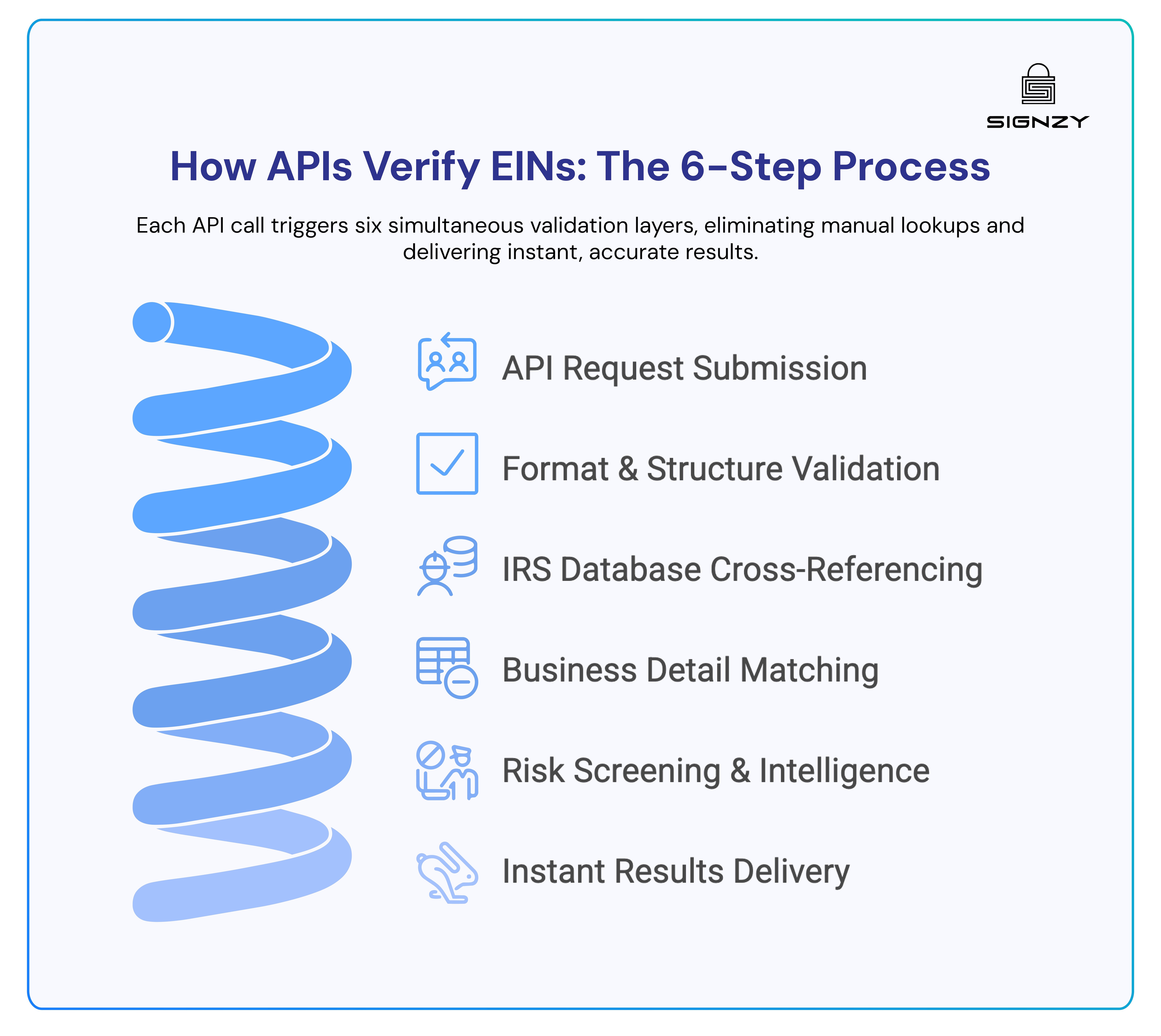
EIN verification APIs operate through direct connections to authoritative business databases and IRS records. Here's how the process works:
- API request submission: You send a verification request containing the EIN and supporting business details (legal name, address, entity type) to the API endpoint. This happens instantly through your application or system integration.
- Format and structure validation: The API first confirms the EIN follows the correct nine-digit format (XX-XXXXXXX) and passes basic checksum validation to catch obvious data entry errors before querying official databases.
- Database cross-referencing: The system queries IRS records to verify the number exists, is currently active, and hasn't been revoked or cancelled. It also checks state-level business registration databases for additional validation.
- Business detail matching: The API compares the EIN against the business's legal name, registered address, and entity type you provided, flagging any mismatches that could indicate fraud or data errors.
- Risk screening and intelligence: Advanced verification systems check the EIN against sanctions lists, watchlists, and adverse media databases while retrieving additional business intelligence like ownership details, registration dates, and industry classifications.
- Response delivery: The API returns a comprehensive response within seconds, including validity status, confidence scores, business details, and any risk indicators detected during verification.
Signzy's EIN verification API delivers all these validation layers through a single integration, returning detailed business intelligence that helps you make informed decisions about vendor relationships or customer onboarding.
How can Signzy simplify EIN verification for your business?
Signzy's EIN verification API eliminates manual lookups and delivers instant validation results by connecting directly to official IRS databases. Whether you're onboarding a single vendor or processing thousands of business applications, the platform handles EIN verification with 100% data accuracy across all 50 states.
We onboard investment firms and broker-dealers, and SEC compliance requires verified EINs before granting trading access. Manual verification meant new clients waited 5-7 business days to start trading, which was unacceptable in a competitive market. We built Signzy's API into our onboarding flow and now activate accounts same-day. Apart from speed, our client satisfaction scores have also jumped from 6.8 to 9.1 out of 10.
— Chief Compliance Officer, Securities Trading Platform
⚡ Instant verification in seconds: Upload EIN entries and validate them immediately instead of waiting days for manual IRS confirmation. The API processes requests in real-time and returns comprehensive business details, including legal name, address, tax status, and registration validity.
📊 Access 30+ business data points: Get complete business intelligence beyond basic EIN validation, including ownership structure, UBO details, bankruptcy filings, liens and litigation records, industry classification, and watchlist screening results, all from a single API call.
🔄 Automated bulk processing: Handle hundreds or thousands of EIN verifications simultaneously through batch uploads. Perfect for procurement teams vetting suppliers, lenders processing loan applications, or payment processors onboarding merchants at scale.
🛡️ Real-time risk alerts: Stay protected with automatic notifications about businesses flagged on government watchlists, those with active bankruptcy proceedings, or entities showing elevated fraud indicators based on pattern analysis.
🔄 Always-updated data: Access business information that refreshes every 2 hours from trusted state sources, ensuring your verification decisions are based on current, accurate data rather than outdated records.
Get in touch to see if Signzy fits your verification volume and compliance needs.
About Signzy: Signzy serves 1000+ global customers, including HSBC, Meta, Stripe, and Citi. The company has been featured in the Gartner Market Guide for KYC Platforms and recognized among the Top 50 Global Financial Crime and Compliance Technology Providers by Everest Group. It holds US patents in Digital Onboarding in the Metaverse and Video-Based Fraud Detection.
From a security and compliance perspective, Signzy adheres to ISO 27001, SOC 2 Type II, PCI DSS, and GDPR standards, with infrastructure designed to support data security, privacy protection, and regulator-aligned auditability across multiple jurisdictions.


FAQ
What should I do if I forget or lose my EIN?

How can I verify a company’s EIN number in the U.S.?
Who needs to apply for an EIN number?
When is a new EIN number required for a business?
What are the current IRS processing times and known issues for EIN applications in 2026?
Can a foreign company get an EIN without a U.S. address or SSN?
Do I need an EIN if I'm a sole proprietor or freelancer with no employees?
Saurin Parikh
Saurin is a Sales & Growth Leader at Signzy with deep expertise in digital onboarding, KYC/KYB, crypto compliance, and RegTech. With over a decade of professional experience across sales, strategy, and operations, he’s known for driving global expansions, building strategic partnerships, and leading cross-functional teams to scale secure, AI-powered fintech infrastructure.

Related Blogs
View all![5 Best Tools to Verify an EIN Number [Free + Paid] - 2026](https://cdn.sanity.io/images/blrzl70g/production/5acdb26c768fcb06fbd9cfbfb94a408cb3d22bd1-2560x600.webp)

5 Best Tools to Verify an EIN Number [Free + Paid] - 2026

SSN vs. EIN vs. ITIN: Business owner’s guide to Taxpayer Identification Numbers
![How to Lookup a Company's EIN Number? [2026 Guide]](https://cdn.sanity.io/images/blrzl70g/production/3ceee4c0b2fac3923bd2303cd5b313631bea7258-2560x600.webp)
How to Lookup a Company's EIN Number? [2026 Guide]

EIN Search For Business Verification: 6 Methods (Free + Paid)
The best in business


The global API marketplace for KYC, KYB, & AML
Explore the end-to-end verification stack trusted by 1,000 businesses.
Get in touch