





What Is an EIN? Employer Identification Number Explained (2026)

By Tanya Narayan
 Open in ChatGPT
🗒️ Key Highlights
- An Employer Identification Number (EIN) is a nine-digit number, written XX-XXXXXXX, that the IRS assigns to identify a business or other entity for tax purposes.
- You need an EIN if you have employees, operate as a corporation or partnership, file certain excise or employment tax returns, or run entities such as trusts, estates, and nonprofits. A sole proprietor with no employees can often use their SSN instead.
- Applying is free on IRS.gov. The online application needs the responsible party's SSN or ITIN, issues the EIN immediately, and is limited to one EIN per responsible party per day.
- To confirm your own EIN, the IRS can send Letter 147C; to check another business's EIN, payers can use IRS TIN Matching.
Quick answer: An EIN, or Employer Identification Number, is a unique nine-digit number the IRS assigns to businesses and other entities to identify them for federal tax purposes. It works like a Social Security number for a business. You use it to file business tax returns, pay employees, open a business bank account, and apply for licenses and credit.
This guide covers what an EIN is, who needs one, how to apply, and how to look up or verify an EIN.
What is EIN?
An EIN is a nine-digit number issued by the IRS in the format XX-XXXXXXX, for example 12-3456789. Corporations, partnerships, LLCs with employees or more than one member, nonprofits, trusts, estates, and employers all use EINs.
An EIN is one type of Taxpayer Identification Number (TIN). TIN is the umbrella term for any number the IRS uses to identify a taxpayer, including Social Security numbers (SSNs) and Individual Taxpayer Identification Numbers (ITINs). Our guide to SSN vs. EIN vs. ITIN explains the differences. An entity generally needs only one EIN, and you should include it on every return and document you send to the IRS or the Social Security Administration.
Importance of EIN
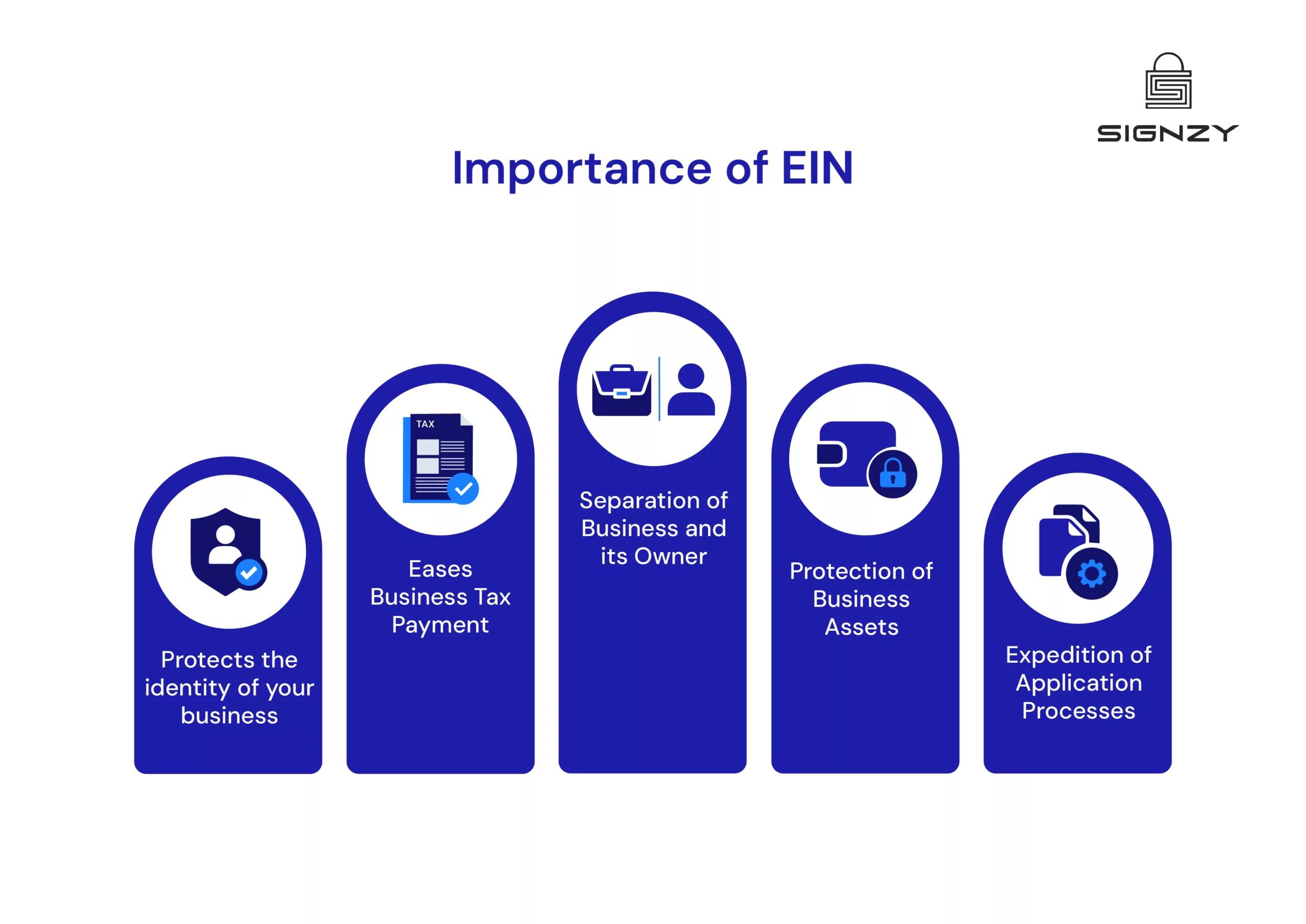
Obtaining an EIN for your business has the following advantages:
- Keeps your SSN private: You can give your EIN to clients, vendors, and banks instead of your Social Security number, which lowers the risk of identity theft.
- Simplifies business taxes: Employment, excise, and business income tax filings are tied to the EIN, so your business tax records stay separate from your personal ones.
- Separates business and personal finances: Most banks ask for an EIN to open a business bank account, which makes it easier to keep business money apart from personal money.
- Helps with loans, licenses, and credit: Lenders, licensing agencies, and suppliers use the EIN to identify your business and check its credit and registration.
An EIN doesn't create liability protection on its own. That comes from your business structure, such as forming an LLC or corporation.
Who needs EIN?
According to the IRS, you need an EIN if any of the following apply:
- You have hired any employees.
- You operate a business as a corporation or a partnership.
- You have a business that files Employment, Excise, or Alcohol, Tobacco and Firearms Tax Return.
- Your business withholds taxes on income paid to a non-resident alien, other than wages.
- Your business has a Keogh plan.
- You are involved with organizations like Trusts (except certain grantor-owned revocable trusts), IRAs, Exempt Organization Business Income Tax Returns, Estates, Real estate mortgage investment conduits, Non-profit organizations, Farmers’ cooperatives, or Plan administrators.
If none of these apply, for example you are a sole proprietor with no employees and no excise or pension plan filings, you can usually use your SSN instead. Many banks and payment providers still ask for an EIN, so getting one can be worthwhile anyway.
How to apply for EIN online?
Applying for an EIN is free, so avoid websites that charge a fee to file for you. You can apply online, by fax, or by mail, and online is the fastest.
Apply for EIN Online
- Go to the IRS page Get an employer identification number and start the online application.
- Apply during the service hours (Eastern Time): Monday to Friday, 6 a.m. to 1 a.m. the next day; Saturday, 6 a.m. to 9 p.m.; Sunday, 6 p.m. to midnight.
- Answer the interview-style questions about your entity and its responsible party.
- Receive your EIN immediately, then download and save the confirmation notice.
Things to know before you start:
- Finish the application in one session. It can't be saved, and it expires after 15 minutes of inactivity.
- The responsible party, the person who ultimately owns or controls the entity, must be an individual and must have a valid SSN or ITIN to apply online.
- The IRS issues only one EIN per responsible party per day, whichever method you use.
- Since August 2025, the online application has a new design and also accepts federal, state, and local government entities.
Apply for EIN by Fax or Mail
If you can't apply online, for example because the responsible party has no SSN or ITIN or the business is based outside the US, complete Form SS-4 and send it by fax or mail. Fax applications usually get a reply in about four business days, and mail applications take about four weeks. The IRS lists the current fax numbers and mailing addresses in the Form SS-4 instructions. International applicants can also apply by phone.
How to Look Up or Verify an EIN
To find or confirm your own EIN, check your IRS confirmation notice (CP 575), an earlier tax return, or your bank or license records. If you still can't find it, call the IRS Business and Specialty Tax Line at 800-829-4933 and ask for Letter 147C, which confirms the EIN previously assigned.
To check another business's EIN, there is no free public IRS lookup. Businesses that file information returns, such as Forms 1099, can use IRS TIN Matching to confirm that a name and EIN combination matches IRS records. Our guide on how to look up a company's EIN covers other free and paid methods, and we compare tools to verify an EIN separately.
For onboarding at scale, Signzy's EIN Verification API checks EINs automatically and returns results in about 0.9 seconds, so you can verify business customers and vendors without manual lookups. Book a call to see it in action.
Conclusion
An EIN identifies your business to the IRS, keeps your SSN out of business paperwork, and is needed for hiring, business banking, and most business tax filings. Apply for free on IRS.gov, and verify the EINs of the businesses you work with before you pay or onboard them.


FAQ
What is an EIN number?

What is an example of an employer identification number?
How do I find my EIN?
Is an EIN the same as a TIN?
Can a foreign company get an EIN?
Does it cost anything to get an EIN?
Tanya Narayan
Tanya is a Product Marketing Manager at Signzy and a GrowthX Fellow, with a strong focus on SaaS and fintech. She specializes in go-to-market strategy, customer research, and positioning to help teams bring products to market effectively. She has also cleared the Company Secretary foundation level, reflecting her grounding in corporate and compliance fundamentals.

Related Blogs
View all



The best in business


The global API marketplace for KYC, KYB, & AML
Explore the end-to-end verification stack trusted by 1,000 businesses.
Get in touch