





What are Articles of Incorporation? + How to find them

 Open in ChatGPT
🗒️ Key Highlights
- Articles of incorporation are legal documents filed with state governments that officially establish a corporation's existence, containing essential information like business name, registered agent, purpose, and stock structure.
- Verifying articles of incorporation helps businesses confirm legal status, manage partnership risks, and meet KYB compliance requirements by ensuring potential partners are legitimate entities authorized to conduct business.
- Signzy streamlines verification by providing centralized access to Secretary of State databases across all 50 states, plus comprehensive tools for UBO identification, sanctions screening, and complete business verification.
- What are articles of incorporation?
- What information can (and can't) you get from articles of incorporation?
- Why do businesses need to verify articles of incorporation?
- Articles of incorporation, certificate of incorporation, and corporate charter: what's the difference?
- Articles of incorporation vs. bylaws: what's the difference?
- Articles of incorporation for different business types
- Red flags to look for when reviewing articles of incorporation
- Certified and uncertified incorporation documents
- How to find articles of incorporation for verification?
- How can Signzy help you find articles of incorporation?
- FAQ
Would you buy a house without checking the deed? Of course not. The same principle applies to business relationships. Good intentions matter, but documentation proves legitimacy.
For businesses, that documentation starts with Articles of Incorporation. These records tell you everything you need to know about a potential business partner.
Let’s walk through what these essential documents tell you, why they matter for your business decisions, and most importantly, how to verify them effectively.

What are articles of incorporation?
Articles of incorporation are the official legal documents that businesses file with their state government to formally establish a corporation as a separate legal entity. These documents contain essential information about the corporation's structure, including its name, purpose, registered agent, and stock authorization.
When filed with the Secretary of State or equivalent state agency, articles of incorporation officially create the corporation and establish it as an entity distinct from its owners.
In the United States, articles of incorporation are the formal legal documents filed with a state government agency, typically the Secretary of State, to officially create a corporation and establish it as a separate legal entity.
What information can (and can't) you get from articles of incorporation?
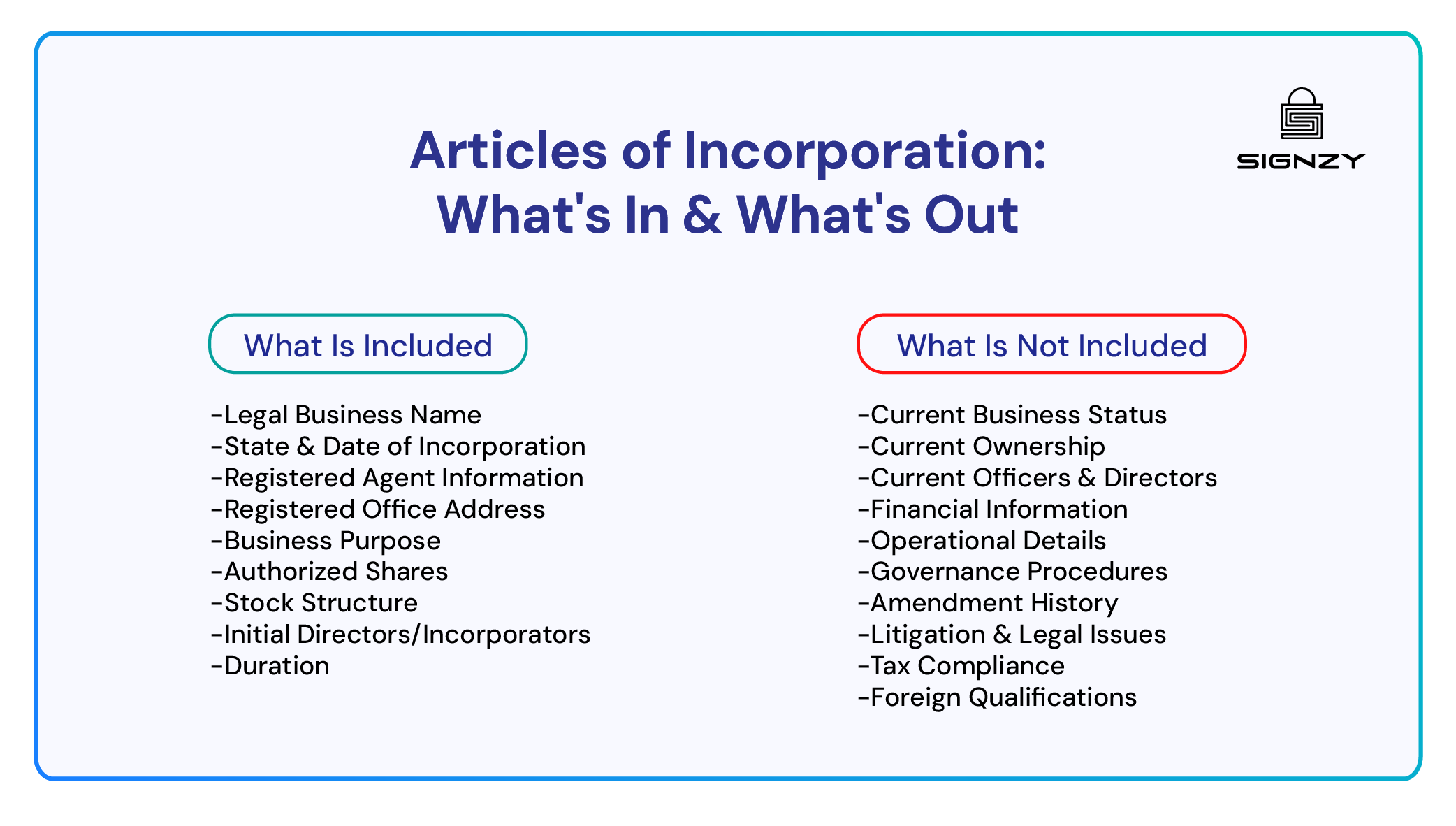
Articles of incorporation provide certain foundational details about a corporation, but not everything needed for thorough verification.
Let’s look at this aspect from both sides.
Which information is included in articles of incorporation?
Articles of incorporation typically contain the following information:
- Legal business name: The corporation's official registered name, including required designators (Inc., Corp., Ltd.)
- State and date of incorporation: Where and when the corporation was legally formed
- Registered agent information: The designated person or entity authorized to receive legal documents on behalf of the corporation
- Registered office address: The official address where legal correspondence can be sent
- Business purpose: A statement describing the corporation's intended activities (may be broad or specific depending on state requirements)
- Authorized shares: The number and type of shares the corporation is permitted to issue
- Stock structure: Details about share classes, par value, and voting rights (if applicable)
- Initial directors or incorporators: Names of individuals who established the corporation (requirements vary by state)
- Duration: Whether the corporation is perpetual or has a specific end date
Which information is not included in articles of incorporation?
Articles of incorporation do not contain the following information:
- Current business status: Whether the corporation is currently active, in good standing, or compliant with state requirements
- Current ownership: Who actually owns shares today (if ownership has changed since incorporation)
- Current officers and directors: The present management team (if different from initial filing)
- Financial information: Revenue, assets, liabilities, or creditworthiness
- Governance procedures: Internal rules about meetings, voting, or decision-making processes
- Amendment history: Changes made after initial filing (unless you review all filed amendments separately)
- Litigation or legal issues: Lawsuits, judgments, or regulatory actions
- Tax compliance - Whether the corporation has paid required taxes or filed necessary reports
- Foreign qualifications: Authorization to operate in states other than the incorporation state
For complete business verification, articles of incorporation should be supplemented with other documents such as certificates of good standing, bylaws, and beneficial ownership records.
Why do businesses need to verify articles of incorporation?
Businesses need to verify articles of incorporation because when you’re considering a partnership or significant business deal, these are the documents that confirm that a company actually exists as a legal entity and has the authority to enter into contracts.
While hopefully you’ve now understood why you need to verify these articles, let’s see some specific angles that press their importance:
To verify other businesses
Companies frequently operate in states different from where they're incorporated. Amazon, for example, operates extensively in California but is incorporated in Delaware. This common practice creates verification complexity; you need to confirm both the incorporation state and where the company is authorized to do business.
Articles of incorporation provide the foundation for this verification by establishing the company's legal home state and registered status.
We needed to verify 200+ existing vendor incorporations after a failed audit. Manual lookups would have taken our team 6 weeks. Signzy's batch processing delivered complete verification results in 2 days. Found 27 compliance issues we fixed immediately before the follow-up audit.
— Corporate Compliance Manager, Investment Fund.

To manage risk
Verifying articles of incorporation is also an investment in risk management. By examining these documents, you can confirm:
- Legal status and authority - Whether the company is actively registered and in good standing with state authorities, confirming their ability to legally conduct business and enter into contracts.
- Corporate structure - Details about stock authorization and ownership structure that affect business relationships, helping you assess financial stability and understand decision-making processes.
- Official representatives - The legal authorities authorized to make commitments on behalf of the company, preventing dealings with unauthorized individuals who might put agreements at risk.
A small upfront effort to confirm these details can prevent major complications down the road. This isn't just paperwork - it's protection against entering agreements with entities that can't fulfill their obligations.
To stay compliant
Many industries now require thorough Know Your Business (KYB) processes, which will require you to verify various business details before you start working with them.
Financial institutions, for instance, must verify business documentation as part of their due diligence requirements. Getting this wrong can lead to significant regulatory issues and financial risks.
We understood ‘what’ and ‘why’ till now. Now comes the main part: let’s see how to find articles of incorporation for verification.
Articles of incorporation, certificate of incorporation, and corporate charter: what's the difference?
These three terms refer to the same document. Articles of Incorporation, Certificate of Incorporation, and Corporate Charter are simply different names that states use for the legal filing that creates a corporation. The terminology varies by state, but the document's purpose and contents remain consistent across all jurisdictions.
For example, California uses "Articles of Incorporation," Delaware uses "Certificate of Incorporation," and some states refer to the document as a "Corporate Charter."
Articles of incorporation vs. bylaws: what's the difference?
Articles of incorporation create the corporation and are filed with the state, while bylaws govern how the corporation operates internally and are not filed publicly. Both documents are essential for complete business verification.
| Aspect | Articles of Incorporation | Bylaws |
|---|---|---|
| Purpose | Legally creates the corporation | Governs internal operations and procedures |
| Filing Requirement | Must be filed with the state | Not filed with the state (private document) |
| Public Access | Public record, accessible to anyone | Private, not publicly available |
| Content | Basic corporate structure (name, purpose, shares, registered agent) | Operating rules (meetings, voting, officer duties, procedures) |
| Amendment Process | Requires filing with the state and often shareholder approval | Can typically be amended by the board of directors without state filing |
| Legal Status | Required to form a corporation | Not legally required, but highly recommended |
| Verification Use | Confirms legal existence and basic structure | Reveals governance procedures and decision-making authority |
When conducting business verification, articles of incorporation confirm that a company legally exists, while bylaws help you understand who has the authority to make decisions and sign contracts on behalf of the corporation.
Articles of incorporation for different business types
While the basic structure of articles of incorporation remains similar across all corporations, certain business types have specific requirements or variations in their filing documents.
- C Corporation Articles of Incorporation: C corporations file standard articles of incorporation with no special tax-related language. These are the default corporate structures subject to double taxation, where the corporation pays taxes on profits and shareholders pay taxes on dividends.
- S Corporation Articles of Incorporation: S corporations file the same articles of incorporation as C corporations. The S corporation designation is a tax election made separately with the IRS after incorporation, not a different entity type.
- Nonprofit Corporation Articles of Incorporation: Nonprofit articles must include specific language stating the organization's charitable, educational, religious, or other tax-exempt purpose. They must also contain dissolution clauses specifying that assets will be distributed to another nonprofit if the organization dissolves, as required for IRS 501(c)(3) tax-exempt status.
- Professional Corporation Articles of Incorporation: Professional corporations (for licensed professionals like doctors, lawyers, or accountants) require articles stating the specific professional service to be provided. Many states mandate that all shareholders hold the required professional license and include additional provisions restricting ownership to licensed individuals.
- Benefit Corporation Articles of Incorporation: Benefit corporations must explicitly state in their articles that they are organized as a benefit corporation and identify the public benefit purpose they intend to pursue.
Here's a quick comparison table summarizing differences:
| Feature | C Corp | S Corp | Nonprofit | Professional | Benefit Corp |
|---|---|---|---|---|---|
| Filed with the state | ✔️ | ✔️ | ✔️ | ✔️ | ✔️ |
| Includes business name | ✔️ | ✔️ | ✔️ | ✔️ | ✔️ |
| Requires a registered agent | ✔️ | ✔️ | ✔️ | ✔️ | ✔️ |
| Special-purpose language | ❌ | ❌ | ✔️ | ✔️ | ✔️ |
| Tax-exempt provisions | ❌ | ❌ | ✔️ | ❌ | ❌ |
| License requirements stated | ❌ | ❌ | ❌ | ✔️ | ❌ |
| Public benefit statement | ❌ | ❌ | ❌ | ❌ | ✔️ |
Red flags to look for when reviewing articles of incorporation
🚩 Recently incorporated with extensive claims - A company formed within the last few months claiming decades of experience or major industry presence may be misrepresenting its history.
🚩 Dissolved or inactive status - The corporation's status shows as dissolved, suspended, revoked, or not in good standing, indicating serious compliance failures or that the entity no longer legally exists.
🚩 Multiple name changes - Frequent amendments changing the corporate name could signal rebranding to escape negative reputation, legal issues, or creditor problems.
🚩 Registered agent using residential address - Professional corporations typically use commercial registered agents; residential addresses may indicate less established or less professional operations.
🚩 Vague or overly broad purpose statement - Generic purpose clauses like "any lawful activity" with no specific business description could indicate a shell company or entity used for unclear purposes.
🚩 Mismatched business addresses - The registered office address conflicts with the claimed operational headquarters or doesn't align with where the company says it conducts business.
🚩 Incorporation in high-privacy states without business reason - Companies incorporated in states known for secrecy (like Wyoming or Nevada) but operating entirely elsewhere, particularly when there's no tax or operational justification.
🚩 Unusually complex stock structure - Multiple classes of shares, preferred stock arrangements, or convoluted ownership structures that obscure who actually controls the company.
🚩 Missing or incomplete information - Required fields left blank, minimal details provided, or information that doesn't meet standard filing requirements for the state.
🚩 Frequent structural amendments - Multiple amendments changing shares, directors, or fundamental corporate structure within short timeframes may indicate instability or internal disputes.
🚩 Registered agent frequently changed - Multiple registered agent changes could signal the company is difficult to work with or is trying to avoid legal service.
🚩 Foreign qualification gaps - Company claims to operate in multiple states but lacks required foreign qualification filings in those jurisdictions, suggesting non-compliance with multi-state business laws.
Certified and uncertified incorporation documents
There are actually two versions available: certified and uncertified copies. Certified copies come directly from the Secretary of State’s office, complete with official seals and security features. But you don’t always need a certified copy. For most business verification purposes, uncertified copies work just fine. These are physical or digital replicas of the original documents that still come from official sources.
While uncertified copies lack the formal state seal, they contain the same information and are perfectly acceptable for typical Know Your Business (KYB) procedures.
How to find articles of incorporation for verification?
There are three ways to find articles of incorporation: you can either find them from the Secretary of State's official website, visit the Secretary's office in person, or through third-party verification providers.
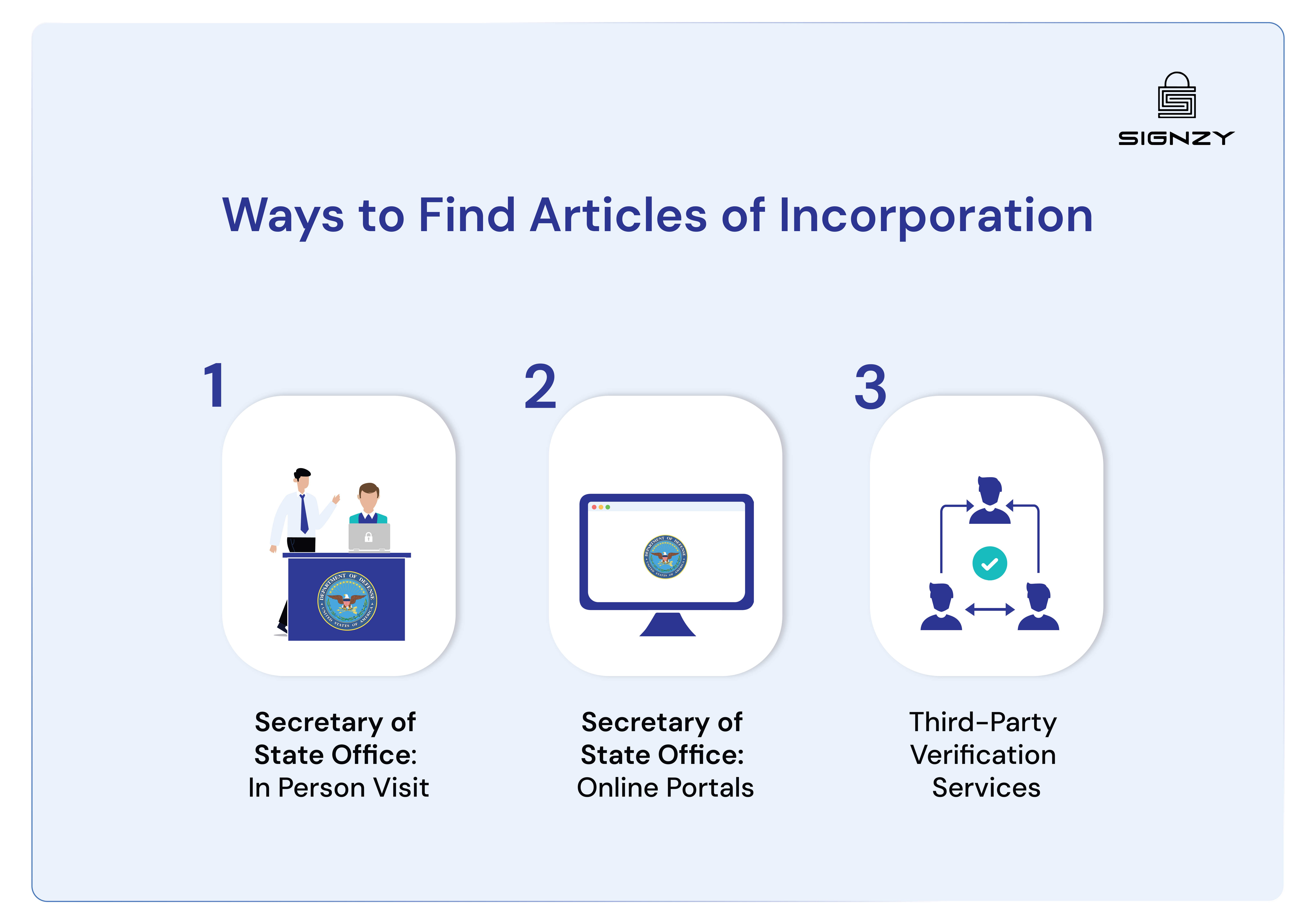
Way #1: Secretary of State office: In-person visit
The traditional approach involves working directly with state offices, and you have two options here: in-person visits or official state portals.
For in-person verification, you’ll need to visit the Secretary of State’s office in the state where the business is incorporated. The process is no different.
- Arrive at the state office.
- Present identification
- Submit a formal records request
- Pay the applicable fees, if any
While they provide immediate access to state records, they’re not always the most efficient option. Plus, if you’re verifying a business incorporated in another state, travel becomes impractical.
Way #2: Secretary of State office: Online portals
All Secretary of State offices in the US operate their own unique digital system, much like different banks having their own online platforms, creating varying experiences in navigation and access methods.
Here, accuracy often becomes the first major hurdle, as corporate names must match state records exactly. Even minor discrepancies like missing commas, extra spaces, or using “Corp.” instead of “Corporation” can derail the verification process.
Some states provide comprehensive access to historical filings and amendments, giving you a complete picture of a corporation’s history. Others might limit online access to basic information, requiring additional steps for detailed documentation.
Way #3: Third-party verification platforms
Third-party verification platforms provide centralized access to business records across all states, eliminating the need to navigate multiple individual portals.
These services connect directly to Secretary of State databases and streamline the verification process for businesses conducting regular due diligence. Key advantages of third-party verification services:
For businesses conducting regular verifications, operating across multiple states, or requiring comprehensive KYB compliance, third-party platforms like Signzy offer the most efficient solution by consolidating all verification needs into a single streamlined process.
Below’s a deeper look at how exactly Signzy can help.
How can Signzy help you find articles of incorporation?
When businesses need to verify articles of incorporation, Signzy provides the tools and access to make the process faster and more reliable. Here's what sets Signzy apart:
Because incorporation documents are filed at the state level in the US, verifying a company often requires searching multiple Secretary of State registries depending on where the entity is registered. This fragmented system makes manual verification slow and difficult for teams handling large volumes of vendor or partner checks.
Signzy powers business verification for 1,000+ global companies, including Fortune 500 organizations across banking, fintech, and payments. Our infrastructure runs real-time identity and compliance checks across 240+ countries, helping teams move from manual verification to automated due diligence at scale.
↪ Centralized Secretary of State search
Search for articles of incorporation across all states from one platform. Enter a business name, filing number, or registered agent to access incorporation documents, registration details, and filing status. Signzy gives real-time access to 50+ Secretary of State systems under a single platform.
We onboard 50+ vendors monthly across different states, and manually checking each Secretary of State website was taking our procurement team 3-4 hours per vendor. Signzy cut that to under 5 minutes with centralized access to all 50 states. Our vendor approval time dropped from 2 weeks to 3 days.
— Director of Vendor Management, Payment Processing Company
↪ Complete business verification tools
Articles of incorporation confirm a company's legal formation, but they don't provide the full picture needed for thorough due diligence.
Signzy offers additional verification tools that work alongside incorporation document checks to give businesses a complete view of their potential partners.
✔️ Ultimate Beneficial Owner (UBO) identification - Uncovers the actual individuals who own or control a business entity. This goes beyond the corporate structure listed in articles of incorporation to reveal beneficial ownership chains and identify who ultimately controls the company.
✔️ Sanctions and watchlist screening - Checks businesses and their officers against OFAC lists, PEP databases, and global sanctions registers. This ensures you're not entering relationships with entities or individuals flagged for regulatory violations or criminal activity.
✔️ Business document verification - Validates supporting documentation like bank statements, tax filings, and corporate resolutions to build a comprehensive company profile beyond basic registration information.
These tools work together to provide complete business verification, ensuring you understand not just whether a business was legally formed, but whether it remains legitimate, compliant, and safe to work with today.
↪ Scalable verification on your terms
Signzy operates on pay-as-you-go pricing, allowing businesses to verify one company or hundreds without fixed subscription costs.
The platform integrates with existing systems through APIs, fitting into your current workflows rather than requiring process overhauls. Scale verification volume up or down based on actual business needs.
If you're ready to move past manual state searches and fragmented verification processes, let's talk. Schedule a demo here.
About Signzy: Signzy supports compliance and verification workflows for 1,000+ global companies, including banks, fintech platforms, and Fortune 500 enterprises. The platform processes large-scale identity and business verification across 150+ countries, enabling compliance teams to automate due diligence and vendor onboarding workflows.


FAQ
What information can I find in a company's articles of incorporation?

How can I obtain copies of another corporation's articles?
Are articles of incorporation available to the public?
What if I can't find a company's articles in state records?
Saurin Parikh
Saurin is a Sales & Growth Leader at Signzy with deep expertise in digital onboarding, KYC/KYB, crypto compliance, and RegTech. With over a decade of professional experience across sales, strategy, and operations, he’s known for driving global expansions, building strategic partnerships, and leading cross-functional teams to scale secure, AI-powered fintech infrastructure.

Related Blogs
View all

Business Registration Lookup: How to Check if a Company Is Registered (2026)

EIN Search For Business Verification: 6 Methods (Free + Paid)
![US Business Formation Documents: Requirements, Process, and More [2026]](https://cdn.sanity.io/images/blrzl70g/production/a544730083916aa0a50dff554d16418c000306d4-2560x600.webp)
US Business Formation Documents: Requirements, Process, and More [2026]

KYB vs KYC: What Are the Key Differences? Complete 2026 Guide
The best in business


The global API marketplace for KYC, KYB, & AML
Explore the end-to-end verification stack trusted by 1,000 businesses.
Get in touch