





What documents confirm SSN? Acceptable proof for verification

 Open in ChatGPT
Key Highlights
- SSN verification requires a specific documentation hierarchy, with the Social Security card as primary proof, followed by tax documents (W-2, 1099 forms), pay stubs, and secondary sources like benefit statements or bank records that link to official government records.
- Different groups require different documentation sets: US citizens need birth certificates or passports, non-citizens must provide immigration documents (I-551, I-94, I-766), and children require birth certificates or adoption decrees alongside parental identification.
- Since June 2025, a FinCEN CIP exemption allows banks to collect SSNs from third-party verification providers instead of directly from customers — the biggest shift in SSN collection rules since the CIP Rule was adopted in 2003.
- Signzy's SSN verification API cross-references official government databases to instantly validate Social Security Numbers, detect deceased individuals, and flag name-to-SSN mismatches without manual document collection.
- What is a Social Security Number (SSN)?
- Which documents can confirm an SSN?
- Which secondary documents can verify an SSN?
- Which documents can't confirm an SSN?
- How to automate SSN verification?
- 🔔 2025 Regulatory Update: Banks Can Now Collect SSNs from Third Parties
- Special considerations for SSN verification
- How can Signzy speed up your SSN verification?For organizations that need SSN verification integrated into automated workflows, Signzy's SSN Verification API provides real-time validation against government databases with implementation in 2–4 business days.
- FAQ
SSN verification doesn't have to be complicated.
You need to confirm someone is who they say they are, match their number to their identity, and move on with your process, whether that's onboarding an employee, opening an account, or processing a transaction.
This guide packs answers to all the questions you have. By the last paragraph, you would be aware of which documents confirm SSN, which don't, special considerations, and a lot more. And, in case you are running short on time, here's a gist of the documents you need to confirm SSN:
| Category | Documents |
|---|---|
| Primary Documents | Social Security Card, SSA-1099 Form, W-2 Form, 1099 Forms (Non-SSA), Pay Stubs |
| Secondary Documents | DD214 (Military Discharge), NGB 22 (National Guard Record), 1098 Forms (Mortgage/Education), Bank Statements, Loan Documents, Financial Account Documents |
| Edge Case Documents | Marriage Certificate, Divorce Decree, Court Order (for name changes), ITIN Documentation (for non-SSN holders), Birth Certificate (for newborns), Work Authorization Documents (for visa holders) |
Below’s a detailed version. And before we start, let’s define SSN quickly first.
What is a Social Security Number (SSN)?
A Social Security Number (SSN) is a nine-digit identifier that the US government assigns to each citizen, permanent resident, and some temporary residents. Issued by the Social Security Administration (SSA), this unique identifier is used to track earnings, benefits, and identity for employment, banking, government services, and tax reporting.
SSNs follow the format XXX-XX-XXXX. Since June 2011, the SSA uses random assignment rather than the previous geographic-based system — meaning the first three digits no longer indicate the state of issuance.
Which documents can confirm an SSN?
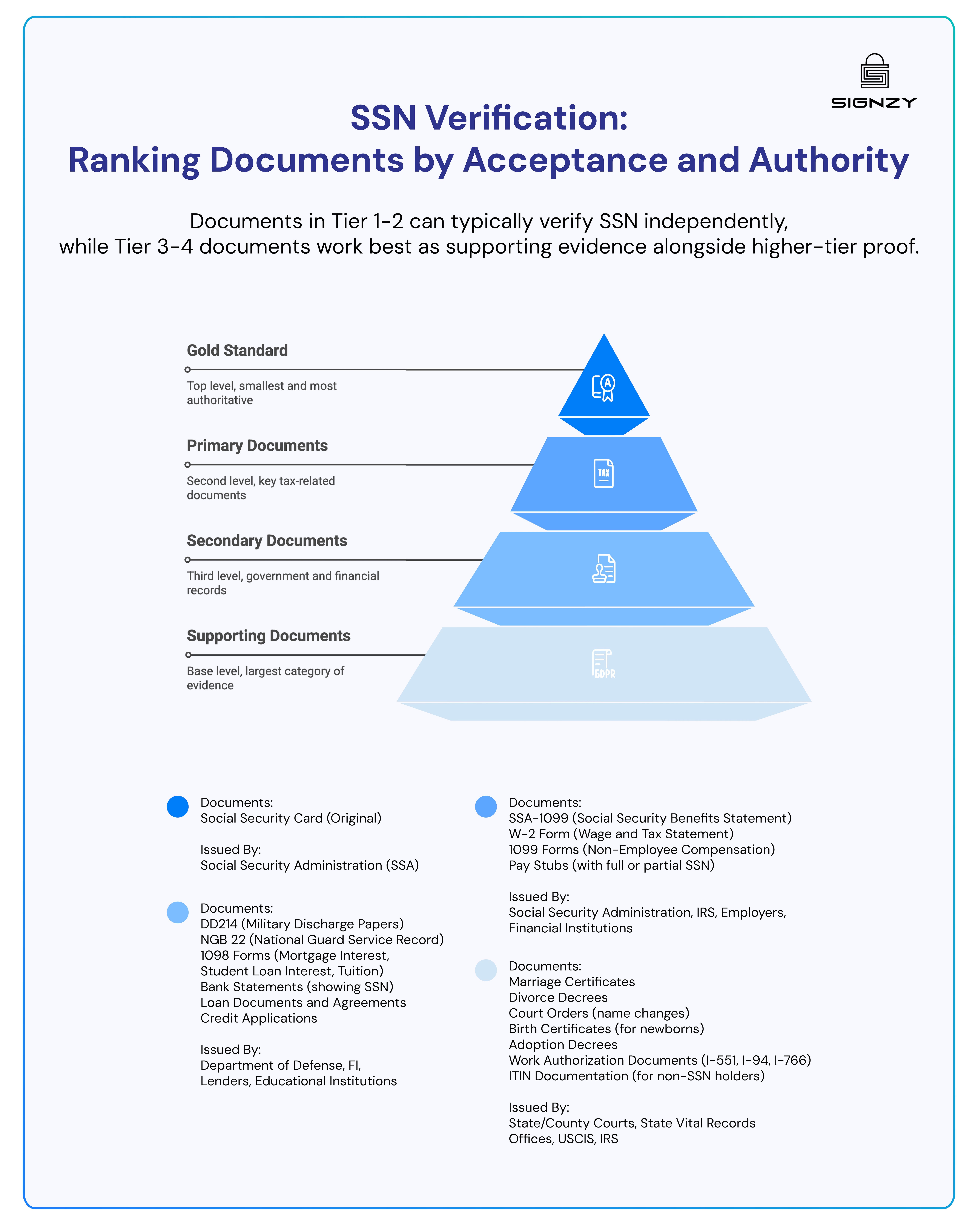
A Social Security Number can be verified through several official documents issued by government agencies or authorized entities. These documents provide reliable proof of an individual's SSN and are commonly accepted across employment, financial, and government processes.
1. Social Security Card
The Social Security card is the primary document for confirming an SSN. Issued directly by the Social Security Administration (SSA), it displays the individual's full name and nine-digit SSN. This card serves as the most direct form of verification and is widely accepted by employers, banks, and government agencies.
Because it comes straight from the SSA, it's considered the gold standard for SSN confirmation. The card itself is a small, paper-based document that has evolved over the years with various security features to prevent fraud.
Original cards are typically issued shortly after birth for US citizens, or upon approval for permanent residents and eligible temporary workers.
2. SSA-1099 Form
The SSA-1099 form is issued directly by the Social Security Administration to individuals who receive Social Security benefits. This form reports the total benefits paid during the tax year and includes the recipient's SSN.
This form also originates from the SSA itself, the same agency that issues Social Security cards. The SSA-1099 is particularly valuable for retirees, disabled individuals, or survivors receiving benefits, as it serves both as tax documentation and SSN verification.
3. Tax Documents
Tax-related documents issued by the Internal Revenue Service (IRS) or other tax authorities also serve as reliable proof of an SSN. These documents are tied to official financial records and include:
- W-2 Form: This form is issued annually by employers to report an employee's wages and the SSN associated with those earnings. Because it's used for tax filing purposes, it's considered highly reliable for SSN verification.
- 1099 Form: Used to report various types of non-salary income, such as freelance earnings, contract payments, or investment interest, the 1099 form also displays the recipient's SSN. Like the W-2, it's connected to official tax records, making it a trustworthy verification source.
The credibility of tax documents stems from their direct link to federal reporting systems and their issuance by authorized tax authorities.
4. Pay Stubs
Pay stubs from an employer can confirm an SSN when they display either the full number or at least the last four digits. These documents are generated regularly, typically with each paycheck, and reflect current employment status.
Pay stubs are particularly useful for ongoing verification needs because they provide up-to-date information about an individual's employment and earnings. Many organizations accept pay stubs as supplementary proof, especially when combined with other documentation.
Which secondary documents can verify an SSN?
While primary documents offer the most direct proof of an SSN, secondary documents can also serve as supporting verification.
These documents are issued by various authorized entities and contain SSN information as part of broader records related to military service, education, or financial transactions.
1. DD214 (Certificate of Release or Discharge from Active Duty)
The DD214 is a military document issued by the Department of Defense to service members upon separation from active duty. Since it's an official military record used for accessing veterans' benefits, employment verification, and other purposes, the DD214 is widely recognized as a reliable secondary source for SSN confirmation.
This form contains comprehensive service information, including the individual's Social Security Number. Veterans often use this document when their Social Security card is unavailable.
2. 1098 Forms
The 1098 series of tax forms reports specific types of payments to the IRS and includes the recipient's or payer's SSN. These forms are issued by financial institutions, lenders, or educational institutions and are filed with the IRS. Common variations include:
- 1098: Reports mortgage interest paid to a lender during the tax year
- 1098-E: Documents student loan interest paid, issued by loan servicers
- 1098-T: Shows tuition payments and scholarships, provided by educational institutions
- 1098-C: Records charitable contributions of vehicles
Primarily, they are used for tax deduction purposes, but they can serve as secondary SSN verification because they link the individual to official financial or educational records.
3. NGB 22 (National Guard Report of Separation and Record of Service)
The NGB 22 serves a similar function to the DD214 but is specifically for members of the National Guard. Issued upon separation or retirement from the National Guard, this form documents service history and includes the member's SSN. It's accepted by veterans' affairs offices, employers, and other institutions as proof of both military service and SSN.
Like the DD214, it provides an authoritative secondary verification option for individuals with National Guard service.
4. Bank, loan, or financial documents
Various financial documents from banks, credit unions, or lending institutions can verify an SSN when it appears on official statements or agreements. These include bank statements, loan applications, mortgage documents, and credit card statements.
Financial institutions are required to collect and verify SSNs for tax reporting and regulatory compliance, making these documents reliable for secondary verification. However, their acceptance varies by organization, and they're typically used in conjunction with other forms of proof.
Secondary documents provide valuable alternatives for SSN verification, particularly when primary documents are unavailable or when additional supporting evidence is needed.
While they may not carry the same standalone authority as a Social Security card or SSA-issued forms, they're widely accepted across various verification processes and offer practical solutions for confirming an individual's SSN.
Which documents can't confirm an SSN?
- Photocopies or scanned images without original documents: Copies can be easily altered or fabricated, making them unreliable for verification. Most institutions require original documents or certified copies to ensure authenticity.
- Student ID cards: While some educational institutions may include SSNs on student IDs, these cards are not issued by government agencies and lack the security features necessary for official verification.
- Employee badges or workplace ID cards: Even if an SSN appears on an employee badge, these are internal documents without official standing outside the issuing organization.
- Handwritten documents or informal records: Personal notes, handwritten forms, or informal records containing SSNs lack official authentication and are not acceptable for verification.
- Expired government-issued IDs: While driver's licenses or state IDs may show SSNs in some states, expired versions are generally not accepted for verification purposes.
- Social media profiles or digital screenshots: Any digital image or screenshot claiming to show SSN information is easily manipulated and carries no official weight.
- Utility bills or subscription statements: Even though these may reference an SSN for account purposes, they're commercial documents without government or tax authority backing.
How to automate SSN verification?
As we've discussed, SSN verification can be accomplished through various documents, from Social Security cards and tax forms to military records and financial statements. However, collecting these documents manually and verifying their authenticity presents significant challenges.
Organizations must handle physical paperwork, manage storage, train staff to recognize valid documents, and spend considerable time processing each verification request.
For businesses dealing with high volumes of applicants, employees, or customers, this manual approach quickly becomes inefficient and costly. This is where automation transforms the verification process.
Below are two ways to conduct SSN verification at scale for faster, more accurate, and scalable results.
Option 1: Verification through the Social Security Administration portal
The Social Security Administration offers the Social Security Number Verification Service (SSNVS) for employers and third-party submitters who need to verify that employee names and SSNs match Social Security records.
However, SSNVS is restricted to employers and third-party submitters and can only be used for wage reporting purposes, not for broader identity verification needs.
This free service offers two verification options: an online service for immediate results and a bulk upload feature for larger databases.
- Visit the SSA Business Services Online (BSO) Welcome page to begin registration.
- Social Security will verify your identity against its records during the registration process.
- After registration, sign in using Login.gov or ID.me credentials and request access to the SSNVS service.
- An activation code will be mailed to your employer's address for security purposes.
- Your employer provides you with the received activation code
- Return to the BSO Welcome page, sign in with Login.gov or ID.me, and input your activation code to access SSNVS
- Select either the online option (verify up to 10 names and SSNs per screen for immediate results) or the bulk upload option (upload files of up to 250,000 names and SSNs for next-day results)
- Enter employee information or upload your file, depending on your chosen method
- Receive instant results for online verifications or next-business-day results for bulk uploads
This method ensures correct names and SSNs on W-2 wage reports, reduces processing costs, minimizes W-2c corrections, and helps Social Security provide proper credit to employees' earnings records.
Two verification modes:
| Mode | Capacity | Turnaround |
|---|---|---|
| Online | Up to 10 names/SSNs per screen | Immediate results |
| Bulk upload | Up to 250,000 names/SSNs per file | Next-business-day results |
Critical limitation: SSNVS is restricted to wage reporting purposes only. It cannot be used for customer onboarding, KYC, identity verification, or any purpose other than ensuring correct W-2 filing. Using SSNVS for non-wage-reporting purposes violates the SSA's terms of service.
💡 Related Blog:

Option 2: SSA's eCBSV (Paid, Financial Institutions)
The Electronic Consent Based SSN Verification (eCBSV) service is the SSA's paid, real-time verification tool designed specifically for financial institutions and permitted entities. Authorized under Section 215 of the Economic Growth, Regulatory Relief, and Consumer Protection Act, it provides a more comprehensive verification than SSNVS.
What eCBSV verifies:
- SSN, name, and date of birth match against SSA records
- Returns a match/no-match result per element
- Indicates whether the SSN holder is deceased
- Requires the individual's electronic consent (via SSA-89 form)
2025 Pricing Update: In March 2025, the SSA announced significant fee reductions (~25% across tiers), with the ABA noting additional enhancements planned for summer 2025, including granular per-element Yes/No responses for SSN, name, and DOB separately.
Current eCBSV Pricing Tiers (Post-2025 Reduction):
| Annual Verification Volume | Annual Fee | Effective Cost Per Check |
|---|---|---|
| Up to 10,000 | $6,650 | ~$0.67 |
| Up to 100,000 | ~$33,000 | ~$0.33 |
| Up to 1,000,000 | ~$165,000 | ~$0.17 |
| Up to 200,000,000 | ~$7,840,000 | ~$0.04 |
Eligibility: Available to financial institutions, their affiliates, authorized agents, and other permitted entities. Requires a signed agreement with SSA and tier selection. Access the External Testing Environment for integration testing.
SSN verification through third-party platforms
Third-party verification platforms offer comprehensive SSN verification services for organizations that need commercial-grade solutions, aren't eligible for eCBSV, or need integration with broader identity verification workflows.
These platforms connect to multiple data sources to provide instant verification results with enhanced security checks — including fraud pattern detection, deceased indicator matching, and address correlation that go beyond what SSNVS or eCBSV alone provide.
Below’s how you can get started with such platforms:
- Sign up with a SSN verification service provider (like Signzy) that meets your compliance, volume, and integration requirements
- Receive your API key and access credentials for integration
- Work with your development team to embed the verification API into your application or workflow
- Set up rules for what level of matching is required and what additional checks to perform
- Get immediate verification responses with detailed match information, fraud indicators, and risk flags
- Use the verification results to automatically approve, flag, or reject applications based on your criteria
Third-party solutions handle high volumes efficiently, verify SSNs aren't associated with deceased individuals, confirm address validity, and check for fraud patterns.
SSNVS vs. eCBSV vs. Commercial APIs: Which to Use?
| Criterion | SSNVS | eCBSV | Commercial APIs |
|---|---|---|---|
| Cost | Free | $0.04–$0.67/check (volume-based) | Per-check pricing (varies) |
| Eligibility | Employers/payroll submitters only | Financial institutions/permitted entities | Any business |
| Purpose | W-2 wage reporting only | KYC, account opening, identity verification | Any verification use case |
| What it verifies | Name \+ SSN match | SSN \+ Name \+ DOB match \+ deceased indicator | SSN \+ Name \+ DOB \+ address \+ fraud signals |
| Speed | Immediate (online) / next-day (bulk) | Real-time | Real-time |
| API access | No (web interface only) | Yes | Yes |
| Consent required | No (employment relationship) | Yes (electronic consent, SSA-89) | Varies by provider |
The previous SSN verification service had a 48-hour turnaround. Candidates would accept other offers while waiting. Real-time verification means we can complete onboarding the same day. Huge competitive advantage in tight labor markets.
— Onboarding Specialist, Tech Platforms (400+ employees)

Whether through direct SSA services for basic employment checks or sophisticated third-party platforms for comprehensive identity verification, automation makes SSN verification seamless and scalable.
🔔 2025 Regulatory Update: Banks Can Now Collect SSNs from Third Parties
On June 27, 2025, the FDIC, OCC, and NCUA — with FinCEN concurrence — issued an exemptive order under 31 U.S.C. § 5318(l)(6) allowing banks to collect full TINs (including SSNs) from reliable third-party verification providers instead of requiring customers to provide the number directly. The Federal Reserve extended this to Fed-supervised banks on July 31, 2025\.
Why this matters: Since the CIP Rule was adopted in 2003 (31 CFR § 1020.220, originally published at 68 FR 25090), banks were required to obtain the full SSN directly from the customer before opening an account. In the era of data breaches and digital-first banking, this created significant friction — customers were increasingly reluctant to share full SSNs through remote channels.
What changed:
| Aspect | Before (2003–2025) | After (June 2025\) |
|---|---|---|
| SSN collection | Must be obtained directly from customer | Can be obtained from reliable third-party sources (e.g., SSA eCBSV, credit bureaus) |
| Scope | All accounts at FDIC/OCC/NCUA/Fed-supervised institutions | Same scope — but now with an alternative collection path |
| Verification standard | No change — banks must still have reasonable belief in customer's true identity | No change |
| Customer consent | Required for eCBSV | Still required for eCBSV |
Practical impact: This exemption makes SSN verification via services like SSA's eCBSV or third-party APIs a fully compliant alternative to asking customers to type their full SSN into a form. For fintechs and digital banks, this reduces onboarding friction while maintaining BSA/AML compliance.
Special considerations for SSN verification
Social Security Number verification can present unique challenges for certain populations who may have limited documentation, special circumstances, or non-standard SSN issuance. Below is a discussion on a few of the common special populations:
Non-Citizens with work authorization
Individuals on work visas are eligible for Social Security Numbers while they have employment authorization in the United States. Their SSNs function identically to those of citizens and permanent residents for verification purposes. They may or may not have an SSN depending on their situation:
| Category | Description | SSN Eligibility |
|---|---|---|
| H-1B visa holders | Temporary workers in specialty occupations | Upon employment authorization |
| F-1 OPT participants | International students with Optional Practical Training | During the approved OPT period |
| J-1 visa holders | Exchange visitors in work or training programs | With a work authorization letter |
| Green card applicants | Individuals transitioning to permanent residency | With approved work authorization |
These individuals may have fewer historical documents available, particularly if they recently arrived in the country. Tax documents like W-2 or 1099 forms become especially important for this group, as they may not yet have accumulated other financial records.
Employers and institutions should be aware that valid SSNs exist for temporary residents and that verification requirements remain the same.
Individuals without Social Security Numbers
Certain populations may not have SSNs, including undocumented immigrants, recent immigrants awaiting work authorization, or individuals with religious exemptions (such as some Amish communities who opt out of the Social Security system).
For these individuals, alternative identification methods must be used, such as Individual Taxpayer Identification Numbers (ITINs) issued by the IRS for tax purposes.
Organizations conducting verification should have clear policies for handling cases where no SSN exists, as the absence of an SSN does not necessarily indicate ineligibility for services or employment in all contexts.
Children and newborns
Parents typically apply for a child's SSN shortly after birth, but young children present unique verification challenges due to their limited documentation history:
- At birth, SSN applications are usually processed through the hospital or submitted directly to the SSA within weeks of birth
- Limited documentation: Newborns and young children typically only have the Social Security card itself, lacking tax forms, pay stubs, or financial records
- Dependent verification: For tax purposes, parents use the child's SSN on returns, but the child has no independent financial history
- Educational contexts: Schools and childcare facilities must accept the Social Security card as primary proof since secondary documents don't exist
For minors, the Social Security card itself becomes the primary, and sometimes only, document available for verification. Institutions should be prepared to accept this as sufficient proof without requiring additional documentation that young children cannot reasonably possess.
Name changes
Individuals who have legally changed their names due to marriage, divorce, or court order may have documentation that shows different names. The Social Security card reflects the name on file with the SSA, but other documents, like old tax forms, bank statements, or military records, may display a previous name. This discrepancy can complicate verification processes.
Individuals in this situation should update their information with the SSA to receive a corrected card, but during transitional periods, supporting documentation such as marriage certificates or court orders can help establish the connection between the old and new names.
How can Signzy speed up your SSN verification?For organizations that need SSN verification integrated into automated workflows, Signzy's SSN Verification API provides real-time validation against government databases with implementation in 2–4 business days.
Key capabilities:
- Real-time API verification — accepts SSN and personal information inputs, returns detailed match results within seconds
- Deceased indicator detection — flags SSNs associated with deceased individuals
- Name-to-SSN mismatch detection — identifies discrepancies that may indicate fraud or data entry errors
- USA Patriot Act and KYC/AML compliance — built to meet CIP requirements under 31 CFR § 1020.220, including compatibility with the June 2025 FinCEN third-party collection exemption
Part of a global KYC suite — extend to EIN verification, identity verification, AML screening, and credit risk assessment across 180+ countries
We process retirement account rollovers constantly. SSN verification prevents us from crediting the wrong person's account. One typo could mean someone's life savings go to the wrong SSN. Can't afford those mistakes.
— Director of Compliance, Fintech platform (300+ employees)
⚡ Real-time API integration with fast go-live
Signzy's SSN Verification API integrates directly into existing business systems with implementation taking just 2 to 4 business days. The API accepts SSN and personal information inputs, processes verification requests in real-time, and returns detailed results within seconds.
This seamless integration eliminates manual document collection and data entry, allowing verification to happen instantly during account creation, loan applications, or employee onboarding.
The API handles enterprise-scale volumes without performance issues, making it suitable for businesses of any size, from startups to Fortune 500 companies.
The platform also offers complementary verification tools, including EIN verification for business entity checks, ensuring complete due diligence for both individuals and organizations.
🔒 USA Patriot Act compliance and KYC/AML protection
Signzy's platform is built specifically to meet stringent US regulatory requirements. The service helps financial institutions and businesses comply with the USA Patriot Act, KYC (Know Your Customer), and AML (Anti-Money Laundering) regulations through thorough due diligence checks.
This regulatory-first approach protects both the organization and legitimate customers while reducing financial risk exposure.
🌍 Part of a complete global KYC suite
SSN verification is just one component of Signzy's comprehensive identity verification ecosystem. The platform is available across 180+ countries, offering region-specific verification solutions including identity verification, business verification, background checks, AML screening, and credit risk assessment.
Signzy reduced our invalid SSN submissions by roughly 70%. Before this, almost every morning started with fixing messed-up entries. Now most applications pass through cleanly without the usual detective work.
— Senior Compliance Associate, credit platform (100+ employees)
Whether you need SSN verification in the US, CURP checks in Mexico, CNPJ verification in Brazil, or KYC solutions in the UAE and Canada, Signzy provides a unified platform for global compliance.
This means businesses can onboard users globally while staying compliant locally, all through a single API integration.
If you are ready to strengthen your compliance procedure with reliable SSN verification, book a demo here.
About Signzy: Signzy is an end-to-end compliance and identity verification platform trusted by 1,000+ global companies, including Fortune 500 leaders like Microsoft, Meta, FedEx, Citi, and Mastercard.
Operating across 150+ countries, our Gartner-recognized One Touch KYC verifies users in seconds by running document checks, face matching, liveness detection, and AML screening simultaneously, supported by strong US data coverage including SSN validation.


FAQ
Can I verify an SSN without collecting physical documents?

How long does automated SSN verification take?
Is SSN verification legally required for all businesses?
What happens if an SSN fails verification?
What is the difference between eCBSV and SSNVS for SSN verification?
What are the penalties for incorrect SSN verification in business processes?
What SSN verification method is required for KYC compliance at financial institutions?
Gaurav Gupta
Gaurav Gupta is the Global Product Head at Signzy, leading the strategy and development of the company’s KYC, KYB, AML, and digital onboarding products used by banks, fintechs, and financial institutions across global markets. He specializes in building scalable compliance and verification platforms, transforming complex regulatory and risk workflows into seamless, automated product experiences. Gaurav works at the intersection of product, engineering, and AI.

Related Blogs
View all



![AML Watchlist Screening Guide: Regulations, Tools, and More [2026]](https://cdn.sanity.io/images/blrzl70g/production/d6f119be39abfc6cd718c86eb5a401ddc6d44e66-1920x450.png)
The best in business


The global API marketplace for KYC, KYB, & AML
Explore the end-to-end verification stack trusted by 1,000 businesses.
Get in touch