





What Is a Merchant Category Code (MCC)? How MCCs Work in 2026

By Agrima Dwivedi
 Open in ChatGPT
🗒️ Key Highlights
- A merchant category code (MCC) is a four-digit number that classifies a business by what it mainly sells, such as 5411 for grocery stores or 7995 for betting and gambling.
- The acquiring bank, or its processor, assigns the MCC based on the merchant's primary business. ISO 18245 defines the codes, and Visa and Mastercard publish the lists and rules for using them.
- MCCs affect interchange fees, authorization decisions, card rewards, and risk monitoring. A wrong code can mean declines, extra scrutiny, or network penalties.
- MCCs keep changing: Mastercard added 5262 for marketplaces in April 2025, and the firearms code 5723 is required in some US states and banned in about 20 others.
Quick answer: A merchant category code (MCC) is a four-digit number assigned to a business when it starts accepting card payments. It tells card networks and banks what kind of business it is, which affects the fees it pays, how its transactions are authorized, and how closely it is monitored for risk.
For fintechs, payment companies, and crypto businesses, the MCC matters more than most people expect. Being coded as a gambling merchant or a high-risk money transmitter when you're not can lead to declined transactions and extra compliance scrutiny. This guide explains how MCCs are assigned, which codes financial businesses use, and how to fix a wrong one.
What is a Merchant Category Code?
A merchant category code (MCC) is a four-digit number that classifies a merchant by the type of business, trade, or service it provides. The codes are defined by the international standard ISO 18245, whose current edition was published in 2023, and Visa and Mastercard publish their own lists with rules for when each code applies.
The MCC is assigned by the acquiring bank, or a processor acting for it, when the merchant applies to accept cards. Under Visa's rules, the acquirer must choose the code that best describes the merchant's primary business, generally based on where most of its sales come from. Payment facilitators such as Stripe or Square usually handle this step for the businesses they onboard.
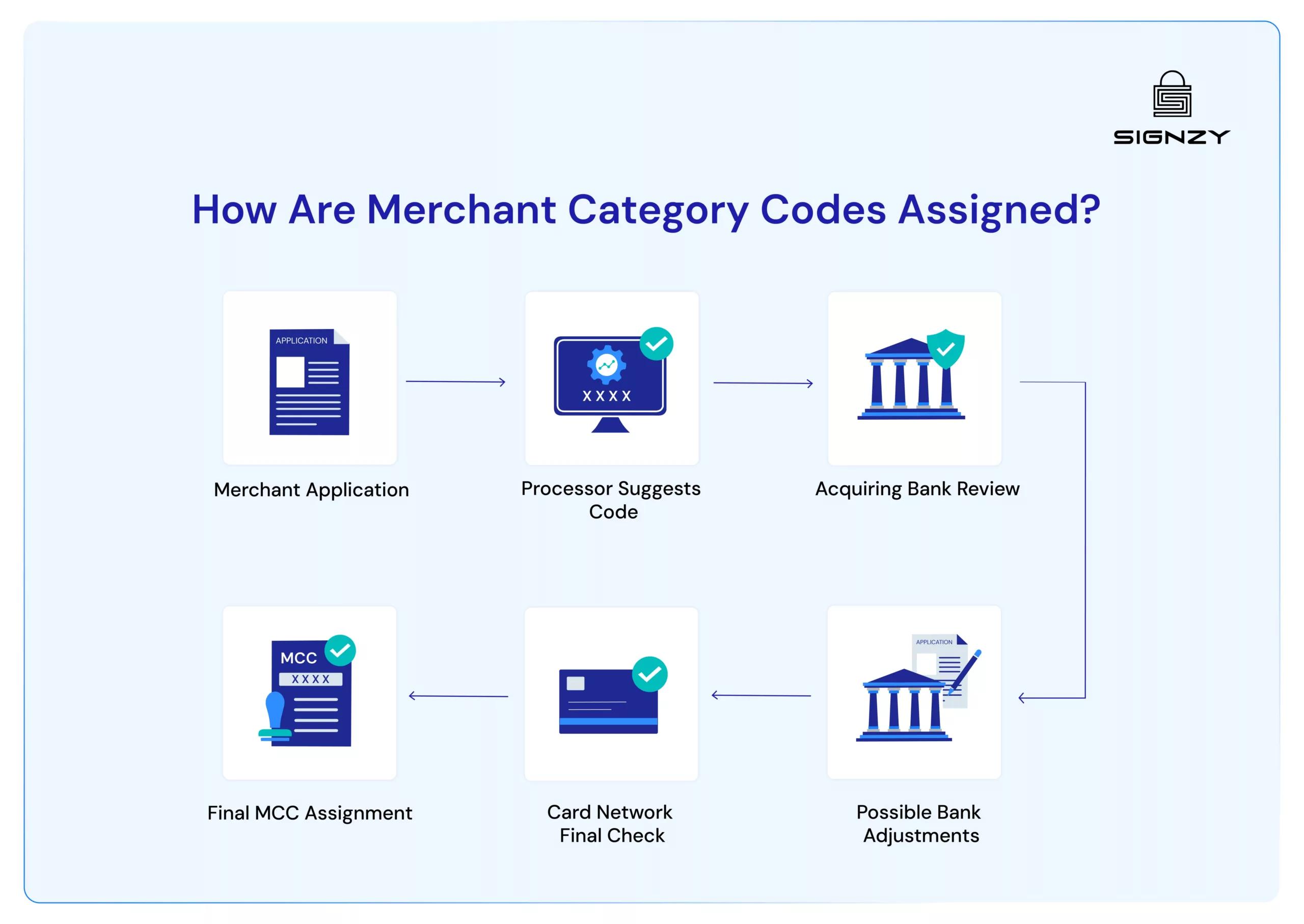
In practice, the processor proposes a code based on the merchant's application, the acquiring bank confirms it, and the card networks can require a correction if the code doesn't match what the business actually does.
💡 Related Blog:

How Does MCC Codes Affect The Transactions?
Every swipe, tap, or click that processes through your payment system carries an MCC code.
The code determines which interchange category a transaction falls into, how issuers assess its risk, and which network rules apply. When the MCC is wrong, the effects show up quickly.
Example: a crypto platform coded as a betting merchant (7995) instead of 6051, the code for non-financial institutions selling crypto, foreign currency, and money orders, can face:
- Declines from issuers, and from cardholders who block gambling transactions
- Different interchange fees and processing costs
- Cardholder rewards that don't apply as expected
- Extra due diligence and network monitoring for a high-risk category
- Penalties or account termination if the network finds the code doesn't match the business
That's why a wrong MCC is a compliance issue, not just a billing detail. Miscoded merchants also tend to see more disputes; our guide to chargeback fraud prevention covers how to keep dispute rates down.
ISO 18245 standardizes the codes internationally, and today they are used for everything from interchange pricing to risk assessment and spending analytics.
MCC Categories For Financial Institutions
Processing financial transactions isn’t as simple as money moving from point A to point B. Each type needs its own handling – from basic bank transfers to crypto trades, from investment purchases to insurance payments. To handle, all are assigned different MCC codes.
For financial institutions, crypto platforms, and similar businesses, the 6000-series MCC codes create this structure. Some important codes are
| MCC | Description |
|---|---|
| 6010 | Financial Institutions – Manual Cash Disbursements |
| 6011 | Financial Institutions – Automated Cash Disbursements |
| 6012 | Financial Institutions – Merchandise And Services |
| 6050 | Quasi Cash–Member Financial Institution |
| 6051 | Non-Financial Institutions – Foreign Currency, Money Orders (Not Wire Transfer), Cryptocurrency And Travelers Cheques |
| 6211 | Security Brokers/Dealers |
| 6300 | Insurance Sales, Underwriting, And Premiums |
| 6513 | Real Estate Agents And Managers |
| 6535 | Value Purchase – Member Financial Institution |
Also, you don’t necessarily need to use only one MCC code. Financial businesses often need multiple MCCs to operate effectively.
Take a digital payment platform – it might handle basic banking through 6012, offer crypto services under 6051, and process international transfers using 4829.
Each code serves a specific purpose, carrying its own regulations, fee structures, and processing rules. This separation helps maintain clear records and ensures appropriate fee structures for each service type.
Why MCC Codes Matter?
MCCs play several critical roles in financial operations:
- Interchange Rates and Processing Fees
Different MCCs fall into different interchange categories, which set the fees issuers receive when merchants accept card payments. For high-volume businesses, being in the right category can make a noticeable difference to processing costs.
- Risk Management
Payment processors use MCCs to assess transaction risk levels. These codes are used as a traffic light system. Green means go, yellow means caution, and red… well, let’s just say it’s best to avoid red.
Visa's Integrity Risk Program applies extra requirements to high-integrity-risk categories. For example, Visa treats card-absent transactions under 7995 (betting and gambling) as high integrity risk, and certain card-not-present cryptocurrency purchases coded 6051 or 6012 must carry a special condition indicator.
- Monitoring and Analytics
Issuers, networks, and regulators use MCCs to spot unusual spending patterns, apply spending controls, and analyze where money goes. Many corporate and government card programs block whole categories of codes, so a wrong MCC can stop legitimate business purchases.
- Authorization and Processing
The code attached to a transaction influences how it’s routed through payment networks. Wrong MCCs can lead to unnecessary declines or processing delays, especially in cross-border transactions.
Consider a fintech platform incorrectly coded as a high-risk merchant (MCC 7995) instead of a financial institution (MCC 6012) – their standard $5,000 transfer might get declined due to gambling limits, despite being a legitimate financial transaction.
MCC Changes in 2025 and 2026
The code lists change every year. Recent changes worth knowing:
- Mastercard 5262, Marketplaces (April 11, 2025): for online marketplaces that bring together buyers and third-party sellers across several types of goods or services, where no other MCC fits better.
- New named-merchant codes: Visa and Mastercard regularly add codes for specific airlines and hotel groups. Visa added another group in April 2026 and has announced four more for October 23, 2026.
- Fuel codes: Visa announced that, from October 24, 2026, its acquirer-confirmation advice for automated fuel dispensers (5542) also covers service stations (5541).
- Firearms code 5723: ISO approved a code for firearms and ammunition retailers in September 2022. California, Colorado, and New York require it to be assigned, with assignment starting May 1, 2025, while about 20 states have passed laws banning its use. In July 2026, the US House passed H.R. 1181, which would ban firearms-specific codes nationwide; it is not yet law.
Finding MCC Code of Business (And Making Changes)
While the process might seem hard at first, clear methods exist for both verification and adjustments when needed.
Direct Verification Methods
The foundation starts with processor documentation – no guesswork needed. Major card networks maintain comprehensive MCC listings through their official guides. Visa’s Merchant Data Standards Manual and Mastercard’s Quick Reference Booklet serve as essential reference points, offering precise classifications for every business type.
For active merchants, the monthly processor statement holds valuable information. The assigned MCC typically appears near the business details or within the fee structure breakdown – making regular verification straightforward.
Card Statement Verification
Transaction appearances on credit card statements offer another practical verification method. MCCs show up either as four-digit codes or category descriptions, providing clear insight into how charges appear to customers and confirming proper classification status.
Making Changes When Needed
Miscoding often happens when businesses don’t fit neatly into traditional categories.
Take a fintech lending app marked as a cash advance business because of similar transaction patterns or because the processor’s classification system hasn’t caught up with newer business models. Sometimes it’s as simple as the business description being too vague, or staff not being familiar with emerging industries like cryptocurrency trading.
When MCCs need adjustment:
- Document misalignment between current classification and primary business activity
- Compile evidence of core business operations and revenue sources
- Submit formal requests through payment processors
- Maintain consistent follow-up until resolution
If you still don’t find a resolution, gather documents and visit or contact your payment processor or bank directly to get more clear steps to resolution.
Speaking of documentation for fixing MCC codes – automated verification systems can speed things up considerably.
When merchants need to prove their business model and activities to get their MCC corrected, digital KYC and business verification APIs can gather all that evidence in minutes instead of days of back-and-forth with processors. Check Signzy for more.


FAQ
What is an MCC code?

Who assigns a merchant category code?
How do I know if my business has the right MCC?
Can I change my MCC?
Can a business have multiple MCCs?
What is MCC 5723?
Do MCCs affect credit card rewards?
Agrima Dwivedi
Agrima is an Associate Product Marketer at Signzy, currently working in the B2B fintech space. She brings over two years of experience in copywriting and content writing, which laid the foundation for product marketing. Today, she leverages both creative and strategic skills to drive go-to-market efforts and build user-focused marketing strategies.

Related Blogs
View all

Chargeback Fraud Prevention: How to Detect and Stop It (2026 Guide)
![How to Verify a Business: The Complete KYB Verification Process Guide [2026]](https://cdn.sanity.io/images/blrzl70g/production/6383af30b009a4e1389b5aaac8c5f6b1ba89e064-2560x600.webp)
How to Verify a Business: The Complete KYB Verification Process Guide [2026]
Transaction Screening vs Transaction Monitoring: Key Differences (2026)

10 Best AML Watchlist Screening Tools for 2026 (Compared)
The best in business


The global API marketplace for KYC, KYB, & AML
Explore the end-to-end verification stack trusted by 1,000 businesses.
Get in touch