





10 Best AML Watchlist Screening Tools for 2026

 Open in ChatGPT
Key Highlights
- AML watchlist screening is a regulatory requirement for most financial institutions, involving continuous checks against sanctions lists, PEP registries, adverse media, and criminal watchlists to prevent financial crime.
- The best screening tools differentiate on data freshness, false positive handling, geographic coverage, and how well they fit into existing compliance workflows, not just the number of lists they cover.
- Signzy stands out with its single API covering 1,000+ lists, daily data refresh across 200+ jurisdictions, modular architecture, and pay-per-call pricing trusted by 1,000+ businesses globally.
- What is AML Watchlist Screening?
- What are the benefits of using an AML Watchlist Screening tool?
- Top 10 AML Watchlist Screening Tools for 2026
- #2. Flagright
- #3. AML Watcher
- #4. ComplyAdvantage
- #5. NICE Actimize
- #6. Didit
- #7. Oracle FCCM
- #8. Zigram
- #9. Idenfy
- #10. Persona
- How to pick the best AML Watchlist Screening tool?
- Get started with Signzy’s AML Watchlist Screening today
- FAQ
Keeping financial crime out of your business starts with knowing who you are dealing with. AML watchlist screening is how regulated businesses do exactly that, checking customers and entities against sanctions lists, PEP registries, and other high-risk databases before and during a business relationship.
The challenge is that not every tool does this equally well. Some platforms offer broad data coverage but limited workflow integration. Others are built for enterprise deployments that take months to go live. And a few try to do everything at once, often at the cost of doing any one thing particularly well.
This guide breaks down the top 10 AML watchlist screening tools for 2026, what each one does, where it fits, and what to watch out for, so you can make a more informed decision for your compliance program.

What is AML Watchlist Screening?
AML Watchlist Screening is the process of checking individuals, businesses, and entities against government-issued and regulatory watchlists to identify potential financial crime risks. These lists include sanctioned persons, politically exposed persons (PEPs), known fraudsters, and other high-risk profiles maintained by bodies like OFAC, the UN, the EU, and FATF.
What are the benefits of using an AML Watchlist Screening tool?
Manually screening customers against hundreds of global watchlists is slow, error-prone, and not scalable. An AML Watchlist Screening tool automates and strengthens this process. Here is what that looks like in practice:
🟢 Faster onboarding: Automated screening cuts verification time from hours to seconds, so compliant customers move through onboarding without unnecessary delays.
🟢 Reduced false positives: Smart matching algorithms distinguish real risks from name-based coincidences, reducing the burden on compliance teams chasing irrelevant alerts.
🟢 Real-time monitoring: Continuous screening ensures that when a customer's risk profile changes, such as appearing on a new sanctions list, your team is alerted immediately.
🟢 Comprehensive coverage: A good tool screens across multiple global watchlists simultaneously, so no high-risk entity slips through due to a missed data source.
🟢 Audit-ready records: Every screening check is logged automatically, making it easier to demonstrate compliance during regulatory audits or investigations.
🟢 Lower compliance costs: Automation reduces the manual effort required, allowing compliance teams to focus on high-priority cases rather than repetitive checks.
Top 10 AML Watchlist Screening Tools for 2026
| Platform | Description | Transaction Monitoring | Pricing Model |
|---|---|---|---|
| Signzy | Full AML + KYC stack for fintechs and financial institutions | ✅ Yes | Pay-per-call |
| Flagright | AI-native AML platform with no-code compliance workflows | ✅ Yes | Subscription |
| AML Watcher | Screening-focused platform with deep proprietary data | ❌ Limited | Custom |
| ComplyAdvantage | Real-time risk intelligence with proprietary screening data | ✅ Yes | Subscription |
| NICE Actimize | Enterprise AML suite with 25+ years of market presence | ✅ Yes | Enterprise licensing |
| Didit | Identity-first platform with AML embedded in KYC flow | ❌ Limited | Pay-per-use |
| Oracle FCCM | Comprehensive enterprise compliance suite on Oracle Cloud | ✅ Yes | Enterprise licensing |
| Zigram | Modular RegTech platform with vast multilingual watchlist data | ✅ Yes | Modular/Custom |
| Idenfy | Combined KYC, KYB, and AML platform for SMBs | ❌ Limited | Pay-per-use |
| Persona | Identity verification platform with embedded AML screening | ❌ No | Usage-based |
#1. Signzy
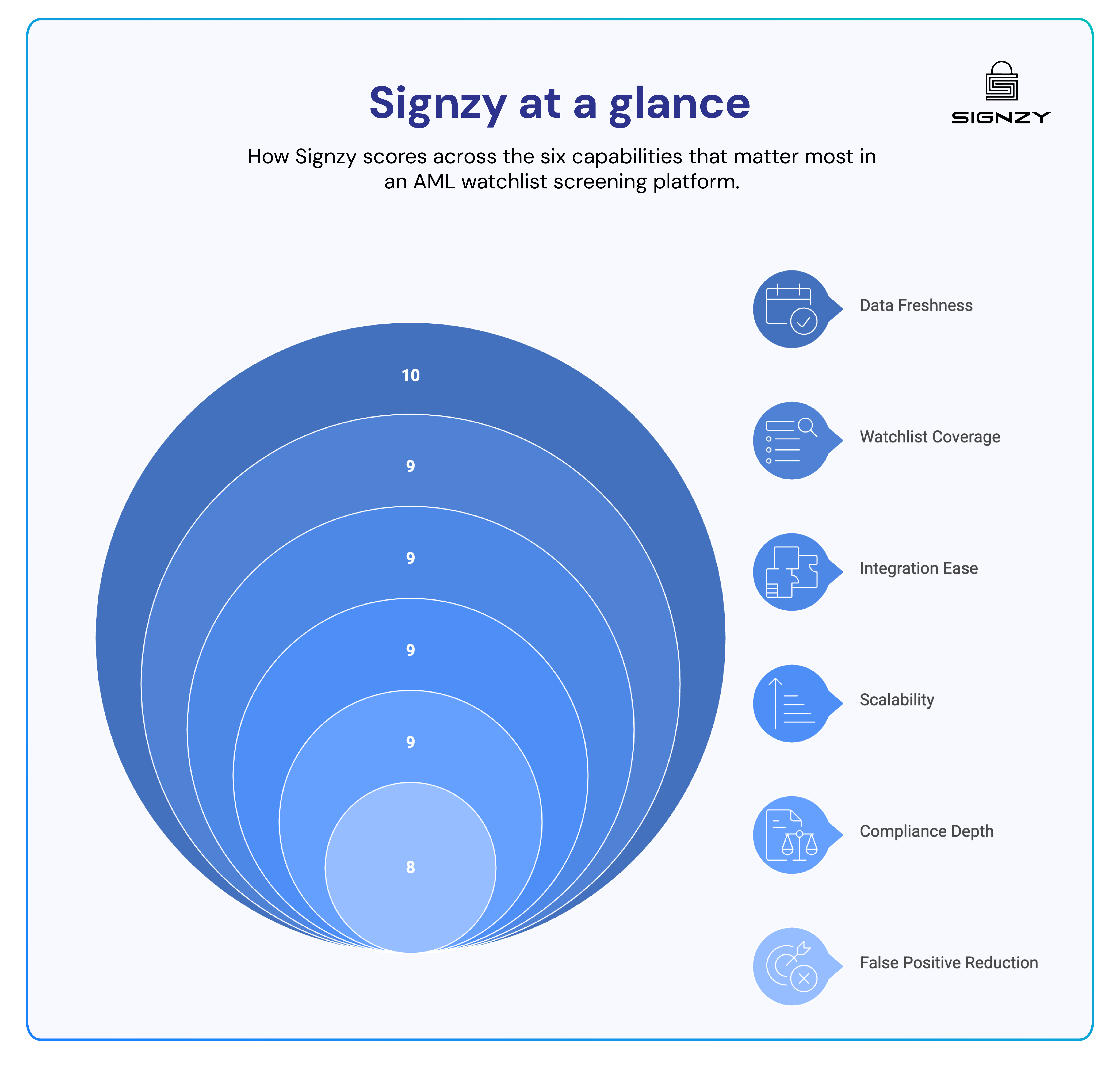
Signzy is a modular compliance platform built for financial institutions and fintechs that want AML watchlist screening as part of a larger onboarding and risk workflow. On the AML side, the platform covers sanctions screening, PEP checks, adverse media monitoring, criminal watchlists, and real-time transaction monitoring, all accessible through a single API.
Its machine learning layer continuously analyzes transaction patterns to detect structuring, layering, and other suspicious behaviors, while AI-powered risk assessments help compliance teams prioritize genuine threats over noise.
The platform supports global and local regulatory frameworks, including FATF, OFAC, BSA, and EU directives, and refreshes watchlist data daily across 200+ jurisdictions. It is trusted by 1000+ businesses across 150+ countries, including 10+ from the Fortune 500.
Signzy's key capabilities
🟢 Single API, multiple list types: Screen against sanctions lists, PEP registries, adverse media, and criminal watchlists through one integration, with AI-powered name matching that handles aliases, transliterations, and variations.
🟢 Daily watchlist refresh: Unlike platforms that update weekly or monthly, Signzy refreshes data daily across 200+ jurisdictions, reducing the risk of gaps between regulatory updates and your screening results.
🟢 Modular and scalable architecture: Each compliance capability works independently, so teams can start with watchlist screening and layer in transaction monitoring, KYB, or risk scoring as needs grow.
🟢 Pay-per-call pricing: No mandatory monthly platform fee, making it accessible for businesses with variable screening volumes.
Signzy pros and cons
✅ Single API covers sanctions, PEP, adverse media, and criminal records in one call
✅ Daily data refresh ensures screening runs against current, up-to-date watchlists
✅ Modular setup lets compliance teams start lean and expand without re-integrating
✅ Pay-per-call model keeps costs proportional to actual screening volumes
✅ Covers 180+ countries with jurisdiction-specific AML regulatory alignment
❌ Platform depth may feel excessive for teams with simple, standalone screening needs
We were managing three separate vendor subscriptions for sanctions, PEP, and adverse media. Signzy brought it all into one API and cut our screening costs significantly within the first quarter.
— Head of Compliance, Digital Lending Platform

#2. Flagright
Flagright is an AI-native AML compliance platform. The platform processes transactions in real time and includes an AI forensics layer to assist with investigations and SAR generation. It is a solid option for modern financial institutions looking for fast deployment and operational independence from technical teams.
Flagright key capabilities
🟢 No-code rules engine: Build, test, and adjust monitoring rules using nested logic and risk-based thresholds, without writing a single line of code.
🟢 Backtesting on historical data: Test new rules against past transactions before going live to avoid miscalibrated thresholds and alert floods.
Flagright pros and cons
✅ Real-time transaction monitoring with sub-second response times
✅ Unified platform handles screening, monitoring, and case management together
❌ Newer platform with a limited enterprise track record compared to established vendors
❌ Depth of watchlist data coverage is narrower compared to dedicated screening tools
#3. AML Watcher
AML Watcher is a screening-focused platform built around a proprietary in-house database covering sanctions, PEPs, adverse media, watchlists, and international leaks. The platform works well for compliance teams that are not looking for a full-stack AML workflow solution.
AML Watcher key capabilities
🟢 Proprietary in-house database: Maintains its own dataset of 1,300+ watchlists and 200+ sanction regimes, resulting in cleaner and more structured data than aggregated sources.
🟢 TruRisk false positive filtering: Uses entity-specific identifiers to separate genuine matches from name-based noise, reducing manual review load for compliance officers.
🟢 Multilingual screening: Covers 80+ languages, including local PEP definitions and regional watchlists that many global platforms overlook.
AML Watcher pros and cons
✅ Proprietary database reduces reliance on third-party data quality inconsistencies
✅ TruRisk actively filters false positives using customer-specific identifiers
❌ Primarily a screening tool with limited transaction monitoring capabilities
❌ No broader KYC or onboarding workflow, so it needs to be paired with other platforms
#4. ComplyAdvantage
ComplyAdvantage is a SaaS-based risk intelligence platform that combines proprietary data with AI-powered screening across sanctions, PEPs, adverse media, and watchlists. The platform is widely used by fintechs and financial institutions that want deep, real-time risk intelligence alongside flexible screening configuration. It is present across 40 countries with a particularly strong footprint in the UK and US markets.
ComplyAdvantage key capabilities
🟢 Agentic AI for alert remediation: The platform's AI agents can auto-remediate a significant portion of false positive alerts without human intervention, freeing analysts to focus on genuine risks.
🟢 Highly configurable screening logic: Teams can customize which lists apply to which entity types, set fuzzy matching thresholds, and route alerts by type or severity to match their risk policies.
ComplyAdvantage pros and cons
✅ Proprietary data refreshed faster than most third-party aggregated sources
✅ Unified platform covers screening, monitoring, and case management together
❌ No native KYC or identity verification, so it needs pairing with an IDV platform
❌ Pricing can be difficult to predict at scale for teams with variable screening volumes
❌ Feature depth may exceed what smaller compliance teams need or can fully utilize
#5. NICE Actimize
NICE Actimize is an enterprise-grade financial crime compliance platform with over 25 years in the market, serving more than 1,000 organizations across 70+ countries. The platform takes an entity-centric approach, placing the customer at the center of all AML risk management processes, and covers the full AML value chain from onboarding through to ongoing monitoring and SAR filing.
NICE Actimize key capabilities
🟢 Entity-centric AML architecture: Builds a consolidated risk view around each customer, linking watchlist hits, transaction behavior, and investigation history in one place.
🟢 Autonomous AML suite: Applies machine learning and intelligent automation across transaction monitoring, customer due diligence, and case management to reduce manual workload.
NICE Actimize pros and cons
✅ Proven enterprise platform with a long track record at global financial institutions
✅ Full AML suite covers everything from onboarding to regulatory reporting
❌ Implementation and licensing costs are high, making it less accessible for smaller institutions
❌ Configuration and tuning often require significant internal or consultant support
❌ Platform complexity can slow down deployment compared to newer cloud-native alternatives
#6. Didit
Didit is an identity-first compliance platform that integrates AML watchlist screening directly into its KYC verification workflow. The platform is built for simplicity, with a no-code visual workflow editor and pay-per-use pricing that requires no contracts or monthly minimums. It suits businesses that want AML checks embedded within their onboarding flow rather than managed as a separate compliance layer.
Didit key capabilities
🟢 Ongoing monitoring at a flat rate: Post-onboarding daily re-screening is priced per user per year rather than per check, keeping costs predictable for businesses with large monitored populations.
🟢 No-code workflow builder: Compliance flows can be built and adjusted using a drag-and-drop editor without engineering involvement.
Didit pros and cons
✅ Simple integration with AML and KYC combined in a single API call
✅ No-code setup means compliance teams can manage workflows without developer support
❌ Limited depth in transaction monitoring compared to dedicated AML platforms
❌ Less suited for large financial institutions that need advanced case management tools
❌ Watchlist coverage, while broad, does not match the depth of specialized screening providers
#7. Oracle FCCM
Oracle FCCM (Financial Crime and Compliance Management) is a comprehensive enterprise compliance suite backed by over 25 years of experience working with 180+ global financial institutions. It covers customer screening, sanctions screening, transaction monitoring, KYC, case management, and regulatory reporting, all delivered as a cloud service on Oracle Cloud Infrastructure.
Oracle FCCM key capabilities
🟢 End-to-end compliance suite: Covers the full AML value chain from customer onboarding and watchlist screening through to investigation, SAR filing, and regulatory reporting in one integrated platform.
🟢 Graph analytics and entity resolution: Identifies hidden relationships between entities and surfaces complex laundering patterns that standard rule-based screening would miss.
Oracle FCCM pros and cons
✅ Decades of proven deployment at large and global financial institutions
✅ Comprehensive coverage across every AML function without needing third-party tools
❌ High implementation cost and complexity make it unsuitable for smaller organizations
❌ Deployment timelines tend to be long compared to modern cloud-native platforms
❌ Requires significant IT and compliance resources to configure and maintain effectively
#8. Zigram
Zigram is a RegTech platform built around a modular suite of compliance tools it calls the Complete AML System, covering watchlist screening, transaction monitoring, entity risk management, and enhanced due diligence. The platform is particularly well regarded for its data depth and is designed to serve both large enterprises and fast-growing fintechs looking for scalable, independently deployable compliance modules.
Zigram key capabilities
🟢 Extensive proprietary watchlist library: Covers 3,300+ global watchlists and over 9 billion content items across 250+ jurisdictions, with support for local and regional lists often missed by larger platforms.
🟢 Multilingual screening: Supports 45 languages with transliteration and fuzzy matching, making it suitable for compliance programs that operate across diverse geographies.
Zigram pros and cons
✅ One of the largest proprietary watchlist databases available among independent RegTech providers
✅ Strong multilingual support suited to businesses operating across emerging markets
❌ Less established brand recognition outside of South and Southeast Asia
❌ The user interface and onboarding experience are less polished than some Western competitors
❌ Transaction monitoring depth is more limited compared to dedicated monitoring platforms
#9. Idenfy
Idenfy is a RegTech platform that combines identity verification, KYB, and AML screening within a single compliance workflow. It's an AML screening module that checks individuals and businesses against sanctions lists, PEP databases across four risk tiers, and adverse media sources, with daily data refresh and ongoing monitoring available through its dashboard or API.
Idenfy key capabilities
🟢 Four-tier PEP screening: Covers all four PEP risk levels, including relatives and close associates, with jurisdiction filtering and tier-level labeling to help teams apply proportionate due diligence.
🟢 Company and UBO screening: AML checks extend to business entities, including automatic screening of directors, shareholders, and beneficial owners within the same workflow.
Idenfy pros and cons
✅ Strong combination of KYC, KYB, and AML in one platform with no separate integration needed
✅ Four-tier PEP screening with detailed filtering keeps due diligence proportionate and accurate
❌ Transaction monitoring is limited compared to standalone AML monitoring platforms
❌ Sanctions list coverage is narrower than dedicated screening-first providers
❌ Better suited for small to mid-sized businesses rather than large enterprise compliance teams
#10. Persona
Persona is an identity verification and risk management platform that has grown to process 300 million+ verifications annually. Screening is embedded within Persona's broader identity workflow rather than offered as a standalone module, making it a strong fit for product teams that want KYC and AML handled in one configurable system.
Persona key capabilities
🟢 Modular identity and screening in one flow: AML watchlist checks sit alongside identity verification, liveness detection, and KYB within the same workflow engine, reducing the need for multiple vendor integrations.
🟢 Broad list coverage with match control: Screens against 100+ sanctions lists and 5,000+ PEP databases, with configurable match sensitivity and PEP category filters to reduce false positives.
Persona pros and cons
✅ Strong KYC and AML combination with no-code workflow configuration
✅ Flexible match controls help teams align screening sensitivity with their risk appetite
❌ AML screening is not a standalone product, so it may not suit teams that only need screening
❌ Transaction monitoring is not part of the platform, requiring additional tooling for that function
❌ Deeper compliance features like case management and SAR reporting are limited compared to dedicated AML platforms
How to pick the best AML Watchlist Screening tool?
Choosing an AML watchlist screening tool directly shapes how your compliance program operates, how fast you can onboard customers, and how confidently you can stand in front of a regulator.
With dozens of platforms on the market, the right choice comes down to a few factors that matter more than feature lists.
↪ Know what you actually need to screen
Some platforms are built for end-to-end AML compliance, while others focus purely on screening data. Before evaluating tools, be clear on whether you need standalone watchlist screening or whether you also need transaction monitoring, KYC, or case management.
Buying more than you need adds cost and complexity. Buying less leaves gaps.
↪ Check how often data gets refreshed
Watchlist data that updates weekly or monthly creates real compliance exposure. If a customer gets sanctioned on a Tuesday and your lists refresh on Sunday, you have a problem. Look for platforms that update daily at a minimum, and verify this claim before signing a contract.
↪ Understand how false positives are handled
Every tool will flag matches. The question is how well it distinguishes genuine risks from name-based noise. Ask vendors to show you their matching methodology, whether they use fuzzy logic, phonetic matching, transliteration, or entity-specific identifiers.
A high false positive rate drains your compliance team's time and attention.
↪ Confirm geographic and language coverage
If your business operates across multiple jurisdictions, a tool that covers global lists but misses local PEP registries or regional watchlists is only doing half the job. Make sure the platform covers the specific countries and languages relevant to your customer base.
↪ Evaluate how well it fits your tech stack
A tool that requires months of integration work is a liability, not an asset. Look for API-first platforms with clear documentation, flexible deployment options, and pricing that scales with actual usage rather than fixed monthly minimums.
↪ Consider how much the tool can grow with you
Your compliance needs today will not be the same in two years. A modular platform that lets you add transaction monitoring, KYB, or risk scoring without switching vendors or rebuilding integrations is worth the investment early on.
Get started with Signzy’s AML Watchlist Screening today
Most compliance teams reach a point where their current screening setup starts costing more than it should, whether that is in false positive reviews, patchy data, fragmented vendor relationships, or integrations that never quite worked.
The risk does not announce itself. It accumulates quietly until an audit, a missed match, or a regulatory inquiry brings it into focus.
Signzy was built to close those gaps. Daily watchlist refresh across 200+ jurisdictions, a single API for sanctions, PEP, adverse media, and criminal screening, modular architecture that grows with your compliance program, and pricing that reflects actual usage rather than theoretical capacity. It is trusted by 1000+ businesses globally, including institutions that operate across some of the most complex regulatory environments in the world.
The daily watchlist refresh was the deciding factor for us. Our previous provider updated weekly, and we had already experienced a near-miss. That is not a risk we were willing to carry.
— Chief Risk Officer, Regional Bank.
If your screening program is due for a closer look, this is a good place to start. Book a demo and see what Signzy can do for your compliance team.


FAQ
How often should AML watchlist screening be performed?

What is the difference between sanctions screening and watchlist screening?
Can small businesses use AML watchlist screening tools?
What happens if a customer matches a watchlist entry?
Saurin Parikh
Saurin is a Sales & Growth Leader at Signzy with deep expertise in digital onboarding, KYC/KYB, crypto compliance, and RegTech. With over a decade of professional experience across sales, strategy, and operations, he’s known for driving global expansions, building strategic partnerships, and leading cross-functional teams to scale secure, AI-powered fintech infrastructure.

Related Blogs
View all

10 Best KYB Verification Services in 2026 | Complete Comparison Guide

10 Best Identity Verification Solutions in 2026: Full Breakdown

10 Best KYB Verification Platforms in India – 2026 Guide
![10 Best KYC Software Providers of 2026 [US Guide]](https://cdn.sanity.io/images/blrzl70g/production/008b1ea8636a5a1febcd10331269d51c5c29090e-3985x933.jpg)
10 Best KYC Software Providers of 2026 [US Guide]
The best in business


The global API marketplace for KYC, KYB, & AML
Explore the end-to-end verification stack trusted by 1,000 businesses.
Get in touch