





AML Watchlist Screening Guide: Regulations, Tools, and More [2026]

 Open in ChatGPT
Key Highlights
- AML watchlist screening requires checking individuals and entities against sanctions lists, PEP registries, and law enforcement databases, with regulations varying significantly across the US, EU, and other major jurisdictions.
- Effective screening goes beyond a one-time onboarding check, requiring continuous monitoring, quality data, sophisticated matching logic, and documented processes that hold up under regulatory examination.
- Signzy's modular platform handles real-time screening against sanctions, PEP, and criminal watchlists through a single API, with the flexibility to expand into full KYC and AML workflows as compliance needs grow.
- What is AML watchlist screening?
- How does AML watchlist screening work?
- What is the purpose of watchlist screening?
- Types of watchlists screened for AML compliance
- What regulations govern AML watchlist screening?
- Who uses AML watchlist screening?
- What does effective AML watchlist screening actually look like? Best practices explored
- What tools are used for AML watchlist screening?
- How does watchlist screening work alongside other AML solutions?
- Stay ahead of AML watchlist risks with Signzy
- FAQ
AML watchlist screening is a foundational requirement for any business operating in regulated financial environments. As regulators tighten enforcement expectations globally, the ability to identify sanctioned individuals, politically exposed persons, and other high-risk parties before entering a financial relationship has moved from best practice to baseline obligation.
But the mechanics behind it are more involved than they appear. Effective screening runs across dozens of lists simultaneously, handles name variations, scores matches by risk level, and continues monitoring long after onboarding is complete. The gap between a screening program that satisfies regulators and one that doesn't usually comes down to how well each of those elements is executed.
This guide covers the full picture: what AML watchlist screening is, how it works, what regulations govern it, who uses it, and what good implementation actually looks like. Let's start with the definition.

What is AML watchlist screening?
AML watchlist screening is the process of checking individuals and entities against government-maintained and regulatory databases to identify those flagged for financial crime, sanctions violations, corruption, or other risks. It is a core component of Anti-Money Laundering compliance, helping businesses determine whether a customer, vendor, or counterparty poses a risk before or during a financial relationship.
How does AML watchlist screening work?
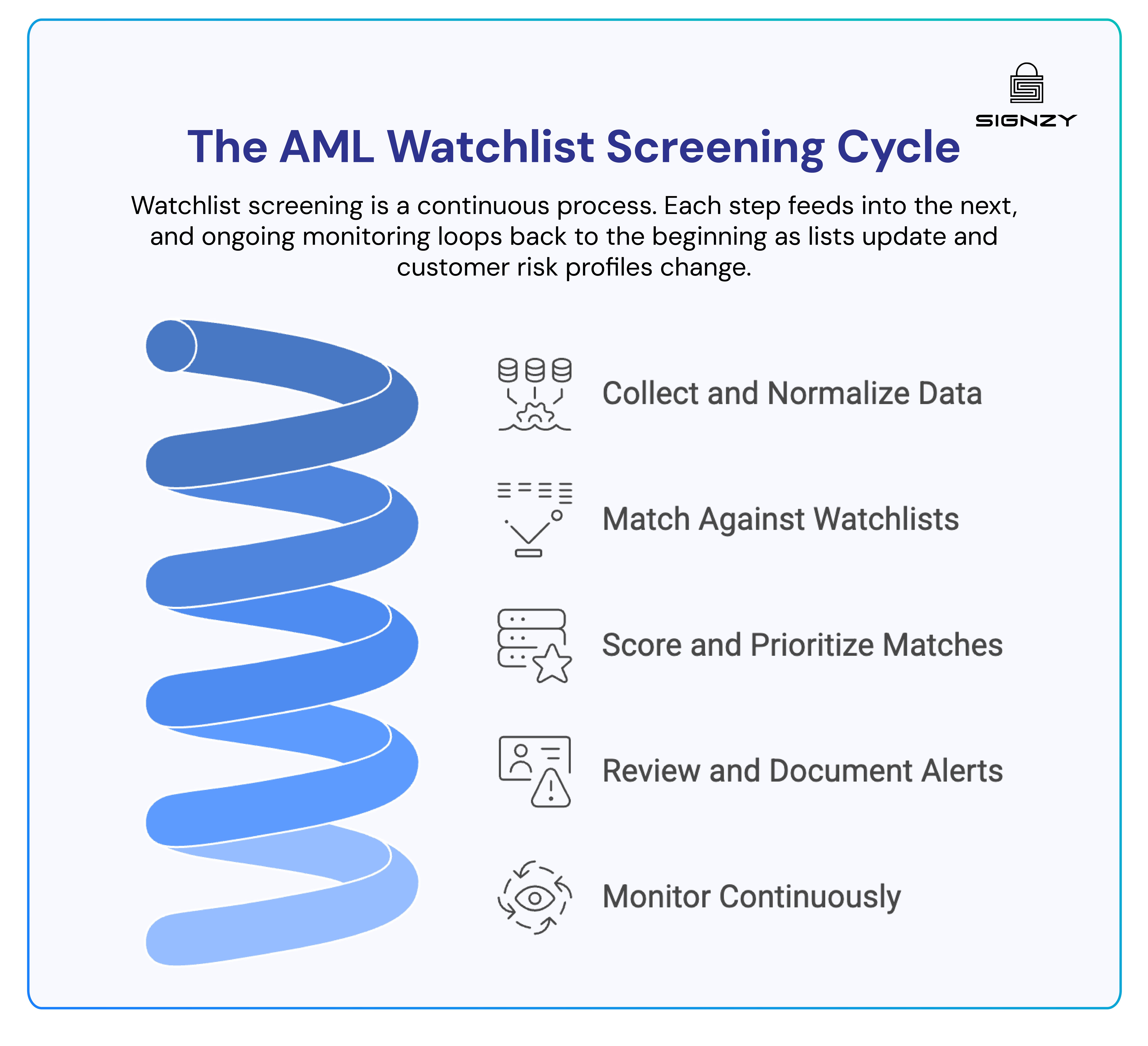
Watchlist screening runs across dozens of lists simultaneously, and how well it works depends entirely on what happens at each step.
Step 1: Data collection and normalization
Before any screening happens, the system needs clean, consistent input. Names, dates of birth, nationalities, and entity identifiers are collected and standardized to account for spelling variations, transliterations, and missing fields. This step is unglamorous but critical. Most missed matches trace back to data quality problems here, not failures in the matching engine itself.
Step 2: Matching against watchlists
Normalized data is run against relevant databases simultaneously. Sanctions lists, PEP registries, law enforcement records, adverse media sources, all at once.
Rather than requiring exact string matches, most systems use fuzzy matching algorithms that account for aliases, name variations, and deliberate obfuscation. The breadth of list coverage and the sophistication of the matching logic here determine how much slips through.
Step 3: Risk scoring and alert generation
Not every potential match carries the same weight. A high-confidence hit against an OFAC sanctions list is a different situation than a partial name match on a disciplinary action record.
Scoring layers in match confidence, list type, and the entity's broader risk profile to prioritize what actually needs immediate attention versus what goes into a review queue.
Step 4: Alert review and disposition
Compliance teams review flagged matches to determine true positives from false positives. Common names, incomplete records, and transliteration inconsistencies mean this step requires genuine human judgment.
Every decision gets documented because in a regulatory examination, the audit trail matters as much as the outcome.
Step 5: Ongoing monitoring
A clean result at onboarding doesn't stay clean forever. Watchlists update continuously, and individuals can be added to sanctions or PEP lists at any time after your initial check. Ongoing monitoring closes that gap, ensuring a customer who passed screening six months ago gets flagged the moment their status changes.
The process is only as strong as the frequency of its list updates and the quality of its matching logic. A point-in-time check at onboarding alone leaves a compliance gap that regulators will find.
What is the purpose of watchlist screening?
Regulators expect businesses to prove they made a reasonable effort to identify and avoid bad actors. Watchlist screening is how that obligation gets met in practice. It turns an abstract compliance requirement into a concrete, repeatable process with a documented audit trail. Here's what it's actually doing:
👉 Identify sanctioned individuals and entities before entering a financial relationship, ensuring compliance with OFAC, UN, and other regulatory mandates that carry strict liability regardless of intent
👉 Detect politically exposed persons who, by virtue of their position, carry elevated corruption and bribery risk requiring enhanced due diligence under FATF guidelines
👉 Flag individuals and businesses with prior fraud, enforcement actions, or criminal history that would make them unacceptable counterparties under the firm's risk policy
👉 Protect the business from reputational damage associated with onboarding high-profile bad actors, even in cases where no direct legal violation has occurred
👉 Satisfy regulatory examination requirements by demonstrating a documented, repeatable screening process that auditors can verify
Ultimately, watchlist screening is what separates a compliance program that exists on paper from one that actually works in practice.
Types of watchlists screened for AML compliance
AML screening draws from a wide range of lists maintained by governments, international bodies, and regulatory agencies. Each serves a distinct purpose, and comprehensive compliance requires coverage across all of them.
- FATF High-Risk Jurisdiction List: Identifies countries with weak or deficient AML and counter-terrorism financing frameworks. Businesses transacting with individuals or entities from these jurisdictions are expected to apply enhanced due diligence under FATF Recommendation 19.
- Sanctions lists (OFAC, UN, EU): The most critical category. OFAC's SDN list, UN consolidated sanctions list, and EU restrictive measures list identify individuals, entities, and countries subject to asset freezes and transaction prohibitions. Violations carry severe civil and criminal penalties regardless of whether the business knew about the designation.
- Fugitive lists: Maintained by law enforcement agencies to identify individuals wanted for criminal offenses across jurisdictions. Onboarding a fugitive creates direct legal and reputational exposure for the business.
- Exclusion lists: Used primarily in government contracting and healthcare to identify parties barred from participating in federal programs. The HHS OIG exclusion list is the most referenced in regulated industries.
- Disciplinary actions: Records of formal sanctions issued by financial regulators such as FINRA, SEC, and FCA against licensed professionals and firms for misconduct, rule violations, or compliance failures.
- Debarment lists: Identify parties prohibited from receiving government contracts or grants, typically following fraud, corruption, or performance failures. Relevant for businesses operating in or supplying to the public sector.
- Enforcement actions: Regulatory orders, consent decrees, and civil money penalties issued against businesses and individuals by agencies like the CFPB, OCC, and FinCEN. A history of enforcement actions signals elevated compliance risk.
- Interpol and law enforcement lists: Interpol red notices and diffusions identify individuals wanted for extradition by member countries. Relevant for businesses operating internationally or onboarding foreign nationals.
- Restricted and denied party lists: Maintained by agencies like the Bureau of Industry and Security (BIS), these lists identify parties restricted from receiving exports, technology transfers, or specific financial services under trade control regulations.
- PEP lists: Politically Exposed Persons are current or former government officials, their family members, and close associates who carry elevated corruption risk. PEP status doesn't disqualify someone from being a customer, but it triggers mandatory enhanced due diligence under most AML frameworks.
What regulations govern AML watchlist screening?
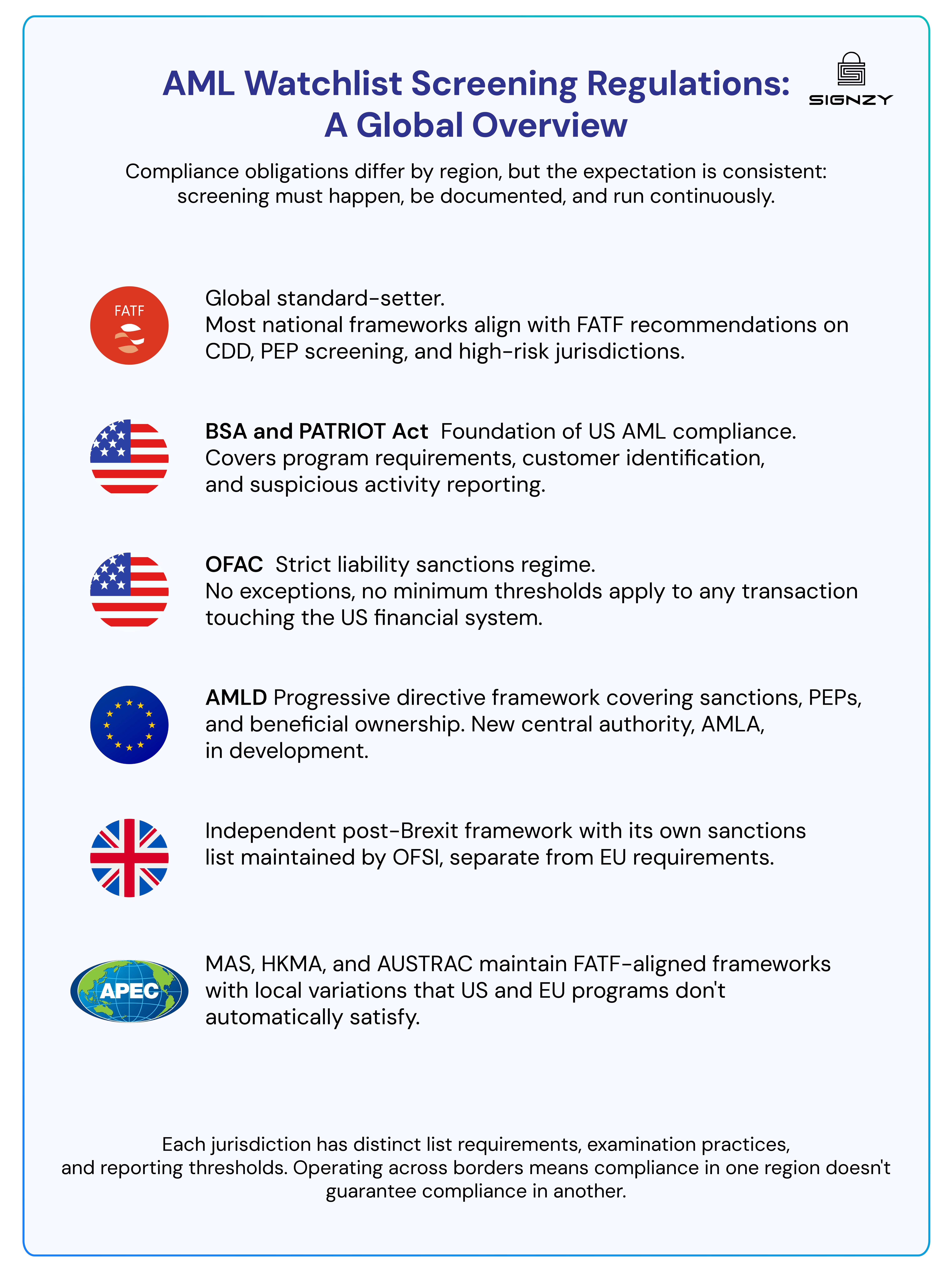
No single global rulebook governs watchlist screening. Instead, businesses operate within a layered framework of national laws, regional directives, and international standards that overlap in some areas and diverge in others.
What's consistent across all of them is the expectation that screening happens, that it's documented, and that it's ongoing.
Bank Secrecy Act and USA PATRIOT Act (United States)
The BSA, originally enacted in 1970 and significantly expanded by the USA PATRIOT Act in 2001, forms the foundation of AML compliance in the US. It requires financial institutions to establish AML programs, conduct customer due diligence, and file Suspicious Activity Reports when red flags arise.
The PATRIOT Act layered in stricter customer identification requirements and extended BSA obligations to a broader range of non-bank financial institutions. FinCEN administers and enforces both, with examination authority sitting across the OCC, FDIC, and Federal Reserve, depending on the institution type.
OFAC sanctions regulations (United States)
OFAC administers and enforces US economic and trade sanctions, maintaining the SDN list and various country-based sanctions programs. It operates separately from the BSA but is enforced alongside it in most examinations.
OFAC compliance carries strict liability, meaning a business can face civil penalties even without knowing a counterparty was sanctioned. There is no de minimis exception, which makes real-time screening against OFAC lists a non-negotiable requirement for any business touching US dollars or the US financial system.
EU anti-money laundering directives
The EU has progressively tightened its AML framework through successive directives, with the 6th Anti-Money Laundering Directive currently in force. Key requirements include:
- Mandatory screening for PEPs, sanctions, and beneficial ownership across financial institutions and designated non-financial businesses
- Compliance with the EU's own consolidated sanctions list, separate from OFAC, applying to any entity operating within the EU or transacting in euros
- Enhanced due diligence obligations for high-risk third countries identified by the European Commission
A 7th directive is in progress, and the EU is establishing a new central AML authority, AMLA, to coordinate enforcement across member states.
APAC and emerging market frameworks
Regulatory expectations across Asia-Pacific vary considerably but are tightening. Singapore's MAS, Hong Kong's HKMA, and Australia's AUSTRAC all maintain AML frameworks broadly aligned with FATF standards, with local nuances around reporting thresholds, list requirements, and examination frequency.
Businesses expanding into these regions cannot assume that US or EU compliance transfers directly. Local list requirements and reporting rules frequently differ in ways that matter operationally.
FATF recommendations
The Financial Action Task Force sets the international standard that most jurisdictions align their domestic laws to. The most relevant recommendations for watchlist screening are:
- Recommendation 10, covering customer due diligence requirements, including ongoing monitoring
- Recommendation 12, addressing PEP identification and enhanced due diligence obligations
- Recommendation 19, requiring enhanced measures for transactions involving jurisdictions on FATF's greylist and blacklist
FATF has no direct enforcement authority, but failing a mutual evaluation carries significant consequences for a country's access to the international financial system, which creates a strong incentive for domestic regulators to comply.
We expanded into 6 new Asian markets last year. Signzy's platform is adapted to each country's AML regulations without us rebuilding workflows. Made global expansion actually feasible for our small compliance team.
— Risk Analyst, Fintech (300+ employees)

Who uses AML watchlist screening?
- Banks and financial institutions: Required by BSA and FATF guidelines to screen all customers at onboarding and on an ongoing basis, covering retail accounts, commercial clients, and correspondent banking relationships.
- Fintechs and payment processors: Screen users and merchants to comply with FinCEN requirements and prevent their platforms from being used to move illicit funds across borders or between accounts.
- Cryptocurrency exchanges: Required under FinCEN's money services business rules to screen wallet holders and transaction counterparties against sanctions lists and PEP registries before processing transfers.
- Insurance companies: Screen policyholders and beneficiaries to avoid paying out claims to sanctioned individuals or entities, particularly in life insurance and high-value commercial policies.
- Healthcare organizations: Screen vendors and contractors against HHS OIG exclusion lists before entering into contracts that involve federal program billing or reimbursement.
- Government contractors: Required to verify that suppliers, subcontractors, and partners are not on debarment or exclusion lists before executing federally funded contracts.
What does effective AML watchlist screening actually look like? Best practices explored
✅ Screen against multiple list types simultaneously rather than running sequential checks, as risk rarely shows up in just one database, and gaps between checks create exploitable windows.
✅ Use fuzzy matching with configurable thresholds rather than exact string matching, since bad actors routinely use name variations, aliases, and transliterations to avoid detection.
✅ Establish a documented escalation process for true positive matches so that compliance teams know exactly what steps to take, who to notify, and how quickly, before a match ever occurs.
✅ Refresh watchlist data as frequently as your vendor allows, ideally in real time, because sanctions designations and PEP additions can happen at any point, and stale data creates direct liability exposure.
✅ Maintain detailed audit logs of every screening decision, including the list version used, the match score, and the reviewer's disposition, to support regulatory examinations and internal audits.
✅ Extend screening beyond onboarding with ongoing monitoring programs that automatically rescreen existing customers when watchlists are updated, rather than waiting for the next periodic review cycle.
What tools are used for AML watchlist screening?
The right screening tool depends on the size of the business, the volume of checks being run, and how much of the broader compliance stack needs to connect to it. Here are three platforms that represent different ends of the market.
Signzy
Signzy is a modular compliance platform built for financial institutions and fintechs that need watchlist screening as part of a broader onboarding and risk workflow. Rather than offering screening as a standalone product, it embeds within a full KYC, KYB, and AML suite, making it particularly suited for businesses that want to start with screening and expand into other compliance functions without changing vendors or reintegrating systems.
Screening 1,000+ sanctions lists used to mean multiple vendor subscriptions and manual reconciliation. Signzy consolidated everything. Overall, we reduced our screening cost by 60%
— Risk Manager, Banking Platform (100+ employees)
The platform is trusted by 500+ businesses, including 10+ from the Fortune 30, and covers 180+ countries. Here are some of Signzy's key features that can help with AML watchlist screening.
- Real-time screening against sanctions lists, PEP registries, adverse media, and criminal watchlists through a single API
- AI-powered matching algorithms that handle name variations, aliases, and transliterations to minimize false positives while flagging genuine risks
- Criminal Screening API covering arrest records, warrant lists, court cases, sex offender registries, and parole data across multiple jurisdictions
- Modular architecture allowing businesses to layer in fraud detection, AML monitoring, and beneficial ownership checks without new integrations
- Pay-per-call pricing with no monthly platform fee, making it accessible for businesses screening at varying volumes
LexisNexis Bridger Insight XG
Bridger Insight XG is one of the most widely deployed enterprise compliance platforms in the market. It combines LexisNexis WorldCompliance Data, covering over 7 million risk profiles across sanctions, PEPs, adverse media, and state-owned entities, with intelligent filtering software that auto-remediates up to 97% of matches and reduces false positives by 50-70%.
The platform supports OFAC, BSA, PATRIOT Act, and EU AML Directive requirements, and is designed for high-volume environments that need both batch and real-time screening within an existing enterprise infrastructure.
Dow Jones Risk and Compliance
Dow Jones Risk and Compliance is one of the most established data-focused screening providers in the market, particularly strong in content depth and editorial accuracy. Its Watchlist dataset is curated by a dedicated global research team using Factiva publications, covering sanctioned parties, PEPs and their relatives and close associates, persons of special interest, and adverse media entities across more than 1,100 databases worldwide.
Global coverage of sanctions and official lists, including OFAC, EU, UN, and HM Treasury, with daily updates
How does watchlist screening work alongside other AML solutions?
Watchlist screening is one piece of a larger compliance picture. On its own, it tells you whether a customer or counterparty appears on a known risk list.
What it doesn't do is monitor how that customer behaves over time, verify whether their identity documents are legitimate, or flag unusual transaction patterns. That's where the surrounding AML infrastructure comes in.
- KYC and identity verification establish who the customer actually is before screening checks whether they appear on any lists. Without a verified identity, a clean screening result doesn't mean much.
- Customer due diligence (CDD) uses screening results to inform risk ratings, which then determine how much ongoing monitoring a customer requires and whether enhanced due diligence is needed.
- Transaction monitoring runs continuously in the background, flagging behavioral patterns like structuring, rapid fund movement, or transactions with high-risk jurisdictions that wouldn't show up in a name-based screen.
- Adverse media monitoring supplements formal watchlists with intelligence from news sources, catching reputational risks that haven't yet resulted in a regulatory designation.
- Beneficial ownership verification ensures that the individuals actually controlling an entity are screened, not just the entity name on the account, which is where sanctioned individuals most commonly try to hide.
Watchlist screening works best when it feeds into these systems rather than operating in isolation. A match that isn't connected to a CDD workflow or a case management system is just an alert with nowhere to go.
Stay ahead of AML watchlist risks with Signzy
Most businesses don't have a screening problem. They have a scale problem. Checking customers against dozens of lists, across jurisdictions, while keeping data fresh and false positives manageable, gets unwieldy fast without the right infrastructure behind it.
Signzy handles real-time screening against sanctions lists, PEP registries, adverse media, and criminal watchlists through a single platform. The matching logic is built to catch genuine risks across name variations and transliterations without burying your compliance team in noise.
And because the platform is modular, you can start with screening and add KYC, fraud detection, or beneficial ownership checks as your needs grow, all within the same integration.
Book a demo to see how it works in practice.


FAQ
What is name screening in AML?

What is sanction screening in anti-money laundering?
What are the sources used for AML watchlists?
What is the difference between AML screening and transaction monitoring?
How often should AML watchlist screening be performed?
Saurin Parikh
Saurin is a Sales & Growth Leader at Signzy with deep expertise in digital onboarding, KYC/KYB, crypto compliance, and RegTech. With over a decade of professional experience across sales, strategy, and operations, he’s known for driving global expansions, building strategic partnerships, and leading cross-functional teams to scale secure, AI-powered fintech infrastructure.

Related Blogs
View all



The best in business


The global API marketplace for KYC, KYB, & AML
Explore the end-to-end verification stack trusted by 1,000 businesses.
Get in touch