





CURP Verification in Mexico: How to Validate a CURP (2026 Guide)

 Open in ChatGPT
🗒️ Key Highlights
- CURP is Mexico's 18-character population registry key. You can check one for free on RENAPO's official portal (gob.mx/curp) or validate CURPs at scale through an API connected to RENAPO data.
- A correctly formatted CURP is not proof of identity. Validation confirms the record exists and matches the data you collected; it does not prove the person in front of you is the holder.
- Since the July 2025 reform of the General Population Law, public and private entities must request CURP for their procedures and services. Adding fingerprints and a photo to a CURP requires the person's consent.
- CURP and RFC are different: CURP identifies a person, while RFC confirms tax registration with SAT. Many onboarding flows check both.
Quick answer: To verify a CURP, enter it on RENAPO's official CURP consultation portal and check that the name, date of birth, sex, and state of birth it returns match what your customer gave you. If you onboard more than a handful of people, use a CURP verification API that checks the same RENAPO data automatically and returns a match or no-match result in seconds.
This guide explains what each of the 18 characters means, the two ways to validate a CURP, what changed under Mexico's July 2025 CURP reform, and the data protection rules that apply when you collect it.
CURP, Quick Overview
The Clave Única de Registro de Población, aka CURP, is Mexico’s 18-character identity code (like the USA’s Social Security Number).
It all started on October 23, 1996, when the Presidential Agreement established the CURP system.
Every Mexican citizen, and every foreign resident registered with RENAPO, has a CURP. Each of its 18 characters has a specific meaning:
| Position | Characters | What they mean |
|---|---|---|
| 1–4 | 4 letters | First letter and first internal vowel of the first surname, first letter of the second surname, first letter of the given name |
| 5–10 | 6 digits | Date of birth in YYMMDD format |
| 11 | 1 letter | Sex marker (H or M) |
| 12–13 | 2 letters | State of birth code (NE for people born abroad) |
| 14–16 | 3 letters | First internal consonant of the first surname, second surname, and given name |
| 17 | 1 character | Homonym and century marker: 0–9 for births up to 1999, A–J from 2000 onward |
| 18 | 1 digit | Check digit calculated by RENAPO |
For example, Juan Pérez Gómez, a man born on May 14, 1995 in Jalisco, would have a CURP that starts with PEGJ950514HJCRMN. RENAPO assigns the last two characters, so you can't reliably rebuild or validate a full CURP from someone's details alone. There are also exceptions for compound names and missing second surnames, which is another reason to check against the official record.
What Changed With CURP in 2025 and 2026
A decree published in Mexico's Official Gazette on July 16, 2025 amended the General Population Law, effective the next day. The changes that matter for businesses:
- You must request CURP. Public and private entities must ask for CURP in the procedures and services they provide. The law gave them 90 days to adopt this.
- Biometric CURP is an official ID. A CURP that includes fingerprints and a photograph is recognized as a national identification document that must be accepted. Adding biometrics to a person's CURP requires their prior consent, and the decree sets no deadline for everyone to enroll.
- Requesting is not validating. RENAPO's November 2025 guidelines for its unique identity platform distinguish between consulting a CURP, validating that it is authentic, and validating a person's identity. Automated access to the platform requires authorization.
- Mobile lines are now linked to CURP. The telecom regulator (CRT) requires operators to link every mobile line to its holder and validate the holder's CURP against RENAPO. Deadlines for unlinked lines are staggered by the last digit of the number through December 31, 2026. Our guide to Mexico's KYC rules for mobile lines covers the details.
What is CURP Verification?
CURP verification means checking a CURP against RENAPO's records to confirm that the key exists and that the personal data linked to it match what the person gave you.
Why it matters:
- Format checks aren't enough. A CURP that looks valid can still be made up or belong to someone else. Only a check against RENAPO data confirms the record and the match.
- Banks are required to check it. Under CNBV rules, banks opening certain accounts must obtain the customer's CURP and confirm with RENAPO that the data match before contracting.
- It catches errors and fraud early. A mismatch in a name, birth date, or sex marker flags typos and possible identity fraud before an account is opened.
Related Blog

CURP Data Protection Requirements
The Federal Law on Protection of Personal Data Held by Private Parties (LFPDPPP) governs how businesses handle CURP information:
Mexico replaced its 2010 data protection law with a new LFPDPPP, published on March 20, 2025. It keeps the core duties: tell people how their data will be used, use it only for those purposes, keep it secure, and honor their rights to access, rectify, cancel, and object to its use (ARCO rights). Data classed as sensitive, such as biometrics, needs the person's express written consent, subject to limited exceptions.
For businesses verifying CURPs, this means you must:
- Provide clear privacy notices explaining how CURP data will be used
- Implement security protocols to protect stored CURP information
- Only use CURP data for the purposes disclosed to users
- Allow individuals to access or correct their CURP information when requested
How to Conduct CURP Verification?
There’s a big difference between verifying a handful of CURPs for your first Mexican employees versus processing thousands of customer sign-ups daily. Your verification approach needs to match your scale.
There are two main methods businesses use for CURP verification.
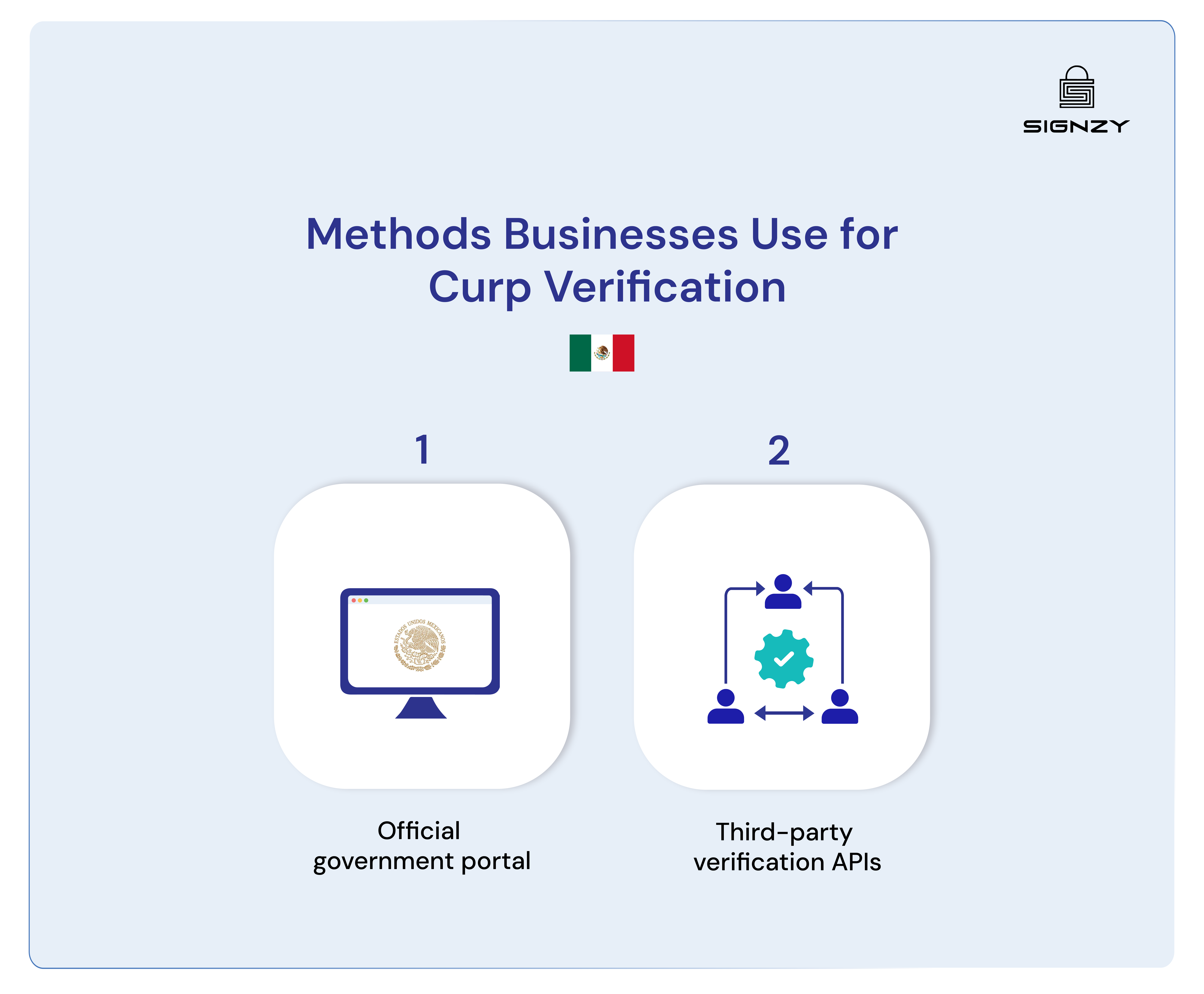
Method 1: Official Government Portal
The most straightforward (and free) way to verify CURP codes is through Mexico’s official government site: https://www.gob.mx/curp/
The process:
- Go to gob.mx/curp.
- Enter the 18-character CURP, or search by personal data (names, surnames, date of birth, sex, and state of birth).
- Complete the verification code (captcha).
- Compare the returned name, date of birth, sex, and state of birth with the data your customer provided.
- Download or print the CURP record if you need it for your files.
The portal is designed for one-off lookups. It works for a few checks, but it has no bulk option or integration, so it doesn't suit customer onboarding at scale.
💡 Related Blog:
Method 2: Third-Party Verification APIs
For onboarding at volume, a CURP verification API checks the data against RENAPO records automatically and returns a structured result your system can act on, with an audit trail for compliance.
The process:
- Integration: Connect the verification service to your application using their API
- Data Collection: Gather the user’s CURP or personal information
- Verification Request: Send this data to the verification API
- Database Check: The service checks against RENAPO’s official database
- Response Processing: Receive verification results within seconds
- Result Handling: Your system decides what to do based on the response
Once the API is integrated, these steps run in the background of your sign-up flow. The cost per check is usually far lower than the staff time needed to verify identities by hand, and every result is logged for audits.
Signzy’s Mexico CURP Verification API
Several providers offer CURP checks. Signzy's Mexico CURP Verification API is built for onboarding flows in Mexico and returns field-level results you can act on automatically.
Signzy’s API offers:
- Cross-referencing of personal data against authorized Mexican government databases.
- Match/no-match verification of first name, father’s surname, mother’s surname, date of birth, gender, and the CURP itself.
- Results and audit logs designed to support Mexican KYC compliance processes.
In practice, one API call checks the CURP and each identity field, so you can approve a customer, reject them, or route them to manual review automatically.
CURP is one piece of KYC in Mexico. For the tax side, see our guide to the Mexico RFC; for how CURP, RFC, and CLABE fit together, read CURP, RFC, and CLABE explained; and if you're comparing vendors, see the best KYC verification platforms in Mexico.
Talk to Signzy to test the Mexico CURP Verification API in your onboarding flow.


FAQ
Is CURP verification enough for KYC compliance in Mexico?

Can I verify a CURP for free?
Does a valid CURP prove someone's identity?
Do foreign residents in Mexico have a CURP?
Is biometric CURP mandatory in 2026?
What data should we keep after a CURP check?
Saurin Parikh
Saurin is a Sales & Growth Leader at Signzy with deep expertise in digital onboarding, KYC/KYB, crypto compliance, and RegTech. With over a decade of professional experience across sales, strategy, and operations, he’s known for driving global expansions, building strategic partnerships, and leading cross-functional teams to scale secure, AI-powered fintech infrastructure.

Related Blogs
View all

KYB in Mexico: Article 115 and CNBV Rules Explained

Signzy and MagicPay Partner to Streamline Merchant Onboarding in Mexico

Mexico RFC Number: How to acquire & verify RFC in 2026 (Step-by-Step)

CURP, RFC, and CLABE: Complete Mexico ID Guide (+ When to Use What)
The best in business


The global API marketplace for KYC, KYB, & AML
Explore the end-to-end verification stack trusted by 1,000 businesses.
Get in touch