





10 Best KYB verification Solutions in Mexico, Ranked [2026 Guide]

- What are KYB verification tools?
- How can KYB tools help with Mexican compliance?
- How were the best KYB tools selected?
- 10 Best KYB verification tools in Mexico
- #1. Signzy
- #2. Shufti Pro
- #3. Sumsub
- #4. Persona
- #5. Trulioo
- #6. LexisNexis Risk Solutions
- #7. KYCKR (FullCircl)
- #8. IDMERIT
- #9. Moody’s Orbis
- #10. Middesk
- How Signzy streamlines Mexican KYB verification?
- FAQ
If you're doing business in Mexico, you know that verifying your business clients has become pretty important. The good news? There are some genuinely solid KYB solutions out there now that make this a lot easier than it used to be.
Mexico has its own quirks when it comes to business verification. You're dealing with RFCs, different corporate structures like SAPIs and SAs, and you need to pull data from Mexican government databases. The CNBV has specific requirements, too, especially if you're in fintech or financial services.
We spent time looking at the KYB providers that actually operate in Mexico and understand the local setup. Further, we ranked them based on speed, accuracy, how easy they are to integrate, and what kind of support they offer. Before anything, let's understand what exactly a KYB verification tool is.

What are KYB verification tools?
Know Your Business (KYB) tools help you confirm whether a business is real, registered, active, and safe to work with. They gather information from places like tax authorities, government registries, and corporate filings. Then they connect that data with identity checks on the people behind the company, especially owners and decision makers.
Instead of doing all this manually (searching registries, requesting documents, chasing signatures, verifying IDs, screening for sanctions), these tools automate it. That matters because business risk today isn't just about legitimacy. It's about exposure, compliance, and the shared responsibility between you, regulators, and whoever you onboard.
How can KYB tools help with Mexican compliance?
Mexico has compliance expectations that go beyond "does this company exist." Verifying a business there usually means combining tax identifiers, public registry information, documents, and screening steps.

A good KYB tool brings all of that into one process you can repeat, audit, and scale.
⏩ Beneficial ownership verification
Mexican AML rules under LFPIORPI (Ley Federal para la Prevención e Identificación de Operaciones con Recursos de Procedencia Ilícita) require identifying the individuals who ultimately benefit from or control a business. That goes beyond listing shareholders. KYB platforms can map ownership structures, analyze submitted documents, and screen individuals against watchlists or politically exposed persons (PEP) lists.
This helps teams avoid relying solely on self-declared ownership, which can hide risk or create compliance gaps.
⏩ RFC validation and tax status checks
The Registro Federal de Contribuyentes (RFC) is the anchor identifier for legal entities in Mexico. A mismatch or inactive status can signal fraud risk, non-compliance, or ongoing legal issues.
Some KYB systems can streamline this step by automatically validating the RFC against available data sources and comparing it with submitted documents, reducing false approvals and manual back-and-forth with applicants.
⏩ Registry and corporate record verification
Public commercial records in Mexico vary in structure and digital maturity, depending on the state and entity type. KYB tools help by gathering what is available, standardizing formats, and filling gaps with document verification workflows.
This creates a more consistent onboarding experience even when public data quality is uneven.
⏩ AML screening and sanctions checks
Mexican compliance isn’t limited to entity validation. Screening must include both the business and key individuals.
KYB platforms centralize sanctions lists, enforcement actions, and PEP classification so teams don't have to manage multiple disconnected databases. This reduces oversight gaps and makes screening outcomes more defensible.
⏩ Ongoing monitoring obligations
Mexico treats due diligence as an ongoing responsibility, not a point-in-time event. Risk profiles can shift after onboarding.
KYB tools automate periodic re-screening and trigger alerts if ownership changes, a sanctions result appears, or new negative media emerges. This prevents compliance teams from relying on outdated information.
⏩ Auditability and decision traceability
Regulators, especially under CNBV oversight, expect companies to show evidence of how onboarding decisions were made. KYB systems help by recording each step: data sources used, documents reviewed, screening outcomes, and who approved the case.
How were the best KYB tools selected?
The evaluation started with a simple question: Does this tool meaningfully support KYB in Mexico's environment? Mexico has uneven registry digitization, variable document standards, and regulatory requirements that combine AML expectations with tax identity and ownership clarity. Tools were reviewed based on how well they handle those realities.
Each platform was assessed across several dimensions:
- The quality and reliability of business data available for Mexican entities
- How they handle ownership and AML screening
- Whether automation supports or complicates onboarding at scale
- Real-world usability, including support responsiveness and implementation maturity
Industry fit was also considered. A tool perfect for a bank may not be necessary for a marketplace onboarding small suppliers, and vice versa. Finally, user feedback and known operational pain points were included because capability without dependable execution isn't useful in compliance-heavy environments.
The result is a blended ranking: part accuracy, part operational feasibility, and part alignment with Mexican compliance expectations.
10 Best KYB verification tools in Mexico
Below's a quick view of.10 best KYB verification tools in Mexico, followed by detailed discussions on each tool.
| Rank | Tool | Best Fit | One-line Takeaway |
|---|---|---|---|
| #1 | Signzy | Teams needing an AI-driven, globally scalable KYB platform with native RFC, CURP, and document automation | A global KYB platform operating in 180+ jurisdictions that handles Mexico’s mixed registry and document reality without requiring separate workflows or manual workarounds. |
| #2 | Shufti Pro | Organizations onboarding Mexican SMEs and sole traders with inconsistent documentation | Handles Mexican business paperwork well and works when verification depends more on document evidence than structured registry data. |
| #3 | Sumsub | Companies want one KYB system for Mexico and international markets | A structured end-to-end verification pipeline that works across countries, though the workflow can feel rigid in Mexico’s messy onboarding scenarios. |
| #4 | Persona | Teams that need flexible local workflows for Mexico, rather than one fixed global rule set | Best when Mexico onboarding requires conditional steps like “RFC → CURP → documents if needed” instead of a single standardized flow. |
| #5 | Trulioo | Global teams onboarding Mexican entities with complete digital footprints | Strong when the business already appears cleanly in Mexican registries or has cross-border records. Less effective for SMEs without polished data trails. |
| #6 | LexisNexis Risk Solutions | Regulated Mexican institutions prioritize risk scoring and enforcement signals. | Useful where KYB is tied to AML rigor and audit-proof, not just entity existence. Good for high-risk Mexico onboarding scenarios. |
| #7 | KYCKR (FullCircl) | Teams requiring registry-sourced legal confirmation for Mexican entities | Ideal when the entity exists in digitized Mexican registries. Not suitable as the only tool when onboarding SMEs with limited digital presence. |
| #8 | IDMERIT | LATAM-focused teams onboarding Mexican SMEs with varied data maturity | Works well in Mexico when registry data is incomplete and verification depends on RFC and document checks. Practical but lighter on advanced compliance features. |
| #9 | Moody’s Orbis | Teams onboarding Mexican entities with foreign ownership or complex structures. | Great for mapping ownership behind a Mexican business, especially when international holding companies influence risk scoring. Not a standalone KYB engine. |
| #10 | Middesk | Platforms onboarding Mexican companies that also operate in the United States | Ideal only when the applicant has both Mexican and U.S. corporate identity footprints. Not usable as a standalone KYB solution for Mexico. |
#1. Signzy
👉 Best for: Teams that want automated KYB for Mexico with native support for RFC validation, document-driven verification, and ongoing AML monitoring.
Signzy offers an AI-driven KYB platform designed to operate in jurisdictions without a single authoritative registry source, which matches the reality of Mexico. The platform supports the extraction and validation of Mexican documents such as Acta Constitutiva, Poder Notarial, and legal representation evidence.
KYB verification often requires combining SAT RFC validation, RFC status checks, CURP checks for legal representatives, commercial registry data, and supporting legal documents. Signzy provides automation for these paths rather than assuming every business exists in a single structured dataset.
We didn’t buy it expecting magic, but the reduction in manual checks was noticeable. Once the RFC and representative workflows were tuned, about a third of cases just moved through without anyone touching them. That changed our workload planning.
— Chief Compliance Officer, Mexican Enterprise Fintech (1000+ employees)

Where automation is possible, Signzy handles verification through API-based data enrichment. When information exists only through documents, its document AI can extract, validate, and route cases with rules rather than manual review.
The system is scalable and has been deployed by more than 600 institutions globally, including 10+ Fortune 30 organizations.
I never write reviews, seriously. But moving from Mexico KYB to UAE onboarding without rebuilding everything caught us off guard. We just swapped the data sources, and the workflows stayed the same. Our team expected weeks of rework. Instead, we lived in days. Kind of thankful we chose Signzy because that saved a ton of effort.
— Risk Officer, cross-border payments platform (500+ employees)
Signzy’s key capabilities
- Native RFC verification and CURP validation for legal representatives support statutory identity and tax identity checks
- AI-driven extraction and comparison of Acta Constitutiva and Poder Notarial for representation validation
- Automated UBO discovery and AML screening align with expectations for obligated entities under LFPIORPI and CNBV oversight
- Configurable workflows allow differences across risk classes, market segments, and industries
- Scales onboarding volume without proportional staff increase, which is relevant for high-growth fintechs and enterprise onboarding teams
We tried two other KYB tools before Signzy, and both broke down the moment we dealt with Mexican SMEs without clean registry data. With Signzy, once we tuned the RFC and document flow, approvals became predictable. Honestly, I'm relieved we switched.
— Chief Risk Officer, Digital Lender (200+ employees)
Signzy’s pros and cons
✅ Fits Mexico’s mixed-data onboarding reality instead of assuming one verification source will work for every business type.
✅ Automation reduces repetitive work, which can meaningfully lower review time once workflows stabilize.
✅ Flexible enough to support structured enterprises, newly incorporated SMEs, and document-first cases in the same onboarding engine.
✅ Cost efficiency improves as automation replaces review repetition rather than increasing headcount for growth.
❌ Teams still need a basic compliance framework before configuring the workflow; otherwise, they spend time defining rules mid-implementation.
#2. Shufti Pro
👉 Best for: Organizations needing broad geographic KYB reach, including Mexico, where registry data is fragmented, and document verification remains essential for SMEs and sole legal representatives.
Shufti Pro’s relevance in the Mexican market comes from its hybrid verification approach: registry lookup when possible, and human review when needed. That matters because many Mexican companies, especially smaller ones, rely on document-based corporate existence proofs like Acta Constitutiva, Poder Notarial, and CFDI invoices rather than fully digitized registry records.
Shufti Pro is often adopted when the compliance function must handle unpredictable data maturity levels across customer types, such as marketplaces, B2B SaaS, or onboarding flows involving service providers or import/export operators.
Shufti Pro’s key capabilities
- Supports Mexican corporate documents and can extract structured data via OCR for comparison against application details.
- Can validate addresses and business information where automation signals are not strong enough for registry-only matching.
- UBO screening supports AML frameworks aligned with FATF methodology, which is relevant because Mexico is a FATF jurisdiction.
- Multi-language support simplifies workflows for legal representatives and compliance review teams.
Shufti Pro’s pros and cons
✅ Flexible verification approach reduces failure rate in fragmented data environments where registry digitization varies.
✅ Supports a wide range of document formats, which is useful when onboarding SMEs with incomplete or non-standard records.
❌ Accuracy can fluctuate in document-heavy workflows, leading to rechecks or manual review.
❌ Limited workflow orchestration compared to platforms designed for automated escalation and monitoring.
#3. Sumsub
👉 Best for: Companies that want one structured KYB system for Mexico and other countries, instead of separate tools.
Sumsub operates like a verification pipeline. You define the steps, conditions, and thresholds, and the platform runs them in sequence. That usually includes entity checks, RFC validation, document review when records are incomplete, ownership identification, and AML screening. This structured flow fits Mexico because KYB often requires multiple signals rather than one authoritative registry source. The system brings them together instead of relying on manual comparison.
However, structure is only valuable if the operational layer behind it is dependable. One user review you shared points to a weakness worth noting. The reviewer explained that support responses were slow, dismissive, and often redirected responsibility back to the client's platform.
"Sumsub does not have any support; the way they reply is phlegmatic and indifferent, and not acceptable."
For a compliance system embedded in onboarding, that type of experience can create bottlenecks. The case backlog risk increases if the support response time is slow. Signzy is designed to minimise this by keeping decisioning logic and automation closer to the product and operations teams.
Sumsub’s key capabilities
- Can combine corporate data, RFC-like identifiers, and company metadata into one risk view instead of dumping raw fields.
- Supports a flow where you verify the entity, then automatically move into UBO checks and KYC on key individuals.
- Offers ongoing screening and monitoring, which lets you meet “know your customer” obligations as a process.
- Let's you define country-specific flows, so Mexico can have stricter steps than, say, a low-risk EU market if needed.
Sumsub’s pros and cons
✅ One pipeline for data, documents, and AML, which reduces tool sprawl and manual stitching.
✅ Monitoring and history around cases gives compliance teams a traceable story if regulators ask “what did you check and when”.
❌ Reported weak support means incidents can stay open longer than acceptable for regulated onboarding.
❌ Rigid structure can feel heavy if you want to experiment quickly with different KYB strategies per segment.
#4. Persona
👉 Best for: Companies that need flexibility to design Mexico-specific KYB workflows instead of relying on one rigid verification path.
Persona behaves like a configurable compliance engine rather than a fixed KYB product. You define workflows, risk logic, and fallback paths, and the platform executes them consistently. That matters in Mexico because the quality and structure of business data vary widely.
A large corporation in an industrial hub may have clean digital records. A small service business may only have scanned documents and an RFC certificate. Persona supports both without forcing a single verification format or rigid path.
Persona’s key capabilities
- Conditional verification flows that adjust based on entity type, risk, document availability, or jurisdiction
- Ownership and representative verification are built into the same process rather than separate checks
- Document-driven verification for SMEs with limited registry presence
- Clear review and escalation paths when files or signals conflict
- Suitable for teams scaling into multiple markets where flexibility matters more than rigid automation
Persona’s pros and cons
✅ Strong fit for Mexico's uneven data environment, where no single verification method works for all applicants.
✅ Combines business verification and key-person verification in one workflow, reducing operational steps.
❌ Requires structured implementation and governance, or the flexibility becomes operational noise.
❌ Not ideal for teams seeking ready-made automation without configuration effort.
#5. Trulioo
👉 Best for: Global onboarding teams where Mexican entities represent part of a multi-country verification program.
Trulioo is built around data coverage and automation rather than customization. The platform connects to a broad network of registries and private datasets, allowing businesses to confirm entity existence, ownership, and risk signals quickly. In Mexico, this works well when onboarding entities with strong digital footprints, cross-border corporate linkage, or regulated financial profiles. If the entity exists in structured data, Trulioo can process it efficiently.
Where Trulioo becomes valuable is in enterprise onboarding scenarios where manual review creates bottlenecks. Ownership checks, sanctions screenings, and watchlist matching are executed in the same workflow, producing results in a format suitable for automated decision systems.
The tradeoff is rigidity. If the business cannot be matched through available sources, the fallback process may be slower or require human intervention.
Trulioo’s key capabilities
- Automated registry and database matching for entities with formal records
- Integrated ownership screening suitable for regulated or high-risk onboarding
- KYB and KYC verification in one system for cases where legal representatives must also be verified
- Useful when onboarding Mexican businesses that operate internationally or accept foreign investment
Trulioo’s pros and cons
✅ Strong choice when automation and scale matter more than customization. Signzy offers similar levels of automation while providing more granular control over workflow design, which can be useful in Mexico’s mixed data environment.
✅ Useful for regulated industries where ownership screening and ongoing checks are required.
❌ Less effective when verifying informal or newly registered Mexican SMEs without rich data trails.
❌ Automation requires oversight to avoid false approvals or compliance edge cases.
#6. LexisNexis Risk Solutions
👉 Best for: Mexican institutions that want to attach a risk lens to KYB, not just confirm registration and identity.
LexisNexis offers the InstantID® Business platform to conduct KYB verifications. It approaches KYB differently from most tools. Instead of stopping at "does this entity exist," the platform verifies the business, links it to associated individuals, and produces a Business Verification Index (0–50) that reflects potential risk exposure. This combines registry-level validation, tax and business data, ownership or authorized-signer information, sanctions screening, and watchlist checks.
What can influence implementation, however, is the vendor experience. Several user comments pointed to slow or rigid communication during onboarding and account management. One review described the interaction as "pushy," and another shared that follow-ups required repeated chasing. When a platform becomes part of regulated onboarding, that kind of friction has operational consequences and rivals may seem a better fit.
LexisNexis Risk Solutions’ key capabilities
- Entity validation, paired with authorization mapping, provides clarity on who has signing rights
- Risk scoring supports decisions in regulated environments where reasoning must be documented
- Broad screening coverage allows teams to detect risk tied to ownership, affiliations, or enforcement history
- Workflow integration supports automated approvals, manual review, or a mix, depending on risk
LexisNexis Risk Solutions’ pros and cons
✅ Combines verification, ownership linkage, and risk assessment in a single workflow aligned with compliance expectations.
✅ Decision summary and scoring help justify approvals and rejections during audits or regulatory review.
❌ Reported support and engagement friction may slow implementation and ongoing operations.
❌ Can feel heavier than necessary for low-risk onboarding, where basic verification is sufficient.
❌ Priced higher than many of the other tools in this list.
#7. KYCKR (FullCircl)
👉 Best for: Teams that want business verification sourced directly from official registries, not blended datasets or inferred corporate profiles.
KYCKR’s core value is its source philosophy. Instead of stitching together commercial databases or relying on probabilistic matching, the system retrieves information directly from government and authoritative registries.
In the context of Mexico, registry coverage varies depending on the type of business, sector, and jurisdiction. For entities that do exist in accessible government records, KYCKR can provide a reliable picture of legal standing, filing history, and registration status.
However, effectiveness depends entirely on registry digitization. When an applicant operates in regions or categories where data is fragmented or not digitized, KYCKR will often not return a usable result.
KYCKR (FullCircl)’s key capabilities
- Direct registry retrieval helps teams validate that a business exists and remains active
- Useful for onboarding programs where the compliance standard requires evidence tied to official records
- Supports environments where regulators require traceability from decision back to source
KYCKR (FullCircl)’s pros and cons
✅ High-confidence KYB verification when a Mexican entity exists in a digital registry environment.
✅ Strong audit defensibility since every data point is tied to original registry sources rather than secondary aggregation.
❌ Does not cover end-to-end KYB needs on its own. Most teams still need a screening or workflow layer.
❌ Coverage is binary: either records exist cleanly or nothing returns, which limits suitability in Mexico’s mixed-record landscape.
#8. IDMERIT
👉 Best for: LATAM-focused onboarding where registry quality varies and document pathways are required.
IDMERIT positions itself as a provider with regional depth rather than a platform optimized for North American or European data structures. The core advantage is coverage: the system can validate entities using official data sources, RFC checks, and document analysis when structured registry data is incomplete or unavailable.
IDMERIT does not offer ownership intelligence or continuous monitoring at the same depth as platforms like Signzy that are designed for highly regulated enterprise environments. As a result, teams evaluating it for regulated banking may require supplemental capabilities or additional validation.
IDMERIT’s key capabilities
- Works with Mexico’s mixed verification model by combining registry checks and document analysis when needed
- Supports legal representative identity verification alongside corporate data, aligning with AML expectations
- Suitable for companies that want to expand across LATAM without managing separate verification vendors country by country
IDMERIT’s pros and cons
✅ Helpful for businesses operating across multiple LATAM markets that need one framework instead of one vendor per country.
❌ Less enterprise-proven compared to older compliance brands, which means some firms will request additional validation.
❌ Monitoring capability is not as advanced or integrated as high-tier compliance ecosystems.
#9. Moody’s Orbis
👉 Best for: Teams that care about who stands behind a Mexican entity, not just whether the entity appears valid.
Orbis is essentially a very large, very structured company database. The useful part for KYB is not the existence check but the ownership picture. You can see parent companies, subsidiaries, branches, and in many cases, beneficial owners and links across countries.
For example, if you are onboarding a Mexican payments company with a holding in another jurisdiction, Orbis helps you see that relationship clearly and decide whether the group structure, not just the Mexican entity, is acceptable from a risk perspective. This is the type of analysis regulators expect in higher-risk sectors.
Orbis does not replace a KYB workflow engine. You still need something else to ask applicants for data and documents, run "approve or reject" logic, and store case decisions. Orbis is the reference source you query when a case is not straightforward, and you need evidence on structure.
Moody’s Orbis’ key capabilities
- Useful for Mexican companies that have foreign parents, investment funds, or cross-border holding layers.
- Supports identification of complex shareholding patterns, which helps distinguish normal corporate structure from risk-heavy ones.
- Can feed into your internal risk-scoring engine, so ownership depth becomes a factor instead of a manual note.
Moody’s Orbis’ pros and cons
✅ Provides ownership clarity that local registry views rarely supply, especially for cross-border structures.
✅ Strong fit for banks, PSPs, and regulated firms that must justify why a given entity’s ownership is acceptable.
❌ Does not run KYB workflows, so you must integrate it into another system to make decisions.
❌ Licensing and data model are overkill for teams that only need basic KYB on small, domestic Mexican clients.
#10. Middesk
👉 Best for: Platforms onboarding Mexican businesses that also operate in the U.S., especially where tax identity, cross-border trust signals, or KYB harmonization with U.S. compliance frameworks matter.
On its own, Middesk is not a Mexican KYB solution. However, its relevance emerges when onboarding Mexican entities with U.S. presence, tax registration, or business ties, because many marketplaces and fintechs treat Mexico-to-US compliance as a dual jurisdiction risk environment.
Middesk excels in environments requiring alignment with OFAC and U.S. AML frameworks, which complements Mexico’s own AML regime overseen by UIF and CNBV. In cross-border merchant or payment flows, this matters because even if a business is registered in Mexico, the moment they transact through a U.S. entity, the oversight scope expands. This cross-border relevance is the main reason Middesk appears in a list focused on Mexican KYB.
Middesk’s key capabilities
- Does not verify Mexican businesses directly, but helps when the same business has a U.S. entity, EIN, Delaware parent, or tax nexus.
- Useful for payments platforms onboarding dual-registered businesses, common in logistics, SaaS, e-commerce sellers, or U.S.-Mexico export companies.
- Supports AML expectations aligned to FATF membership (Mexico is a FATF member), making it compatible with international due diligence expectations.
- Acts as a complement to a Mexico-capable KYB tool rather than a replacement.
Middesk’s pros and cons
✅ Very high accuracy for U.S. corporate identity and tax validation, making it ideal for dual jurisdiction compliance models.
❌ No native coverage for Mexican registries or RFC validation, requiring a second KYB provider for full compliance in Mexico.
❌ Not suitable for global KYB. Any company operating beyond the United States will need additional tooling to avoid fragmented workflows.
How Signzy streamlines Mexican KYB verification?
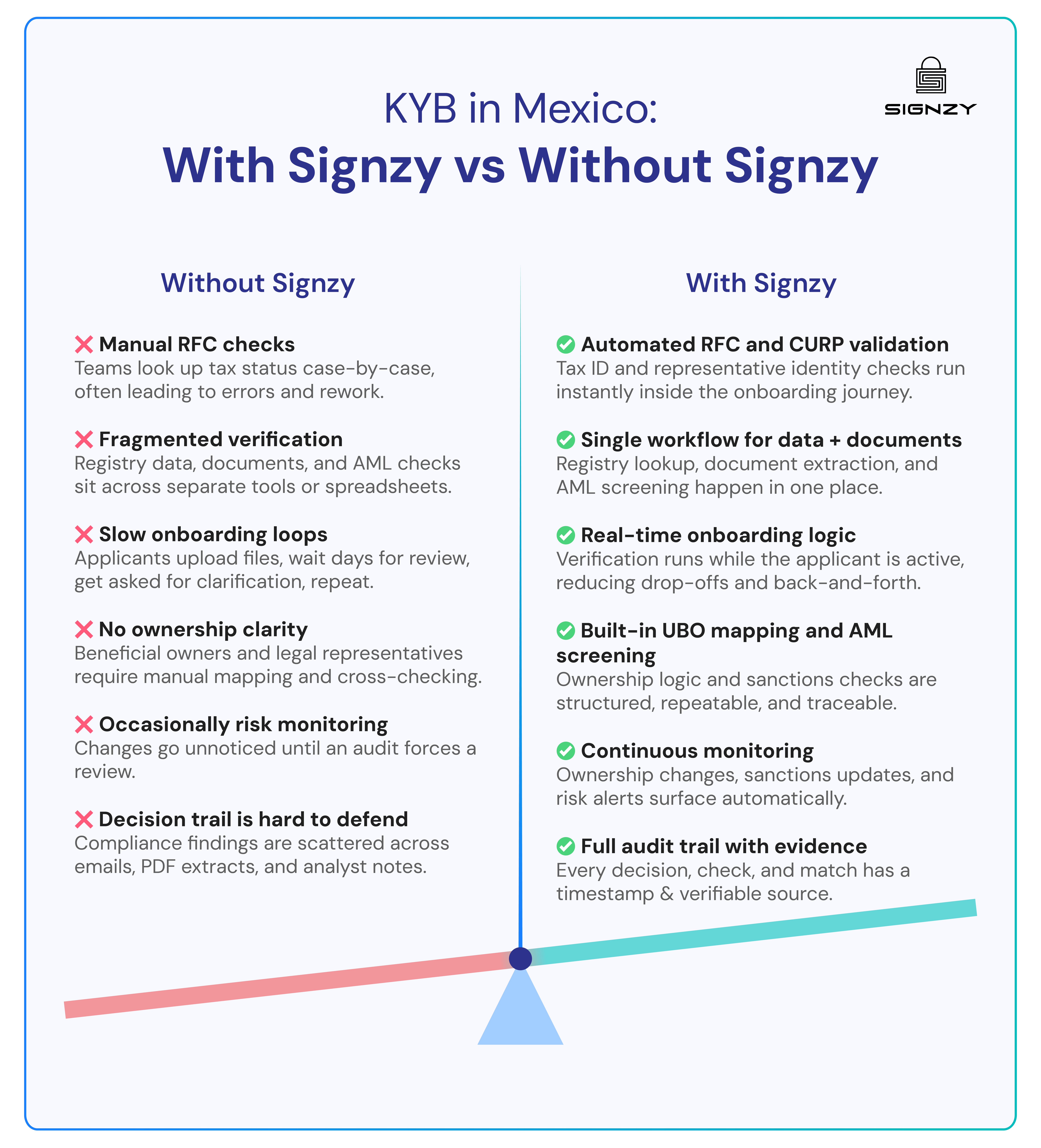
If you are considering upgrading or formalizing KYB in Mexico, explore how Signzy's structured verification can help you evaluate whether your current process is scalable or only temporarily functional.
🔗 API integration and real-time onboarding
Signzy fits directly into the onboarding flow rather than sitting on the side as a separate compliance step. Verification events are triggered automatically when a business submits information, so checks run while the user is engaged, not after the fact. This shortens the delay between application and decision, which can materially reduce abandonment in Mexico, where document submission and back-and-forth approvals are common.
Real-time onboarding helps remove friction because the experience feels like part of the sign-up journey, not an audit. Instead of asking a business to upload files, wait for review, and then respond to clarifications, the workflow becomes structured and responsive.
This creates a cleaner process where compliance does not interrupt product experience.
🧩 Modular verification rather than one fixed setup
Signzy does not require building the full compliance workflow on day one. The system is modular, so verification can expand as risk exposure, regulation, or scale increases. This gives teams space to align compliance maturity with business needs rather than over-engineering from the start.
Some examples of how a modular KYB setup works:
- A company may begin with basic entity verification and RFC checks
- Once onboarding volume increases, ownership verification and document screening can be added
- When the business enters a regulated category, ongoing monitoring and AML screening can be layered in
- For cross-border onboarding, international registry and document modules can be activated
By evolving the workflow rather than rebuilding it, teams avoid the fatigue and operational disruption common in compliance program redesign.
A modular approach also helps new markets because the workflow can adapt without rewriting the core logic.
⚡ Scalability for mixed onboarding scenarios
Mexico has a wide distribution of business maturity. A percentage of entities appear cleanly in structured registry data. Others rely on document-based proof because their filings are fragmented, regional, or not digitized. Signzy supports both patterns, which allows onboarding to scale without creating separate tracks for different types of businesses.
When verification adapts to the format of the data rather than expecting the business to meet a rigid structure, approval flow becomes more predictable. Analysts spend less time interpreting documents manually and more time resolving edge cases. This is useful for platforms onboarding a combination of SMEs, regulated entities, international subsidiaries, and suppliers.
Scaling is not just about volume. It is about keeping the verification process stable as the mix of applicant types becomes more diverse. Signzy is designed for that type of evolution.
🖥️ Monitoring and audit traceability
Once a business is approved, the verification record does not disappear. Signzy stores the supporting data, outcomes, and decision history so compliance teams can reference it during internal reviews or regulatory assessments. Each verification event, document submission, and screening match is logged in a way that is easy to retrieve.
Continuous monitoring can be applied across ownership, sanctions lists, and other relevant risk signals. If something material changes, the system can surface the event instead of relying on manual periodic reviews.
In regulated industries, this reduces the gap between onboarding and ongoing due diligence. The result is a KYB framework that behaves like a living control rather than a one-time task.
If Signzy looks like a fit, you can book a demo and review how the workflow applies to your use case.


FAQ
How is KYB different from KYC in Mexico?

Why do businesses in Mexico need KYB?
What information is used in Mexican KYB checks?
Can KYB platforms validate Mexican SMEs?
Do KYB tools integrate AML screening in Mexico?
Saurin Parikh
Saurin is a Sales & Growth Leader at Signzy with deep expertise in digital onboarding, KYC/KYB, crypto compliance, and RegTech. With over a decade of professional experience across sales, strategy, and operations, he’s known for driving global expansions, building strategic partnerships, and leading cross-functional teams to scale secure, AI-powered fintech infrastructure.

Related Blogs
View all

7 Best EIN Verification Services in 2026: Features & Best Picks

KYB in Mexico: Article 115 and CNBV Rules Explained

Mexico RFC Number: How to acquire & verify RFC in 2026 (Step-by-Step)

CURP, RFC, and CLABE: Complete Mexico ID Guide (+ When to Use What)
The best in business


The global API marketplace for KYC, KYB, & AML
Explore the end-to-end verification stack trusted by 1,000 businesses.
Get in touch