





What Is Document Verification? Process, Benefits & Compliance Guide [2026]

 Open in ChatGPT
🗒️ Key Highlights
- Document verification uses OCR, AI, and biometric matching to confirm the authenticity of IDs, passports, licenses, and business documents — detecting fabricated, stolen, and tampered documents in real time.
- Businesses in banking, fintech, crypto, insurance, and other regulated industries use document verification to meet KYC/AML requirements under frameworks like FATF Recommendation 10, FinCEN's Bank Secrecy Act, and the EU's 6th Anti-Money Laundering Directive.
- In 2025, synthetic identity fraud grew 8× year-over-year (LexisNexis), and high-risk document tampering rose 28.5% (Resistant AI) — making automated verification essential for fraud prevention at scale.
- Platforms like Signzy support 14,000+ document types across 240+ countries, enabling organizations to automate the full document verification lifecycle — from document capture through compliance decisioning — in under 5 seconds.
As digital communication is on the rise, verifying the legitimacy of a document being scanned, emailed, or sent online has become important. Document verification services employ protocols and procedures to evaluate whether a document is real.
What is document verification?
The document verification process defines the steps of recognizing documents and ensuring their legitimacy. Depending on the situation, such documents may vary from notarized documents to personal or professional ID cards, contractual agreements to passports. Document verification is an important part of KYC compliance.
While the process can appear tiresome, its relevance remains high, especially with the pace of technological improvements and rising cybercrime. AI-driven technology, for example, can generate deep fakes and lead to illegal activities using personal and sensitive data of an individual or critical data of an organization. Document verification is necessary with identity-related paperwork such as passports, licenses, and other important documents.
During KYC compliance, document verification reduces these risks and provides a more secure experience for all end users.
Online document verification is an improvement on the existing methods of physically verifying paperwork. It allows businesses to review and verify their users’ information from anywhere.
Why is document verification important?
Without proper verification measures, fake or stolen documents can be used to open an account(s). Document verification helps in catching forgeries and reducing fraud.
Based on an Internet Crime Complaint Centre (IC3) report, the number of identity theft complaints has gone down from 27,922 to 19,778. However, based on the same report, the amount of losses reported due to identity theft still stands at $126.2 million.
Incorporating document verification into their KYC compliance processes can help businesses lower the risk of fraud and ensure the security of their operations.
Organizations must consider incorporating this process into their KYC compliance efforts to lower the risk of fraud while still ensuring the security of their operations. Businesses can confirm the legitimacy of a person’s identity by verifying identity documents such as ID cards, passports, social security numbers, and other official documents.
When sensitive information is at risk, document verification takes a high priority. Here’s a list of businesses that need to have proper document verification methods in place:
- Financial Institutions and Banks: Document verification is an important step in the KYC process during client onboarding for financial institutions like banks, credit unions, and more. It ensures that the customers are who they say they are when opening accounts or applying for credit.
- Healthcare: The healthcare industry uses document verification to verify the identity of a patient and ensure that the appropriate individual receives the right treatment.
- E-commerce: Online marketplaces employ document verification to affirm the sellers’ and purchasers’ identities. This helps in preventing fraudulent transactions as confirmed identities.
- Gaming and Gambling: Document verification is used in online gaming and gambling to verify age and comply with regulatory laws. Users are required to provide proof of age documents, such as a driver’s license or another form of government-issued ID card, during the registration process.
Physical document verification vs. digital document verification
Physical document verification is an older technique in which an individual’s identification and supporting documents are verified in person. This process requires a face-to-face meeting and a manual check of printed documents to ensure their validity and authenticity.
Although this method has a long history, it is time-consuming, susceptible to human error, and less secure due to the possibility of getting lost, theft, or forgery.
In contrast, digital document verification employs electronic methods such as document scanning and the use of document verification software. The benefits are obvious: it is faster, more precise, and secure. In a research conducted by RegulaForensics, 65% of the respondents to their survey preferred digital document verification as their identity verification method.
Businesses and individuals are increasingly turning to digital verification solutions to ensure a higher degree of security and efficiency.

Benefits of online document verification
Online document verification can provide significant benefits to your organization. Some of the benefits have been highlighted below:
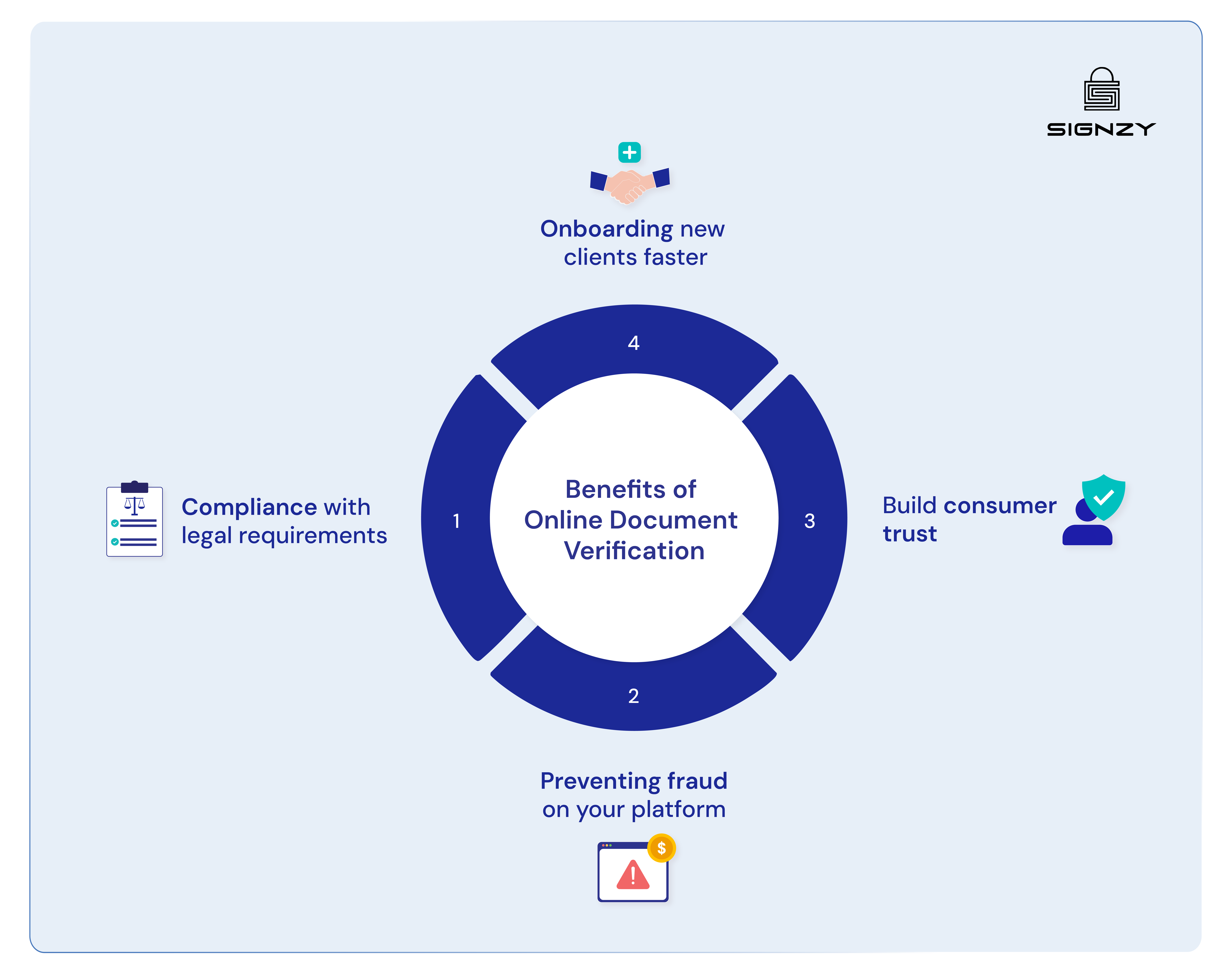
- Compliance with legal requirements: Depending on the industry in which your organization works, you may be obligated by law to verify new users’ identities. Document verification is a widely acknowledged and extremely successful method of ensuring legal KYC compliance.
- Preventing fraud on your platform: Even if you are not required by law to verify user identity, doing so can help you reduce the occurrence of identity theft and other types of fraud on your platform (such as account creation fraud).
- Build consumer trust: Integrating identity verification (in its different forms) into your onboarding process can go a long way toward increasing customer trust in your company or platform. Since all the users complete the same verification, bad actors will find it far more difficult to get through and wreak harm.
- Onboarding new clients faster: When combined with automation, online document verification can be accomplished in seconds in many circumstances. This is far faster than manual review, which might take minutes or days depending on the techniques utilized.
What Are the Best Practices for Implementing Document Verification?
Effective document verification requires more than selecting a technology provider. It demands a thoughtful approach to risk, user experience, and ongoing optimization. The following best practices apply across industries and use cases.
1. Define your risk appetite and compliance requirements first. Before configuring any verification flow, map your regulatory obligations (KYC, AML, age verification, data privacy) and determine your fraud risk tolerance. This determines which document types you require, what level of biometric assurance is needed, and how you handle edge cases.
2. Use risk-based document requests. Not every user needs the same level of scrutiny. Apply progressive verification: low-risk users receive streamlined flows (single document, basic checks), while high-risk users — flagged by transaction amount, geography, or behavioral signals — trigger Enhanced Due Diligence with additional documents and biometric steps. This approach is aligned with FATF's risk-based approach to CDD.
3. Combine document verification with biometric signals. Document checks alone cannot detect false documents (genuine documents used by the wrong person). Pair every document flow with liveness detection and facial matching for meaningful fraud prevention.
4. Automate routine decisions, escalate edge cases. Use AI for clear pass/fail outcomes. Route ambiguous results — borderline image quality, partial data mismatches, unusual document types — to human reviewers. This maximizes speed for the majority of verifications while preserving accuracy for complex cases.
5. Support multilingual and global document types. If you operate cross-border, ensure your system handles non-Latin scripts, regional ID formats, and jurisdiction-specific regulatory requirements. A system trained only on Western European documents will produce unacceptable false rejection rates in markets like India, MENA, or Latin America.
6. Monitor performance and iterate continuously. Track key metrics: verification pass rate, false rejection rate, fraud detection rate, onboarding abandonment rate, and time-to-verify. Use this data to refine rules, adjust thresholds, and identify emerging fraud patterns. KYC best practices evolve as threats evolve — static configurations degrade over time.
7. Ensure data security and privacy compliance. Encrypt documents in transit and at rest. Implement data minimization — collect only what's necessary. Define retention policies aligned with GDPR, CCPA, India's DPDPA, and local privacy regulations. Provide users with clear consent mechanisms and transparency about how their data is handled.
Signzy’s Document Verification APIs
Document verification is an important part of customer identity verification, and it also serves as an integral part of the KYC process. As digitization gains greater traction, the document verification process has also moved online. Therefore businesses need to update their verification standards to allow ease of use for customers.
In the modern business environment, Passport verification, Social Security Number (SSN) verification, and Driver’s License (DL) verification are some of the most commonly used identity verification methods. Signzy offers a vast toolkit of APIs to help businesses move to or improve their online document verification standards.


FAQ
What is the difference between document verification and identity verification?

What documents are most commonly used for KYC verification?
How accurate is automated document verification compared to manual review?
Which regulations require document verification?
How long does automated document verification take?
Can document verification detect deepfakes and AI-generated IDs?
What is the cost of implementing document verification?
How does document verification work for non-English documents?
What happens when a document fails verification?
What is the difference between document verification and document authentication?
Saurin Parikh
Saurin is a Sales & Growth Leader at Signzy with deep expertise in digital onboarding, KYC/KYB, crypto compliance, and RegTech. With over a decade of professional experience across sales, strategy, and operations, he’s known for driving global expansions, building strategic partnerships, and leading cross-functional teams to scale secure, AI-powered fintech infrastructure.

Related Blogs
View all

![KYC Challenges: Common Issues + Solutions [2026 Guide]](https://cdn.sanity.io/images/blrzl70g/production/a54a1ddd2fec7fc298bd7152a176ce79ebdd74de-5642x1326.png)


The best in business


The global API marketplace for KYC, KYB, & AML
Explore the end-to-end verification stack trusted by 1,000 businesses.
Get in touch