





9 best bank account verification tools in the US [2026 Guide]

- What is a bank account verification tool?
- Key Takeaways: 10 Best bank account verification tools in the US
- How can bank account verification help with US compliance?
- How is a bank account verified? Key verification methods explored
- Best bank account verification tools in the US: Features, pros, and cons explored
- #1. Signzy
- #2. Yodlee
- #3. Plaid
- #4. LexisNexis Risk Solutions
- #5. LSEG Risk Intelligence
- #6. Stripe Financial Connections
- #7. iDenfy
- #8. Sumsub
- #9. Mastercard Account Owner Verification
- How to choose a bank account verification tool?
- How quickly can businesses deploy Signzy's verification APIs?
- FAQ
If you're processing ACH payments, paying out to vendors, or handling bank transfers at any scale, you've probably dealt with account verification at some point. Maybe you're doing it manually right now, or maybe you're using a tool that's only solving part of the problem.
Bank account verification tools basically check whether the account information someone provides is legitimate. The good ones do this in real-time, so you're not slowing down your workflow or finding out about issues after the fact.
There are quite a few options in the US market, and they range pretty widely. Some are built for high-volume operations that need instant results. Others are geared toward companies that need deeper checks for compliance or fraud prevention. And depending on what else you're handling (invoicing, payments, reconciliation, etc), you might want something that plugs into your existing setup versus a standalone tool.
We spent some time looking at the main players' businesses that they actually use. What we found is that the "best" tool really depends on what you're trying to solve for. Here's how the top options stack up and what to consider for your specific situation. But first, here's a quick definition to ensure we are on the same page, followed by an article summary if you are short on time.
What is a bank account verification tool?
A bank account verification tool checks that a bank account is real, active, and belongs to the person who claims to own it. These tools connect with banks or data providers to automatically confirm account details, replacing the need for manual paperwork review and reducing errors in payment processing.
Key Takeaways: 10 Best bank account verification tools in the US
- Instant verification specialists like Signzy, Plaid, and Stripe Financial Connections excel in speed and user experience through OAuth and API-based methods. While Plaid and Stripe focus primarily on US ACH payments, Signzy extends instant verification across 180+ countries with integrated KYC/KYB capabilities and flexible pricing.
- Enterprise platforms like LSEG Risk Intelligence and LexisNexis provide comprehensive fraud detection with identity graphs and risk scoring. They suit regulated industries requiring sophisticated analytics, transaction monitoring, and audit trails, though complexity and pricing target larger organizations over startups.
- Global aggregators like Yodlee and specialized providers like iDenfy address international verification needs across multiple payment rails. Yodlee connects 17,000+ institutions for transaction data access, while iDenfy offers hybrid AI-manual review with pay-per-approval pricing for fraud-heavy industries.
- Signzy combines bank account verification with unified KYC/KYB/AML screening through no-code workflows, manual review fallback, and transparent pay-per-use pricing. The platform delivers sub-second verification, behavioral fraud detection, and NACHA/ACH compliance, designed for businesses needing scalable verification without enterprise overhead or forced feature bundles.
How can bank account verification help with US compliance?

Account verification helps meet several regulatory requirements at once, making operations more efficient while lowering the risk of penalties.
NACHA operating rules
The ACH network requires businesses that initiate payments to ensure account information is correct before sending transactions. ACH verification directly addresses these operational standards.
- Pre-transaction validation: NACHA requires originators to validate account details before initiating ACH payments, and verification tools provide the technical means to meet this standard at scale.
- Return rate management: Verifying accounts before transacting reduces failed payments due to incorrect details, helping you stay below NACHA's return rate thresholds that trigger network scrutiny.
- Unauthorized debit prevention: Confirming account ownership before pulling funds helps prevent unauthorized debits, which NACHA treats as serious violations that can result in penalties or network removal.
- Documentation requirements: Verification records serve as evidence that you took reasonable steps to confirm account validity, which matters during NACHA audits or dispute resolution processes.
Proper account verification helps maintain good standing within the ACH network by demonstrating you're operating with adequate controls over the payments you originate.
Office of Foreign Assets Control (OFAC) screening
OFAC rules prohibit transactions with sanctioned individuals and entities. While verification tools don't screen for sanctions directly, they provide the confirmed identity information needed for accurate OFAC checks. This matters because screening against wrong or incomplete data creates gaps where prohibited transactions might go unnoticed.
Account verification serves as a basic infrastructure that supports multiple compliance needs rather than solving just one regulatory problem.
Know Your Customer (KYC) and Know Your Business (KYB) requirements
There are two primary identification frameworks that support account verification, each addressing different entity types.
🧑 Know Your Customer (KYC): For individual customers, account verification matches the account holder's name to identity information, confirming the person controls a bank account at a legitimate financial institution. This creates a verifiable data point that supports customer identification programs and helps classify individuals into appropriate risk categories for ongoing monitoring.
🏦 Know Your Business (KYB): For business entities, account verification establishes that the company exists as a legal entity with actual banking relationships, not just as a registered name without operational substance. This helps confirm the business is real and operational, providing a foundation for assessing commercial relationships and transaction patterns.
Account verification doesn't complete KYC verification or KYB obligations alone, but it provides verifiable data points that strengthen your overall identification program.
Anti-Money Laundering (AML) standards
AML programs focus on understanding where money comes from and where it goes. Verification helps confirm that accounts belong to real people or legitimate businesses rather than fake entities. When paired with transaction monitoring, it shows regulators you've taken steps to prevent money laundering through your system.
How is a bank account verified? Key verification methods explored
Verification methods vary mainly in how fast they work, how much effort they require from users, and what type of confirmation they give. Primarily, these four bank verification methods are used across the world:
- Micro-deposit verification: This method sends two small test amounts to the account, and the account holder reports back what they received. It confirms someone can access the account and it works properly, but takes 2-3 days. It remains popular for one-time account setups where speed is less important than certainty.
- Instant account verification: Users log into their bank through a third-party API service like Plaid or Signzy that pulls account information directly from the bank's system. These APIs establish secure connections with financial institutions to retrieve account status, balance information, and ownership details in real time. You get immediate confirmation, but it only works if the bank supports the integration and users feel comfortable sharing their login credentials.
- Automatic bank account validation: This approach checks the account details against large databases that data providers maintain with information from financial institutions. You get a quick answer on whether the routing and account number combination exists in their records. It can also include prenote transactions that send a zero-dollar test payment through the ACH network to see if the receiving bank accepts it, confirming the account can receive payments.
- Document-based verification: Staff examine bank statements, cancelled checks, or official letters that customers submit to confirm account details and ownership. This method handles unusual cases and situations where automated verification isn't available, but doesn't scale efficiently for processing large numbers of verifications.
We’ve covered these methods in depth in our “How to Complete Bank Account Verification?" blog. For now, the above descriptions should be enough to tell you how these methods work. As of 2026, Instant Account Verification can be considered the most efficient and commonly adopted method.
That said, let’s now explore the best bank verification tools you can use when scaling in the US.
Best bank account verification tools in the US: Features, pros, and cons explored
| Feature | Signzy | Plaid | LexisNexis | LSEG | Stripe | iDenfy | Sumsub | Mastercard | Yodlee |
|---|---|---|---|---|---|---|---|---|---|
| Instant Verification | ✔️ | ✔️ | ✔️ | ✔️ | ✔️ | ✔️ | ✔️ | ✔️ | ✔️ |
| Global Coverage | ✔️ | ❌ | ✔️ | ❌ | ❌ | ✔️ | ✔️ | ✔️ | ✔️ |
| KYC/Identity Integration | ✔️ | ❌ | ✔️ | ✔️ | ❌ | ✔️ | ✔️ | ✔️ | ❌ |
| AML Screening | ✔️ | ❌ | ✔️ | ✔️ | ❌ | ✔️ | ✔️ | ✔️ | ❌ |
| Document Verification | ✔️ | ❌ | ❌ | ✔️ | ❌ | ✔️ | ✔️ | ❌ | ❌ |
| Biometric Verification | ✔️ | ❌ | ❌ | ✔️ | ❌ | ✔️ | ✔️ | ❌ | ❌ |
| API Integration | ✔️ | ✔️ | ✔️ | ✔️ | ✔️ | ✔️ | ✔️ | ✔️ | ✔️ |
| Micro-deposit Fallback | ✔️ | ✔️ | ❌ | ❌ | ✔️ | ❌ | ❌ | ❌ | ❌ |
| NACHA Compliant | ✔️ | ✔️ | ✔️ | ✔️ | ✔️ | ❌ | ❌ | ❌ | ✔️ |
#1. Signzy
Signzy operates as a global identity verification and compliance platform serving financial institutions, fintechs, and enterprises across 180+ countries. The platform's key differentiator is offering instant bank account verification that completes without requiring user consent or login, alongside traditional consent-based verification when additional account data is needed.
We had someone manually checking bank statements for every new vendor. When she left, we realized how unsustainable that was. Signzy automated the whole thing, and we're way more consistent now. Honestly, I should have done this years ago.
— Operations Lead, B2B Payments Company.

Unlike solutions focused solely on account validation, Signzy consolidates KYC, KYB, AML screening, document verification, biometric checks, and fraud detection into customizable workflows that businesses can configure through a no-code interface.
Signzy Bank Account Verification Features
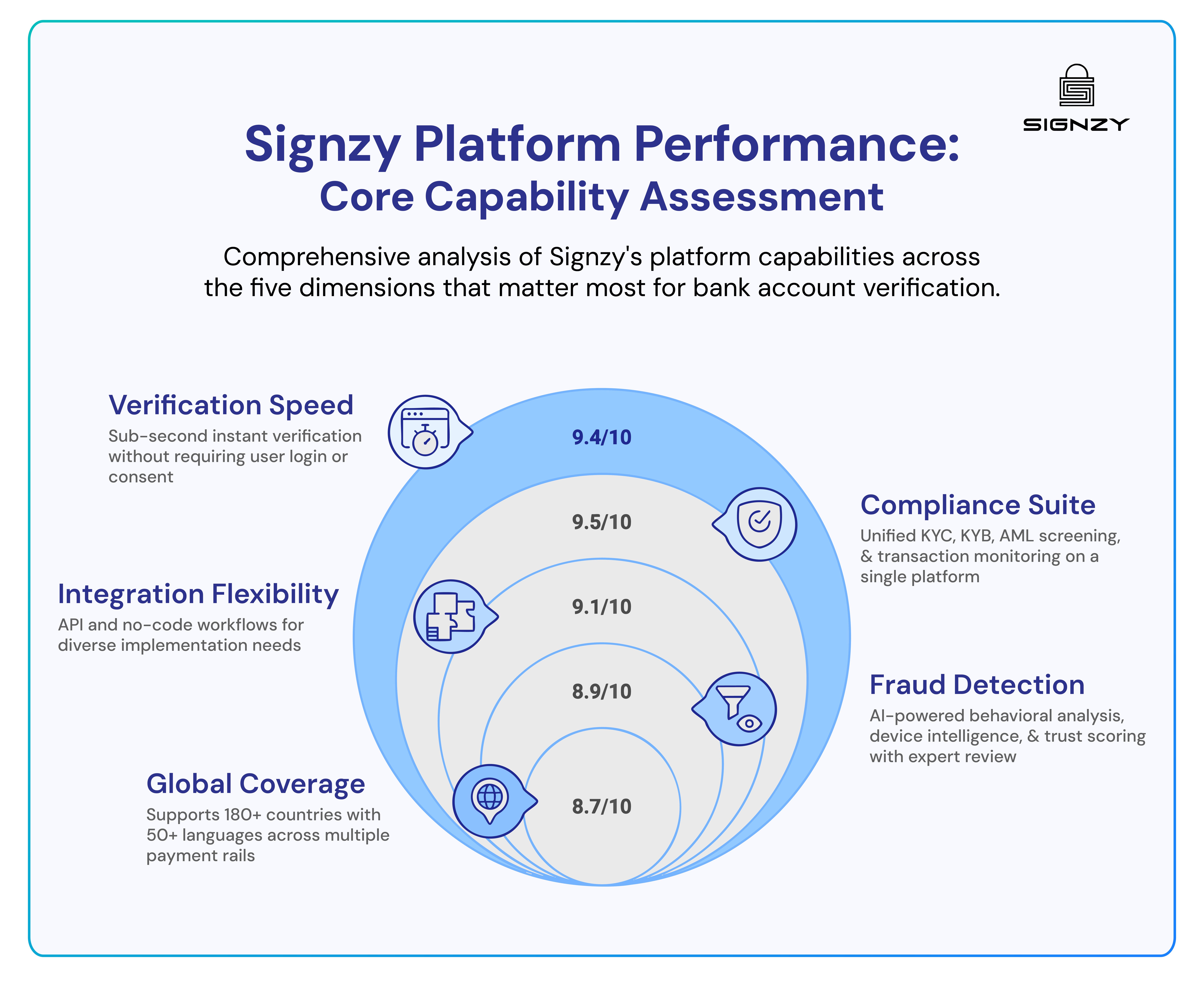
- Instant Verification Without User Login: Performs bank account validation through direct database checks and multiple open banking provider partnerships, completing verification in under one second without requiring users to authenticate with their bank.
- Unified Compliance Workflow: Integrates bank account verification with identity validation (KYC), business verification (KYB), AML screening against global watchlists, document authenticity checks, biometric liveness detection, and deepfake prevention.
- Global Coverage with Local Precision: Supports account verification across 150+ countries with 50+ language support, including the US, Asia-Pacific, Latin America, Africa, and the Middle East, where many competitors lack coverage.
- Comprehensive Fraud and Risk Detection: Analyzes behavioral patterns, device signals, verification history, and ACH return risk to flag suspicious accounts before processing payments. The MuleShield feature generates AI-powered trust scores trained on 200+ risk signals from device, transaction, and identity data, while expert review teams provide human oversight for edge cases within minutes.
Signzy's Pros and Cons
✔️ Instant bank account verification without user consent eliminates login friction and completes validation in under one second, achieving 30% higher conversion rates than consent-based alternatives
✔️ True global coverage across 150+ countries and 50+ languages, including emerging markets where competitors have gaps, with 10% higher coverage than top vendors
✔️ Comprehensive compliance suite consolidates BAV, KYC, KYB, AML screening, transaction monitoring, fraud detection, and contract management, eliminating the need for 5-7 separate vendor relationships
✔️ Flexible pay-as-you-go pricing with no hidden tier charges, only for what you use, delivering up to 60% cost savings compared to tiered enterprise pricing models
❌ Platform modularity allows feature selection but requires upfront decisions about which compliance modules to activate
#2. Yodlee
Yodlee has operated in the financial data aggregation space since 1999, initially using screen-scraping techniques to connect to bank accounts before evolving into a major infrastructure provider.
Beyond basic account validation, the system retrieves transaction histories, balance data, and detailed account information that organizations use for credit underwriting and risk assessment.
Yodlee Bank Account Verification Features
- Real-Time Account Verification: Confirms account ownership, validates account and routing numbers, and retrieves holder names without micro-deposits or manual documentation.
- Balance Verification and Monitoring: Checks current and available account balances before initiating ACH debits, payouts, or recurring payments to prevent NSF charges and transaction failures.
- Multi-Country Account Support: Verifies accounts across multiple regions with support for various payment rails, including ACH in the US, EFT in Canada, Faster Payments in the UK, and corresponding systems in Australia and New Zealand.
Yodlee's Pros and Cons
✔️ Instant verification eliminates micro-deposit delays entirely, improving user experience and reducing abandonment during onboarding flows
✔️ NACHA-compliant solutions meet strict ACH network requirements, including Web Debit Account Validation Rule for fraudulent transaction detection
❌ Platform complexity and enterprise focus may present implementation challenges for smaller businesses seeking straightforward verification without data aggregation features
#3. Plaid
Plaid has established itself as the dominant player in US financial data connectivity, processing billions of dollars in ACH payments annually through partnerships with major banks and fintechs.
The platform built its reputation on consent-based bank account linking through OAuth technology, where users authenticate directly with their financial institution rather than sharing credentials with third parties. However, security concerns have emerged around credential-based connections. As one verified G2 reviewer noted,
A subscriber of Plaid can attempt to create an illegal connection to someone else's financial institution using hacked or stolen credentials. According to Plaid, they have no ability to assist a financial institution or account holder at that institution in identifying which Plaid user attempted such an illegal transaction. This intentional anonymity creates a significant security risk within financial transaction flows." Verified G2 Reviewer.
Platforms like Signzy address these concerns through instant bank account verification that validates ownership without requiring credential sharing, combined with fraud detection layers that analyze behavioral patterns, device signals, and identity consistency to flag suspicious connection attempts before funds are accessed.
Plaid Bank Account Verification Features
- Consent-Based OAuth Verification: Users authenticate through their bank's native login interface, granting Plaid permission to access account information without sharing credentials with third parties. This consent-based approach requires users to actively log in during each verification session, introducing friction that can impact conversion rates.
- Comprehensive US Institution Coverage: Connects to over 12,000 financial institutions across the United States, including major banks, regional banks, and credit unions, through both OAuth and credential-based connections.
- Account Aggregation and Transaction Data: Plaid retrieves historical transactions and account details that businesses use for underwriting decisions and personal financial management applications, positioning Plaid primarily as a financial data aggregation platform where bank account verification serves payment initiation use cases rather than compliance-driven identity verification workflows.
Plaid's Pros and Cons
✔️ Market-leading US coverage with connections to 12,000+ financial institutions provides comprehensive reach for domestic ACH payment and account aggregation needs
✔️ OAuth-first approach delivers strong security by eliminating credential sharing, with users maintaining control through bank-native authentication interfaces
❌ Consent-based verification requires active user login, which introduces friction, potentially causing higher abandonment rates compared to instant verification methods
❌ Limited international coverage focuses the platform primarily on the US market, requiring additional vendors for businesses operating in Europe, Asia-Pacific, or emerging markets
❌ Focused primarily on account connectivity and payment initiation rather than comprehensive compliance workflows, requiring additional vendors for KYC, AML, and fraud prevention needs
Related Reading

#4. LexisNexis Risk Solutions
LexisNexis Risk Solutions operates as a comprehensive risk intelligence provider with multiple products addressing bank account verification and identity validation needs across global markets.
The platform combines payment validation tools, identity verification systems, and fraud prevention capabilities into an integrated suite serving financial institutions, businesses, and government agencies.
LexisNexis Bank Account Verification Features
- Bankers Almanac Validate: Validates payment details, including IBAN, BIC, ABA numbers, and national clearing codes across 200+ countries in under half a second.
- Multi-Bureau Account Verification: Provides dual-bureau checking capability in the UK market, validating customer bank details against two leading credit bureaus simultaneously.
- Safe Payment Verification: Confirms that payment details route to the true intended recipient through real-time API verification. The service validates account ownership, checks if accounts are open or closed, and protects against impersonation scams, invoice fraud, and misdirected payments while ensuring compliance with payment regulations.
LexisNexis's Pros and Cons
✔️ Extensive global coverage with validation services spanning 200+ countries and access to 65,000+ financial institutions through Bankers Almanac
✔️ Multiple verification tiers available from basic payment validation to comprehensive identity cross-checks, allowing businesses to scale solutions based on risk tolerance
❌ Solutions appear fragmented across multiple product lines rather than unified in a single platform, potentially requiring multiple integrations
❌ Pricing structure varies significantly by product tier and verification volume, making cost comparison difficult for businesses evaluating total investment
#5. LSEG Risk Intelligence
LSEG Risk Intelligence, part of the London Stock Exchange Group, delivers verification and screening solutions following its acquisition of GIACT. The platform unifies bank account verification, identity validation, and compliance screening into a single infrastructure, serving financial services organizations with real-time decisioning capabilities across the full customer lifecycle.
LSEG Bank Account Verification Features
- Global Account Verification: Covers over 95% of US consumer and business deposit bank account records with real-time verification via API or terminal.
- Account Insights: Provides additional intelligence layers, including transaction history and aggregated account activity data beyond basic validation. This enhanced visibility helps detect account takeovers, authorized push payment fraud, and synthetic identities by analyzing how accounts have been used over time and identifying unusual behavioral patterns.
LSEG's Pros and Cons
✔️ Market-leading US coverage at 95%+ of deposit accounts provides comprehensive reach for domestic ACH and payment operations
✔️ Unified API architecture integrates account verification with World-Check sanctions screening and identity validation, eliminating the need for multiple vendor relationships
❌ Primary strength concentrated in the US market, with less mature coverage for international account verification compared to identity verification capabilities
#6. Stripe Financial Connections
Stripe developed Financial Connections to address a persistent issue their customers faced: traditional ACH payment verification methods caused excessive friction and multi-day delays. The solution connects users to over 5,000 US financial institutions primarily through OAuth, the same authentication protocol used when logging into applications with existing accounts like Google.
However, fraud resolution support has been a concern for some users. One verified G2 reviewer shared the frustration, stating,
Stripe Connect's support is extremely unhelpful and unreliable, particularly when it comes to resolving serious issues like fraud. Despite following all required steps and receiving guidance from multiple banks, Stripe refused to assist in recovering $5,152.25 that was fraudulently taken.
— Verified G2 user.
Platforms like Signzy mitigate these risks through layered fraud detection that combines bank account verification with proprietary MuleShield, ongoing transaction monitoring, and other AI-powered methods.
Stripe Financial Connections Bank Account Verification Features
- Comprehensive Financial Data Access: Retrieves account numbers, routing numbers, account types, current and pending balances, transaction history, and account ownership details, including names and addresses.
- Microdeposit Fallback with Enhanced Security: For smaller banks and credit unions without OAuth support, the system sends a single $0.01 microdeposit with a unique 6-digit code appended to the business name.
- Integrated Fraud Prevention: Employs Stripe Radar's machine learning system trained on billions of data points from Stripe's entire payment network to detect credential testing, account takeover attempts, and other fraud patterns.
Stripe Financial Connections' Pros and Cons
✔️ Seamless integration with Stripe's payment infrastructure means businesses already using Stripe can add verification with minimal additional development effort
✔️ OAuth-first approach provides superior security compared to credential-sharing methods, with users maintaining control and the ability to disconnect access anytime
❌ Primarily focused on the US market with limited international coverage compared to global verification platforms
#7. iDenfy
iDenfy is a Lithuanian identity verification company that combines automated AI analysis with human oversight to achieve higher accuracy than purely automated systems.
The platform operates on a pay-per-approved-verification model, meaning businesses only pay for successful verifications rather than rejected fraud attempts or system errors. This pricing structure has made iDenfy particularly attractive to crypto platforms, gaming operators, and fintechs dealing with higher fraud rates.
iDenfy Bank Account Verification Features
- Biometric Verification with Liveness Detection: Employs 3D liveness detection to prevent spoofing attacks using photos, masks, or video recordings during identity verification.
- eIDV Cross-Database Verification: Validates customer data across USA databases and other regional sources within 30 seconds, confirming that individuals exist in authoritative records.
iDenfy's Pros and Cons
✔️ Rapid integration with no-code options allows deployment in minutes, plus API, SDK, and plugin support for WordPress, Shopify, WooCommerce, and Magento
✔️ ISO-27001 and SOC 2 certified, with full GDPR and CCPA compliance, ensures enterprise-grade data security and regulatory adherence
❌ Manual review component introduces 3-minute processing delays for human-supervised checks, which may not suit applications requiring instant verification responses
Related Reading
#8. Sumsub
Sumsub started as a London-based graphic editor detection tool in 2015 before evolving into a comprehensive KYC platform. Rather than requiring businesses to integrate separate vendors for identity checks, AML screening, transaction monitoring, and fraud detection, Sumsub consolidates these functions into a single platform.
Sumsub Bank Account Verification Features
- Rapid Identity Verification: Onboards users in under 30 seconds with support for 50+ languages, verifying government-issued documents, performing liveness checks, and conducting biometric face matching.
- No-Code Workflow Builder: Enables businesses to create and customize verification flows in approximately 50 seconds without engineering resources.
- Integrated Compliance and Fraud Prevention: Combines identity verification with AML screening, transaction monitoring, and fraud detection in one unified platform.
Sumsub's Pros and Cons
✔️ Fastest setup and configuration in the industry, with 50-second workflow creation and an intuitive no-code interface, reduces time to market dramatically
✔️ Comprehensive all-in-one platform eliminates the need for multiple vendors by integrating KYC, KYB, AML, transaction monitoring, and fraud prevention
✔️ Reusable Digital Identity system improves user experience and conversion rates by allowing customers to verify once and reuse credentials across platforms
❌ Platform breadth may result in feature overload for businesses requiring only basic identity verification without a full compliance suite
Related Reading
#9. Mastercard Account Owner Verification
Mastercard entered account verification by building on the Open Banking infrastructure it had already established for payment services. The system connects directly to financial institutions through regulated APIs that comply with PSD2 in Europe and emerging Open Banking standards in the United States, rather than maintaining proprietary databases of account information.
Mastercard Account Owner Verification Features
- Real-Time Account Ownership Confirmation: Retrieves bank-verified account holder information, including names, addresses, email addresses, and phone numbers, directly from financial institutions through Open Banking connectivity.
- Identity Insights and Risk Scoring: Provides identity risk assessments based on user activity patterns and behavioral analysis to detect fraudulent behavior.
- Multi-Use Case Flexibility: Supports various applications, including digital wallet setup, payment service provider onboarding, wealth management account opening, insurance verification, e-commerce merchant validation, and marketplace vendor screening.
Mastercard Account Owner Verification's Pros and Cons
✔️ Leverages bank-verified data directly from financial institutions rather than third-party databases, providing the highest accuracy and reducing false positives
✔️ Match score system provides nuanced risk assessment rather than binary pass/fail, allowing businesses to calibrate acceptance thresholds to their risk appetite
✔️ Integration with the broader Mastercard Open Finance ecosystem enables combination with sanctions screening, device intelligence, and additional fraud signals
❌ Open Banking dependency means coverage is limited to regions with mature Open Banking infrastructure, potentially excluding some markets and smaller institutions
How to choose a bank account verification tool?
The market offers solutions ranging from basic account validation services to comprehensive platforms that combine verification with fraud detection and compliance screening. Your choice should align with your operational scale, technical capabilities, budget constraints, and regulatory obligations.
- If you need instant verification with minimal integration effort → Signzy or Plaid for rapid deployment across US and global markets, or Stripe Financial Connections for existing Stripe users.
- If you require combined identity and account verification → Signzy for unified KYC/KYB/account verification or LSEG Risk Intelligence for compliance-heavy workflows.
- If you prioritize human-reviewed verification accuracy and can incur high costs and timelines → iDenfy for hybrid AI and manual review.
- If you handle high transaction volumes requiring enterprise-grade reliability → Signzy for proven infrastructure and sub-second response times or LSEG Risk Intelligence for enterprise SLAs.
- If you need specialized regional expertise → Signzy for US and Asia-Pacific operations, Mastercard Account Owner Verification for Europe, or Yodlee for North America.
How quickly can businesses deploy Signzy's verification APIs?
Signzy's implementation process takes 2-4 days from initial contact to production deployment. The platform offers sandbox access for testing, comprehensive API documentation, and dedicated integration support to ensure your verification workflows launch smoothly without disrupting existing systems.
We started building our own verification system and quickly realized we were in over our heads. There's so much complexity we hadn't considered. Signzy just handled all of it. Saved us from what would have been a disaster.
— CTO, Payment Gateway Startup.
Implementation takes just four steps:
- Schedule a consultation to discuss your specific verification requirements, geographic coverage needs, compliance obligations, and expected transaction volumes.
- Receive API credentials and documentation to test verification flows and explore features in a risk-free environment.
- Implement Signzy's RESTful APIs into your application with support from the technical team, typically requiring 1-2 days of development effort.
- Launch verification capabilities after testing, with ongoing monitoring, performance analytics, and dedicated support to optimize approval rates.
Book a demo to see how Signzy's bank account verification can streamline your compliance workflows and reduce fraud risk.


FAQ
How do verification tools handle joint accounts or business accounts?

What information do I need to verify a bank account?
Do verification tools work with credit unions and smaller banks?
Can I verify international bank accounts like IBANs?
Saurin Parikh
Saurin is a Sales & Growth Leader at Signzy with deep expertise in digital onboarding, KYC/KYB, crypto compliance, and RegTech. With over a decade of professional experience across sales, strategy, and operations, he’s known for driving global expansions, building strategic partnerships, and leading cross-functional teams to scale secure, AI-powered fintech infrastructure.

Related Blogs
View all
![AML Watchlist Screening Guide: Regulations, Tools, and More [2026]](https://cdn.sanity.io/images/blrzl70g/production/d6f119be39abfc6cd718c86eb5a401ddc6d44e66-1920x450.png)



The best in business


The global API marketplace for KYC, KYB, & AML
Explore the end-to-end verification stack trusted by 1,000 businesses.
Get in touch