





What Is an FBO Account? How It Works, Regulations & Fintech Use Cases [2026]

 Open in ChatGPT
Key Highlights
- An FBO account is a pooled master account held by a sponsor bank on behalf of a fintech's customers — the fintech manages the account, but the end-users legally own the funds and receive FDIC pass-through insurance up to $250,000 per depositor per bank.
- FBO structures allow fintechs to offer bank-like services — digital wallets, savings accounts, payment processing — without obtaining a banking license or, in many states, a money transmission license, by keeping customer funds under the bank's control.
- The 2024 Synapse bankruptcy exposed critical weaknesses in FBO governance — opaque ledgers, poor reconciliation, and unclear fund ownership — prompting the FDIC to mandate daily reconciliation and annual certification from banks holding FBO deposits.
- Platforms like Signzy enable the identity verification, KYC, and AML screening that both sponsor banks and fintechs must perform on FBO account beneficiaries — a compliance requirement that has intensified significantly post-Synapse.
- What Is an FBO Account?
- How Does Daily FBO Transaction Processing Work?
- What Are the Main Use Cases for FBO Accounts?
- How Does FDIC Pass-Through Insurance Work for FBO Accounts?
- What Happened with Synapse and Why It Matters for FBO Governance
- What Regulatory Requirements Apply to FBO Accounts?
- How Can Signzy Help with FBO Account Compliance?
- FAQ
An FBO (For Benefit Of) account is a pooled bank account where one party — typically a fintech, broker, or trust company — opens and manages the account, while the funds inside legally belong to the end-users (beneficiaries). FBO accounts are the standard structure enabling neobanks, payment platforms, and embedded finance products to hold customer funds under FDIC pass-through insurance without obtaining their own banking charter. This guide covers how FBO accounts work, how they differ from traditional bank accounts, FDIC insurance mechanics, regulatory requirements after the Synapse collapse, and best practices for fintech compliance teams building on FBO infrastructure.
What Is an FBO Account?
An FBO (For Benefit Of) account is a fiduciary bank account where one entity — called the custodian, agent, or account holder — opens and controls the account on behalf of one or more beneficiaries who legally own the funds inside.
The "FBO" designation in the account title (e.g., "Acme Fintech FBO Customer Name") signals to the bank, regulators, and the FDIC that the account holder is acting as an agent, not as the owner of the funds. This distinction has significant legal and insurance implications.
How FBO Accounts Differ from Other Account Types
| Account Type | Who Opens It | Who Owns the Funds | Who Controls It | FDIC Insurance | Tax Reporting |
|---|---|---|---|---|---|
| Regular Checking/Savings | Individual | Individual | Individual | Direct — $250K per depositor | Owner's SSN |
| Joint Account | Two+ individuals | All co-owners | All co-owners | $250K per co-owner | Each owner's SSN |
| Business Account | Company | Company | Authorized signers | $250K for the entity | Company's EIN |
| Trust Account | Trustee | Beneficiary | Trustee | $250K per beneficiary | Beneficiary's SSN |
| FBO Account | Custodian/Fintech | Beneficiary (end-user) | Custodian/Fintech | Pass-through — $250K per beneficiary (if records qualify) | Beneficiary's SSN |
The critical distinction: even though the custodian controls the FBO account, the beneficiary retains legal ownership of the funds, receives the tax documents under their SSN, and qualifies for FDIC insurance independently — provided the account records meet FDIC pass-through requirements.
The FBO Structure in Fintech
In practice, most fintechs and neobanks don't open individual bank accounts for each customer. Instead, they use a single pooled FBO master account at a sponsor bank, with an internal ledger system that tracks each customer's individual balance as a virtual sub-account.
According to Galileo Financial Technologies, this is the standard model for Banking-as-a-Service (BaaS) in North America — the sponsor bank holds the master FBO account, while the fintech manages the sub-ledger, customer-facing experience, and transactions.
This structure means:
- One bank account holds funds for potentially millions of customers
- Internal ledgers track each customer's balance, transactions, and ownership
- The bank is the legal holder of the account and the FDIC-insured institution
- The fintech is the agent managing the account on behalf of customers
How Does Daily FBO Transaction Processing Work?
FBO accounts process transactions through a combination of batch processing and real-time systems. Here's what happens behind the scenes at a typical BaaS operation:
1. Batch inflows (overnight): The system ingests bulk files from employers, payment networks, or ACH processors — payroll contributions, new enrollments, transfers, and withdrawals. Each transaction is matched to the correct beneficiary using employer codes, Social Security Numbers, or account identifiers.
2. Automated allocation: For accounts with pre-set instructions (e.g., investment allocations, savings rules, or payment splits), the system executes these automatically without manual intervention.
3. Balance updates: Each beneficiary's virtual sub-account balance is updated to reflect new deposits, withdrawals, fees, and investment gains or losses.
4. Exception handling: Transactions that don't match — mistyped account numbers, insufficient funds, name mismatches — are flagged for manual review. This is where TIN verification and identity checks become critical to prevent errors from compounding.
5. Real-time processing: Throughout the day, customer-initiated transactions (withdrawals, transfers, payments) are processed in real time rather than waiting for the overnight batch.
6. End-of-day reconciliation: The custodian runs a final reconciliation to ensure every dollar received matches every dollar allocated across all beneficiary sub-accounts. Under the FDIC's post-2024 rules, this daily reconciliation is now mandatory for banks holding FBO deposits — a direct response to the Synapse collapse.
What Are the Main Use Cases for FBO Accounts?
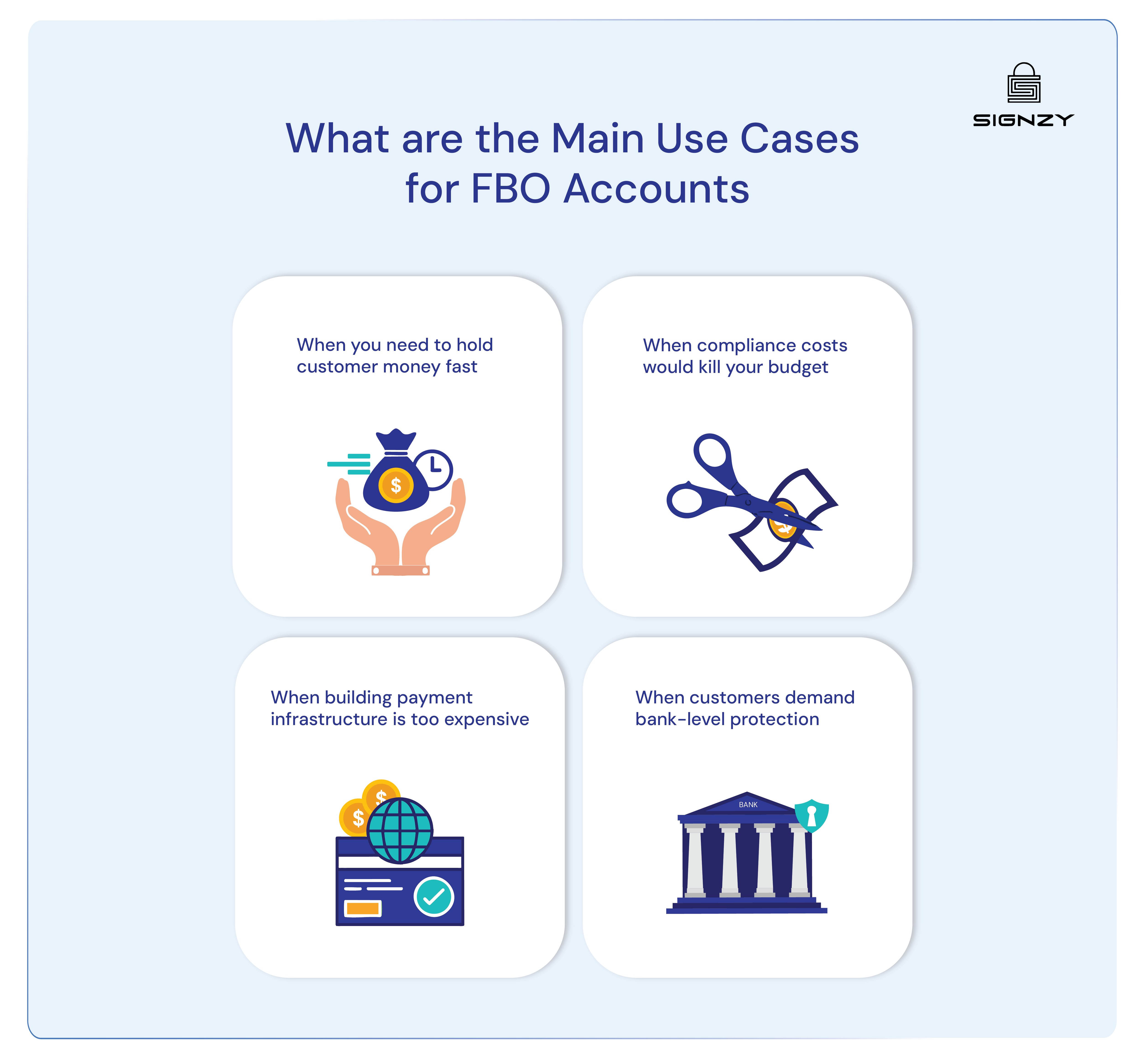
Neobanks and Digital Banking Platforms
FBO accounts are the foundational infrastructure for virtually every neobank in the US. Companies like Chime, Current, and Varo (before obtaining its own charter) built their entire banking products on FBO relationships with sponsor banks. The fintech handles the customer experience — app, cards, notifications — while the sponsor bank holds funds in an FBO structure.
Payment Platforms and Digital Wallets
Payment processors and digital wallet providers use FBO accounts to hold customer balances. When a customer loads money into a payment app, those funds sit in an FBO account at a partner bank until they're spent or withdrawn. This covers platforms handling 1099-K reporting for third-party payment transactions.
Embedded Finance and BaaS
Companies embedding financial services into non-financial products — marketplaces, SaaS platforms, gig economy apps — use FBO accounts through BaaS providers. According to Guidehouse's 2026 analysis, the embedded finance model relies heavily on FBO structures to enable virtual sub-accounts for multi-party flows like supplier payouts, escrow, and ACH transfers.
Retirement and Investment Accounts
Traditional use cases remain significant: 401(k) plans, IRAs, 529 college savings plans, and brokerage accounts are typically held as FBO accounts by custodians like Fidelity, Schwab, or Vanguard. Your account statement showing "Fidelity FBO [Your Name]" is this structure in action.
Payroll and Contractor Payment Platforms
Companies managing payroll disbursements or contractor payments hold funds temporarily in FBO accounts before distributing to recipients. This is common in staffing platforms, freelance marketplaces, and contractor management systems that need to verify EINs and SSNs before processing payments.
💡 Related Blog:

How Does FDIC Pass-Through Insurance Work for FBO Accounts?
This is one of the most misunderstood aspects of FBO accounts — and one of the most important for compliance teams to understand correctly.
The Basics
FDIC insurance covers deposits up to $250,000 per depositor, per insured bank. For FBO accounts, coverage passes through to each beneficial owner individually, meaning:
- Each beneficiary gets up to $250,000 in coverage — not the account holder
- The custodian/fintech does NOT receive coverage on the pooled amount
- Coverage is per bank — if a fintech uses multiple sponsor banks, each bank provides separate $250K coverage per beneficiary
Requirements for Pass-Through to Work
Pass-through insurance is NOT automatic. The FDIC requires that:
- The account must clearly indicate agency status — the account title must show the FBO relationship (e.g., "XYZ Fintech FBO Customers")
- Beneficial ownership must be accurately tracked — the bank or custodian must maintain records identifying each beneficiary and their balance
- Records must be verifiable at the time of bank failure — the FDIC verifies pass-through eligibility through agreements, state law, and account records
If these requirements are not met, all funds in the FBO account are aggregated and treated as belonging to the account holder (the fintech/custodian), subject to a single $250,000 limit — potentially leaving millions of customers uninsured.
FBO Accounts vs. Direct Deposit Accounts (DDAs)
| Feature | FBO Account | Direct Deposit Account (DDA) |
|---|---|---|
| Account opening | One master account for all customers | Individual account per customer on the bank's core |
| Customer relationship | With the fintech; bank may not know individual customers | Directly with the bank |
| FDIC insurance | Pass-through (requires proper records) | Direct — automatic $250K per depositor |
| Scalability | High — one account serves millions | Lower — each customer needs core banking setup |
| Regulatory risk | Higher — depends on recordkeeping and reconciliation | Lower — standard banking relationship |
| Speed to market | Fast — no per-customer bank onboarding | Slower — requires bank core integration |
| Post-Synapse scrutiny | Significantly increased | Standard |
Source: [Mercury — DDA vs. FBO Accounts](https://mercury.com/blog/demand-depost-accounts-vs-for-benefit-of-accounts), [Guidehouse — FBO Account Model 2026](https://guidehouse.com/insights/financial-services/2026/fbo-account-model)
What Happened with Synapse and Why It Matters for FBO Governance
The 2024 Synapse bankruptcy is the defining cautionary tale for FBO accounts in fintech. Synapse was a BaaS middleware provider that managed FBO accounts between fintechs and sponsor banks. When it collapsed, thousands of customers couldn't access their funds because:
- Ledger opacity: Synapse's internal ledgers didn't clearly map which funds belonged to which customers
- Poor reconciliation: Daily balances between Synapse's records and the sponsor banks' records didn't match
- Unclear fund ownership: The legal ownership of funds became disputed between multiple parties
- FDIC pass-through failure: Without clear beneficiary records, pass-through insurance eligibility was uncertain
According to Guidehouse's post-Synapse analysis, the collapse exposed three structural weaknesses in the FBO model:
- Over-reliance on middleware providers for ledger accuracy without independent bank verification
- Insufficient real-time reconciliation between fintech sub-ledgers and bank master accounts
- Weak governance of customer disclosures — many end-users didn't understand their funds were in FBO structures
Post-Synapse Regulatory Response
The FDIC responded with enhanced requirements for banks holding FBO deposits:
- Daily reconciliation of customer balances — banks must verify that their records match the fintech's sub-ledger every business day
- Annual certification — bank executives must personally sign off that recordkeeping systems accurately track beneficial ownership
- Enhanced due diligence on fintech partners — banks must demonstrate active oversight of their BaaS relationships, not just contractual compliance
What Regulatory Requirements Apply to FBO Accounts?
FBO accounts exist at the intersection of federal banking regulation, state money transmission law, and anti-money laundering requirements. Here's what compliance teams need to know:
FDIC Requirements
Banks holding FBO deposits must comply with FDIC pass-through insurance rules, which require:
- Clear account titling showing the FBO/agency relationship
- Accurate, verifiable beneficial ownership records
- Daily reconciliation (post-2024 rules)
- Annual certification by bank executives
State Money Transmission Licensing
Using an FBO structure may exempt a fintech from state money transmission licensing requirements — but this is state-by-state and not guaranteed. The key factor is whether the fintech or the bank controls the funds:
- If the bank controls the funds (true FBO structure), many states exempt the fintech from money transmitter licensing
- If the fintech exercises control over fund movement, states may still require licensing regardless of the FBO label
- States vary significantly — consult the CSBS (Conference of State Bank Supervisors) for state-specific guidance
Federal Anti-Money Laundering (AML) Requirements
FinCEN requires both the bank and the fintech to maintain AML compliance programs for FBO accounts:
- Customer Identification Program (CIP): Both parties must verify customer identities — this creates a "double compliance" burden where customers are screened by both the fintech and the bank
- Suspicious Activity Reporting (SAR): The bank files SARs, but the fintech must monitor for and report suspicious activity to the bank
- Bank Secrecy Act (BSA) compliance: Transaction monitoring, record retention, and regulatory reporting requirements apply to FBO accounts the same as any other bank account
- Beneficial ownership verification: Under FinCEN's 2026 exceptive relief (FIN-2026-R001), banks no longer need to re-verify beneficial owners at every new account opening — verification is now required at initial account opening, when ownership changes, or when risk-based triggers occur
Bank Partnership Agreements
The contractual relationship between the fintech and sponsor bank is critical:
- Compliance responsibilities must be clearly defined — who performs KYC, who monitors transactions, who files SARs
- Audit rights — the bank must have the right to audit the fintech's compliance practices
- Data sharing requirements — the fintech must provide customer data to the bank for regulatory compliance
- Termination provisions — what happens to customer funds if the partnership ends (a lesson from Synapse)
How Can Signzy Help with FBO Account Compliance?
The "double compliance" burden of FBO accounts — where both the fintech and the sponsor bank must independently verify customer identities — creates significant operational complexity. Every beneficiary added to an FBO structure must pass through KYC checks, AML screening, and identity verification at both layers.
Signzy's platform addresses this with a unified compliance infrastructure:
- KYC and identity verification: One Touch KYC verifies identity documents, performs facial biometric matching, liveness detection, and deepfake detection across 14,000+ document types in 120+ countries — enabling both fintechs and their bank partners to meet CIP requirements
- AML screening: Real-time screening against OFAC, UN sanctions, PEP databases, and 1,000+ global watchlists — satisfying BSA requirements for both parties in the FBO relationship
- Bank account verification: Validates bank account ownership and details before fund transfers, reducing the reconciliation errors that contributed to the Synapse collapse
- SSN and EIN verification: Validates beneficiary TINs against IRS records — critical for accurate tax reporting under FBO structures where the beneficiary's SSN is used for tax documents
For fintechs operating FBO accounts, the compliance infrastructure must satisfy both their own requirements and their sponsor bank's audit expectations. A single integration point reduces the complexity of managing separate verification vendors for each compliance checkpoint.
To learn more, book a demo here.


FAQ
How does FDIC pass-through insurance work for FBO accounts?

What compliance obligations do fintechs have for FBO accounts?
What happened with Synapse and what does it mean for FBO accounts?
What is the difference between an FBO account and a DDA (Direct Deposit Account)?
Do FBO accounts eliminate the need for a money transmitter license?
Can an FBO account hold funds for international customers?
Shivam Agarwal
Shivam heads the go-to-market strategy at Signzy. He holds the CFA charter and a strong background in financial operations, PE analysis and strategy. His prior roles include business strategy and private-equity analysis in the financial services and fintech domain, giving him deep insight into client needs, risk-adjusted economics and monetisation models for compliance & identity verification platforms.

Related Blogs
View all![5 Best Tools to Verify an EIN Number [Free + Paid] - 2026](https://cdn.sanity.io/images/blrzl70g/production/5acdb26c768fcb06fbd9cfbfb94a408cb3d22bd1-2560x600.webp)
![How to Lookup a Company's EIN Number? [2026 Guide]](https://cdn.sanity.io/images/blrzl70g/production/3ceee4c0b2fac3923bd2303cd5b313631bea7258-2560x600.webp)


The best in business


The global API marketplace for KYC, KYB, & AML
Explore the end-to-end verification stack trusted by 1,000 businesses.
Get in touch