





What are STOs? Regulations, Benefits, and More [2026 Guide]

 Open in ChatGPT
🗒️ Key Highlights
- STOs are regulated fundraising methods where companies issue blockchain-based tokens representing real assets like equity, debt, or property. They combine traditional securities compliance with digital token efficiency.
- Launching an STO requires navigating SEC regulations and conducting thorough KYC/AML verification. Companies must balance benefits like fractional ownership against risks like regulatory uncertainty and limited liquidity.
- Signzy automates STO compliance by verifying identities across 180+ countries and screening against 1,000+ sanctions lists. The platform monitors transactions in real time, helping issuers meet regulatory requirements without slowing growth.
- What is a Security Token Offering (STO)?
- How do STOs work?
- What’s the difference between STO, ICO, and IPO?
- Is it legal to launch an STO in America?
- What are the SEC rules for security tokens?
- What are the KYC/AML requirements for STOs?
- Benefits of security token offerings
- Risks of launching STOs
- How can Signzy help with STO’s KYC/AML compliance?
- FAQ
You know how, when you buy a house, there are like three to five different people who need to verify you're not laundering money? Your bank, the title company, the realtor – everyone's checking the same stuff with various systems that don't talk to each other.
STOs are trying to fix that mess, but for securities. Instead of having multiple intermediaries perform separate compliance checks, everything is integrated into the digital token itself.
But hey, it’s not as simple as the crypto bros make it sound, and it’s not as complicated as traditional finance makes everything, either.
Let’s now walk through what implementing this would actually require.
What is a Security Token Offering (STO)?
A Security Token Offering (STO) is a fundraising method where companies issue digital tokens that represent ownership in real assets like company shares, real estate, or debt. Unlike traditional securities traded through brokers, these tokens exist on a blockchain and must comply with the SEC's securities regulations.
It sits between conventional stock offerings and the cryptocurrency market. When you buy a security token, you're purchasing a regulated investment that gives you legal rights such as dividends, profit sharing, voting rights, or interest payments, depending on what the token represents.
How do STOs work?
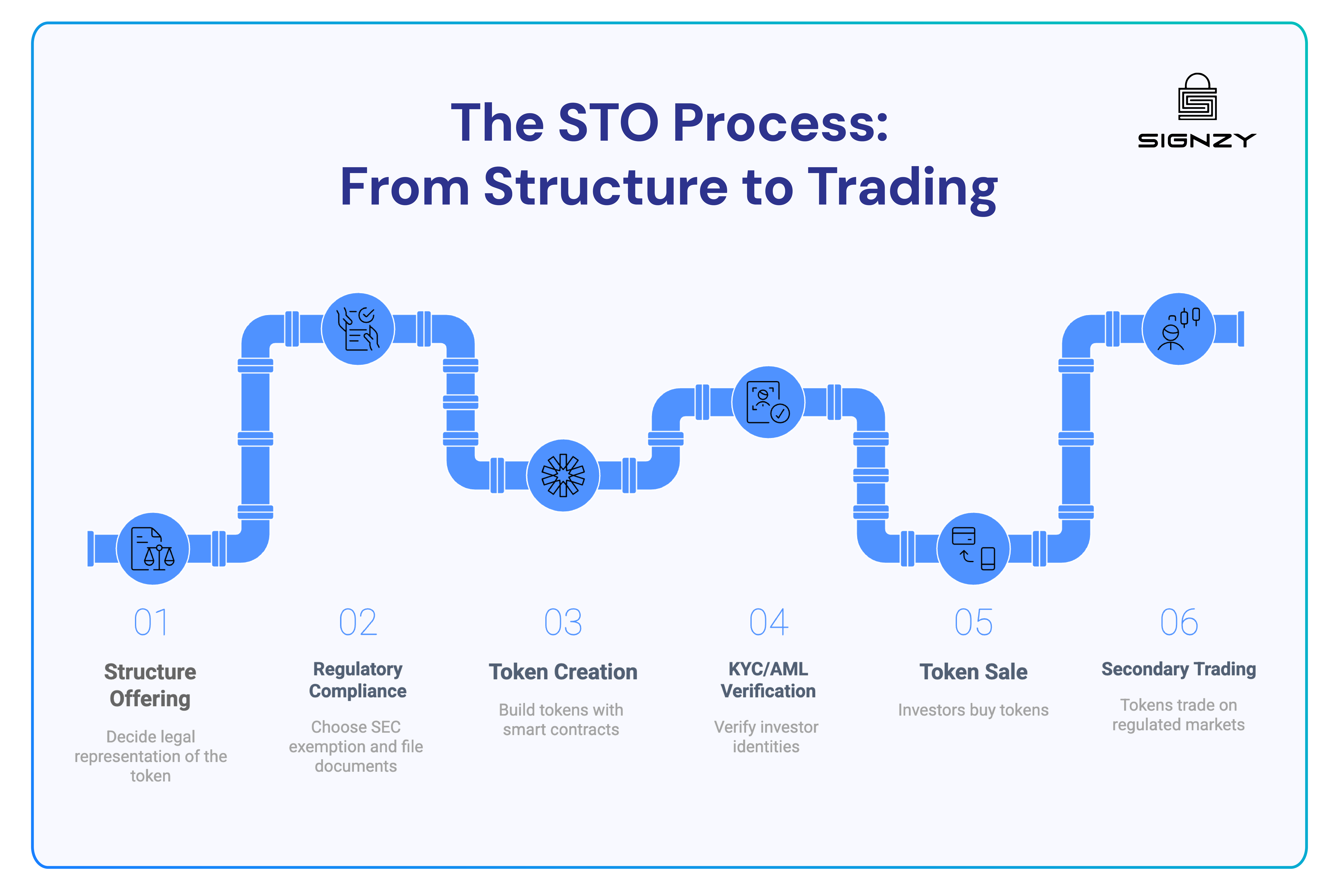
An STO follows a structured process that combines traditional securities regulations with blockchain technology. Here's how the process unfolds:
Step 1: The company structures the offering
The issuing company begins by deciding what asset the security token will represent: equity ownership, debt, profit-sharing rights, or real estate holdings. Working with legal counsel, they draft offering documents that explain the investment terms, risks, and how investor rights will work. This preparation resembles traditional stock offering procedures but is adapted for tokenized securities.
Step 2: Regulatory compliance and filing
With the structure in place, the company determines which regulatory framework applies to its offering. In the US, this typically means filing with the SEC under specific exemptions:
- Regulation D for accredited investors only
- Regulation A+ for both accredited and non-accredited investors with investment limits
- Regulation S for international investors outside the US
They submit all required documentation and wait for approval or clearance before moving forward. This regulatory step ensures the offering meets legal standards and protects investors. More on regulations in a minute.
Step 3: Token creation on blockchain
Once regulatory clearance is obtained, the company creates the actual security tokens on a blockchain platform like Ethereum, Polymath, or Securitize. These tokens are programmed with smart contracts that automate compliance features.
For example, the smart contract can restrict transfers to verified investors only or automatically distribute dividends on scheduled dates.
The blockchain becomes the permanent, immutable record of ownership.
Step 4: KYC/AML verification of investors
Before the sale begins, potential investors must pass identity verification. They submit documents such as passports, proof of address, and, in some cases, proof of income or net worth to demonstrate accredited investor status.
Only those who pass verification can proceed to purchase tokens.
Step 5: Token sale and distribution
With verification complete, qualified investors can purchase tokens using fiat currency like USD or cryptocurrency. Once payment clears, tokens are immediately distributed to the investor's digital wallet.
The blockchain records each transaction permanently and transparently. This process is notably faster than traditional securities transactions, which often require several days to settle through intermediaries.
Step 6: Secondary trading and ongoing management
After the initial offering closes, security tokens may trade on regulated secondary markets or alternative trading systems designed for tokenized securities. However, the embedded smart contracts continue enforcing compliance rules automatically.
What’s the difference between STO, ICO, and IPO?
The main difference lies in regulation, investor protection, and what you're actually buying.
STOs are regulated digital securities that give you legal ownership rights and must comply with securities laws. ICOs are largely unregulated token sales where you typically buy utility tokens or speculative assets with minimal investor protection. IPOs are traditional, heavily regulated stock offerings where companies go public on established exchanges.
Below’s a more detailed comparison.
Security Token Offerings (STOs) vs Initial Coin Offerings (ICOs)
The main difference between STOs and ICOs is regulatory compliance and investor protection. When you buy tokens in an ICO, you're typically purchasing utility tokens that give you access to a platform or service, or you're making a speculative investment with little legal recourse if things go wrong.
ICOs had minimal barriers to entry, which meant anyone could launch a token sale from anywhere in the world. This accessibility came with massive risk. Studies show that over 80% of ICOs conducted in 2017-2018 were scams or failed projects. STOs are slower and more expensive to launch, but investors get legal protections, and companies face real consequences for fraud or misrepresentation.
Another key difference is liquidity and trading. ICO tokens could trade immediately on cryptocurrency exchanges, often seeing wild price swings driven by speculation. Security tokens can only trade on regulated platforms and only between verified investors who meet legal requirements. This creates less volatility but also less immediate liquidity.
Security Token Offerings (STOs) vs Initial Public Offerings (IPOs)
STOs and IPOs both involve selling regulated securities to raise capital, but they differ in cost and infrastructure. An IPO is the traditional method for a company to go public on a stock exchange like the NYSE or NASDAQ. Only mature companies with strong financials and significant revenue can realistically pursue an IPO.
STOs use blockchain technology to reduce costs and broaden access. These can cost hundreds of thousands instead of millions, making them viable for smaller companies. Another advantage is fractional ownership. Blockchain allows assets to be divided into smaller units, so investors can buy portions of expensive assets like real estate.
However, IPOs offer advantages that STOs cannot match yet. Public stock exchanges provide massive liquidity, with millions of potential buyers and established market infrastructure.
Here’s a quick comparison table between all three side-by-side
Quick comparison table: STO vs. ICO vs. IPO
| Feature | STO | ICO | IPO |
|---|---|---|---|
| Regulation | Fully regulated, SEC-compliant | Minimal to none | Heavily regulated |
| Investor protection | High (securities laws apply) | Low (buyer beware) | High (extensive disclosure) |
| What you buy | Security token (equity, debt, asset) | Utility token or speculative asset | Company shares |
| Who can invest | Depends on exemption (often accredited investors) | Anyone with crypto | Anyone through a broker |
| Liquidity | Limited (regulated secondary markets) | High (crypto exchanges) | Very high (major exchanges) |
| Geographic reach | Global with restrictions | Fully global | Primarily domestic exchange |
| Technology | Blockchain based | Blockchain based | Traditional financial system |
| Fraud risk | Low (regulatory oversight) | Very high (80%+ failure rate) | Low (rigorous vetting) |
Is it legal to launch an STO in America?
Yes, it is legal to launch an STO in America, but only if you comply with federal securities laws enforced by the Securities and Exchange Commission (SEC). Security tokens are treated as securities under US law, which means companies must either register their offering with the SEC or qualify for an exemption before selling tokens to investors.
What are the SEC rules for security tokens?

When talking about the US specifically, you have two legal paths:
Path 1: Full SEC registration
This is the same process as a traditional IPO. You file extensive paperwork, get audited financials, submit to SEC review, and if approved, you can sell to anyone – retail investors, institutions, whoever.
The upside is broad market access. The downside is that it costs millions and takes 12-18 months minimum.
Path 2: Regulatory exemptions
Here, you skip the whole registration process but accept certain restrictions on who can buy your tokens and how you can market them. Companies must file Form D with the SEC after their first sale, but don't need pre-approval.
The main exemptions include:
- Regulation D (Rule 506b): Raise unlimited money from accredited investors plus up to 35 "sophisticated" non-accredited investors. No public advertising is allowed. Most private placements use this.
- Regulation D (Rule 506c): Raise unlimited money but only from accredited investors, and you must verify they're actually accredited. You can advertise publicly, which is significant for token sales.
- Regulation A+ (Tier 1): Raise up to $20 million in 12 months from anyone, including retail investors. Requires SEC qualification and state-level review. Slower than Tier 2 but suitable for smaller offerings.
- Regulation A+ (Tier 2): Raise up to $75 million in 12 months from anyone, including retail investors. Requires SEC qualification (like mini-registration), but much faster and cheaper than complete registration. Non-accredited investors can invest up to 10% of their income or net worth. Exempt from state registration.
- Regulation CF (Crowdfunding): Raise up to $5 million in 12 months from the general public through SEC-registered crowdfunding platforms. Individual investors face limits based on income and net worth, ranging from $2,500 to $125,000 per year across all crowdfunding investments.
- Regulation S: Sell to non-US investors outside the US. No SEC registration is needed, but you can't market to US persons or use US infrastructure.
What are the KYC/AML requirements for STOs?
KYC (Know Your Customer) and AML (Anti-Money Laundering) requirements are mandatory identity checks that STO issuers must perform before accepting any investments. These requirements come from federal laws like the Bank Secrecy Act and the USA PATRIOT Act, enforced by FinCEN (Financial Crimes Enforcement Network) and the SEC.
↪ Government-issued ID verification
You must submit a valid passport, driver's license, or national ID card. The verification service confirms your document is real, not expired, and matches your stated identity. Most platforms also require a selfie or live video to prove you're the actual person shown on the ID. Some services use facial recognition to match your live photo with your ID photo, adding another security layer.
Someone tried investing using a high-quality forged passport that looked completely legitimate to our team. Signzy's document analysis caught tampering in the security features we hadn't even noticed. That single catch prevented what would have been a serious regulatory violation.
— Risk Manager, Investment Platform

↪ Proof of address
You need to provide recent documents showing your current residential address, typically from the last 90 days. Acceptable documents include utility bills, bank statements, tax documents, or government correspondence with your name and address. This confirms where you live, which determines which securities laws apply to your investment.
For US-only offerings or international offerings, proving your location is critical for regulatory compliance.
↪ Source of funds documentation
Companies must verify where your investment money comes from to prevent money laundering. For larger investments, you may need to provide bank statements, tax returns, employment verification, or documentation of asset sales. This proves your funds come from legitimate sources rather than criminal activity, corruption, or illegal operations. The larger your investment, the more documentation you'll need to provide.
↪ Accredited investor verification (when required)
For offerings restricted to accredited investors under Rule 506(c), you must prove you qualify. This requires either income verification showing $200,000+ annually for individuals (or $300,000 for married couples) for the past two years, or net worth documentation proving $1 million+ excluding your primary residence.
You can provide tax returns, W2 forms, financial statements, or get a verification letter from a licensed CPA, attorney, or registered investment advisor. These letters are typically valid for 90 days.
↪ Sanctions and watchlist screening
Every investor gets screened against government databases, including OFAC sanctions lists, politically exposed persons databases, and criminal watchlists. This automated process checks if you appear on any list of individuals or entities restricted from financial transactions. If you're flagged, the company must investigate further or reject your investment. This screening happens before you can invest and continues throughout your investment period.
↪ Ongoing monitoring
After you invest, companies continue monitoring your status against updated government lists and screening for suspicious activity. If your circumstances change, such as being added to a sanctions list or involvement in legal proceedings, the company must take action, like freezing your tokens or filing Suspicious Activity Reports with FinCEN.
Examples of STOs
Several real companies have successfully used STOs to raise money across different industries.
tZERO conducted one of the first major STOs in 2018. This subsidiary of Overstock.com raised $134 million from over 1,000 investors by selling tokens representing equity in their trading platform. The tokens were sold to accredited US investors and international investors under Regulation D and Regulation S.
Blockchain Capital launched what many consider the very first security token in April 2017. They raised $10 million in just 6 hours by selling BCAP tokens representing shares in their venture capital fund. The tokens gave investors rights to profits from the fund's investments in blockchain startups.
In real estate, several companies have tokenized properties to let smaller investors buy fractional ownership. One example is the St. Regis Aspen Resort in Colorado, a luxury hotel worth millions. Instead of needing to buy the entire property, investors could purchase tokens representing small ownership stakes. Other platforms have tokenized rental houses and commercial buildings, automatically distributing rental income to token holders through smart contracts.
💡 Related Blog:

Benefits of security token offerings
🟢 Fractional ownership: Security tokens can be divided into smaller units, letting investors buy portions of expensive assets like real estate or art that would otherwise be out of reach.
🟢 Lower costs: STOs eliminate many intermediaries like transfer agents and brokers, reducing issuance costs from millions to hundreds of thousands of dollars compared to traditional IPOs.
🟢 Faster settlement: Transactions settle in minutes through blockchain rather than the 2 to 3 days required by traditional securities systems, improving efficiency for both issuers and investors.
🟢 24/7 trading potential: Unlike stock exchanges with fixed hours, blockchain-based platforms can enable round-the-clock trading, giving investors more flexibility to buy and sell.
🟢 Global investor access: STOs allow companies to reach investors worldwide within regulatory limits, expanding the potential investor base beyond traditional geographic boundaries.
🟢 Automated compliance: Smart contracts can automatically enforce transfer restrictions, distribution of dividends, and regulatory requirements, reducing administrative burden and human error.
Risks of launching STOs
🔴 Regulatory uncertainty: Securities laws for tokens are still evolving, and changes in regulations or enforcement actions could impact your offering or require costly adjustments after launch.
🔴 Limited liquidity: Secondary markets for security tokens are still developing, meaning investors may struggle to sell their tokens even though blockchain theoretically enables easier trading.
🔴 High compliance costs: Meeting SEC requirements and conducting KYC/AML checks can cost hundreds of thousands of dollars, making STOs expensive for smaller companies.
🔴 Technical risks: Smart contract bugs, blockchain vulnerabilities, or platform failures could compromise investor funds or disrupt token transfers, potentially exposing issuers to legal liability.
🔴 Limited investor pool: Many STOs restrict sales to accredited investors only, significantly reducing the number of potential buyers compared to public offerings or even ICOs.
🔴 Market acceptance challenges: Security tokens are still relatively new, and many institutional investors remain hesitant to invest due to unfamiliarity, custody concerns, or internal policies restricting digital asset investments.
How can Signzy help with STO’s KYC/AML compliance?
Launching an STO means handling complex KYC and AML requirements that can quickly become challenges. Manual verification processes slow down investor onboarding and drain resources that could be spent on growing your offering.
We were manually verifying investor documents from 40+ countries, and it was taking our compliance team 3-4 days per application. Signzy's automated verification handles everything in under 5 minutes now. We've processed 800+ international investors this quarter without adding staff.
— Compliance Director, Digital Securities Platform.
Signzy's compliance platform addresses the specific challenges STO issuers face:
- Identity verification across 180+ countries: The platform verifies passports, driver's licenses, and national IDs from any jurisdiction where your investors are located. Advanced document analysis detects forgeries, tampering, and synthetic identities, ensuring every investor is legitimate.
- Real-time AML screening: Automatically screen investors against 1,000+ sanctions lists, PEP databases, and adverse media sources. The system flags high-risk individuals before they invest, protecting your offering from regulatory violations.
- Transaction monitoring: The platform offers continuous monitoring for suspicious transaction patterns and money laundering indicators, meeting ongoing AML obligations automatically.
- Fast API integration: With API response times under 3 seconds and integration completed in 2 to 4 days, you can build compliance into your STO platform without delaying your launch timeline.
If you want to know more about how we can help with KYC/AML compliance, book a quick demo here today!


FAQ
Are security token offerings legal?

Do STO tokens pay dividends?
What is the difference between STO and IPO?
What are the risks of investing in STOs?
Saurin Parikh
Saurin is a Sales & Growth Leader at Signzy with deep expertise in digital onboarding, KYC/KYB, crypto compliance, and RegTech. With over a decade of professional experience across sales, strategy, and operations, he’s known for driving global expansions, building strategic partnerships, and leading cross-functional teams to scale secure, AI-powered fintech infrastructure.

Related Blogs
View all

![Minor KYC Compliance: Verify users under 18 legally [2026]](https://cdn.sanity.io/images/blrzl70g/production/98a6ef4fe9940ed0f34a35a61522f93326c6d420-2846x667.png)

![What is KYC? The end-to-end KYC process explained [2026 guide]](https://cdn.sanity.io/images/blrzl70g/production/9337774b1c8fb9dd12bb6e36092cb452b97248dc-1920x450.png)
The best in business


The global API marketplace for KYC, KYB, & AML
Explore the end-to-end verification stack trusted by 1,000 businesses.
Get in touch