





Minor KYC Compliance: Verify users under 18 legally [2026]

 Open in ChatGPT
🗒️ Key Highlights
- Parental consent is non-negotiable: Minors can't open accounts alone, making it a two-person KYC process involving a guardian.
- Re-verify at adulthood: When minors turn 18–21, account ownership must transfer with fresh adult verification.
- Standard KYC tools fall short: Kids lack typical government IDs, requiring platforms to support alternative documents while staying COPPA-compliant.
- Advanced identity platforms like Signzy adapt verification workflows for minors with AI-powered document authentication across 14,000+ ID types, ensuring age-appropriate compliance without compromising security standards.
When I started working in compliance, I thought KYC for minors would just be regular KYC with smaller signatures.
It turns out there’s a lot more to it, and some pretty interesting reasons why.
Under the Bank Secrecy Act, businesses must collect basic customer information such as name, birth date, address, and ID numbers from everyone. This includes minors, but here’s the catch: kids can’t legally open accounts by themselves, which creates confusion.
COPPA makes it even trickier. If you’re dealing with children under 13, you need documented parental approval before collecting any personal data.
Good news: a clear path exists. Below is what I've learned about how Minor KYC actually works and why these specific requirements exist.
What is Minor KYC?
Minor KYC refers to the specialized Know Your Customer procedure required to verify the identity of individuals below the legal age of adulthood (typically 18 years). Unlike standard KYC, this process requires verifying both the minor's identity and their parent or legal guardian's credentials, along with proof of their relationship.
What makes Minor KYC different from regular customer verification?
Minor KYC differs from regular verification across documentation, consent mechanisms, and operational controls.
| Aspect | Regular KYC | Minor KYC |
|---|---|---|
| Verification Scope | Single individual | Minor + Guardian (dual verification) |
| Legal Capacity | Account holder has full contractual rights | Minor lacks legal capacity; guardian acts on behalf |
| Documentation | ID proof, address proof | Minor's ID + Guardian's ID + Relationship proof |
| Consent | Self-provided | Guardian consent required |
| Account Control | Full autonomy | Guardian oversight mandatory |
| Transaction Limits | Based on account type and risk | Typically, lower limits with stricter controls |
| Monitoring | Standard risk-based monitoring | Enhanced monitoring due to vulnerability factors |
With that said, let’s now see which documents are needed more specifically in the following section.
💡 Related Blog:

What are the key requirements for Minor KYC?
Minor KYC compliance rests on four foundational requirements that you must implement.
1. Guardian oversight
Every minor account requires an authorized adult who maintains legal responsibility for account decisions and transactions. The guardian must be verified through standard adult KYC procedures and holds decision-making authority over withdrawals, transfers, and account modifications.
Institutions establish this oversight through joint account structures or custodial arrangements where the guardian co-signs on all significant transactions. The guardian remains legally liable for account activities, even when the minor has limited transaction capabilities through debit cards or online access.
One must document the guardian's explicit consent to assume this responsibility and update oversight arrangements if custody or guardianship changes. This requirement ensures that a legally capable adult monitors account activity and prevents unauthorized access or misuse.
2. Dual verification
Minor KYC mandates verification of two separate individuals rather than the single-party verification used in standard accounts. Institutions must authenticate the minor's identity through age-appropriate documentation while simultaneously conducting complete KYC on the guardian using adult verification standards.
Both verifications must meet regulatory thresholds independently; a verified guardian cannot substitute for inadequate minor documentation, nor can a confirmed minor bypass guardian verification requirements.
This dual process creates redundancy that protects against fraud, identity theft, and unauthorized account access.
3. Relationship proof
Institutions must verify the legal connection between the minor and guardian through documentary evidence that establishes parental or court-appointed authority.
The relationship verification prevents unauthorized adults from opening accounts in a minor's name or gaining control over a child's finances without legal standing. When multiple potential guardians exist, such as divorced parents or shared custody situations, institutions require documentation clarifying which party holds account management authority.
This proof must be retained in account records and reviewed if guardianship changes due to custody modifications, parental death, or legal emancipation. Without verified relationship proof, the account cannot proceed regardless of how thoroughly the institution has verified the individual identities.
4. Age-based rules
Minor KYC requirements shift as the account holder ages, reflecting increased capability and changing legal status. Institutions implement tiered access controls based on age brackets, for example:
- Under 13: View-only access or heavily restricted transactions
- 13-17: Limited transactions with guardian approval
- 18+: Automatic transition to full adult status
Some jurisdictions mandate reverification at specific age milestones to confirm the minor's continued eligibility and update documentation. These rules also govern marketing communications, data privacy protections, and consent requirements that vary based on the minor's age.
What documents are needed for Minor KYC?
Minor KYC requires documentation from both the minor and their legal guardian, along with proof establishing their relationship, as said earlier.
Documents from the Minor
- Birth certificate
- Passport (if available)
- Social Security card
- Government-issued ID card (if available based on age)
- School identification card
- Student permit or learner's permit
- Recent photograph (if other photo ID unavailable)
Documents from the Guardian
- Government-issued photo ID (driver's license, passport, or state ID)
- Social Security number or Tax Identification Number
- Proof of address (utility bill, bank statement, lease agreement)
- Additional identification as required by institutional policy
Documents to confirm the relationship
- Birth certificate showing parent-child relationship
- Court-issued guardianship order
- Adoption decree
- Custody agreement or court order
- Legal guardianship papers
- Marriage certificate (for step-parent relationships, combined with birth certificate)
Businesses need to verify these documents against official databases, where available, and retain copies for compliance records.
The guardian's documentation undergoes standard adult KYC verification, while relationship documents ensure only authorized individuals manage the minor's account.
How to conduct Minor KYC?
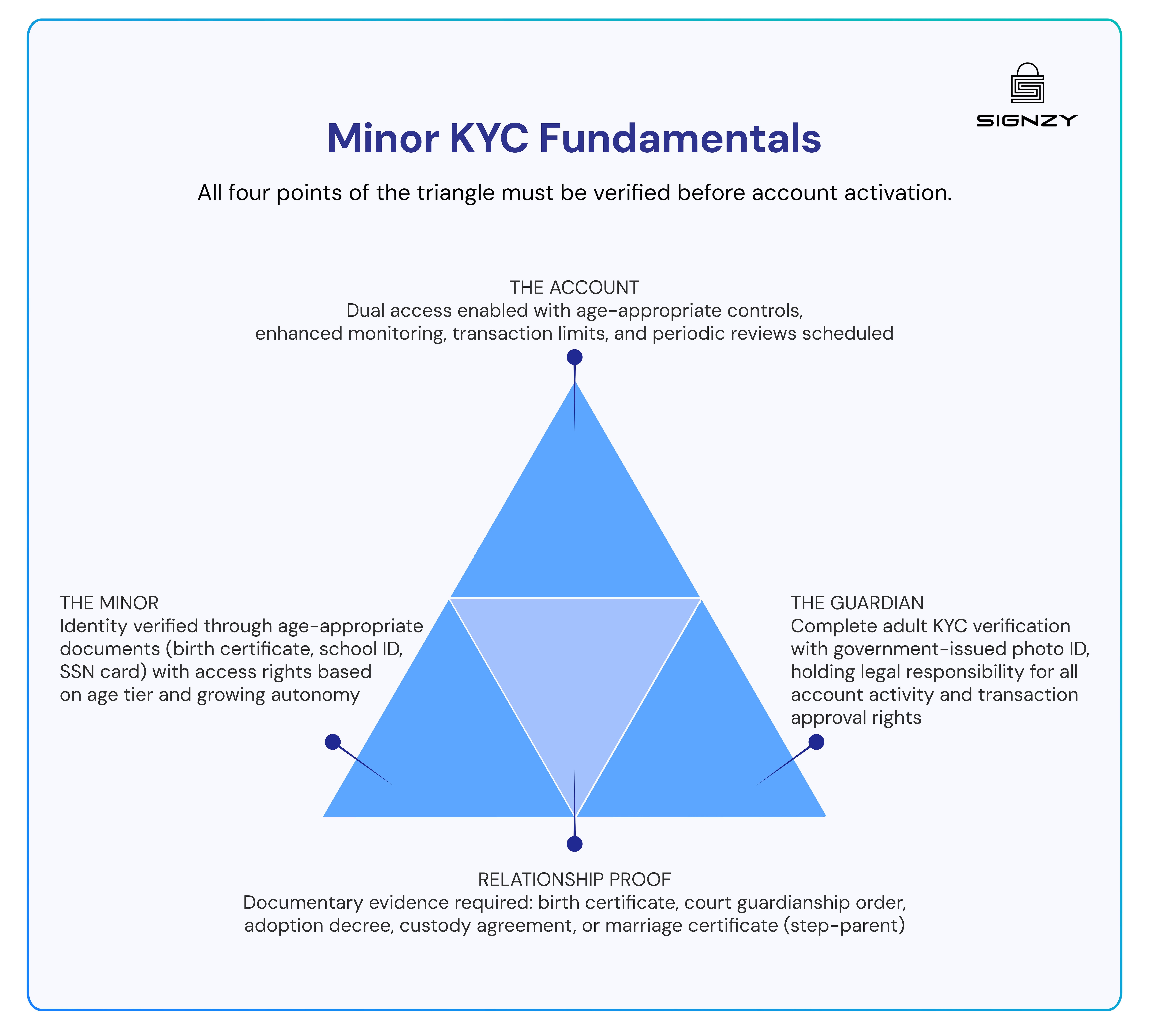
Below's a step-by-step process you can follow to conduct Minor KYC. You can tweak the flow of steps or add/remove any of them as it suits your business. Just ensure you are verifying both the guardian and the minor, along with their relationship proof.
Collect required documentation
Gather identification documents from both the minor and guardian, along with relationship proof as detailed in the documentation section above. Verify that all documents are current, legible, and contain matching information across different credentials.
Verify the guardian's identity first
Complete standard adult KYC verification on the guardian before proceeding with minor verification. Automated KYC solutions like Signzy's verification platform can streamline this process by authenticating documents, running AML screening, and validating credentials against official databases, reducing manual review time while maintaining compliance standards.
I came across Signzy’s One Touch KYC product when reading Gartner's report and signed up right away. They've really reduced a lot from my plate. Even our completion rates on onboarding jumped from 54% to 73%. Really a great product!
— Compliance Supervisor, Digital Banking Platform (200+ employees)

Authenticate the minor's identity
Use age-appropriate verification methods to confirm the minor's identity against submitted documents. Cross-reference name, date of birth, and other identifying information across multiple documents to ensure consistency.
Validate the legal relationship
Review relationship proof documents to confirm the guardian has legal authority over the minor. For non-parental guardians, verify that court orders or legal appointments are current and grant financial management rights.
Obtain guardian consent and signatures
Secure documented consent from the guardian acknowledging their oversight responsibilities and liability for account activities. This consent must be explicit and recorded in the account files.
Set age-appropriate account controls
Configure transaction limits, monitoring rules, and access restrictions based on the minor's age bracket. When using Signzy’s digital KYC platform, you can automatically apply these controls during account setup, ensuring compliance requirements are met without manual configuration errors.
Activate account with dual access
Enable the account with both minor and guardian access credentials, ensuring the guardian maintains oversight capabilities while providing appropriate autonomy to the minor based on their age.
Schedule periodic reviews
Set automated reminders for age milestone reviews, documentation updates, and the eventual transition to adult account status when the minor reaches legal age.
Minor KYC best practices
Effective Minor KYC extends beyond minimum regulatory requirements to encompass operational excellence and risk management.
✔️ Implement dedicated minor account workflows
Businesses should establish separate account opening and management processes specifically designed for Minor KYC rather than adapting adult procedures.
Dedicated workflows ensure staff collect all required documentation upfront, verify relationships before account activation, and apply appropriate transaction controls automatically. These systems should include built-in checklists that prevent accounts from opening with incomplete guardian verification or missing relationship proof.
If possible, also implement automated age-tracking to trigger reviews at key milestones and alert compliance teams when accounts approach the age of majority.
✨ Signzy solution: Signzy enables institutions to build custom Minor KYC workflows with pre-configured checklists and age-based milestone tracking, reducing manual oversight while ensuring complete documentation at every step.
✔️ Maintain robust documentation and record-keeping
This best practice involves digitizing all Minor KYC documents, maintaining version history when updates occur, and implementing secure storage with appropriate access controls.
When guardianship changes, institutions should retain historical documentation while adding new guardian credentials rather than overwriting previous records. Regular audits of minor account files help identify missing documentation before regulators discover gaps.
✨ Signzy solution: Signzy helps institutions maintain audit-ready records by digitizing documents with complete version history and secure storage, simplifying compliance during guardianship transitions or regulatory examinations.
✔️ Apply enhanced monitoring and transaction controls
Minor accounts warrant closer oversight than standard adult accounts due to vulnerability factors and potential for exploitation. To counter, institutions can implement controls like:
- Transaction monitoring flagging unusual patterns: Systems automatically detect abnormal activity like unexpectedly large withdrawals, international transfers, or sudden spending increases that may indicate fraud or unauthorized access.
- Velocity limits restricting daily transaction counts: Caps on how many transactions can occur in 24 hours, preventing someone from quickly draining the account through multiple transfers.
- Mandatory cooling-off periods for significant withdrawals: Large withdrawals require a 24-72 hour waiting period before processing, giving guardians time to verify the request is legitimate.
- Guardian alerts for transactions exceeding set thresholds: Automatic notifications sent to guardians when transactions exceed set dollar amounts, keeping them informed of significant account activity.
These controls protect minors from fraud while also detecting potential financial abuse by guardians themselves.
✨ Signzy solution: Signzy's monitoring capabilities help institutions flag transaction anomalies and trigger guardian notifications in real-time, enabling comprehensive oversight without building custom surveillance infrastructure.
Our team saved roughly 15–20 hours a week because Signzy removed all those unnecessary manual checks. One-Touch KYC honestly gave us room to breathe.
— Head of Ops, lending service (700+ employees)
When a minor becomes a major
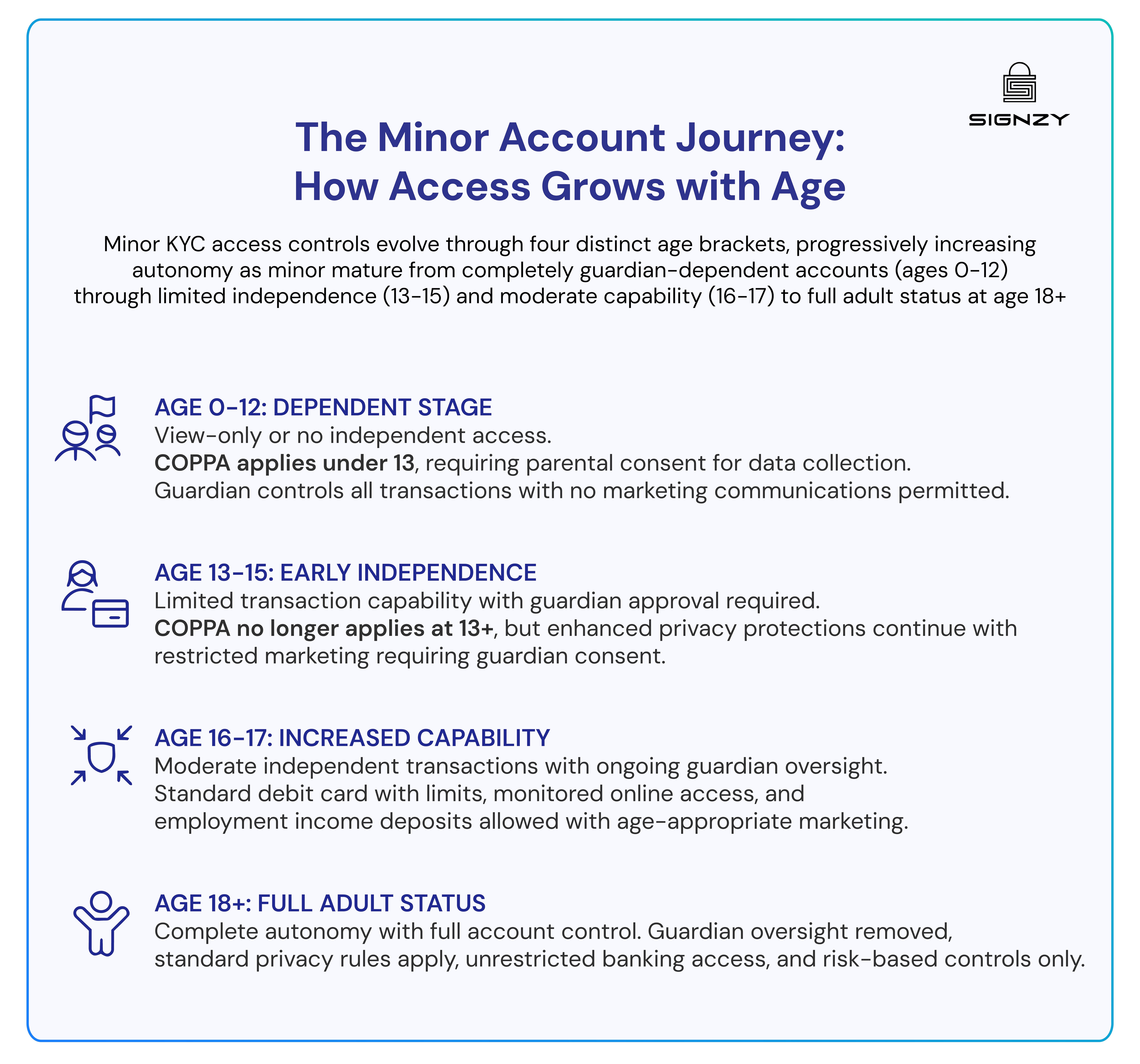
When a minor reaches the age of majority (typically 18 years old), their account must transition from Minor KYC status to standard adult account status. This transition removes mandatory guardian oversight and grants the account holder full legal control over their finances.
The transition requires new account agreements that reflect the holder's legal capacity to contract independently. Guardian access is removed unless the now-adult customer explicitly authorizes continued joint access. Transaction limits imposed during the minority are lifted, and the account becomes subject to standard adult KYC monitoring and compliance requirements.
How to automate Minor KYC with Signzy?
Signzy's platform solves all friction points through purpose-built automation for minor accounts.
🔄 Dual verification without manual coordination
Problem: Verifying both minor and guardian separately creates coordination difficulties. Staff must track two incomplete verification processes, chase missing documents from different parties, and manually cross-reference relationship proof against submitted IDs. This often leads to delays when one party's documentation sits waiting for the other.
Signzy solves this by processing both verifications in a single coordinated workflow that cross-checks relationship documents against submitted IDs, flags mismatches immediately, and prevents account activation when either verification is incomplete.
The 14,000+ document types coverage is real. We onboard from 80 countries and haven't encountered a single document type that it couldn't handle. Even obscure regional IDs from small EU countries work perfectly.
— Head of Compliance, Lending Platform (200+ employees)
This eliminates the extended back-and-forth that typically stretches minor account opening from days to weeks.
📋 Compliance records across the account lifecycle
Problem: Guardian changes, age milestone updates, and consent renewals create documentation complexity. Manual tracking means custody changes get missed, age-based reviews are forgotten, and historical records get overwritten when new guardians are added. These gaps surface during audits and create compliance risks.
Signzy maintains complete audit trails automatically, retaining historical guardian records when custody changes, triggering re-verification at age thresholds, and preserving version history for regulatory review. Institutions avoid compliance gaps without relying on staff to remember review schedules or documentation requirements.
👨👩👧 Age-appropriate controls without custom development
Problem: Different age brackets require different transaction limits, access permissions, and monitoring rules. Building custom logic for these variations is expensive, and manual enforcement means permissions often remain outdated when minors cross age thresholds. This either blocks legitimate transactions or allows unauthorized access.
Signzy applies age-based controls automatically based on the minor's birthdate, adjusting permissions when thresholds are reached without requiring developer involvement. A 15-year-old's limits update when they turn 16, ensuring compliance without manual intervention.
⚡ Faster processing with better accuracy
Problem: Traditional Minor KYC takes 5 to 7 business days because staff manually review every document, verify guardian credentials through phone calls or letters, and check relationship proof against multiple databases. This delays account opening and creates frustration for customers waiting for approval.
Signzy's document verification and database cross-checks complete verification in minutes for straightforward cases, letting institutions approve same-day while flagging genuinely suspicious applications for human review. Staff focus on exceptions rather than routine processing, reducing turnaround time while improving fraud detection.
Want to see how it handles your specific documentation requirements and compliance scenarios? Book a demo to walk through your minor verification workflow.


FAQ
ow do fintech platforms verify minors while staying compliant with KYC and AML rules?

What is the minimum age for a minor to open a bank account?
Do I need to verify the identities of both the minor and the parent?
What documents do I need from the parent or guardian?
Does the Children's Online Privacy Protection Act (COPPA) apply to all businesses that deal with minors?
What regulations apply when verifying minors in the United States?
Roshan Kumar
Roshan leads product strategy for Identity and Fraud Verification at Signzy Technologies, where he oversees the development of secure, scalable ID Verification, Automated CKYC, and AI-powered Video KYC solutions for regulated banks and fintechs. With over five years of hands-on experience in KYC and API banking and a strong engineering background, he focuses on building platforms that ensure seamless and compliant onboarding across the BFSI sector. His expertise spans designing and implementing solutions that address evolving regulatory requirements and industry challenges.

Related Blogs
View all

How age verification protects your business?

Face Matching vs Selfie Verification: Differences and Which to Use (2026)
![Common Uses of Biometrics in Business [Examples Included]](https://cdn.sanity.io/images/blrzl70g/production/4de0ced79be899652dd0b149acbf195bb67e5a63-2821x663.png)
Common Uses of Biometrics in Business [Examples Included]

What is Government ID Verification? Step-by-Step Guide for businesses
The best in business


The global API marketplace for KYC, KYB, & AML
Explore the end-to-end verification stack trusted by 1,000 businesses.
Get in touch