





How to Spot Fake IDs by State? Types, solutions, and more - 2026

 Open in ChatGPT
🗒️ Key Highlights
- Nearly 32% of college students admit to possessing fake IDs, exposing industries like iGaming, crypto, alcohol, and gambling to serious regulatory and financial risk from underage or fraudulent access.
- Fake identity documents vary widely by state and country, with differences in layout, holograms, microprint, UV features, and card materials that make visual checks alone unreliable.
- Modern ID verification like Signzy's now relies on a combination of document forensics, database checks, and liveness detection to identify forged, altered, and synthetic IDs before they lead to compliance breaches or fraud losses.
Joseph Cox, a hacking journalist, in one of his experiments, claims he created two fake IDs within minutes. As shown in the image he shared, one of the IDs was of California.
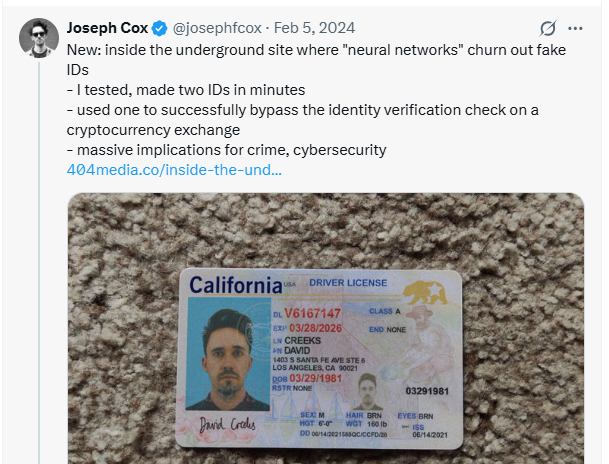
One of the Fake IDs even passed an identity verification on a cryptocurrency exchange named OKX.
OKX's system said it was reviewing my identity. Then it approved it. There you go: successfully made a cryptocurrency account with a fake name, fake ID. The face is mine (didn't want to implicate innocent person) but site says its going to launch AI faces,” he shared on X (formerly Twitter).

This experiment is of 2024, before even any sophisticated AI image generation models like Nano Banana were launched. The scary accuracy of these models is all over social media.
Now, if you manage compliance for your own or any other business, the responsibility lies upon you to detect these almost-perfect fakes. For your relief: yes, solutions exist.
Below, we'll walk through how you can spot fake IDs by state, covering manual security checks, automated verification methods, state-specific features, and best practices that expose counterfeits most effectively.
What is a fake ID?
A fake ID represents any identification that’s been altered, forged, or obtained dishonestly to misrepresent someone’s identity. The scope ranges from crude modifications of legitimate IDs to sophisticated forgeries that can pass basic security checks.
Which IDs are faked and why?
Driver's licenses are the most commonly faked documents because they're accepted universally for identity verification while being difficult for verifiers to authenticate across different state designs.
National identity cards follow closely, targeted for banking access and government services in regions where they're mandatory. Passports, despite being hardest to replicate, attract sophisticated fraudsters due to their high value for international fraud and identity establishment.
Student IDs serve as entry-level fakes due to minimal security features and low legal penalties, primarily used for age-restricted purchases.
How to spot fake IDs by state?
Quick Answer: How to Spot Fake IDs
Check these key indicators:
- Laser perforations – Look for correct state cut patterns
- Holograms – Tilt the ID to verify smooth color shifts
- Embossing – Feel for raised text or signatures
- Layout & fonts – Ensure spacing and formatting match official designs
- UV features – Use blacklight to reveal hidden patterns
- Secondary documents – Cross-verify with supporting ID documents

Fake IDs are getting harder to detect, but each state incorporates unique security features designed to catch counterfeits. We'll show you what to look for during manual inspection and how automated solutions can scale these checks without sacrificing accuracy.
1. Laser perforation analysis
Each state includes specific perforation patterns (tiny holes that generate a certain pattern or picture when held up to light):
- California: Features the California grizzly bear, gold rush, and poppy on the license.
- New York: Showcases the Statue of Liberty and the state seal with a bald eagle.
- Texas: Highlights the Texas Capitol building and the state’s iconic design.
- Florida: Depicts a sunny beach scene, reflecting the state’s “Sunshine State” motto.
- Georgia: Displays the state’s official fruit, the peach, on its driver’s license.
- Arizona: Includes a desert landscape, symbolizing the state’s vast desert regions.
- Ohio: Features the state seal, depicting the Scioto River and wheat fields.
Hold the ID up to direct light. These perforations should appear clean, precise, and show clear edges. If they look fuzzy, irregular, or just slightly off – take a closer look.
Most counterfeiters struggle with this feature because it requires specialized equipment to replicate.
🎯 Automation advantage: Signzy's document verification analyzes perforation patterns and micro-details through advanced image processing, detecting irregularities in laser perforation quality that are invisible during manual inspection. This eliminates the need for staff to memorize state-specific perforation designs across all 50 states.
I was skeptical about another verification vendor, honestly. We'd tried two others that either rejected real customers or let fraudsters through. Signzy's face matching caught a stolen ID case our previous system missed entirely. That one catch paid for the annual contract in saved fraud costs.
— Head of Risk Management, Fintech Startup
2. State-specific hologram features
Your most reliable verification tool might be state holograms – each state designs theirs uniquely. Tilt any ID and watch how the hologram shifts. Real holograms change appearance smoothly when viewed from different angles. Fakes often look static or show jarring transitions.
🎯 Automation advantage: Signzy's document verification uses advanced forgery detection to analyze security features across 200+ ID types from 180+ countries, flagging anomalies that manual inspection might miss.
3. Embossing and tactile elements
Close your eyes and feel the ID. Seriously – this works.
Real IDs have specific raised areas you can feel. Some states put their birth dates at a particular height. Some make sure you can feel that signature.
Take some time to see how the original ones feel. And during check, if anything feels rough or irregular, that’s your warning sign.
🎯 Automation advantage: Signzy's OCR understands document layouts and validates formatting details, helping identify structural inconsistencies in counterfeit IDs that lack proper physical security features.
4. Document format and layout
Check the text spacing, image placement, and overall design. Size and thickness specifications matter too – most states follow the standard credit card size (3.370 × 2.125 inches). Compare fonts and colors to state standards as well.
🎯 Automation advantage: Signzy's system validates document formatting against precise specifications for each state's current and historical designs, automatically flagging deviations in text spacing, font types, and layout measurements that manual checkers would miss. This works across documents from 180+ countries, not just US states.
5. UV Light responses
UV security features reveal state-specific patterns invisible to the naked eye. California embeds a lighter version of the driver’s photo, while Florida integrates distinct header patterns.
Pro Tip: Create a quick reference guide for the states you check most often. Focus on their unique security features and common fake tells. This speeds up verification while maintaining accuracy.
6. Secondary ID verification
Secondary ID verification requires users to provide a second form of identification beyond their primary document, creating a cross-validation layer that catches inconsistencies fraudsters typically miss when preparing a single fake identification.
💡 Related Blog:

🎯 Automation advantage: Signzy offers multi-document verification for utility bills, bank statements, or additional government IDs.
Many verification platforms struggle with false rejections or missed fraud. However, when with Signzy, our advanced document intelligence reduces false rejections by accurately distinguishing authentic documents from fakes, ensuring legitimate users aren't blocked while maintaining security. The system's training across 180+ countries means it recognizes valid document variations that other platforms might incorrectly flag as suspicious.
Top 5 states with fake IDs, ranked

According to IDScan.net's 2024 Fake ID Report analyzing over 130 million physical ID scans (with at least 600,000 scans per state), these five states emerge as the most commonly counterfeited.
#1. Texas (1.18% fake rate)
Texas leads with the highest percentage of fake IDs in circulation among all US states. The state's massive population of 30+ million creates a large pool of legitimate IDs in circulation, making Texas licenses familiar to verifiers nationwide. This familiarity paradoxically works in fraudsters' favor because people assume they know what a Texas ID should look like without checking carefully.
Additionally, Texas has issued multiple design versions over the past decade, creating confusion about which features should be present based on issue date. This variation gives fraudsters room to operate, as verifiers can't immediately determine if an older-looking design is authentic or simply outdated.
#2. South Carolina (1.15% fake rate)
South Carolina claims second place with a fake rate nearly identical to Texas. The state's earlier ID versions featured relatively straightforward designs with fewer complex security features compared to states like California or New York, making them easier targets for replication.
#3. Arizona (1.09% fake rate)
Arizona ranks third, with counterfeiters capitalizing on the state's recognizable format and clean, structured layout. Arizona licenses feature a distinctive desert landscape design that's widely known but not intensively studied by out-of-state verifiers.
The state's significant youth population, driven by major universities like Arizona State University (over 80,000 students), creates natural demand for fake IDs among underage individuals seeking age verification bypass. This college-town ecosystem supports a robust market for Arizona fakes.
#4. Washington D.C. (1.00% fake rate)
The nation's capital shows exactly 1% of scanned IDs as fraudulent, a significant rate considering D.C.'s relatively small population compared to states. The District's unique position as a federal territory rather than a state contributes to verification confusion, as many people are less familiar with D.C. license designs.
#5. New Mexico (0.83% fake rate)
New Mexico rounds out the top five, with counterfeiters targeting its IDs despite a slightly lower fake rate. The state's distinctive turquoise and red color scheme makes New Mexico licenses visually recognizable, but this recognition doesn't translate to verification expertise among out-of-state checkers.
While New Mexico has modernized its licenses, the pace of updates hasn't matched states like California or New York, leaving a larger window where older security standards remain acceptable.
Detecting by features: What are features of fake IDs?
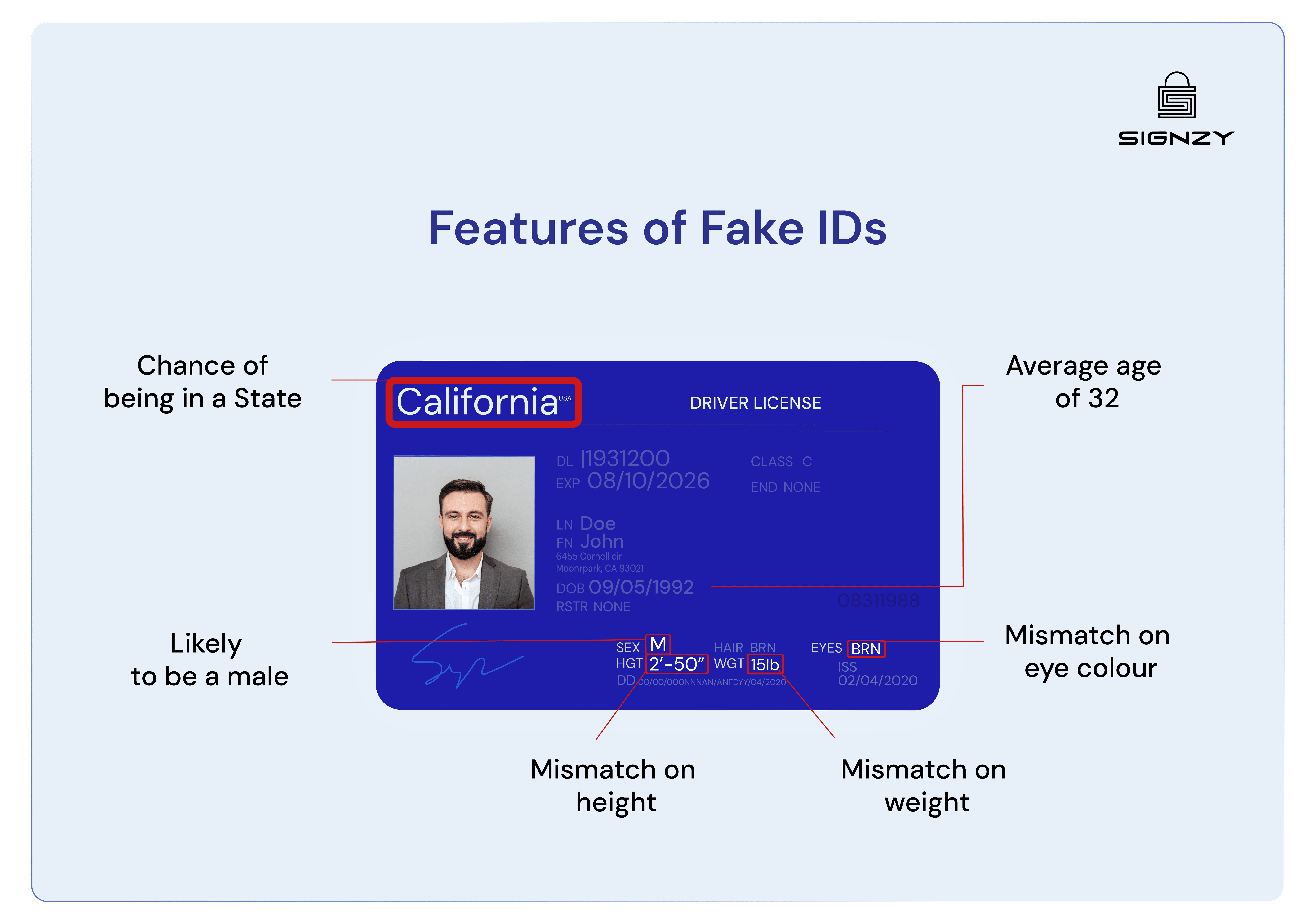
Here are some common features of fake IDs with examples.
Most fake IDs fail on multiple features. If something seems off about one aspect, chances are you’ll find other issues if you keep looking.
Rather than training staff to memorize specifications for documents, businesses can rely on Signzy's system to flag format deviations and data mismatches instantly, reducing false acceptances while maintaining smooth user experience.
Detecting by type: What are the most common types of fake IDs? [Red flags included]
There are four main types of fake IDs: altered IDs (legitimate documents with modified details), forged IDs (completely fabricated documents), scannable fake IDs (counterfeits with working barcodes), and stolen IDs (real documents used by unauthorized individuals).
Each type exploits different vulnerabilities in verification systems. And actually, if you figure out the method used to create the fake ID, you can narrow down your inspection to specific features.
This section has all the answers you need in order to detect the method used to create fake ID.
1. Altered IDs: Legitimate documents with fraudulent modifications
Altered IDs begin as genuine government-issued documents where specific details like birth dates, names, or photos are changed while original security features remain intact. Fraudsters heat-remove laminates to swap photos, digitally edit and reprint sections, or use matching fonts to modify dates.
How to detect altered IDs?
🚩 Lamination edges showing signs of lifting, resealing, or adhesive residue
🚩 Font inconsistencies in modified fields compared to original document typography
🚩 Photo misalignment with embedded security features like ghost images or holographic overlays
🚩 Color variations in edited sections that don't match the original printing
🚩 Uneven surface texture where laminate has been reapplied
🎯 Signzy Identity Verification API advantage: Signzy's document verification system analyzes ID authenticity across multiple countries and document types, catching tampering through automated forgery detection that identifies inconsistencies invisible to manual checks.
2. Forged IDs: Completely fabricated documents built from scratch
Forged IDs are entirely counterfeit documents created without authentic base material, replicating government identification through reproduced security features. AI image generation models and modern desktop printers produce convincing results using layered holographic films, UV-reactive inks, replicated microprinting at 6-point sizes, and embossed tactile text. Now
How to detect forged IDs?
🚩 Hologram angles shifting incorrectly or not at all when rotated under light
🚩 Cardstock thickness deviating by 0.1mm from legitimate specifications
🚩 UV patterns glowing in wrong colors, incorrect locations, or missing entirely
🚩 Microprinting that blurs under 10x magnification where authentic versions stay crisp
🚩 Tactile elements feeling flat or incorrectly raised compared to genuine documents
🚩 Overall print quality appearing too glossy or matte compared to government-issued standards
🎯 Signzy Identity Verification API advantage: Signzy verifies documents from 180+ countries by comparing submitted IDs against legitimate formats, catching counterfeit documents through pattern recognition that identifies deviations from authentic government specifications.
3. Scannable fake IDs: Counterfeits with functional but fraudulent barcodes
Scannable fake IDs contain working barcodes encoding information matching printed card details, but the data itself is fabricated. Fraudsters use free PDF417 barcode generators to encode any information, then print this barcode on fake IDs. A successful scan only confirms the barcode is readable, not that encoded data corresponds to real government records.
How to detect scannable fake IDs?
🚩 Data mismatches between scanned information and what's printed on the card
🚩 State codes in barcode data not matching the issuing authority format
🚩 Issue dates that are impossibly recent for obsolete document designs
🚩 Encoded addresses showing different states than the issuing authority
🚩 Barcode placement or sizing that deviates from standard positioning
🚩 Scan results showing formatting errors in data fields like license numbers
🎯 Signzy Identity Verification API advantage: Signzy's OCR technology extracts text from documents in multiple languages and validates the extracted data, helping businesses verify that printed and encoded information align correctly across different ID formats.
4. Stolen IDs: Genuine documents used by unauthorized individuals
Stolen IDs are real, unaltered government documents presented by someone other than the legitimate owner. Every security feature authenticates perfectly because the document is genuine; the fraud occurs in document misuse, not falsification. These are obtained through theft, purchased from lookalike original owners, or found after being lost.
How to detect forged IDs?
🚩 Facial features not matching the document photo (different eye shape, nose structure, or face geometry)
🚩 Hesitation or incorrect responses when asked to verify basic information like birth date or address
🚩 Physical characteristics like height or eye color not matching document details
🚩 Nervous behavior or avoiding eye contact during document presentation
🚩 Document showing excessive wear inconsistent with the issue date
🚩 Presenter unable to answer questions about specific document security features
🎯 Signzy Identity Verification API advantage: Signzy combines face matching technology with liveness detection to confirm the person presenting the ID matches the document photo and is physically present, blocking attempts to use stolen documents or deepfake impersonation.
Why should businesses care?
You might be thinking, “Sure, fake IDs are out there, but why should my business worry about them?”
Well, the short answer is: a lot.
Fake IDs can spell disaster for your business in more ways than you might imagine.
- Financial Fraud: Fake IDs can enable identity theft, financial scams, and other crimes that can harm your business.
- Reputational Damage: Being caught accepting fake IDs can tarnish your brand reputation and drive away customers.
- Lost Revenue: Every fake ID accepted is a potential loss of products or services given away for free.
- Safety and Security: Fake IDs compromise the safety of your customers and employees by allowing unknown individuals access.
- Liability: If a fake ID enables a crime, your business could be held liable for damages.
- Compliance: Many industries, especially finance-related, have strict ID verification requirements that must be met to avoid penalties.
And it doesn’t end here.
We are not counting the indirect impact, like increased chargebacks from unauthorized transactions and higher insurance premiums due to heightened risk.
Our old system flagged so many legitimate IDs that customer support was overwhelmed with verification tickets. Switching to Signzy cut our false positives by half within the first month. Our NPS scores actually improved because onboarding stopped feeling like an interrogation.
— Head of Customer Experience, Crypto Exchange
Using Signzy to detect Fake IDs at scale
As businesses grow, manually checking IDs becomes a real headache. It just doesn’t cut it when you’re dealing with hundreds or thousands of customers daily.
That’s where API-based identity verification can prove to be a real table-turner for businesses looking to scale up without sacrificing accuracy or security.
So, how do these API solutions actually work?
Here’s a breakdown:
- Users input an ID into the system, either by scanning it or uploading a digital copy.
- The API quickly analyzes the ID, checking for authenticity, consistency, and all those crucial security features we mentioned earlier.
- It cross-references the ID data with various databases to ensure the information is valid and matches the individual presenting the ID.
- The API then returns a result indicating whether the ID is authentic or if there are any red flags that need further investigation.
The beauty of API-based ID verification is that it seamlessly integrates with your existing systems and processes.
I've integrated a lot of APIs in my career. Most identity verification vendors promise two-week implementation and deliver two-month headaches. Signzy's documentation was actually accurate, their sandbox worked properly, and we went live in 11 days. My developers weren't complaining for once.
— CTO, Online Marketplace
Tweak a few settings here and there to get the best results for your particular business. And, of course, it’s always a good idea to keep an eye on the verification results, just to make sure everything’s running fine.
And the best part? Businesses don’t necessarily need big infrastructure for verifying age or IDs at scale or conducting secondary ID verification at same time – Signzy’s identity verification suite of APIs brings this technology within reach for businesses of all sizes. It can verify multiple ID types across different states, providing instant verification results, and even scales effortlessly with your needs.


FAQ
Can fake IDs scan and show encoded information?

How can businesses verify IDs at scale?
Can you feel the difference between real and fake IDs?
What should businesses do if they suspect a fake ID?
Saurin Parikh
Saurin is a Sales & Growth Leader at Signzy with deep expertise in digital onboarding, KYC/KYB, crypto compliance, and RegTech. With over a decade of professional experience across sales, strategy, and operations, he’s known for driving global expansions, building strategic partnerships, and leading cross-functional teams to scale secure, AI-powered fintech infrastructure.

Related Blogs
View all




The best in business


The global API marketplace for KYC, KYB, & AML
Explore the end-to-end verification stack trusted by 1,000 businesses.
Get in touch