




How to Conduct a Secretary of State Business Search in Washington? Complete Guide [2026]

 Open in ChatGPT
Key Highlights
- Washington's CCFS portal at ccfs.sos.wa.gov is one of the most capable state business registries in the US — offering free searches by business name, UBI number, registered agent, or governor/officer name, plus free document downloads for most filings.
- The Unified Business Identifier (UBI) is Washington's 9-digit number assigned to every registered entity — and it's shared across multiple state agencies (Department of Revenue, Labor & Industries, Employment Security), making it one of the most useful cross-referencing tools in any state KYB workflow.
- With CTA BOI reporting suspended for domestic entities in 2026, Washington CCFS data has become the operational foundation of Customer Due Diligence for institutions onboarding Washington businesses — but it must be paired with UBO, sanctions, and adverse media enrichment to satisfy BSA/CDD expectations.
- Platforms like Signzy deliver Washington SOS data in under 3 seconds via API and enrich it with beneficial ownership identification, watchlist and sanctions screening, bankruptcies, UCC filings, EIN verification, and continuous monitoring — turning fragmented manual lookups into audit-ready KYB workflows.
- What Is a Washington Secretary of State Business Search?
- How Does the Washington CCFS Business Search Work?
- What Is Washington's Unified Business Identifier (UBI)?
- What Business Entity Types Appear in Washington's CCFS Search?
- What Data Points Are Available in a Washington SOS Search?
- What Regulatory Frameworks Govern Washington Business Registration?
- What Are the Common KYB Use Cases for Washington SOS Search?
- What Are the Limitations of Relying on Washington SOS Data Alone?
- How Does Signzy Extend Washington SOS Data Into a Complete KYB Workflow?
- FAQ
Washington State is home to one of the most dynamic business ecosystems in the country — anchored by Seattle's tech giants, a rapidly growing fintech corridor, a thriving e-commerce sector, one of the largest legal cannabis markets in the US, and a strategic cross-border trade position with Canada. For compliance teams at banks, fintechs, payment processors, and lenders, the Washington Secretary of State business search is the entry point for verifying any commercial customer registered in the state.
Washington's business registry also happens to be one of the most capable in the country. The Corporations and Charities Filing System (CCFS) supports searches by business name, UBI number, registered agent, and — uniquely among US states — by governor or officer name. It offers free document downloads, real-time filing history, and a clean, modern interface. For compliance teams accustomed to the limitations of other state registries, Washington's CCFS is a welcome outlier.
In 2026, that capability matters more than ever. Following FinCEN's March 2025 Interim Final Rule narrowing the Corporate Transparency Act to foreign-registered entities only, domestic US companies — including every Washington LLC and corporation — no longer file Beneficial Ownership Information with FinCEN. This has returned UBO verification responsibility to financial institutions and elevated state-level registries as the operational foundation for modern KYB programs.
This guide walks compliance, onboarding, and risk teams through exactly how to conduct a Secretary of State business search in Washington. It covers the CCFS portal step-by-step, the Unified Business Identifier (UBI) system that makes Washington's registry uniquely trackable, the entity types governed under RCW 23B and 25.15, and the practical KYB patterns that matter when verifying Washington businesses at scale.

What Is a Washington Secretary of State Business Search?
A Washington Secretary of State business search is the process of querying the state's official business registry — maintained through the Corporations and Charities Filing System (CCFS) — to confirm whether a business is legally registered, review its formation and annual report history, identify its registered agent, check its current compliance status, and retrieve its filing documents.
For compliance teams, this search answers the foundational KYB question: Is this legal entity actually registered with the State of Washington, and is it currently in good standing? Without that confirmation, every downstream control — AML screening, sanctions checks, transaction monitoring, Enhanced Due Diligence — operates on an unverified premise.
Why Washington matters for KYB programs
Washington's business ecosystem is unusually concentrated in sectors that generate high-volume KYB activity:
- Technology — Seattle and the Puget Sound region host Amazon, Microsoft, Boeing, T-Mobile, Expedia, Zillow, and thousands of startups, creating continuous commercial onboarding at banks and payment processors.
- Fintech — A growing fintech corridor in Seattle and Bellevue drives demand for fast, API-based entity verification.
- E-commerce — Washington is an e-commerce hub, with platform sellers, fulfillment businesses, and digital-commerce startups requiring merchant underwriting and KYB checks.
- Cannabis — Washington legalized adult-use cannabis in 2012, creating one of the most mature state cannabis markets with thousands of licensed businesses and elevated KYB requirements.
- Cross-border trade — Washington's border with British Columbia and its major ports (Seattle, Tacoma) create significant trade, logistics, and freight activity that generates KYB verification for US-Canada counterparties.
- Social Purpose Corporations — Washington is one of the few states offering a dedicated Social Purpose Corporation entity type — relevant for impact investors and ESG-focused compliance programs.
For broader context on where business verification fits within AML compliance, Signzy's AML vs KYC guide explains how customer and business identification feed the full AML lifecycle.
How Does the Washington CCFS Business Search Work?
Washington operates its business search through the Corporations and Charities Filing System (CCFS) at ccfs.sos.wa.gov. The search is free, requires no account for lookups, and offers one of the most flexible search interfaces among US state registries.
Step-by-step: Conducting a Washington business search via CCFS
Step 1 — Open the CCFS Business Search page. Navigate to ccfs.sos.wa.gov/\#/BusinessSearch.
Step 2 — Choose your search mode. CCFS offers three match types:
- Contains — broadest option; finds entities where your search term appears anywhere in the name. Best for broad reconnaissance.
- Begins With — narrower; returns names starting with your exact input.
- Exact Match — returns only entities with the precise name you enter. Best for confirming a known legal name.
Step 3 — Select the search field. CCFS supports an unusually broad set of search fields:
| Search Field | Best Used For |
|---|---|
| Business Name | Default search — legal name of the entity |
| UBI Number | Washington's unique 9-digit Unified Business Identifier |
| Registered Agent | Useful for investigating agents handling multiple entities |
| Governor/Officer | Unique to Washington — search by officer, director, member, or manager name |
The governor/officer search is a standout feature. Most state registries only expose officer information within individual entity records — Washington lets you search across the entire registry by a person's name, making it exceptionally useful for fraud investigations and related-party analysis.
Step 4 — Apply advanced filters (optional). Narrow results by:
- Entity type (LLC, Profit Corporation, Nonprofit, LP, LLP, Social Purpose Corporation, etc.)
- Status (Active, Inactive, Dissolved, Delinquent, Administratively Dissolved)
- Address — another broad search capability not available in most state systems
Step 5 — Review the result set. Results display entity name, UBI number, entity type, formation date, status, and jurisdiction (domestic Washington or foreign with home state).
Step 6 — Open the full record. Click any entity to access its complete profile:
- Entity name, UBI number, entity type, and current status
- Formation/registration date and jurisdiction
- Nature of business and NAICS code
- Registered agent name and address
- Governors/officers (members, managers, directors, officers) with names and addresses
- Annual report status and due dates
- Complete filing history with free document downloads — a significant advantage over states that charge for document access
Step 7 — Download documents (free). Most filings — including Certificates of Formation, Articles of Amendment, Annual Reports, and Dissolution filings — can be downloaded directly from the entity's filing-history page at no cost. Certified copies carry a fee, but standard document downloads are free.
Washington LLC search tips
Washington LLC names must be distinguishable from existing registered businesses and include an LLC designator. When searching:
- Drop the designator — search "Cascade Ventures" rather than "Cascade Ventures LLC"
- Remove punctuation — commas, periods, ampersands break exact matching
- Start with "Contains" for broad discovery, then narrow to "Begins With" or "Exact Match"
- Leverage the governor/officer search — if you suspect related-party structures, search by a principal's name to surface all connected entities across the registry
What Is Washington's Unified Business Identifier (UBI)?
Washington's Unified Business Identifier (UBI) is a 9-digit number assigned to every business entity when it registers with the Secretary of State. What makes it genuinely useful for KYB is that the same UBI is shared across multiple Washington state agencies:
- Secretary of State — entity registration, annual reports, filing history
- Department of Revenue — state tax registration, sales tax permits, B&O tax
- Department of Labor & Industries — workers' compensation, industrial insurance
- Employment Security Department — unemployment insurance
This cross-agency linkage means the UBI functions as a universal business identifier within Washington's state government — a rare feature among US states. For compliance teams, it means a single UBI lookup can anchor verification across multiple state databases, making Washington one of the easier states to verify comprehensively.
How to find a Washington UBI number
If you don't already have the UBI, you can find it by:
- Searching CCFS by business name — the UBI appears in search results
- Checking customer-provided documents — the UBI appears on the Certificate of Formation and Annual Reports
- Querying the Department of Revenue's Business Lookup at secure.dor.wa.gov — useful when you have a business license number but not the UBI
What Business Entity Types Appear in Washington's CCFS Search?
Washington recognizes a full range of for-profit, nonprofit, cooperative, and hybrid legal structures.
Washington entity types at a glance
| Entity Type | Governing Framework | Typical KYB Signals to Verify |
|---|---|---|
| Domestic LLC | RCW 25.15 (Washington Limited Liability Company Act) | Status, annual report, governors (members/managers) |
| Foreign LLC | RCW 25.15 registration to transact business in WA | Home jurisdiction, WA registered agent, annual report |
| Profit Corporation (Domestic) | RCW 23B (Washington Business Corporation Act) | Officers, directors, annual report, shares |
| Profit Corporation (Foreign) | Certificate of Authority | Home state, WA registered agent, status |
| Nonprofit Corporation | RCW 24.03A | Directors, mission, tax-exempt status (IRS separately) |
| Limited Partnership (LP) | RCW 25.10 (Revised Uniform Limited Partnership Act) | General and limited partners, status |
| Limited Liability Partnership (LLP) | RCW 25.05 | Partners, service type, status |
| Social Purpose Corporation | RCW 23B.25 | Officers, social purpose statement, annual report |
| Professional LLC/Corporation | RCW 18.100 (Professional Service Corporations) | Licensed professionals, profession type |
| Cooperative | RCW 23.86 | Member structure, directors, status |
The Social Purpose Corporation is a Washington-specific entity type designed for businesses that want to pursue both profit and a stated social purpose — relevant for impact investors and ESG-focused compliance programs that need to verify the entity's stated mission alongside its financial profile.
Sole proprietorships are registered through Washington's Business Licensing Service (BLS) at the Department of Revenue, not the Secretary of State. BLS uses the same UBI number, so sole proprietors can be cross-referenced — but they won't appear in CCFS.
What Data Points Are Available in a Washington SOS Search?
Washington's CCFS exposes more data than most state registries — and at no cost for basic access.
Washington CCFS data coverage
| Data Point | Available via CCFS | Typical KYB Use |
|---|---|---|
| Legal entity name | ✅ | Identity verification |
| Entity type (LLC, Corp, LP, etc.) | ✅ | Risk-tier classification |
| UBI number (9-digit) | ✅ | Cross-agency unique identifier |
| Current status (Active, Inactive, Delinquent, Admin Dissolved) | ✅ | Foundational compliance signal |
| Formation/registration date | ✅ | Business age scoring |
| Home jurisdiction (domestic/foreign) | ✅ | Foreign-entity risk flag |
| Nature of business / NAICS code | ✅ | Industry classification |
| Registered agent name and address | ✅ | Service-of-process verification |
| Governors/officers (members, managers, directors, officers) | ✅ | Identity linkage |
| Annual report status and due dates | ✅ | Compliance signal |
| Filing history and documents | ✅ (free download) | Event timeline and source docs |
| Search by governor/officer name | ✅ | Powerful fraud investigation tool |
| Beneficial Owner (UBO) identity | ❌ | Must be verified separately |
| EIN / Federal Tax ID | ❌ | Requires IRS or third-party enrichment |
| Bankruptcies | ❌ | Federal PACER or third-party data |
| UCC filings | ❌ | Separate SOS UCC module or third-party |
| Sanctions / watchlist exposure | ❌ | Requires OFAC/AML screening |
| Adverse media | ❌ | Separate screening tool |
| Litigation history | ❌ | State and federal court records |
Washington's combination of free document downloads, governor/officer search, UBI cross-referencing, and NAICS code exposure makes it one of the richest state registries for KYB — but the same fundamental gaps apply: no UBO data, no sanctions screening, no federal tax verification, and no continuous monitoring.
Washington business statuses — what they mean
- Active — Entity is in good standing, annual report filed on time
- Delinquent — Entity has missed its annual report deadline but hasn't been dissolved yet. This is a yellow flag — the business may still be operational but has failed a compliance obligation.
- Administratively Dissolved — Entity was dissolved by the state for persistent non-compliance (typically repeated failure to file annual reports or maintain a registered agent)
- Inactive — Entity has voluntarily suspended operations
- Dissolved — Voluntarily wound down through proper dissolution filings
- Expired — Entity's registration has expired (common for LPs and LLPs with fixed terms)
For KYB purposes, Delinquent is a particularly useful status. It's a middle ground — less severe than Admin Dissolved, but a concrete compliance-failure signal that warrants investigation before onboarding. Many states lack this intermediate status category.
What Regulatory Frameworks Govern Washington Business Registration?
Every Washington CCFS search sits within a layered legal framework. Understanding it is what separates KYB as a checkbox from KYB as a defensible compliance control.
Washington Business Corporation Act (RCW 23B)
RCW 23B governs Washington for-profit corporations. It establishes formation requirements, director and officer duties, shareholder rights, annual reporting, and dissolution. Washington corporations must:
- File Articles of Incorporation with the Secretary of State
- Maintain a registered agent with a Washington street address
- File annual reports
- Use a distinguishable corporate name with an appropriate designator
Washington Limited Liability Company Act (RCW 25.15)
RCW 25.15 governs LLCs. Washington LLCs must:
- File a Certificate of Formation with the Secretary of State
- Maintain a registered agent with a Washington street address
- File annual reports to maintain active status
- Use a distinguishable name including an LLC designator
Annual report requirement
Washington requires annual reports from LLCs, corporations, LPs, LLPs, and nonprofits. Reports are typically due on the last day of the entity's formation anniversary month. Failure to file leads to Delinquent status, and persistent failure leads to Administrative Dissolution.
The UBI system and cross-agency integration
Washington's UBI system links entity registration with the Department of Revenue, Department of Labor & Industries, and Employment Security Department. This means compliance teams can verify not just that an entity is registered with the SOS, but also that it holds active state tax registrations and workers' compensation coverage — useful signals for assessing operational legitimacy.
Federal overlays — BSA/CDD, CTA, and FATF
Washington CCFS data interacts with three federal frameworks every KYB team must navigate in 2026:
- BSA Customer Due Diligence (CDD) Rule. Financial institutions must identify and verify legal entity customers and their beneficial owners at account opening. State SOS data anchors the legal-existence confirmation.
- Corporate Transparency Act (CTA). Following FinCEN's March 2025 Interim Final Rule, domestic US entities — including Washington LLCs and corporations — no longer file BOI with FinCEN. UBO verification responsibility has returned to financial institutions.
- FATF Recommendation 10. Risk-based CDD on legal persons, including understanding ownership and control. Washington CCFS data plus third-party UBO verification is the standard compliance path.
For broader AML architecture context, Signzy's guide on the 5 pillars of an AML compliance program covers how CDD fits into the full BSA framework.
Cannabis and sector-specific overlays
Washington legalized adult-use cannabis in 2012 (Initiative 502), creating one of the most mature legal cannabis markets in the US. Cannabis businesses register with the SOS like any other entity, but also hold licenses from the Washington State Liquor and Cannabis Board (WSLCB). For federally regulated financial institutions, the federal illegality of cannabis creates the same layered compliance challenge as in other cannabis-legal states — requiring SOS verification, state license confirmation, and Enhanced Due Diligence.
What Are the Common KYB Use Cases for Washington SOS Search?
Washington's CCFS surfaces across multiple compliance and operational workflows, often with sector-specific angles driven by the state's unique business mix.
Banking and lending onboarding
Banks onboarding Washington commercial customers run CCFS lookups to confirm legal existence, current status, annual report compliance, registered agent, and governor/officer information. The UBI number enables cross-referencing with Department of Revenue data for additional tax-registration signals. Any discrepancy between customer-submitted documents and CCFS records is a material CDD flag.
Fintech and payment-processor underwriting
Seattle's fintech ecosystem creates heavy volumes of both inbound customer onboarding and outbound vendor verification. For institutions processing thousands of applications daily, API-based access to CCFS data (typically <3 seconds per lookup) is the operational default. Manual CCFS lookups are fine for individual checks but can't scale.
Tech startup and venture capital due diligence
Washington's tech sector generates significant M&A and investment due diligence activity. Legal and compliance teams review the full CCFS filing history — Certificate of Formation, amendments, annual reports, and any administrative actions — to map the entity's evolution. The governor/officer search is particularly valuable for surfacing founders' other ventures and related-party structures.
E-commerce and marketplace seller verification
For platforms underwriting Washington-based e-commerce sellers — whether for payment processing, lending, or marketplace compliance — CCFS verification confirms the seller's legal entity status. The NAICS code field in CCFS can provide an additional industry-classification signal.
Cannabis industry compliance
Washington's cannabis market is one of the most mature in the US, with thousands of WSLCB-licensed businesses. For the narrow set of financial institutions serving cannabis customers, CCFS verification is the entry point to a more complex stack: WSLCB license verification, Enhanced Due Diligence, source-of-funds analysis, and FinCEN-guidance-aligned SAR protocols.
Cross-border trade verification
Washington's ports and Canadian border create significant trade and logistics KYB activity. CCFS confirms entity registration; compliance teams then layer customs, freight, and cross-border risk assessment for US-Canada counterparties.
Fraud investigation and shell-company detection
CCFS's governor/officer search is one of the most powerful fraud-investigation features in any US state registry. Investigators use it to surface all entities associated with a specific individual — revealing shell-company networks, nominee structures, and related-party webs. Combined with the levels of due diligence framework and watchlist screening, it powers effective shell-detection workflows.
Social Purpose Corporation verification
For impact investors, ESG funds, and compliance programs evaluating Washington Social Purpose Corporations, CCFS provides the entity's social purpose statement alongside standard registration data — a unique verification capability.
What Are the Limitations of Relying on Washington SOS Data Alone?
Washington's CCFS is one of the strongest state registries in the US, but it's still not a complete KYB solution for financial institutions operating under BSA/AML expectations.
Where Washington CCFS data falls short
| Limitation | Why It Matters |
|---|---|
| No beneficial ownership data | CCFS lists governors/officers and registered agents, not ultimate beneficial owners. With CTA BOI narrowed to foreign entities, UBO verification is now a financial-institution responsibility. |
| No sanctions or watchlist screening | CCFS cannot flag OFAC, EU, UN, or HMT matches. |
| No adverse media | Regulatory actions, litigation, or negative news are invisible to CCFS data. |
| No EIN verification | The UBI is Washington-specific and doesn't validate federal tax registration. |
| No bankruptcy data | Federal PACER records are separate. |
| No UCC filings on entity search | UCC searches require a separate module within the SOS or third-party tools. |
| No cannabis license verification | WSLCB licensing is separate from CCFS. |
| No continuous monitoring | Manual lookups show the state right now. Without continuous monitoring, material changes go unseen between searches. |
| Sole proprietorships not in CCFS | Sole props register through BLS (Department of Revenue), not the SOS — a gap for institutions onboarding very small Washington businesses. |
| No tribal-government data | Washington has 29 federally recognized tribes with significant business activity; tribal enterprises may operate outside state registration. |
Despite these limitations, Washington's combination of governor/officer search, free document downloads, UBI cross-referencing, and NAICS codes gives compliance teams more to work with than almost any other state. The enrichment gap — UBO, sanctions, adverse media, behavioral signals — is where a unified KYB platform closes the loop.
As one compliance practitioner observed on a G2 KYB review thread, "Washington's CCFS is probably the best state registry I've worked with — but the officer search and free downloads don't help when you need UBO, sanctions, and continuous monitoring across 50 states. That's where a single platform saves you."
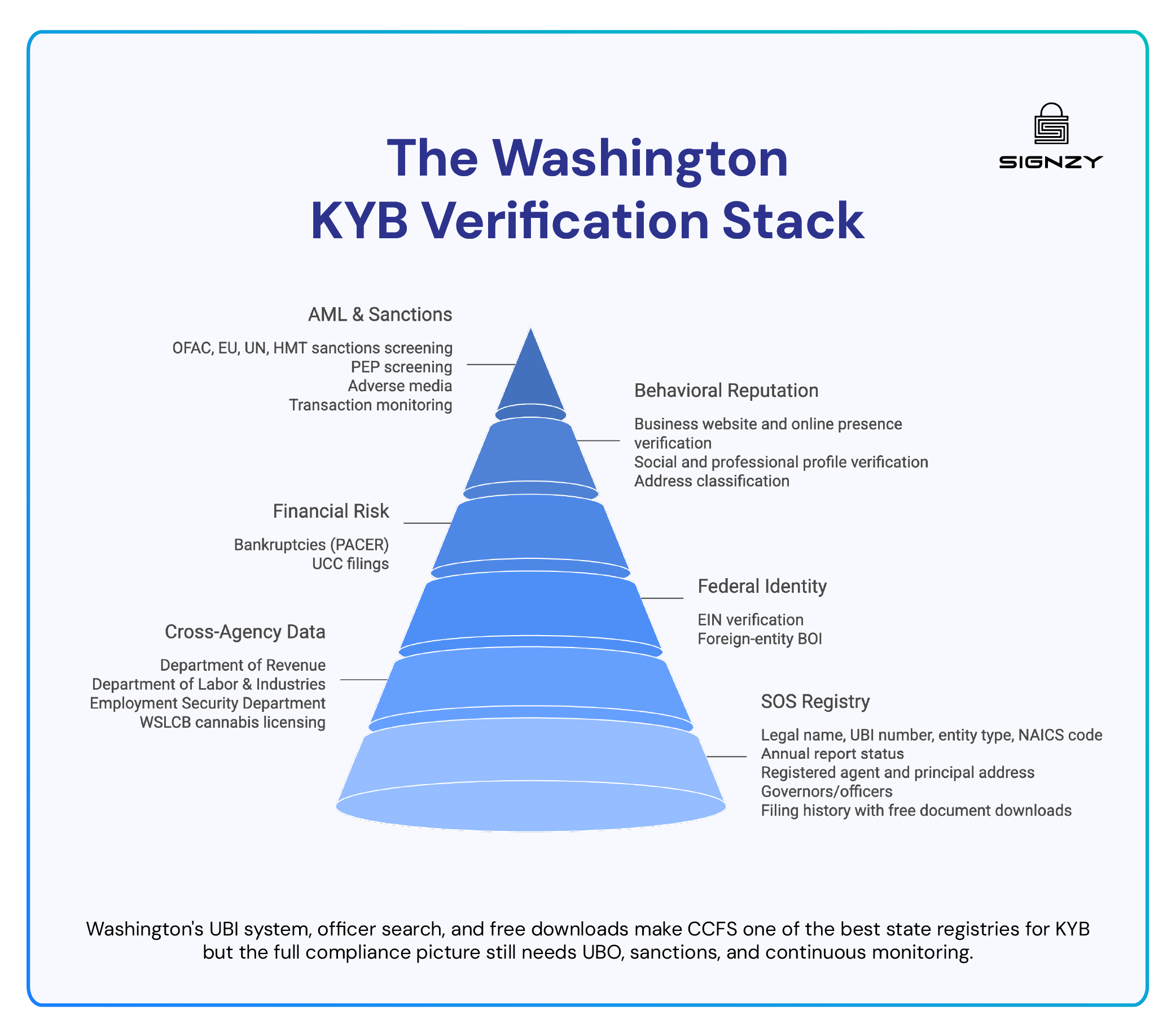
How Does Signzy Extend Washington SOS Data Into a Complete KYB Workflow?
Washington's CCFS is genuinely impressive for a state registry — but for institutions processing hundreds or thousands of business verifications per day, and needing to meet BSA/CDD expectations end-to-end, manual CCFS lookups and fragmented enrichment tools don't scale.
Signzy's Washington KYB solution delivers a single API-driven workflow combining CCFS data with the additional layers regulators expect.
Signzy's Washington KYB capabilities
| Capability | What It Does |
|---|---|
| Washington SOS Data | Real-time entity verification from CCFS — name, UBI, entity type, status, NAICS, registered agent, governors/officers, annual report status, filings — in under 3 seconds |
| EIN Verification | Confirms the IRS-issued Employer Identification Number matches the registered entity — bridging the UBI-to-EIN gap |
| UBO Identification | Identifies ultimate beneficial owners at the 25%+ threshold — the biggest gap post-CTA narrowing |
| Sanctions & PEP Screening | Real-time screening against OFAC, EU, UN, HMT, PEP, and adverse media databases |
| Watchlist Screening | Continuous checks against global financial-crime and integrity watchlists |
| Bankruptcy Checks | Federal bankruptcy data integrated into the same API response |
| Liens & UCC Filings | Washington UCC data and lien records integrated for financial-health signals |
| Address Classification | Distinguishes operational business addresses from residential, virtual-office, and CMRA addresses — particularly relevant in Seattle's dense commercial district |
| Business Website Verification | Confirms the business maintains an authentic online presence — useful for Washington's tech and e-commerce businesses |
| Social Presence Check | Credibility scoring across social and professional profiles |
| Continuous Monitoring | Event-driven alerts when status, annual report, governors, or screening results change — rather than relying on periodic manual re-verification |
| Audit-Ready Reporting | Immutable verification records retained for regulatory examination |
For institutions operating across multiple states, Signzy's unified KYB suite provides 50-state coverage through one API — eliminating the overhead of stitching together state registries, UBO verification, and AML screening across separate vendors. The platform has verified over 10,000 businesses across all 50 states, with typical Washington response times under 3 seconds.
For broader compliance workflows, Signzy's KYC/AML screening use case, Identity Verification, and Governance, Risk and Compliance Suite give compliance teams a unified platform from onboarding through the full customer lifecycle. The AML screening guide and transaction monitoring guide provide strategic context for building the broader AML program around business verification.


FAQ
Is the Washington Secretary of State business search free?

What is a Washington UBI number and why does it matter?
How do I search for a Washington LLC?
Can I search Washington businesses by officer or director name?
What does "Delinquent" status mean in a Washington business search?
How often do Washington businesses file annual reports?
Does Washington CCFS include sole proprietorships?
How does Corporate Transparency Act (CTA) reporting affect Washington business verification?
Saurin Parikh
Saurin is a Sales & Growth Leader at Signzy with deep expertise in digital onboarding, KYC/KYB, crypto compliance, and RegTech. With over a decade of professional experience across sales, strategy, and operations, he’s known for driving global expansions, building strategic partnerships, and leading cross-functional teams to scale secure, AI-powered fintech infrastructure.

Related Blogs
View all![How to Conduct a Secretary of State Business Search? Complete Guide [2026]](https://cdn.sanity.io/images/blrzl70g/production/60077c9d797198958b21b4a5678457b056d4b19e-5641x1325.webp)

How to Conduct a Secretary of State Business Search? Complete Guide [2026]

Texas Secretary of State Business Search: How to look up any Texas entity (2026 Guide)
![How to Conduct a Secretary of State Business Search in Indiana? Complete Guide [2026]](https://cdn.sanity.io/images/blrzl70g/production/068abc4b5797046a5b4423600303f171c1c0738c-2732x640.webp)
How to Conduct a Secretary of State Business Search in Indiana? Complete Guide [2026]
![How to Conduct a Secretary of State Business Search in Oklahoma? Complete Guide [2026]](https://cdn.sanity.io/images/blrzl70g/production/8e8d09744c983724361cf5faf6ae7bc35722ecc8-2732x640.webp)
How to Conduct a Secretary of State Business Search in Oklahoma? Complete Guide [2026]
The best in business


The global API marketplace for KYC, KYB, & AML
Explore the end-to-end verification stack trusted by 1,000 businesses.
Get in touch