





How to Conduct a Secretary of State Business Search in Minnesota

 Open in ChatGPT
Key Highlights
- The Minnesota Secretary of State's MBLS portal at mblsportal.sos.state.mn.us is the official, free business search tool — supporting lookups by business name, file number, and registered agent, with detailed filing histories and certified-copy ordering.
- Minnesota's annual renewal requirement is uniquely strict — unlike most states that allow grace periods or retroactive reinstatement, Minnesota entities that miss their renewal are quickly marked inactive, making status verification one of the highest-value KYB signals in the state.
- With CTA BOI reporting suspended for domestic entities in 2026, Minnesota SOS data has become the operational foundation of Customer Due Diligence for any institution onboarding Minnesota businesses — but it must be paired with UBO, sanctions, and adverse media enrichment to satisfy BSA/CDD expectations.
- Platforms like Signzy deliver Minnesota SOS data in under 3 seconds via API and enrich it with beneficial ownership identification, watchlist and sanctions screening, bankruptcies, UCC filings, EIN verification, and continuous monitoring — turning fragmented manual lookups into audit-ready KYB workflows.
- What Is a Minnesota Secretary of State Business Search?
- How Does the Minnesota MBLS Business Search Work?
- What Business Entity Types Appear in the Minnesota SOS Search?
- What Data Points Are Available in a Minnesota SOS Search?
- What Regulatory Frameworks Govern Minnesota Business Registration?
- What Are the Common KYB Use Cases for Minnesota SOS Search?
- What Are the Limitations of Relying on Minnesota SOS Data Alone?
- How Does Signzy Extend Minnesota SOS Data Into a Complete KYB Workflow?
- FAQ
Minnesota hosts more than 600,000 active business entities — from Fortune 500 headquarters to single-member LLCs — and every single one of them passes through the Minnesota Secretary of State at some point in its lifecycle. For compliance teams at banks, fintechs, payment processors, and payroll providers, the Minnesota SOS business search is frequently the first and most authoritative check they run when onboarding a Minnesota-based commercial customer.
In 2026, the stakes around that check have changed significantly. After FinCEN's March 2025 Interim Final Rule narrowed the Corporate Transparency Act to cover only foreign-registered entities, domestic US businesses — including every Minnesota LLC and corporation — no longer file Beneficial Ownership Information with FinCEN. That means state Secretary of State registries have become the operational ground-truth for domestic entity verification, and financial institutions now carry the full burden of UBO identification themselves.
This guide walks compliance, onboarding, and risk teams through exactly how to conduct a Secretary of State business search in Minnesota. It covers the state's MBLS portal step-by-step, the entity types regulated under Minnesota's 302A and 322C acts, the annual renewal quirk that creates more compliance signals than most other states, and the practical KYB patterns that matter when you're verifying Minnesota businesses at scale.

What Is a Minnesota Secretary of State Business Search?
A Minnesota Secretary of State business search is the process of querying the state's official business registry — maintained through the Minnesota Business & Lien System (MBLS) — to confirm that a business is legally registered, review its formation and renewal history, identify its registered agent and principal office, check its current compliance status, and retrieve supporting filings.
For compliance teams, this is the foundational KYB question answered in about five seconds: Is this legal entity actually registered with the State of Minnesota, and is it currently in good standing? Without that confirmation, every downstream control — AML screening, sanctions checks, transaction monitoring, Enhanced Due Diligence — operates on an unverified premise.
Why Minnesota's business registry matters to financial institutions
Minnesota combines a large regulated financial-services footprint (led by Wells Fargo, U.S. Bank, and Thrivent), a deep public-company presence (3M, Target, Best Buy, UnitedHealth Group), and a rapidly growing startup and fintech scene in the Twin Cities. That mix produces a constant stream of business onboarding decisions — new commercial deposit accounts, SMB lending applications, payment-processor merchant underwriting, payroll service setup — where the Minnesota SOS search is the first filter.
It is also the state with one of the strictest renewal regimes in the country, and those renewal filings generate a continuous stream of compliance signals that matter for KYB teams. More on that below.
For broader context on where business verification fits into the AML framework, Signzy's AML vs KYC guide explains how customer and business identification feed the full AML compliance lifecycle.
How Does the Minnesota MBLS Business Search Work?
Minnesota operates its business search through the Minnesota Business & Lien System (MBLS) portal at mblsportal.sos.state.mn.us, accessed via the Secretary of State's Business & Liens section at sos.state.mn.us/business-liens. The portal is free, requires no account for searches, and supports current versions of Microsoft Edge, Google Chrome, and Firefox (JavaScript and cookies must be enabled).
Step-by-step: Conducting a Minnesota business search via MBLS
Step 1 — Open the Business Filings Online search page. Start at sos.state.mn.us/business-liens and select the Business Filings Online link, or go directly to the MBLS portal.
Step 2 — Choose your search type. The MBLS portal supports two primary search modes:
| Search Type | Best Used For |
|---|---|
| Business Name | Partial or full-name lookup — the default search option |
| File Number | Direct lookup using Minnesota's unique business file number |
Select "Business Name" for most searches. Switch to "File Number" when you already have the entity's unique identifier (from a prior verification or a customer-provided document).
Step 3 — Enter search criteria. Type the business name or file number in the search box and click "Search". For name-based searches, you can choose between:
- Contains — broadest option; finds names with your search term anywhere in the title
- Begins With — narrower; returns names starting with your exact input
Minnesota also allows filtering by status (active/inactive) and including prior names, which is especially useful when tracking businesses that have gone through rebrands, mergers, or ownership changes.
Step 4 — Review the result set. Search results display a list of matching entities with their current status, file number, and entity type. For KYB purposes, pay particular attention to the status column — Minnesota's renewal regime surfaces more inactive entities than most state databases.
Step 5 — Open the full record. Click the "Details" button to the right of any entity to open its full record. The details page shows:
- Entity name, file number, and entity type
- Statute under which it's organized (e.g., Chapter 302A for corporations, 322C for LLCs)
- Home jurisdiction (domestic Minnesota or foreign)
- Formation/renewal dates and current renewal status
- Registered agent and registered office address
- Principal place of business
- Filing history — including articles of organization, amendments, annual renewals, and any administrative actions
Step 6 — Order supporting documents (optional). Check the boxes next to any filings you want copies of, then select "Order Copies". Certified copies — often required for banking, lending, and M&A transactions — are available for a fee.
Minnesota LLC search tips
Minnesota LLC names must be distinguishable from existing registered businesses and must include an LLC designator (e.g., "LLC", "L.L.C.", "Limited Liability Company"). When searching:
- Drop the designator — search "North Loop Capital" rather than "North Loop Capital, LLC"
- Remove punctuation — commas, periods, and ampersands often break exact matching
- Use "Contains" for broad discovery, then narrow to "Begins With" or exact name
- Check "Include prior names" when investigating an entity's history or tracking a rebrand
For name availability, the MN SOS Business Services line is reachable at (651) 296-2803 (Twin Cities metro) or 1-877-551-6767 (Greater Minnesota).
What Business Entity Types Appear in the Minnesota SOS Search?
Minnesota recognizes a full range of for-profit, nonprofit, hybrid, and cooperative legal structures — each with its own formation requirements, renewal rules, and KYB signals.
Minnesota entity types at a glance
| Entity Type | Governing Statute | Typical KYB Signals to Verify |
|---|---|---|
| Domestic LLC | Chapter 322C (Minnesota Revised Uniform Limited Liability Company Act) | Status, annual renewal, governing persons |
| Foreign LLC | 322C registration to transact business in Minnesota | Home jurisdiction, MN registered agent, renewal status |
| Business Corporation (Domestic) | Chapter 302A | Officers, directors, status, share authorization |
| Business Corporation (Foreign) | Certificate of Authority | Home state, registered agent, good standing |
| Nonprofit Corporation | Chapter 317A | Directors, mission, tax-exempt status (IRS separately) |
| Cooperative | Chapter 308A or 308B | Member structure, directors, status |
| Limited Partnership (LP) | Chapter 321 (Uniform Limited Partnership Act) | General/limited partners, status |
| Limited Liability Partnership (LLP) | Chapter 323A | Partners, service type, renewal |
| Public Benefit Corporation | Chapter 304A | Officers, public benefit statement, annual report |
| Assumed Name (DBA) | Chapter 333 (Business and Nonprofit Names Act) | Owner entity, true name, renewal |
Sole proprietorships operating under the owner's personal name are not registered with the Minnesota Secretary of State. Insurance companies and financial institutions typically fall under additional oversight by the Minnesota Department of Commerce, which sits outside the SOS business registry.
What Data Points Are Available in a Minnesota SOS Search?
Knowing exactly what the Minnesota SOS surfaces — and what it does not — is critical for any KYB team calibrating the rest of their verification stack.
Minnesota SOS data coverage
| Data Point | Available via MBLS | Typical KYB Use |
|---|---|---|
| Legal entity name | ✅ | Identity verification |
| Entity type (LLC, Corp, LP, Coop, etc.) | ✅ | Risk-tier classification |
| File number | ✅ | Unique identifier for downstream data |
| Current status (Active, Inactive) | ✅ | Foundational compliance signal |
| Governing statute (e.g., 302A, 322C) | ✅ | Legal framework context |
| Home jurisdiction (domestic/foreign) | ✅ | Foreign-entity risk flag |
| Formation date | ✅ | Business age scoring |
| Most recent renewal date | ✅ | Compliance signal — uniquely strict in MN |
| Registered agent name and address | ✅ | Service-of-process verification |
| Registered office address | ✅ | Principal operational address |
| Governing persons / officers (in public filings) | ✅* | Identity linkage, but no UBO |
| Filing history (articles, amendments, renewals) | ✅ | Amendment and event timeline |
| Documents (for purchase / certified copies) | ✅ | Source-document verification |
| Beneficial Owner (UBO) identity | ❌ | Must be verified separately |
| EIN / Federal Tax ID | ❌ | Requires IRS or third-party enrichment |
| Bankruptcies | ❌ | Federal PACER or third-party data |
| UCC filings and liens | ⚠️ Separate UCC module in MBLS | Integrated for state liens, but not litigation |
| Sanctions / watchlist exposure | ❌ | Requires OFAC/AML screening |
| Adverse media | ❌ | Separate screening tool |
| Litigation history | ❌ | Court records required |
*Officer and governing-person details appear in public filings like the Articles of Organization, but MBLS does not expose a dedicated officer search field the way some other state systems do.
This is where the Signzy operating principle — don't settle for SOS data alone — becomes concrete. A Minnesota SOS search confirms legal existence, but a complete KYB record requires enrichment across beneficial ownership, financial health, sanctions exposure, and behavioral risk signals.
Minnesota's renewal-centric status system
One thing that sets Minnesota apart: annual renewals are not optional, and the grace period is short. Every Minnesota business entity must file an annual renewal by December 31 each year (or sooner, depending on entity type). Entities that miss their renewal can quickly be marked inactive in MBLS. Some types of entities can be reinstated through a specific process, but the operational fact is that Minnesota's registry turns over status faster than most states.
For KYB teams, this creates two implications:
- Current status checks are more meaningful in Minnesota than in states with longer grace periods. An "Active" Minnesota entity has, by definition, filed a renewal recently.
- Inactive status in Minnesota is a stronger signal than Admin Dissolved in other states. A compliance team should treat inactive Minnesota entities with extra caution — the base rate of genuinely-defunct businesses is higher than in less strict regimes.
Minnesota also sends annual renewal reminders via email — but in recent years, there have been reports of mailed renewal notices that turn out to be third-party scams targeting business owners with inflated "filing fees". Compliance teams verifying Minnesota customers should be aware of this risk, since it can create confusion about whether renewals were actually filed with the Secretary of State.
What Regulatory Frameworks Govern Minnesota Business Registration?
Every Minnesota SOS search is a door into a layered legal framework. For KYB to be defensible under BSA/AML and FATF expectations, compliance teams need to understand the frameworks behind the registry data they're consuming.
Minnesota Revised Uniform Limited Liability Company Act (Chapter 322C)
Enacted in 2014, Chapter 322C modernized Minnesota's LLC regime. It governs formation, operating agreements, member/manager roles, and dissolution. Minnesota LLCs must:
- File Articles of Organization with the Secretary of State
- Maintain a registered agent with a Minnesota street address
- File an annual renewal to maintain active status
- Use a distinguishable name including an LLC designator
Minnesota Business Corporation Act (Chapter 302A)
Chapter 302A governs for-profit corporations. It establishes shareholder rights, director duties, officer requirements, and dissolution procedures. Corporations must also file annual renewals, along with Articles of Amendment, merger filings, and dissolution paperwork as events occur.
The annual renewal requirement
Minnesota's annual renewal regime is effectively a state-level "good standing" signal. Entities that file on time remain Active. Entities that don't are moved to inactive status — which is publicly visible in MBLS. This gives compliance teams a near-real-time signal about whether a business is operationally current.
Federal overlays — BSA/CDD, CTA, and FATF
Minnesota SOS data interacts with three federal frameworks every KYB team must navigate in 2026:
- BSA Customer Due Diligence (CDD) Rule. Financial institutions must identify and verify legal entity customers and their beneficial owners at account opening. State SOS data is the legal-existence confirmation that anchors CDD.
- Corporate Transparency Act (CTA). FinCEN's March 2025 Interim Final Rule narrowed BOI reporting to foreign entities only. Minnesota LLCs, corporations, and other domestic entities no longer file BOI with FinCEN — shifting UBO verification back to financial institutions.
- FATF Recommendation 10. Requires risk-based CDD for legal persons, including understanding ownership and control. Minnesota SOS data plus third-party UBO verification is the standard compliance path.
The net effect: Minnesota's SOS registry is now the primary public-data anchor for domestic entity verification. Compliance teams should weight it heavily — and pair it with robust UBO enrichment.
For broader context, Signzy's guide on the 5 pillars of an AML compliance program covers how customer due diligence fits into the full BSA architecture.
What Are the Common KYB Use Cases for Minnesota SOS Search?
Minnesota's SOS search is not a one-use tool. It surfaces across multiple compliance and operational workflows.
Banking and lending onboarding
Before opening a business deposit account or approving commercial credit, banks run an MBLS lookup to confirm the customer's legal existence, current renewal status, registered agent, and principal office. Any discrepancy between customer-submitted documents and SOS records is a material CDD flag. Given Minnesota's strict renewal regime, institutions frequently encounter "Inactive" status on Minnesota applicants — which should trigger a hold on onboarding until the customer reinstates.
Fintech and payment-processor underwriting
For fintechs onboarding Minnesota SMBs — payments, lending, payroll, commercial cards — SOS verification is the first filter. Speed matters: institutions processing thousands of applications daily need API-based verification with response times measured in seconds, not the manual-lookup cadence of MBLS.
Vendor and third-party due diligence
Enterprises procuring from Minnesota vendors verify entity status, agent information, and filing history as part of third-party risk management. This is particularly common for vendors handling sensitive data, critical infrastructure, or regulated workloads.
M&A and investment research
Before acquiring or investing in a Minnesota business, legal and compliance teams review the complete SOS filing history — articles of organization, amendments, renewals, conversions, and any administrative actions. This is often paired with the levels of due diligence framework regulated buyers use.
Fraud investigation and shell-company detection
Minnesota's MBLS supports tracing entities through name history and agent records. Investigators use it to surface clusters of entities sharing registered agents, addresses, or officers — a common pattern in shell company networks and synthetic-entity fraud.
Real estate, UCC, and lien searches
Minnesota combines business registration and state-level lien data in the same MBLS portal, making it unusually efficient for commercial real estate due diligence and UCC searches against Minnesota businesses.
Cooperative verification
Minnesota has one of the largest cooperative business sectors in the country — particularly in agriculture, food, and utilities. The SOS search is often the primary verification mechanism for cooperatives, whose governance structures differ from standard for-profit entities.
What Are the Limitations of Relying on Minnesota SOS Data Alone?
Minnesota's MBLS is a well-designed state registry, but it is not — and was never intended to be — a complete KYB solution for financial institutions.
Where Minnesota SOS data falls short
| Limitation | Why It Matters |
|---|---|
| No beneficial ownership data | SOS shows governing persons and registered agents, not ultimate beneficial owners. With CTA BOI narrowed to foreign entities, domestic UBO verification is now a financial-institution responsibility. |
| No sanctions or watchlist screening | SOS cannot flag OFAC, EU, UN, or HMT matches. |
| No adverse media | Regulatory actions, litigation, or negative news are invisible to SOS data. |
| No EIN verification | The Minnesota file number is state-specific and does not validate federal tax registration. |
| No bankruptcy data | Federal PACER records are separate. |
| No transaction or behavioral signals | Registry data is static — it cannot detect laundering typologies. |
| Static snapshots | Manual MBLS lookups show the state right now. Without continuous monitoring, compliance teams miss material changes. |
| State-by-state fragmentation | Every US state exposes different data fields and search mechanics — fragmenting multi-state KYB programs. |
| Renewal-notice scam confusion | Third-party scam mailers create ambiguity around whether renewals were actually filed with the state. |
For institutions managing Minnesota plus other states, the operational challenge compounds quickly. As one practitioner noted on a G2 KYB platform review thread, "Stitching together 50 state registries, UBO verification, sanctions screening, and document management across separate vendors is the real cost — the verification itself is cheap by comparison."
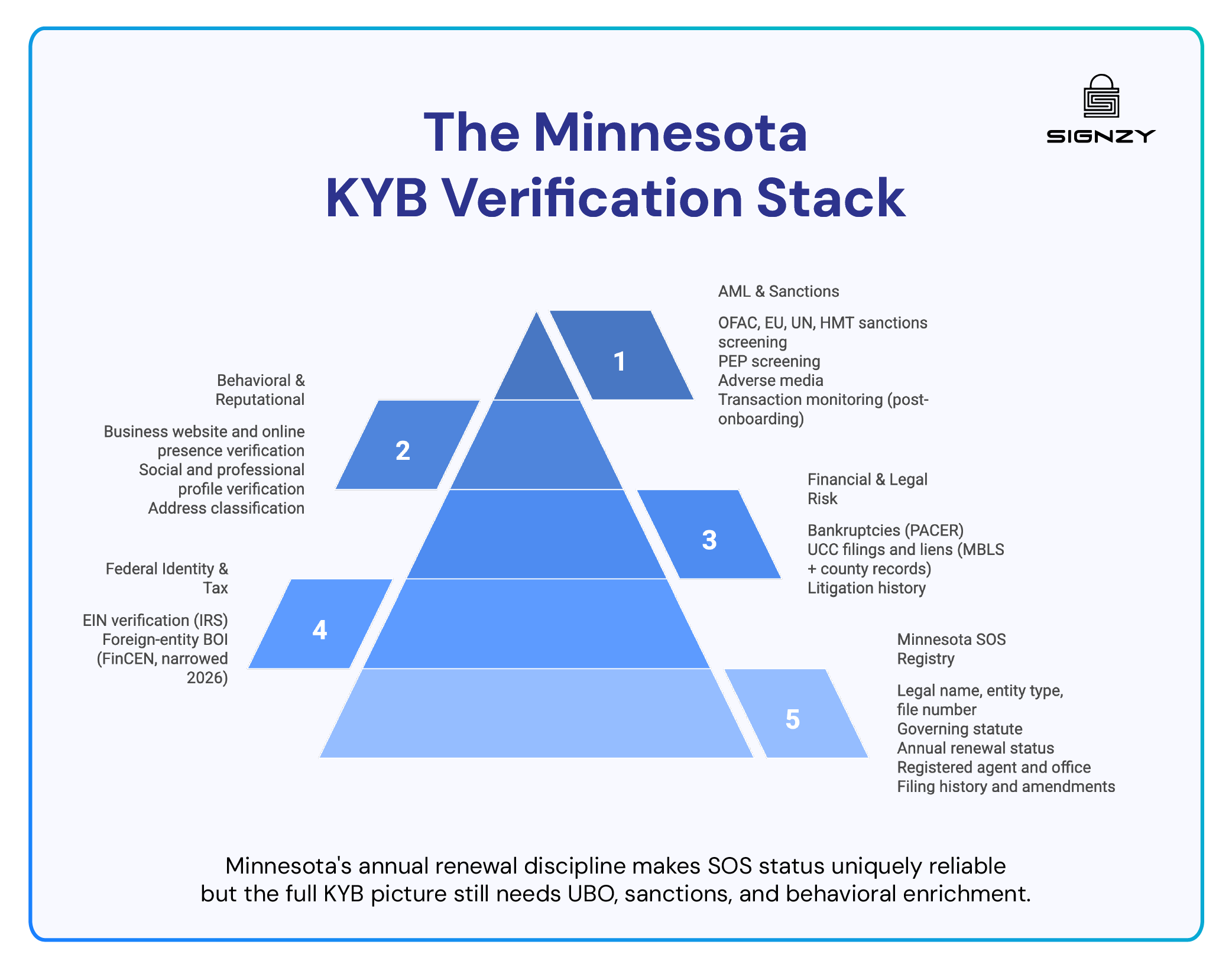
How Does Signzy Extend Minnesota SOS Data Into a Complete KYB Workflow?
Minnesota's MBLS portal is free, public, and reasonably well-designed for manual lookups. But for institutions processing hundreds or thousands of business verifications a day — and needing to meet BSA/CDD expectations end-to-end — manual state searches and fragmented enrichment tools don't scale.
Signzy's Minnesota KYB solution delivers a single API-driven workflow combining MBLS data with the additional layers regulators expect.
Signzy's Minnesota KYB capabilities
| Capability | What It Does |
|---|---|
| Minnesota SOS Data | Real-time entity verification from MBLS — name, file number, entity type, status, renewal, registered agent, registered office, governing persons, filings — in under 3 seconds |
| EIN Verification | Confirms the IRS-issued Employer Identification Number matches the registered entity |
| UBO Identification | Identifies ultimate beneficial owners at the 25%+ ownership threshold — the biggest gap post-CTA narrowing |
| Sanctions & PEP Screening | Real-time screening against OFAC, EU, UN, HMT, PEP, and adverse media databases |
| Watchlist Screening | Continuous checks against global financial-crime and integrity watchlists |
| Bankruptcy Checks | Federal bankruptcy data integrated into the same API response |
| Liens & UCC Filings | Debts and security interests that signal financial health |
| Address Classification | Distinguishes operational business addresses from residential, virtual-office, and CMRA addresses |
| Business Website Verification | Confirms the business maintains an authentic online presence |
| Social Presence Check | Credibility scoring across social and professional profiles |
| Continuous Monitoring | Event-driven alerts when status, renewal, officers, or screening results change — rather than relying on periodic manual re-verification |
| Audit-Ready Reporting | Immutable verification records retained for regulatory examination |
For institutions operating across multiple states, Signzy's unified KYB suite provides 50-state coverage through one API — eliminating the overhead of stitching together state registries, UBO verification, and AML screening across separate vendors. The platform has verified over 10,000 businesses across all 50 states, with typical Minnesota response times under 3 seconds.
For broader compliance workflows, Signzy's KYC/AML screening use case, Identity Verification, and Governance, Risk and Compliance Suite give compliance teams a unified platform from onboarding through the full customer lifecycle. The AML screening guide and transaction monitoring guide provide the strategic context for building out the broader AML program around business verification.


FAQ
Is the Minnesota Secretary of State business search free?

What is the difference between the Minnesota Secretary of State business search and MBLS?
How do I search for a Minnesota LLC?
How often do Minnesota businesses have to file annual renewals?
What does "Inactive" status mean in a Minnesota business search?
Can I search Minnesota foreign (out-of-state) companies?
Does Minnesota publish beneficial ownership (UBO) data on the SOS site?
How fast can I get Minnesota SOS data through an API?
Saurin Parikh
Saurin is a Sales & Growth Leader at Signzy with deep expertise in digital onboarding, KYC/KYB, crypto compliance, and RegTech. With over a decade of professional experience across sales, strategy, and operations, he’s known for driving global expansions, building strategic partnerships, and leading cross-functional teams to scale secure, AI-powered fintech infrastructure.

Related Blogs
View all

Automated KYB- Relevance & Normalization

10 Best KYB Verification Services in 2026 | Complete Comparison Guide
![9 Best Identity Verification Software for 2026 [US Guide]](https://cdn.sanity.io/images/blrzl70g/production/5ff0079f1de485dd7d67cea676b5877b8d019e34-2821x663.png)
9 Best Identity Verification Software for 2026 [US Guide]
![10 Best AML Screening Softwares for Compliance [US 2026 Rankings]](https://cdn.sanity.io/images/blrzl70g/production/d1a6f7f481379dc0d4ee752980ff4c2d089b69ca-725x170.png)
10 Best AML Screening Softwares for Compliance [US 2026 Rankings]
The best in business


The global API marketplace for KYC, KYB, & AML
Explore the end-to-end verification stack trusted by 1,000 businesses.
Get in touch