





UAE AML Registration 2026: Step-by-Step Guide (Avoid Penalties)

 Open in ChatGPT
🗒️ Key Highlights
- AML registration in the UAE is only mandatory for businesses operating in sectors identified as high-risk for money laundering or terrorism financing, including FIs, DNFBPs, and VASPs.
- The Org ID is a unique identification number assigned to your business once AML registration is approved. It’s required for all future reporting and portal access.
- Signzy's AML screening API automates continuous monitoring against PEP databases, sanctions lists, and adverse media sources, helping UAE businesses maintain ongoing compliance beyond initial registration.
Anything that moves fast needs checks to stay stable.
Financial systems are no different. Without built-in friction, bad money flows just as easily as good money.
That’s what AML registration solves. It slows things down just enough to make illegal activity harder and accountability easier.
In the UAE, this isn’t optional for certain businesses. If you operate in sectors like real estate, precious metals, crypto, or professional services, you’re expected to register, report, and stay alert.
If you want to do AML registration in the UAE, grab a cup of coffee, and let's go through the entire process, step by step.
What is AML registration?
Anti-Money Laundering registration in the UAE is a legal requirement for all designated entities under the UAE’s Federal Decree Law No. 20 of 2018 and Cabinet Decision No. 10 of 2019.
This structured process is managed through the goAML portal, operated by the UAE Financial Intelligence Unit under the Central Bank.
How to complete AML registration in the UAE?
AML registration in the UAE follows a sequential two-stage framework: pre-registration in the Sanctions and Compliance Monitoring system and full organizational registration on the goAML platform. Here's how you can get it done:
Step 1: Check if your business needs to register
Before you start, make sure your business actually needs AML registration. Not all businesses have to register; only those in certain categories. We've discussed who needs to register in depth in the next section.
Yet, if you are not sure whether you need to register, check with the Ministry of Economy or ask an AML compliance expert. It is better to check now than face penalties later. The fines for not registering when you should can be anywhere from AED 50,000 to AED 1 million.
Step 2: Choose your compliance officer
Every business needs to pick one person to be the compliance officer. This person will handle the registration, file reports about suspicious transactions, and deal with government authorities. This should be someone senior in your company who understands the business well.
The compliance officer must be a legal UAE resident because you will need their Emirates ID, passport, and residence visa for registration. You need to give this person official permission through an authorization letter on your company letterhead. This letter should clearly state that they can act on behalf of your company for AML matters.
Step 3: Prepare your documents
Get all your paperwork ready before you start the online registration. Missing even one document will cause your application to be rejected. And if you are wondering which documents are required for goAML registration in the UAE, here's the list:
- Trade License: A valid commercial or professional license for your business
- Compliance Officer Documents: Copy of passport, Emirates ID, and residence visa of the appointed AML compliance officer
- Authorization Letter: Signed letter authorizing the compliance officer to act on behalf of the company for AML matters
- Organizational Structure: Basic outline of ownership, partners, and business activities
- Contact Details: Accurate email and phone number for official communication
- Additional Licenses (if applicable): Any sector-specific permits or approvals, depending on your business activity
One important technical requirement: you must combine all these documents into one single PDF file. The file must be less than 5MB in size. Do not try to upload separate files - it will not work.
Step 4: Register on SACM first
SACM stands for Sanctions and Compliance Monitoring. This is the first step where you get your login details to access goAML. Go to the UAE FIU website at services.uaefiu.gov.ae and click on “SACM” under “Systems”.
- When you fill out the form, select "Reporting Entity" as your registration type.
- Then pick your supervisor - for most businesses, this will be the Ministry of Economy. For banks and financial companies, choose the Central Bank.
- Fill in your company details exactly as they appear on your trade license.
- Pick the right business category from the dropdown list. This tells the system what kind of business you run. Upload your combined PDF document.
Here is a common mistake people make: after you click upload, a small pop-up window appears. You MUST click that pop-up to confirm. If you miss this step, your documents will not actually upload, even though it looks like they did.
After you submit, you will receive a username and secret key by email. Check your inbox and spam folder. This usually arrives within 1-3 business days if approved.
Step 5: Set up Google Authenticator
Once you get your secret key from SACM, download the Google Authenticator app on your phone. You can find it free in the App Store or Google Play Store. This app creates a special password that changes every minute for extra security.
Open the app and add a new account. Name it something like "goAML UAE" so you remember what it is for. Enter the secret key exactly as it appears in your email; every letter and number must be correct. After you enter the key, the app will start showing a 6-digit code that changes every 60 seconds. This code is your password for logging into goAML.
Keep your secret key somewhere safe. If you lose your phone or delete the app, you will need this key to set it up again.
Step 6: Complete your goAML registration
Now go to services.uaefiu.gov.ae/goaml and log in.
- Use the username from your SACM email and the 6-digit code showing in your Google Authenticator app right now.
- Once you are in, click "Register as a New Organization."
- Fill in all the required fields marked with a star (*). Enter your company name, license number, address, and business activities.
- Then add information about your Compliance Officer - their name, passport number, Emirates ID, job title, and contact details.
You also need to provide information about who actually owns your company. The government wants to know the real people behind the business, not just company names.
Upload your documents again using the same two-step process - click upload, then click the confirmation pop-up. Double-check that the file name appears before you submit.
Submit the form and wait. The government will review everything you sent.
Step 7: Wait for approval
After you submit your application, it goes to the government for review. You will receive an email telling you if you are approved or rejected.
- If approved, you get a Registration Number - this is your company's unique ID in the goAML system. Keep this number safe because you need it for all future reports.
- If rejected, the email will explain what went wrong. Common problems include missing documents, wrong information, or picking the wrong business category. You can fix the problems and submit again.
Now that you have a working knowledge of what AML registration is in the UAE, its process, and document requirements, let’s see who needs to comply with it.
Who needs to register for AML in the UAE?
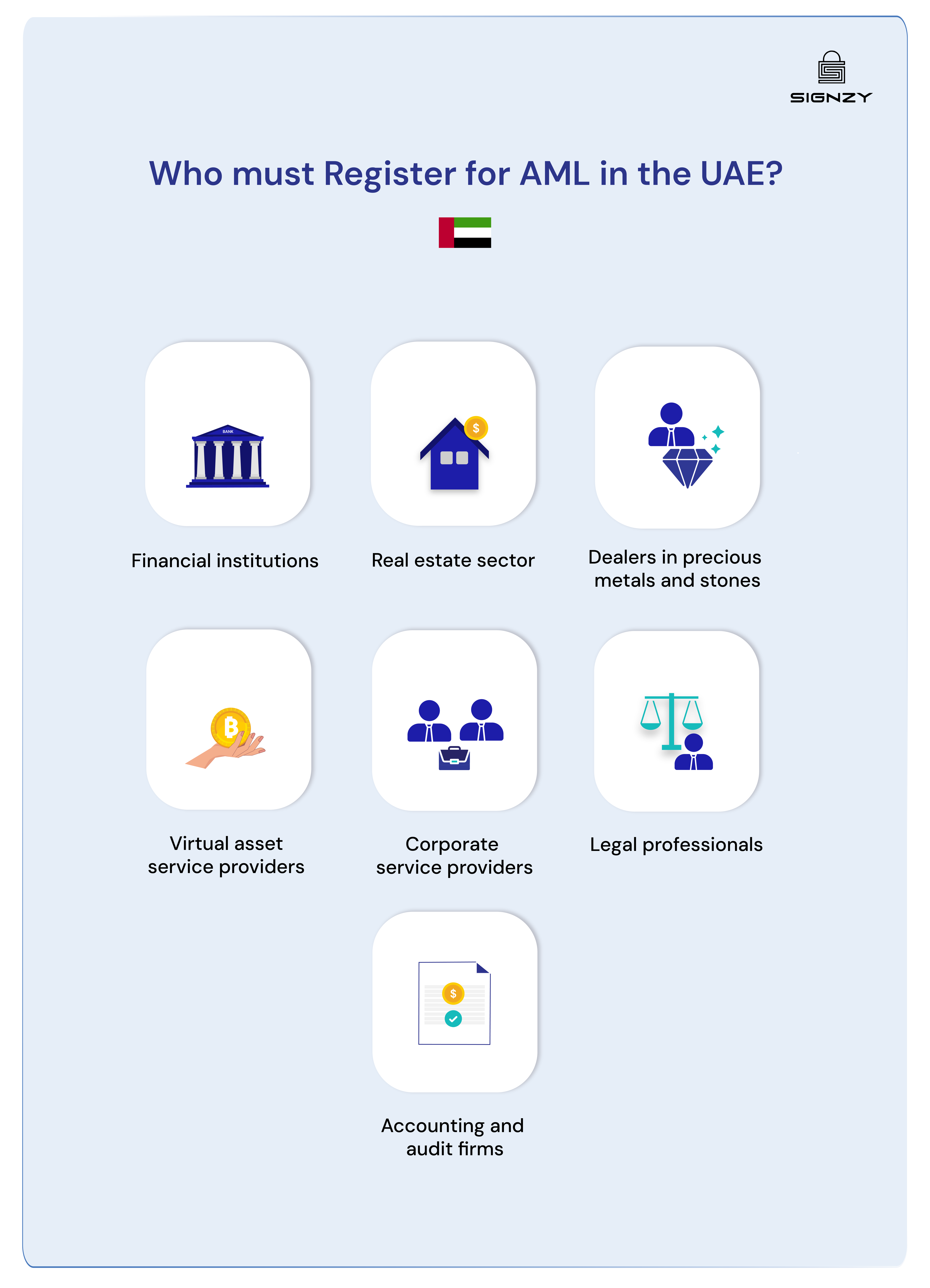
Anti-Money Laundering registration is not a blanket requirement for all businesses operating in the UAE. Rather, the regulatory framework applies a risk-based approach, targeting entities whose operations, by their very nature, could be exploited to conceal illicit funds or facilitate terrorism financing.
The UAE has identified specific categories of businesses, classified as Financial Institutions and Designated Non-Financial Businesses and Professions, that must register on the goAML portal and comply with comprehensive AML obligations.
| Category | Examples |
|---|---|
| Financial Institutions (FIs) | Banks, insurance companies, exchange houses |
| Real Estate Sector | Brokers, developers, and agents involved in property transactions |
| Dealers in Precious Metals and Stones (DPMS) | Jewelry businesses, gold, and diamond dealers |
| Virtual Asset Service Providers (VASPs) | Crypto exchanges, digital wallet providers |
| Corporate Service Providers | Businesses offering company formation, nominee director services |
| Legal Professionals | Law firms, notaries (if engaged in financial or asset transactions) |
| Accounting and Audit Firms | Accountants, auditors, tax advisors |
Financial Institutions
Financial Institutions represent the most traditional category subject to AML oversight. This classification encompasses licensed banks providing retail and commercial banking services, exchange houses facilitating currency conversion and remittance services, insurance companies offering life and general insurance products, and money service providers handling domestic and international transfers.
Real Estate Sector
The real estate sector has been identified as particularly vulnerable to money laundering due to the high value of transactions and the relative ease with which property can be used to legitimize illicit funds. This category includes real estate brokers and agents who facilitate property sales and purchases, developers engaged in the construction and sale of residential or commercial properties, and property management firms handling rental transactions.
Anyone involved in transactions related to the buying, selling, or leasing of real property falls under this designation.
Dealers in Precious Metals and Stones
Dealers in Precious Metals and Stones, commonly abbreviated as DPMS, constitute another high-risk category. This includes businesses involved in the production, trading, cutting, polishing, or refining of precious metals such as gold, silver, and platinum, as well as precious stones, including diamonds.
Jewellery manufacturers, wholesalers, and retailers who handle transactions equal to or exceeding AED 55,000 are subject to DNFBP obligations.
Virtual Asset Service Providers
Virtual Asset Service Providers, or VASPs, represent one of the newest categories to be comprehensively regulated under UAE AML laws. This designation covers cryptocurrency exchanges that facilitate the buying and selling of digital currencies, digital wallet providers offering custody services for virtual assets, and platforms enabling peer-to-peer cryptocurrency transactions.
Signzy’s AML engine flagged suspicious activity roughly 2–3 days earlier than we were catching it manually. I can't emphasize the importance of this lead time since the losses could be huge.
— Director of Compliance, Crypto Exchange.

Legal Professionals
Legal professionals are designated as DNFBPs when they engage in certain financial or commercial transactions on behalf of clients, rather than when providing purely advisory services.
This includes lawyers, notaries, and other independent legal practitioners who participate in buying and selling real estate, managing client money or securities, establishing or administering companies or trusts, or facilitating business transactions.
Accounting and Audit Firms
Accounting and audit firms, including chartered accountants, external auditors, tax advisors, and bookkeeping services, fall under AML regulations when providing certain services to third parties. Their designation as DNFBPs reflects their intimate access to financial information, their role in validating the financial position of businesses and individuals, and their involvement in transactions that could be structured to conceal illicit activity.
💡 Related Blog:

What happens after goAML registration?
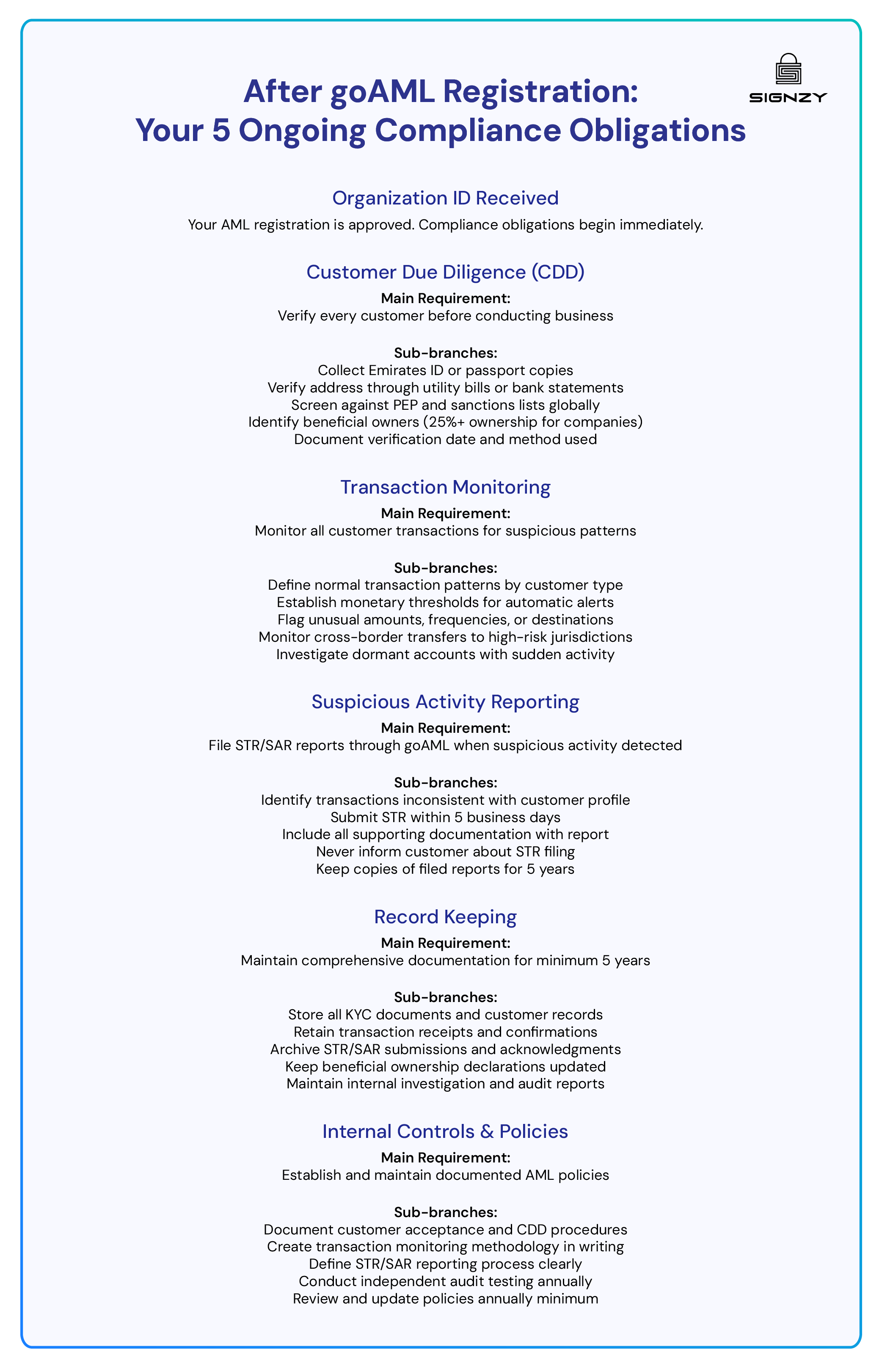
AML compliance after registration is ongoing work that requires proper systems and tools. Your business must now actively prevent money laundering with the help of the following undertakings:
🔍 Customer verification
After registration, every new customer you take on must go through proper identity verification before you can do business with them. This is called Know Your Customer or KYC. You need to collect their identification documents, passport or Emirates ID for individuals, trade license, and ownership details for companies. You must verify that these documents are real and that the information matches official records.
🎯 Signzy advantage: Modern verification technology can make this process much faster and more accurate. Signzy's MENA API marketplace offers automated identity verification tools specifically designed for the UAE market.
These APIs can verify Emirates IDs, passports, and trade licenses in real-time, reducing manual work while ensuring accuracy. Instead of spending hours manually checking documents, your team can verify customers in minutes while maintaining full compliance with UAE AML requirements.
Screening 1,000+ sanctions lists used to mean multiple vendor subscriptions and manual reconciliation. Signzy consolidated everything. Overall, we reduced our screening cost by 60%
— Risk Manager, Banking Platform (100+ employees)
👁️ Transaction monitoring and pattern detection
Once customers are onboarded, you must watch their transactions continuously. This means tracking how much money they move, where it goes, and whether the activity makes sense for their stated business purpose. If a customer who normally does small transactions suddenly starts moving large amounts, or if someone receives money from high-risk countries without a clear reason, these are red flags.
Manual transaction monitoring is nearly impossible to do well, especially as your business grows. You cannot expect your team to review every transaction by hand and spot suspicious patterns. This is where automated systems become necessary.
🎯 Signzy advantage: Signzy's Transaction Monitoring solution uses advanced technology to watch all customer transactions in real-time. The system automatically flags unusual activity based on rules you set, like transactions over certain amounts, transfers to risky locations, or patterns that do not match the customer's normal behavior.
When something looks suspicious, the system alerts your compliance team immediately so they can investigate.
🪓 Preventing mule accounts and fraud
One growing problem in the UAE is money mules, people who let criminals use their bank accounts to move illegal money. These accounts might belong to real people who were tricked or paid to help, or they might be synthetic identities created with fake documents. Either way, if your business accidentally opens an account for a money mule, you become part of the criminal chain.
🎯 Signzy advantage: Signzy's MuleShield is specifically designed to identify and block money mule accounts before they can be used. By catching mule accounts early, you protect your business from being used as a channel for illegal money. This is particularly important because regulators can hold you responsible if you fail to detect obvious signs of account misuse.
What happens if you don't register for AML in the UAE?
The UAE has zero tolerance for businesses that ignore AML laws, and the penalties aren’t light warnings. They hit hard, both financially and reputationally. Here’s a quick snapshot:
| Violation | Penalty |
|---|---|
| Failure to register on goAML | AED 50,000 to AED 5,000,000 |
| Not appointing a Compliance Officer | Heavy fines + possible business review |
| Delayed or missing STR/SAR submissions | Financial penalty + regulatory scrutiny |
| Incomplete or incorrect documentation | Application rejection or delays |
| Not implementing internal AML controls | License suspension or revocation |
| Repeat or willful violations | Criminal investigation or prosecution |
The Signzy approach: Comply with the UAE's AML requirements effortlessly
AML compliance is mandatory, but burning money on manual processes and multiple vendors isn't. Here's how Signzy helps you tackle the biggest bottlenecks:
❌ Problem: Building compliance infrastructure for each new market kills expansion speed
You've nailed AML compliance in the UAE, but now you want to expand to Saudi Arabia, Bahrain, or Egypt. Suddenly, you're back to square one, researching local regulations, finding new verification vendors, building new integrations, and hiring compliance experts who understand each market.
Signzy's platform is built for regional and global scale from the ground up. The same system handling your UAE compliance extends seamlessly across the MENA region and beyond. Need to verify a Saudi national ID? Same platform. Expanding to Egypt and need local document verification? Already supported. The platform covers verification and compliance needs across 180+ countries, all accessible through the same platform you already have running.
We expanded into 6 new Asian markets last year. Signzy's platform is adapted to each country's AML regulations without us rebuilding workflows. Regulatory mapping updates automatically. Made global expansion actually feasible for our small compliance team.
— Risk Analyst, Fintech (300+ employees)
This means expansion becomes a configuration exercise, not a rebuild. Your compliance team sets up risk rules for the new market, your developers enable the relevant verification APIs, and you're live in days instead of months.
As you scale globally, your compliance infrastructure scales with you instead of becoming a heavier anchor at each new location.
❌ Problem: Fixed compliance costs eat your budget even during slow months
Traditional compliance software charges you a fixed monthly fee regardless of how much you actually use it. During slow months or seasonal dips, you're paying the same amount even though you're processing half the verifications.
For startups and growing businesses with unpredictable volume, this creates a painful choice: pay for capacity you don't need, or risk not having enough capacity when you suddenly scale up. Either way, you're losing money.
Signzy's pay-as-you-use pricing model aligns costs with actual usage. You only pay for the verifications you run, the screenings you perform, and the monitoring you need. Process 100 Emirates ID checks this month? Pay for 100. Scale up to 10,000 next month during a marketing push? The system handles it seamlessly, and you pay proportionally.
❌ Problem: Juggling multiple vendors for basic verification needs
Most businesses end up working with three or four different providers just to cover basic compliance needs. One vendor for Emirates ID verification, another for passport checks, a third for company registry lookups, and yet another for sanctions screening.
Your tech team wastes time managing multiple vendors instead of building your actual product.
Signzy's MENA API marketplace consolidates everything you need into a single platform. Our API marketplace includes:
- UAE Passport OCR - Automated passport data extraction with accuracy checks
- PEP & Sanctions Screening - Continuous monitoring against global watchlists
- Adverse Media Screening - Automated checks across news sources and regulatory databases
- KYB (Know Your Business) - Complete corporate verification, including beneficial ownership
- Address Verification - Document-based and database validation for UAE addresses
- UAE Driver's License OCR - Extract and verify driver's license details instantly
- UAE Utility Bill Extraction - Pull address and account details from utility bills
- Emirates ID Extraction API - Real-time Emirates ID scanning and validation
- UAE Trade License Extraction - Capture business license data in seconds
- UAE Tax Registration Number Verification - Confirm TRN validity against FTA records
- UAE Company Info by License Number API - Fetch complete company details using license number
- UAE Company Visa Quota Permit - Verify company visa allocation and compliance status
- UAE Trade License Extraction Advanced - Deep extraction with enhanced data points
There are some more solutions as well. If you are looking for something different or specific, contact us here with your requirements.


FAQ
Who needs to register for AML in the UAE?

Is AML registration a one-time process?
What happens if I don't register?
Can a business owner be the Compliance Officer?
How long does the AML registration process take?
Gaurav Gupta
Gaurav Gupta is the Global Product Head at Signzy, leading the strategy and development of the company’s KYC, KYB, AML, and digital onboarding products used by banks, fintechs, and financial institutions across global markets. He specializes in building scalable compliance and verification platforms, transforming complex regulatory and risk workflows into seamless, automated product experiences. Gaurav works at the intersection of product, engineering, and AI.

Related Blogs
View all

![UAE KYB Documents Requirements [Take-Home List Inside]](https://cdn.sanity.io/images/blrzl70g/production/544d434c34d12f9580fd9f8fbc736de22a07d613-2560x600.webp)

![UAE GoAML Registration: Step-by-Step Guide [2026]](https://cdn.sanity.io/images/blrzl70g/production/306f8b6909dced815cf7dbcd9398b9a60a5c4537-2821x663.png)
The best in business


The global API marketplace for KYC, KYB, & AML
Explore the end-to-end verification stack trusted by 1,000 businesses.
Get in touch