





What is Tax Identification Number (TIN)? Ultimate Guide: 2026

 Open in ChatGPT
Key Highlights
- Tax Identification Number, commonly called TINs, anchors tax and financial identity, helping systems tie income, filings, and regulated activity to the right person or business across different jurisdictions.
- Countries use different names and structures for TINs, but the purpose stays the same: keep tax records consistent and traceable regardless of where someone works or earns.
- TINs appear in banking, payroll, licensing, and cross-border reporting, making them a quiet but essential requirement for anyone participating in formal financial or commercial activity.
- What Is a Tax Identification Number (TIN)?
- Common types of TINs
- Tax Identification Numbers across countries
- TIN use cases: How does TIN work?
- How to apply for TIN?
- Can you have more than one TIN? What happens when you move countries?
- Compliance Side of TIN
- How to check or verify a TIN?
- TIN verification importance, at a glance
- Best third party TIN verification solutions
- What happens when a TIN is missing, incorrect, or invalid?
- What if a TIN doesn’t verify or returns no record?
- FAQ
If you've ever filled out a tax form, opened a bank account, or started a business, you've encountered Tax Identification Numbers. But most people don't realize there are actually five different types of these numbers, and using the wrong one can delay your refund by months.
For businesses, the confusion multiplies. You might need an EIN for federal taxes, a state tax ID for sales tax, and sometimes a separate number for payroll taxes. New business owners often discover they've been using their SSN when they should have applied for an EIN, or they have an EIN but forgot to register for state tax identification. International businesses face another layer, determining whether they need an ITIN, EIN, or both for their U.S. operations.
This guide started as a reference document we created after researching TIN requirements for various business situations. After helping numerous entrepreneurs and tax professionals navigate these requirements, we noticed everyone had the same questions. The IRS website has all this information somewhere, but it's scattered across dozens of publications.
We've organized everything you actually need to know about TINs in one place.
What Is a Tax Identification Number (TIN)?
A Tax Identification Number (TIN) is a government-issued identifier used to track the tax obligations of individuals and businesses. In IRS’s own words,
A Taxpayer Identification Number (TIN) is an identification number used by the Internal Revenue Service (IRS) in the administration of tax laws.

The IRS (In the US) issues different types of TINs.
- SSN (Social Security Number), for U.S. individuals
- ITIN (Individual Taxpayer Identification Number), for non-eligible SSN filers
- EIN (Employer Identification Number), for businesses and entities
- ATIN (Adoption Taxpayer Identification Number), for children in adoption process
- PTIN (Preparer Tax Identification Number), for paid tax preparers
Each has its own pattern, but they all serve the same purpose: linking tax activity to the right person or business.
We will learn about it all more deeply in the next section.
Other countries handle this differently. Some use one national number for taxes and identification, while others assign separate codes for individuals, businesses, and foreign nationals. The name, length, and structure vary widely from place to place.
The idea is the same everywhere though: the system needs a clean way to know who’s who when money and taxes get involved.
Common types of TINs
There are usually five main types of TINs any country can have: one for individuals, one for businesses, one for people who don’t fit the standard system, one for temporary situations, and one for professionals involved in tax work.
Your tax id number in the US is your SSN unless you’re setting up your stream info with a business/LLC that you own in which case it is referred to as your tax ID number
— Tyl3rt on Reddit
To keep things simple, we’ll look at the US versions first since they cover all five categories. After that, we’ll list the country-by-country counterparts so you can see how other places map to the same idea.
| TIN Type | Full Form | Who It's For | How It's Used | Notes |
|---|---|---|---|---|
| SSN | Social Security Number | U.S. individuals | Ties income, employment, benefits, and tax filings to one identity. Used by banks, employers, credit systems, and government services. | Core personal TIN; used in most financial and legal processes. |
| EIN | Employer Identification Number | Businesses and legal entities | Used for payroll, tax filings, merchant accounts, vendor onboarding, and business banking. | Permanent identifier for the entity unless structure changes. |
| ITIN | Individual Taxpayer Identification Number | People not eligible for an SSN | Required for non-citizens, foreign nationals, dependents, or income earners filing U.S. taxes without SSN eligibility. | Always starts with 9; commonly issued to internationals and non-residents. |
| ATIN | Adoption Taxpayer Identification Number | Children pending adoption | Temporary number for tax filing and dependent claims until an SSN is issued. | Exists only until the final SSN is assigned. |
| PTIN | Preparer Tax Identification Number | Paid tax preparers | Used when signing and submitting returns on behalf of clients to track accountability. | Eight-digit number starting with P. Not used as a personal or financial TIN. |
Tax Identification Numbers across countries
Every country has its own version of a TIN. Names, lengths, and formats change, but the purpose stays consistent: link income and identity so the tax system can function.
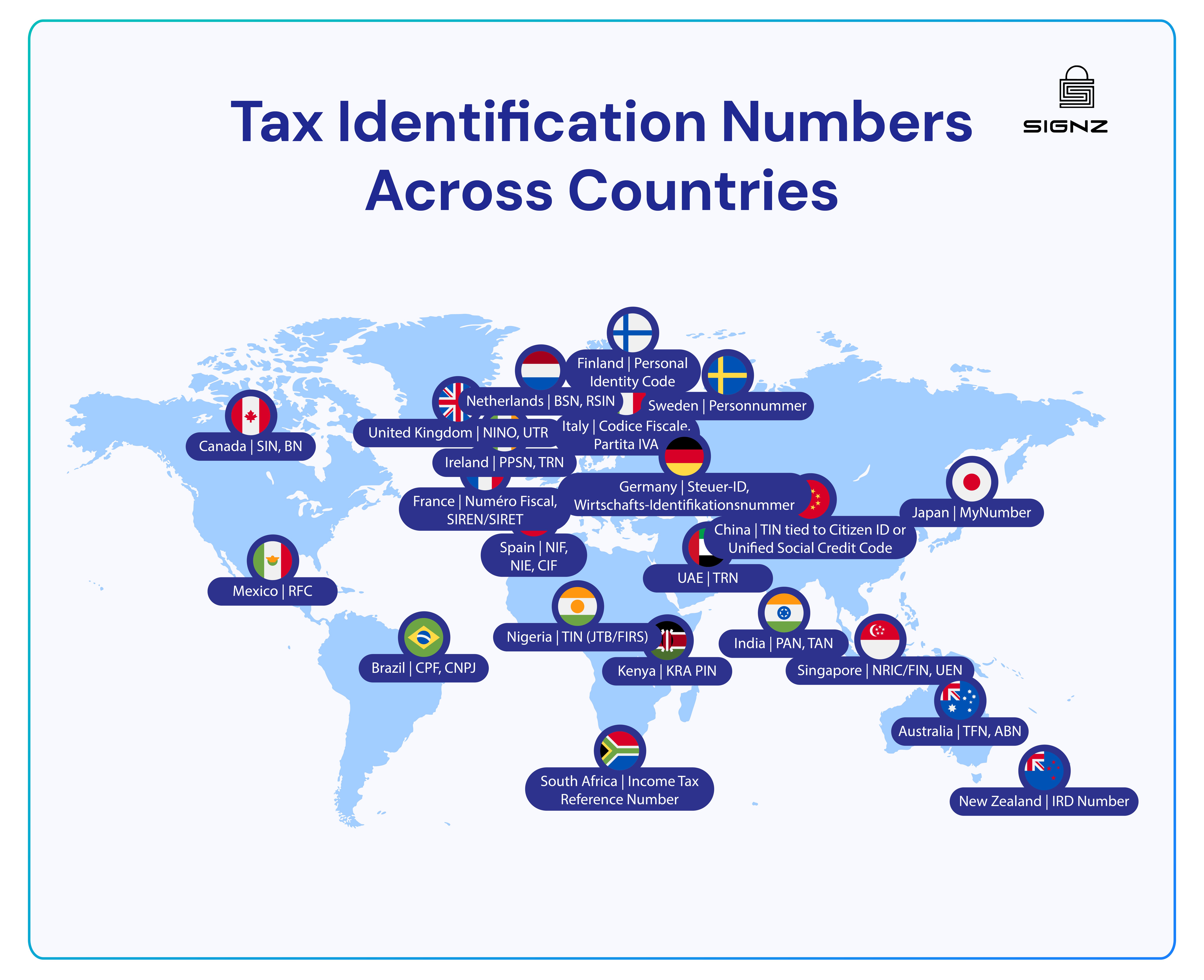
Here’s the list of TIN counterparts in other countries:
- United Kingdom: NINO, UTR
- Canada: SIN, BN
- Australia: TFN, ABN
- India: PAN, TAN
- Brazil: CPF, CNPJ
- Germany: Steuer-ID, Wirtschafts-Identifikationsnummer
- France: Numéro Fiscal, SIREN/SIRET
- Spain: NIF, NIE, CIF
- Italy: Codice Fiscale, Partita IVA
- Mexico: RFC
- Netherlands: BSN, RSIN
- Sweden: Personnummer
- Finland: Personal Identity Code
- South Africa: Income Tax Reference Number
- UAE: TRN
- Singapore: NRIC/FIN, UEN
- Kenya: KRA PIN
- Nigeria: TIN (JTB/FIRS)
- New Zealand: IRD Number
- China: Taxpayer Identification Number tied to Citizen ID or Unified Social Credit Code
- Japan: MyNumber
- Ireland: PPSN, TRN
With core types explained, let’s now explore the use cases of TIN.
TIN use cases: How does TIN work?
A TIN acts as a reference code a tax authority uses to track income, filings, and financial activity. Once assigned, it stays tied to the person or entity and shows up whenever there’s a need to match financial records with tax records. How it works can shift slightly depending on whether it’s an individual, a company, or someone operating across borders.
| Profile / Category | TIN Examples | TIN Use Cases |
|---|---|---|
| Individuals | SSN in the US; PAN in India; SIN in Canada | Filing income tax; salary reporting; freelance payments; opening bank, investment, or pension accounts; loan or mortgage applications; KYC checks; declaring investment gains; refund processing; inheritance paperwork; property transactions; updating tax records after a move or name change. |
| Businesses | EIN in the US; ABN in Australia; CNPJ in Brazil | Company registration; corporate tax filings; issuing invoices; receiving client payments; payroll reporting; business banking; merchant account setup; vendor compliance; applying for trade/export licenses; VAT/GST reporting; responding to audits. |
| Foreign Nationals / Non-Residents | ITIN in the US; NIF for non-residents in Spain; TRN in UAE | Filing taxes on income earned abroad; short-term work contracts; opening foreign bank or investment accounts; property purchases; FATCA/CRS compliance; residency paperwork; receiving payments from foreign employers; pension withdrawals; regulated financial checks. |
| Cross-Border Workers, Expats, Digital Nomads | Steuer-ID in Germany; CPF in Brazil + TFN in Australia for workers on assignment | Changing tax residency; opening accounts in a new country; employer onboarding abroad; reporting foreign-source income; filing exit returns; double-taxation documentation; renting or buying property in a new jurisdiction; notifying banks of relocation. |
| Regulated sectors | SSN/ITIN for US reporting; foreign TINs for FATCA/CRS disclosures | KYC and AML checks; opening bank or brokerage accounts; reporting interest, dividends, capital gains; assessing withholding rules; cross-border reporting; reviewing flagged transactions; account recovery/record matching; processing transfers tied to tax reporting. |
How to apply for TIN?
Applicants need to start by applying with the official authority, provide basic documents, submit the application, and wait for the system to generate your number.
Step #1: Go to the official portal or tax authority
Every application begins with the country’s tax department or revenue authority. For the United States, this means the IRS (Internal Revenue Service). They handle SSNs via the SSA, EINs through IRS.gov, and ITIN applications through designated IRS processes.
If you reside outside the USA, you’ll find their official portals listed in this table.
| Country | Authority & Portal |
|---|---|
| United States | IRS: https://www.irs.gov |
| India | Income Tax Department: https://incometaxindia.gov.in/Pages/tax-services/apply-for-pan.aspx |
| Australia | ATO: https://www.ato.gov.au/individuals-and-families/tax-file-number |
| United Kingdom | HMRC: https://www.gov.uk/log-in-register-hmrc-online-services/register |
| Germany | BZSt (Federal Central Tax Office): https://www.bzst.de/EN/Private_individuals/Tax_identification_number/tax_identification_number_node.html |
| Kenya | Kenya Revenue Authority: https://itax.kra.go.ke/KRA-Portal/ |
| Brazil | Receita Federal: https://www.gov.br/receitafederal (general portal) |
| Canada | Government of Canada: https://www.canada.ca/en/employment-social-development/services/sin/apply.html |
| Spain | Agencia Tributaria: https://www.agenciatributaria.es/ |
| Italy | Agenzia delle Entrate: https://www.agenziaentrate.gov.it/ |
| Mexico | Servicio de Administración Tributaria (SAT): https://www.sat.gob.mx/ |
| South Africa | South African Revenue Service (SARS): https://www.sars.gov.za/ |
| Singapore | Inland Revenue Authority of Singapore: https://www.iras.gov.sg/ |
| Netherlands | Belastingdienst: https://www.belastingdienst.nl/ |
| Sweden | Skatteverket: https://www.skatteverket.se/ |
| Finland | Finnish Tax Administration: https://www.vero.fi/en/ |
| UAE | Federal Tax Authority: https://www.tax.gov.ae/ |
| Argentina | Administración Federal de Ingresos Públicos (AFIP): https://www.afip.gob.ar/ |
| Ireland | Revenue: https://www.revenue.ie/ |
Step #2: Gather the required documents
You only need two sets of documents for most TIN applications. One set proves who you are. The other proves where you live or where the business operates.
| Proof of Identity (Documents that confirm legal identity) | Proof of Address (Documents that confirm where an individual or business is located) |
|---|---|
| Passport, national ID card, driver's license, birth certificate (for minors), incorporation certificate, company registration document | Utility bill, bank statement, lease agreement, property document, employment letter with address, business license, registered office proof |
Step #3: Submit the application online or through an approved channel
Some countries let you apply fully online. Others use a mix of online forms, in-person visits, or authorized intermediaries such as accountants or registration agents. Business IDs often require extra verification because of compliance rules, while individual applications tend to move faster.
Businesses that onboard multiple applicants or vendors often automate this step with verification platforms like Signzy, where identity documents, formats, and TIN-linked data can be validated before submission to avoid rejection or delays.
Step #4: Wait for confirmation and activation
After submission, the authority reviews your documents and issues the number once everything checks out. Processing times vary. Some countries generate a TIN instantly. Others take a few days or weeks.
Also, remember getting ITIN can be a bit different from what we discussed above since multiple dynamics come into play. Sharing the solution, one user on Reddit commented,
You need to file Form W-7 to get an ITIN. In order for them to issue an ITIN, you need income taxable in the US, and file the application with a tax return. They generally won't issue an ITIN before you actually have income. There are a few exceptions to this (so that you can file without a tax return) on the Form W-7 instructions. You might fall under one of these exceptions, you might not.
Lastly, once you receive your TIN, the number becomes the anchor for all future tax filings, financial activity, and regulatory records in that jurisdiction.
💡 Related Blog:

Can you have more than one TIN? What happens when you move countries?
Holding more than one TIN isn’t unusual at all. It’s a normal part of living or working across borders. People often end up with more than one TIN when they interact with more than one tax system. A person living in the US might get an SSN. If they move to Canada, they receive a SIN. Both numbers stay active in their respective countries. Neither replaces the other. Each belongs to a different system with its own rules.
Moving countries adds layers. The old number doesn’t vanish. It stays tied to past filings. The new country issues a new identifier for new obligations. Some people also keep tax responsibilities in their old country, especially if they own property, investments, or businesses there. This creates a mix of numbers, each serving a different purpose.
Compliance Side of TIN
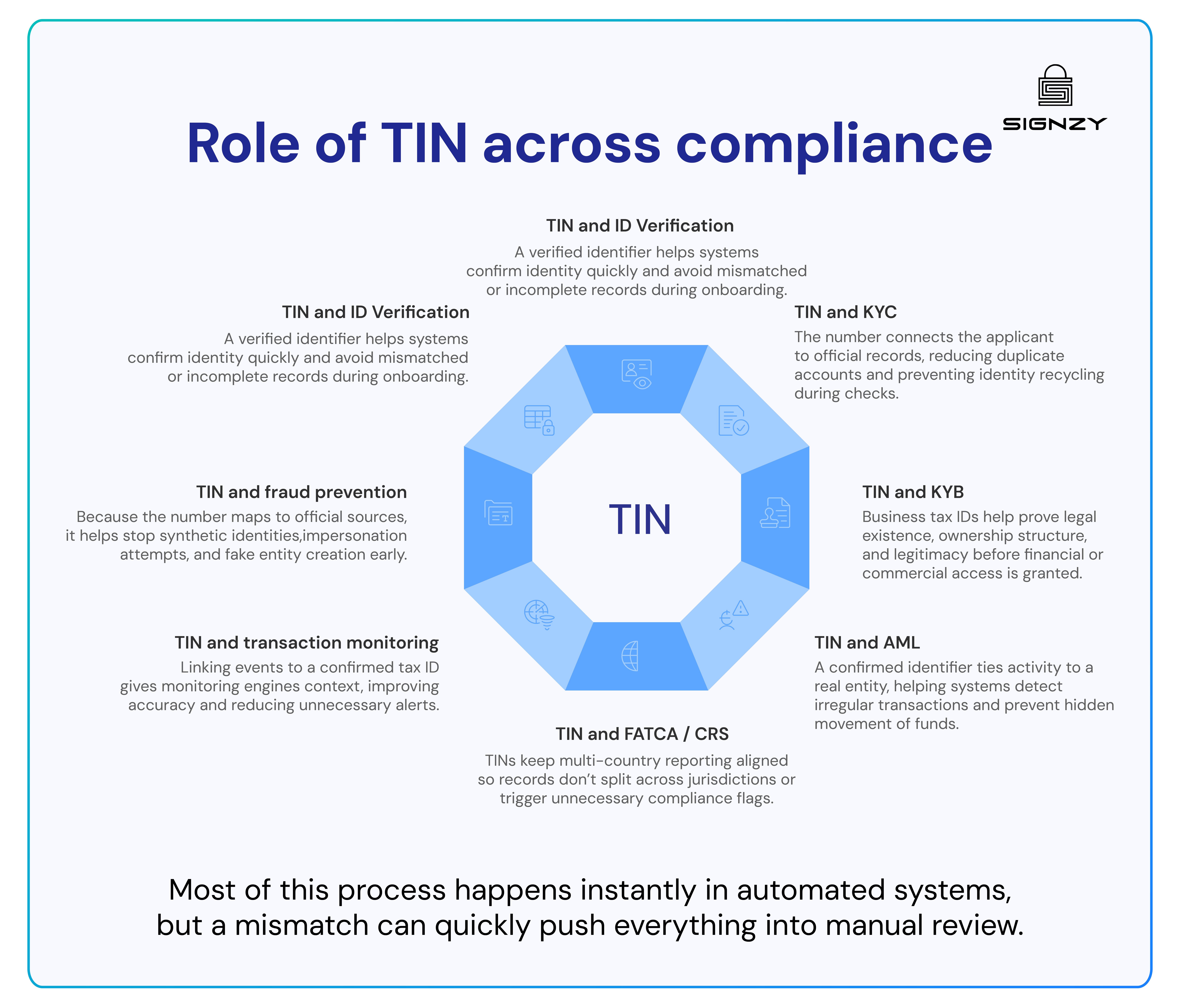
A TIN sits at the center of almost everything that touches compliance. Compliance teams lean on it because it simplifies the three main bottlenecks of verification.
- A number is easier to validate than stacks of documents.
- A number is easier to track through systems.
- A number can be checked, flagged, blocked, cleared, or logged in ways that keep everything clean.
When you look at the world of taxes, banking, anti-fraud checks, and cross-border reporting, the TIN keeps the whole system from collapsing under confusion.
TIN and ID Verification
Verification always starts with one question. Who is this person or entity. A TIN gives the answer in a way the system can understand. Banks take the number and match it with government data or internal records. Employers link it with payroll. Tax authorities check it before they accept any filing. Payment processors load it into their risk engines to work out what kind of activity looks normal.
The process feels simple on the outside. You provide the number. The system checks if it exists. It compares details like your name, address, and date of birth. Anything that doesn’t fit raises a flag. A person using an incorrect or mismatched number gets slowed down or stopped completely. That’s the point of verification. Keep the right people in the flow. Keep everyone else paused until things make sense.
🎯 Signzy Advantage: Signzy ties TIN validation to document checks, OCR accuracy, biometric match and fraud-detection signals, so the identity tied to a TIN is confirmed, and not just accepted.
TIN and KYC
KYC is a gatekeeper. Institutions need to figure out if the person sitting in front of them is real. A TIN helps confirm that the identity matches what’s in official records. When someone opens a bank account or investment account, the TIN lines up with the documents they hand over. If it doesn’t line up, the application stalls.
KYC systems run the TIN through internal and external checks. Sometimes it’s a direct lookup through a government system. Other times the check runs through providers like Signzy, Trulioo, or GBG for formatting intelligence, identity matching, and risk signals. The check isn’t only about validity. It’s about consistency. If the TIN appears in past filings tied to different names or addresses, the profile feels off and gets flagged.
This way, TIN matching reduces fake identities, duplicate accounts, and recycled credentials. Without a functioning TIN check, verification becomes guesswork, and compliance teams end up spending hours on manual follow-ups.
🎯 Signzy Advantage: TIN checks run alongside identity, sanctions, PEP screening and fraud markers in one workflow, reducing manual reviews and accelerating approvals without lowering controls.
TIN and KYB
For businesses, KYB works the same way but with more steps. A company hands over its TIN so banks and payment providers can confirm that the entity exists in official registers. They check the company’s formation records. They match the number with ownership details. They look at who controls the entity.
A company’s TIN also helps track obligations the business hasn’t met. Unfiled returns. Unpaid taxes. Suspicious patterns in invoices. Regulators rely on it during audits because it shows what the business reported and how that compares to what’s happening in the real world. KYB teams depend on this trail to decide if a company should be trusted.
🎯 Signzy Advantage: Signzy connects TIN validation with Secretary-of-State records, business registries, ownership data and compliance checks, giving a single accurate source of truth for entity onboarding.
TIN and AML
AML checks deal with patterns. Money that moves too fast. Money that moves without context. Money that lands in a place it shouldn’t. A TIN gives investigators a fixed point to start from. The number ties back to a person or company. Once they know who sits behind the activity, they can figure out if the movement makes sense.
TIN checks at the AML stage also help detect laundering methods like mule accounts, identity swapping, duplicate identities spread across institutions, and false residency declarations. Vendors such as Signzy, LexisNexis, and GBG help enrich AML systems with validation, watchlist cross-referencing, and fraud patterns tied to specific TINs.
🎯 Signzy Advantage: TIN results feed directly into AML scoring and monitoring rules, helping detect synthetic identities, mule accounts and mismatched identity trails earlier in the risk pipeline.
TIN and FATCA / CRS
Cross-border tax rules depend heavily on TINs. Banks collect the number from customers with foreign tax obligations. They file that number with foreign tax authorities. The TIN becomes the way countries share information with each other without confusing one person for another.
FATCA and CRS reports rely on correct TINs. If the number is missing or wrong, the account may get blocked or classified as non-compliant. For global workers, digital nomads, or investors handling money in multiple countries, this number is the only thing that keeps their filings from getting tangled up across borders.
🎯 Signzy Advantage: Signzy supports multi-country document verification, identity matching, and TIN checks in workflows built for FATCA and CRS submissions, reducing remediation work and preventing classification issues.
TIN and transaction monitoring
Monitoring systems watch every transfer. They don’t know who people are unless the TIN fills the gap. The number attaches to each party in a transaction, which helps the system spot patterns. Suspicious amounts. Unexpected spikes. Transfers that don’t line up with known income levels.
When the TIN matches trusted registry data, the system processes the transaction normally. When it doesn’t, the transfer may be paused, flagged, or pushed to manual review. Providers like Signzy help enrich monitoring systems with structured validation so the matching logic isn’t only format-driven but grounded in live registry and compliance data.
Good TIN hygiene reduces false positives and accelerates clearing legitimate transactions. Bad or missing TIN data forces monitoring teams into detective mode.
🎯 Signzy Advantage: Signzy feeds validated TIN data directly into monitoring engines, which means cleaner baselines, fewer flagged customers, and faster decision cycles, especially for payouts, recurring payments, and vendor disbursements.
Before Signzy, nearly half of our international applicants stalled because their tax IDs wouldn’t validate cleanly. After implementing automated checks, the approval rate for foreign users improved by about 28%, and support tickets related to TIN issues fell sharply.
— Head of Vendor Operations (Global marketplace processing ~50k monthly applications)
How to check or verify a TIN?
Verifying a TIN looks simple from the outside, but once you get into the details, you realize every country treats the process a little differently. Some give you a direct way to validate the number. Others lock their systems down and expect you to rely on formatting rules, internal checks, or the documents the person brings.
Usually, banks, employers, and compliance teams usually have quicker access to confirmation tools, but the basic idea is the same no matter who’s doing the check. You want to make sure the number is real, active, and tied to the person or business claiming it.
Step #1: Start with the government source or the third party verification tool
If the country offers a verification tool, that’s where you begin. It’s the only place that ties directly into the tax authority’s internal records. Spain has one. Brazil has one. The US only offers public verification for EINs, not SSNs or ITINs. Some countries allow partial matches. Others only confirm validity in the background without showing any personal data.
Most people expect a universal global tool. There isn’t one. Countries protect their databases, so you start with whatever the local authority provides.
While this process works well for small volume requirements, this can break or consume a lot of resources when you need to verify TINs at scale. Solutions exist and we are going to discuss them after step 5.
Step #2: Check the format and structure against known rules
Every TIN has a pattern. Length. Character mix. Sometimes check digits. Sometimes a country code is hidden inside the number. A wrong digit in the wrong spot instantly breaks the pattern. You can rule out a lot of problems with a two-second glance if you know the format.
This isn’t perfect, but it catches most of the obvious mistakes before you go deeper.
Step #3: Match the TIN with the person or business in front of you
A valid number doesn’t mean it belongs to the person using it. That’s where the identity match comes in. Banks compare the TIN with legal documents. Employers check it against payroll history. Tax offices run the number through internal records to see if the name and address line up.
If anything feels off, the system slows or stops the process to protect both sides. It’s one of the quiet ways the system catches impersonation and accidental mix-ups before they spread.
Step #4: Confirm the activity status
TINs can go inactive. Businesses close. People move. Entities merge. Some numbers fall out of use after years of no filings. Others get deactivated because of unresolved issues.
You don’t always get a public status check, but government systems can detect it the moment a filing or payment hits. For individuals, inactivity usually shows up when a return gets kicked back. For companies, banks pick up on it during KYB checks.
Step #5: Review supporting documents if the tin comes from another country
Foreign TINs follow their own rules. A bank in the US can’t directly verify a French NIF or a Brazilian CPF in real time. When a foreign number shows up, supporting documents fill that gap.
Passports. National IDs. Business registration papers. Residency permits. Anything that shows the person or business actually exists in that jurisdiction. It’s slower, but cross-border checks always take a bit more time.
Now, the rest of this section is for businesses who need to conduct TIN verification at scale.
At scale, tools like Signzy automate formatting rules, registry checks, identity validation, and document matching so teams don’t manually search government portals or compare mismatched records.
TIN checks used to drag out onboarding for days. After switching to Signzy, our average verification time dropped by roughly 40 percent and most cases clear without any manual touch. The difference is noticeable across the team.
— Chief Compliance Officer (Payroll and benefits platform, 500+ employees)
They’re most useful when you need to check TINs in bulk. We’ll explore these solution providers later in the guide since they fill in many of the gaps.
TIN verification importance, at a glance
Since we discussed how to verify TIN, it would be better to understand the WHY behind it, In short, verifying a TIN protects the entire workflow. It stops bad records from entering the system and keeps financial, tax, and compliance processes from breaking later.
Below are some reasons businesses shouldn’t overlook TIN verification:
As you can see, for any business dealing with contractors, employees, vendors, or partners, a quick TIN check removes uncertainty and keeps financial and compliance processes steady from the start.
Best third party TIN verification solutions
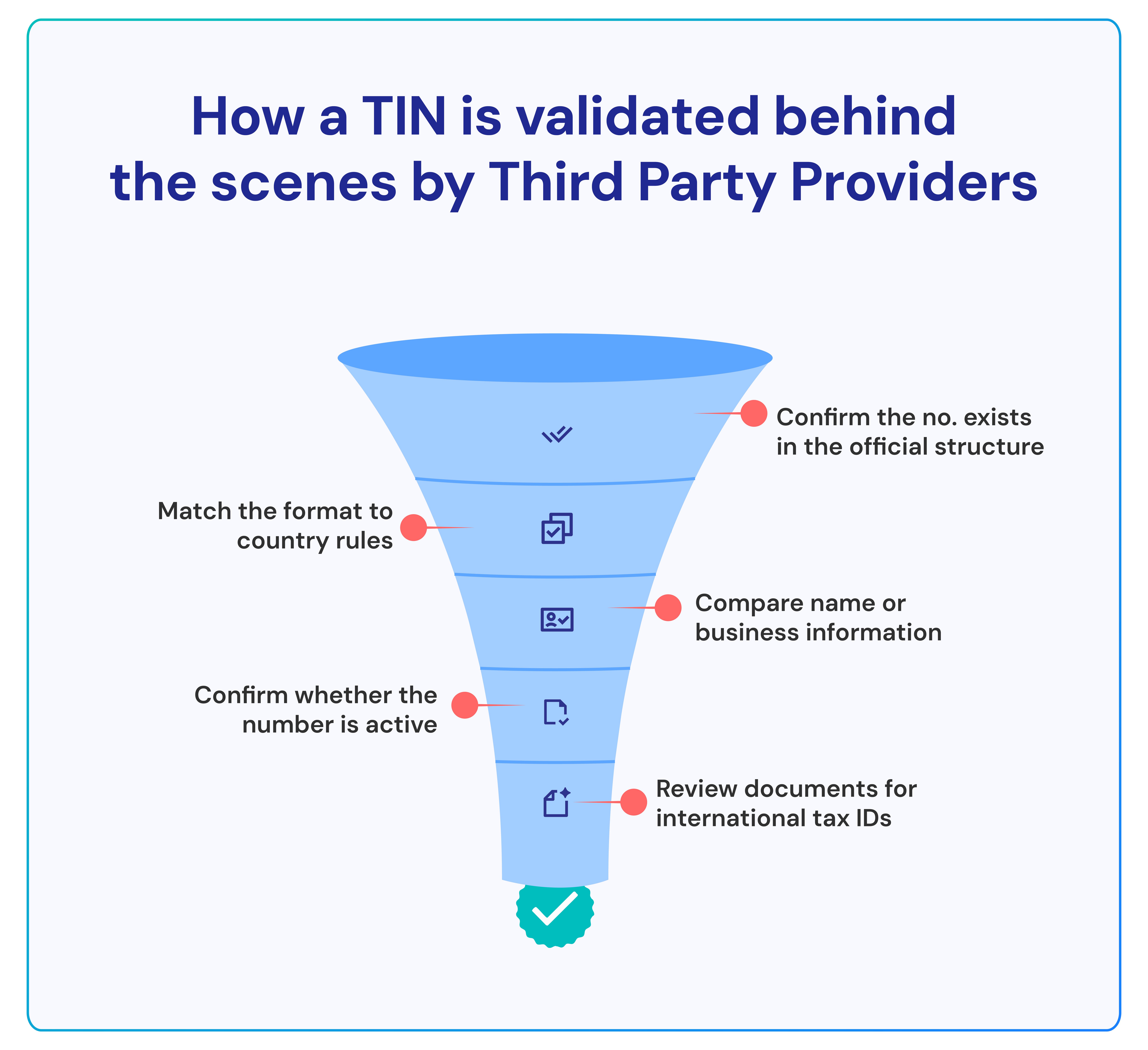
Third-party TIN verification providers plug into official business registers, public tax records, national ID datasets, VAT systems, watchlists, sanction databases, and a long list of compliance sources that aren’t always easy to work with directly.
This way, instead of searching ten different portals, decoding formats you’ve never seen before, and hunting through documents that don’t share a language, you type the number in one place. The engine behind the scenes handles the rest. It validates the format, checks the number against external records, confirms business registration status where possible, and flags activity that doesn’t feel right.
It’s just the result of a lot of integrations stitched together in a way that feels invisible when it works.
There are several strong identity and KYB vendors, but only a few treat TIN verification as a first-class problem. Here is how they stack up when TIN accuracy, speed, and workflow fit really matter.
Signzy: Best TIN verification solution overall
Signzy was built to handle identity and compliance checks without turning the whole process into a maze. The platform pulls data from tax authorities, business registers, national ID systems, and regulated data partners, then layers TIN validation on top of that foundation. The goal has always been the same. Keep the workflow clean. Cut down on the back-and-forth. Remove the awkward manual steps that slow everything down.
Accuracy matters, but so does speed, which is why Signzy is built to handle high-volume verifications. Signzy can support multiple regions, multiple formats, and mixed-use cases where a business might need to check personal TINs, business TINs, or foreign identifiers in the same pipeline.
On top of everything, you can always add more modules as and when needed. AML screening, biometric checks, liveness authentication are some of the examples.
🔒 User reviews
We handle thousands of EIN and SSN verifications every month, and mismatches used to be a constant blocker. With Signzy plugged into our workflow, mismatch rates dropped by about 30% and the back-and-forth with vendors reduced to almost nothing
— Chief Risk Officer (Fintech, 1000+ employees)
We went from 3-day onboarding cycles to same-day approvals, and our TIN mismatch rate dropped from 12% to under 2%. Signzy just works.
— PMM (BFSI, 200+ employees)
Trulioo
Trulioo covers a wide sweep of countries and pairs identity data with business verification records. It isn’t limited to TIN checks. It bundles in document verification, watchlist screening, and business registry matching. The strength here is reach. If you’re dealing with customers across borders, Trulioo gives you one place to run the checks without switching between regional tools.
LexisNexis Risk Solutions
This one targets teams that deal with higher-risk profiles or need deeper due-diligence layers. It connects with corporate registries, tax identifiers, sanctions lists, and public data sources. The system focuses more on risk and monitoring than simple format checks. Good fit for banks and financial institutions that need a heavy background check wrapped around TIN verification.
GBG
GBG offers identity and business verification for multiple countries. It pulls data from official registers, electoral rolls in some regions, and commercial datasets that track business activity. Their TIN checks are usually bundled inside broader compliance flows, which makes them helpful for companies that prefer everything under one dashboard.
Buyers can refer to this comparison snapshot of best KYC solutions for quick assessment
| Provider | Core focus in practice | TIN verification strengths | Coverage and data sources | Best suited for | Trade-offs |
|---|---|---|---|---|---|
| Signzy | KYC, KYB, AML with strong TIN and doc data at the core | Purpose-built TIN verification for SSN, EIN, ITIN and business TINs with IRS, Secretary of State and other registries in the loop. Built to plug into KYC, KYB and payouts with bulk and real-time checks. | KYB and database checks across 180+ countries, US-wide SoS coverage, business registries, credit and watchlist data. Real-time KYB for all 50 US states with integrated TIN validation. | Banks, fintechs, B2B platforms and marketplaces that need TIN to be accurate on day one and want it wired into onboarding, vendor checks and payouts rather than handled manually. | Not a generic data broker. The value shows up most when you wire the APIs into real workflows instead of using it just as a one-off lookup tool. |
| Trulioo | KYC and KYB platform | Supports tax IDs and business registration numbers as part of global identity data. Great if you need one vendor for many ID types, though TIN is one of many fields rather than a dedicated product line. | Massive global coverage with hundreds of data sources and entities in 195+ countries. Strong for cross-border digital onboarding and layered KYC + KYB flows. | Enterprises that already standardize on Trulioo for identity and want TIN checked as part of a large multi-country KYC or KYB stack. | Broad platform and a lot of configuration. If TIN is your main problem rather than "all identity everywhere", Signzy will usually be simpler to adopt. |
| LexisNexis Risk Solutions | Risk, fraud, credit and investigation-grade data | Very strong on risk and credit intelligence with business and identity verification. TIN or business registration checks normally sit inside bigger fraud and credit workflows, not as a stand-alone TIN solution. | Rich data across financial services, insurance, healthcare and government, with deep analytics and risk scores. Built for heavy compliance and investigation use cases. | Large banks, insurers and agencies that already use LexisNexis for risk and want TIN to live inside that wider risk view rather than an onboarding-only tool. | Enterprise-grade complexity, licensing and integration effort. Often more than you need if your primary goal is "clean TINs at onboarding and payouts". |
| GBG | Identity verification and fraud prevention | Can validate tax ID documents and business identifiers as part of identity checks. Strong ID stack, but no single "TIN product" that is tuned specifically around SSN or EIN workflows. | Global identity networks, document checks, electoral and commercial datasets. Good reach for ID proofing and fraud checks across a mix of sectors. | Organisations that already use GBG for ID and fraud and want tax IDs to be checked as one more piece of the identity puzzle. | Very capable for generic ID verification. Less opinionated around TIN-first flows like 1099 reporting, vendor onboarding and US-specific TIN compliance. |
What happens when a TIN is missing, incorrect, or invalid?
A missing or wrong TIN tends to break things fast. Systems that rely on the number don’t know who they’re dealing with. That leads to delays, blocked applications, and rejected filings. It can also cause problems in payroll or banking because those systems need a clean match before they move forward.
There are specific SSNs that are publicly known to be invalid due to historical misuse,” shared Aggressive-Dealer426 on Reddit. “A well-known example is 078-05-1120, which became widely circulated in 1938 when a wallet manufacturer used it as a sample SSN on display cards inserted into wallets sold across the U.S…As a result, it was used fraudulently thousands of times and has since been invalidated by the SSA.
For individuals, an incorrect TIN creates issues during tax season. Returns bounce back. Refunds stall. Employers may flag the mismatch. For companies, it becomes even more visible. Payments freeze. Vendor records don’t update. Compliance checks fail. Everything slows down until the number is corrected.
The fix usually involves updating details in the right place. You correct the typo. You supply the right documents. You give the tax authority what they need. Once the system sees a valid number tied to the right profile, everything starts moving again.

What if a TIN doesn’t verify or returns no record?
A TIN that fails verification doesn’t always signal a major issue, but it does mean something doesn’t line up.
| Scenario | What's Likely Wrong | What to Do Next |
|---|---|---|
| TIN exists but doesn't match the submitted name | Typo, formatting issue, name change not updated, or mismatch with legal documents | Re-check spelling, confirm legal name format, request updated proof (passport, business registration, SSN card, etc.) |
| No record found for the TIN | Wrong number, outdated identifier, unissued or inactive TIN | Ask for the official document showing the TIN, verify format rules, and confirm whether the number is newly issued and still syncing across systems. |
| Business TIN fails match | Business name changed, entity restructuring, or outdated registry entry | Cross-check with business registries, Secretary of State records, or request updated formation or EIN confirmation letter. |
| Foreign TIN rejected or unreadable | Wrong country format or unsupported format validation | Request supporting documents such as passport, residency permit, or official tax document; validate format rules for the originating country. |
| TIN validated but flagged as high-risk | Suspicious activity tied to identity or entity in compliance or risk systems | Run enhanced due diligence: sanctions screening, identity verification, document check, and entity background review. |
| System delay or partial match | Newly generated TIN not yet fully registered or synced across databases | Wait for registry update window, or verify through official authority portal if available. |
| Repeated verification failure | Identity mismatch, fraud attempt, or misrepresentation | Escalate to manual review with full identity documents, proof of ownership, and, if applicable, secondary verification sources. |
That’s the end of the guide. Thanks for staying with it. And if you want a system that can take TIN verification off your plate and run it smoothly at high volume, you can grab a no-pressure demo with Signzy here.


FAQ
Is a TIN linked to my credit history?

Does a TIN expire or need renewal?
Is a TIN visible on public records?
Can minors have a TIN?
Does every income type require a TIN?
Is there a difference between a TIN, EIN, and SSN?
Saurin Parikh
Saurin is a Sales & Growth Leader at Signzy with deep expertise in digital onboarding, KYC/KYB, crypto compliance, and RegTech. With over a decade of professional experience across sales, strategy, and operations, he’s known for driving global expansions, building strategic partnerships, and leading cross-functional teams to scale secure, AI-powered fintech infrastructure.

Related Blogs
View all![5 Taxpayer Identification Number Types Explained [2026]](https://cdn.sanity.io/images/blrzl70g/production/ab51b58ad90fb655dc3a2a9121557160dfe3276a-2821x663.png)

5 Taxpayer Identification Number Types Explained [2026]
![How to Verify TIN Online? Free, Paid, and Bulk Methods [2026]](https://cdn.sanity.io/images/blrzl70g/production/17b953e70e885c58b7a41d0d921c545f3854782c-2821x663.png)
How to Verify TIN Online? Free, Paid, and Bulk Methods [2026]

What is a Tax Identification Number (TIN)? Complete Guide

SSN vs. EIN vs. ITIN: Business owner’s guide to Taxpayer Identification Numbers
The best in business


The global API marketplace for KYC, KYB, & AML
Explore the end-to-end verification stack trusted by 1,000 businesses.
Get in touch