





What Is an NFC Tag? NFC Tag vs NFC Chip Explained (2026)

By Agrima Dwivedi
 Open in ChatGPT
🗒️ Key Highlights
- An NFC tag is a small, battery-free device with a chip and an antenna. It powers up from a phone's or reader's radio field when tapped and shares data such as a link or an ID.
- "NFC chip" can mean different things: the controller inside a phone that reads tags, the chip inside a tag, or the secure chip in an ePassport or ID card.
- NFC works only at very short range, typically a few centimeters. The NFC Forum's 2025 Release 15 raised the certified operating distance from 0.5 cm to 2 cm.
- In identity verification, a phone uses NFC to read the chip in an ePassport or ID card and check the issuer's digital signature, which is much harder to fake than a photo of the document.
Quick answer: An NFC tag is a tiny, unpowered device made of a microchip and an antenna, usually embedded in a sticker, card, or label. When you hold an NFC-enabled phone close to it, the phone's radio field powers the tag and the tag sends back the data it stores, such as a web link, a product ID, or a credential. An NFC chip is the broader term for the chips involved, including the NFC controller inside your phone that does the reading.
This guide explains how NFC tags work, how tags and chips differ, the main tag types, and how businesses use NFC to verify passports and ID cards during onboarding.
💡 Related Blog:

What is an NFC Tag?
In its simplest form, an NFC tag is a small electronic component that communicates wirelessly with smartphones and other NFC-enabled devices.
Think of it as a tiny radio transponder that only responds when a reader comes very close, typically within a few centimeters.
What makes these tags particularly practical is their self-sufficient nature.
Unlike other wireless technologies that need constant power, NFC tags stay dormant until activated by another device, making them both cost-effective and environmentally conscious.
Components of NFC Tags
The magic of NFC happens through three essential components:
- The chip: a small integrated circuit with memory and logic for communication and, on some tags, security features such as password protection or cryptographic authentication. Memory varies by product: common sticker tags such as NXP's NTAG213, NTAG215, and NTAG216 hold 144, 504, and 888 bytes of user memory, enough for a URL or short record.
- The Antenna: The antenna might look like a simple coil of wire, but it’s precisely engineered to create and maintain the magnetic field necessary for communication and convert radio waves into usable electric current. Moreover, it’s also engineered to enable data transmission through electromagnetic coupling.
- The Substrate: This protective layer shields the internal components while maintaining the tag’s functionality.
Now comes the real benefit:
NFC readers are now standard in most smartphones, so customers can usually use NFC without any extra hardware. iPhones can read NFC tags through Apple's Core NFC framework, and most Android phones include NFC.
Are NFC Tags and NFC Chips Different?
They are related but not the same. An NFC tag is usually a passive device that stores data and waits to be read. "NFC chip" is a looser term that can mean the NFC controller in a phone or payment terminal, the chip inside a tag, or a secure chip such as the one in an ePassport.
| Feature | NFC tag | NFC controller (in a phone or reader) | Secure chip (ePassport, ID card, payment card) |
|---|---|---|---|
| Power | Passive, powered by the reader's field | Powered by the device | Passive, powered by the reader's field |
| Role | Stores data such as a link or ID | Generates the field and reads or emulates tags | Stores identity or payment data and runs cryptographic checks |
| Typical memory | Bytes to a few kilobytes | Not a storage device | Kilobytes, including signed data and a facial image on passports |
| Security | Basic on simple tags; some support authentication | Works with a secure element for payments | Access control and issuer-signed data |
| Example | Sticker on a product or poster | Chip inside a smartphone | Chip in an ePassport |
How NFC Tags Work?
When a phone comes near an NFC tag, its NFC controller generates a high-frequency radio field at 13.56 MHz. Through magnetic induction, the tag's antenna draws enough power from that field to wake the chip, which then sends its stored data back to the phone. The whole exchange takes a fraction of a second.
The NFC Forum defines five tag types, Types 1 to 5, based on standards such as ISO/IEC 14443 and, for Type 5, ISO/IEC 15693. They differ in how they communicate and how much data they hold, not in one fixed capacity per type.
Simple tags send data unencrypted, so they are not secure on their own. Identity documents are different. When a phone reads an ePassport or electronic ID card, it follows the ICAO Doc 9303 standard:
- Basic Access Control (BAC) or PACE: the phone uses data from the document's machine-readable zone to open an encrypted session, which prevents casual skimming. ICAO requires new chips to support PACE from January 1, 2027.
- Passive Authentication: the phone checks the issuing country's digital signature on the chip data, proving the data is genuine and hasn't been altered.
- Active or Chip Authentication: where supported, the chip proves it is the original and not a copy.
The very short range also helps: an attacker would need to be extremely close to intercept the exchange.
Why Does NFC Stand Out? NFC vs. Other Technologies
| Feature | NFC | RFID (general) | Bluetooth | QR codes |
|---|---|---|---|---|
| Typical range | A few centimeters | Centimeters to several meters, depending on the system | Several meters or more | Line of sight to a camera |
| Tag power | Passive | Passive or active | Both devices powered | None |
| Interaction | Deliberate tap | Can be read without a tap | Pairing or proximity | Scan with a camera |
| Phone support | Most smartphones | Usually needs a dedicated reader | Universal | Any phone camera |
| Best for | Secure, intentional interactions | Inventory and logistics | Ongoing connections | Low-cost links |
Real-World Applications of NFC Tags
Basically, it solves two seemingly opposing challenges:
maintaining airtight security while creating smooth, friction-free experiences.
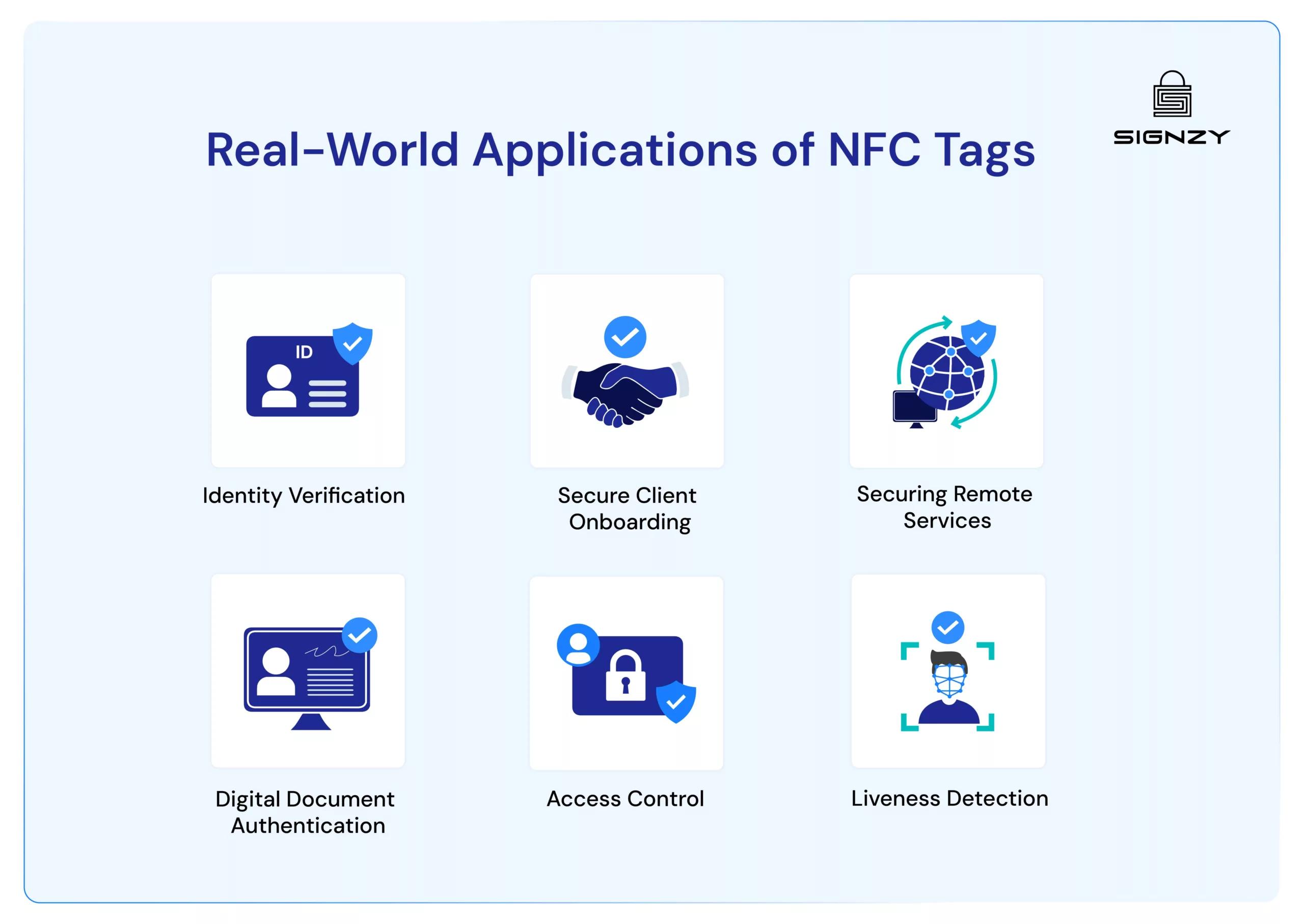
While NFC tags pop up everywhere – from retail stores to transit systems to smart homes – we are focusing on what matters most for financial institutions and businesses handling sensitive customer data.
- Identity Verification
Gone are the headaches of manual KYC checks and endless document verification loops. Businesses can now verify customer identities in real time by simply having them tap their ID against a phone.
Modern passports and many national ID cards store the holder's facial image on the chip, signed by the issuing authority. Matching that image against a live selfie confirms both that the document is genuine and that the person presenting it is its owner. Our guide to online passport verification explains the process.
- Secure Client Onboarding
Onboarding a new user used to mean paperwork. NFC-enabled document verification makes it almost entirely digital: the phone reads the issuer-signed data from the passport or ID chip, so the details don't depend on reading a photo of the document, and tampering is easy to detect.
With this, banks, financial institutions, fintechs, and similar businesses can instantly validate government IDs, cross-reference biometric data, and create secure customer profiles in minutes instead of days.
This means faster service for customers and better fraud prevention for businesses – a genuine win-win situation.
- Securing Remote Services
The shift toward digital banking has made remote verification essential. NFC technology enables financial institutions and crypto platforms to verify customers’ identities remotely with the same level of certainty as in-person checks.
Whether it’s opening new accounts, authorizing large transactions, or updating customer information, NFC-based verification provides a secure, contactless way to confirm customer identities without requiring branch visits.
- Digital Document Authentication
The challenge with digital documents has always been proving they’re real. NFC tags embedded in official documents can serve as digital seals of authenticity. When scanned, these tags reveal encrypted certificates that confirm the document’s origin and detect any tampering attempts.
For financial institutions handling sensitive documents, this technology has become invaluable in preventing fraud while speeding up document processing.
- Access Control
Modern office buildings and secure facilities now use NFC-enabled employee badges that do much more than just open doors.
These badges can enforce different security clearance levels and integrate with time and attendance systems. Badges that support cryptographic authentication are much harder to clone than older proximity cards.
- Liveness Detection
NFC tags work hand-in-hand with liveness detection to create a powerful anti-spoofing system.
When a customer taps their ID, the phone reads the signed facial image from the chip and compares it with a live, liveness-checked selfie. This confirms that the ID is authentic and that a real person, the rightful holder, is present. See our guide to selfie identity verification for how liveness works.
Take Action
NFC chip reading adds a strong layer to identity verification, but it works best combined with face matching and liveness detection. Signzy's Face Match API and Liveness Check API complete the check by confirming the person matches the document. For the basics of the technology, read what NFC is and how NFC chips work.
Book a demo to see how it fits your verification flow.


FAQ
What is an NFC tag used for?

What is the difference between an NFC tag and an NFC chip?
How secure are NFC tags?
What is the range of an NFC tag?
Do NFC tags work through cases or wallets?
Can an iPhone read NFC tags and passports?
Agrima Dwivedi
Agrima is an Associate Product Marketer at Signzy, currently working in the B2B fintech space. She brings over two years of experience in copywriting and content writing, which laid the foundation for product marketing. Today, she leverages both creative and strategic skills to drive go-to-market efforts and build user-focused marketing strategies.

Related Blogs
View all




The best in business


The global API marketplace for KYC, KYB, & AML
Explore the end-to-end verification stack trusted by 1,000 businesses.
Get in touch