





What Is Biometric Verification? How It Works and How Secure It Is (2026)

By Agrima Dwivedi
 Open in ChatGPT
🗒️ Key Highlights
- Biometric verification confirms who someone is by comparing a live sample of a physical trait, such as a face, fingerprint, or voice, with one captured earlier or with the photo on an ID document.
- In digital KYC, the most common form is a selfie matched to an ID photo, combined with a liveness check that confirms a real person is present.
- Biometrics are harder to steal than passwords, but not impossible to fake. Deepfakes, masks, and injection attacks that bypass the camera are growing, so liveness and injection detection now matter as much as the face match.
- NIST's final SP 800-63-4 guidelines, published in July 2025, require presentation attack detection tested to ISO/IEC 30107-3 and controls against injected or manipulated media for remote identity proofing.
Quick answer: Biometric verification is a way of confirming someone's identity using a physical characteristic that is unique to them, most often their face or fingerprint. A system captures a live sample, turns it into a mathematical template, and compares it with a stored template or the photo on an ID document. If the two match closely enough, and a liveness check confirms a real person is present, the identity is verified.
What is Biometric Verification?
Biometric verification is a method by which you can be identified using physical aspects that are specific to you. These aspects include your fingerprint, voice, retinal patterns, hand and face scans, and more. However, the most commonly used biometric features are a person’s fingerprint, voice, and facial scan.
You have likely already used biometric verification in some capacity. Most personal electronic devices these days come fitted with biometric authentication features like fingerprint readers and facial recognition.
Apple’s Touch ID and Face ID are examples of proprietary biometric verification methods.
How Secure is Biometric Verification?
Biometric verification is more secure than passwords in one important way: there is nothing to guess, reuse, or phish. Brute-force attacks that crack weak passwords like "123456" or "password" don't work against a face or fingerprint.
It isn't unbreakable, though. Attackers try to fool biometric systems in two main ways:
- Presentation attacks: showing the camera or sensor a printed photo, a screen replay, a mask, or a fake fingerprint.
- Injection attacks: bypassing the camera entirely and feeding a deepfake or pre-recorded video into the system through a virtual camera, emulator, or tampered app.
These attacks are rising. Entrust's 2026 Identity Fraud Report found deepfakes behind about one in five of the biometric fraud attempts it saw, with injection attacks up 40% year over year. Our guide to how deepfakes bypass biometric verification explains the methods in detail.
The defenses are just as specific:
- Liveness detection, also called presentation attack detection (PAD): tested against the ISO/IEC 30107-3 standard. Independent labs such as iBeta test liveness products against it at different levels of attack difficulty.
- Injection attack detection: covered by the European technical specification CEN/TS 18099, published in late 2024.
- NIST SP 800-63-4: the final US digital identity guidelines, published in July 2025, require PAD tested to ISO/IEC 30107-3 and controls against injected or manipulated media whenever biometrics are collected remotely.
Use Cases/Applications of Biometric Verification
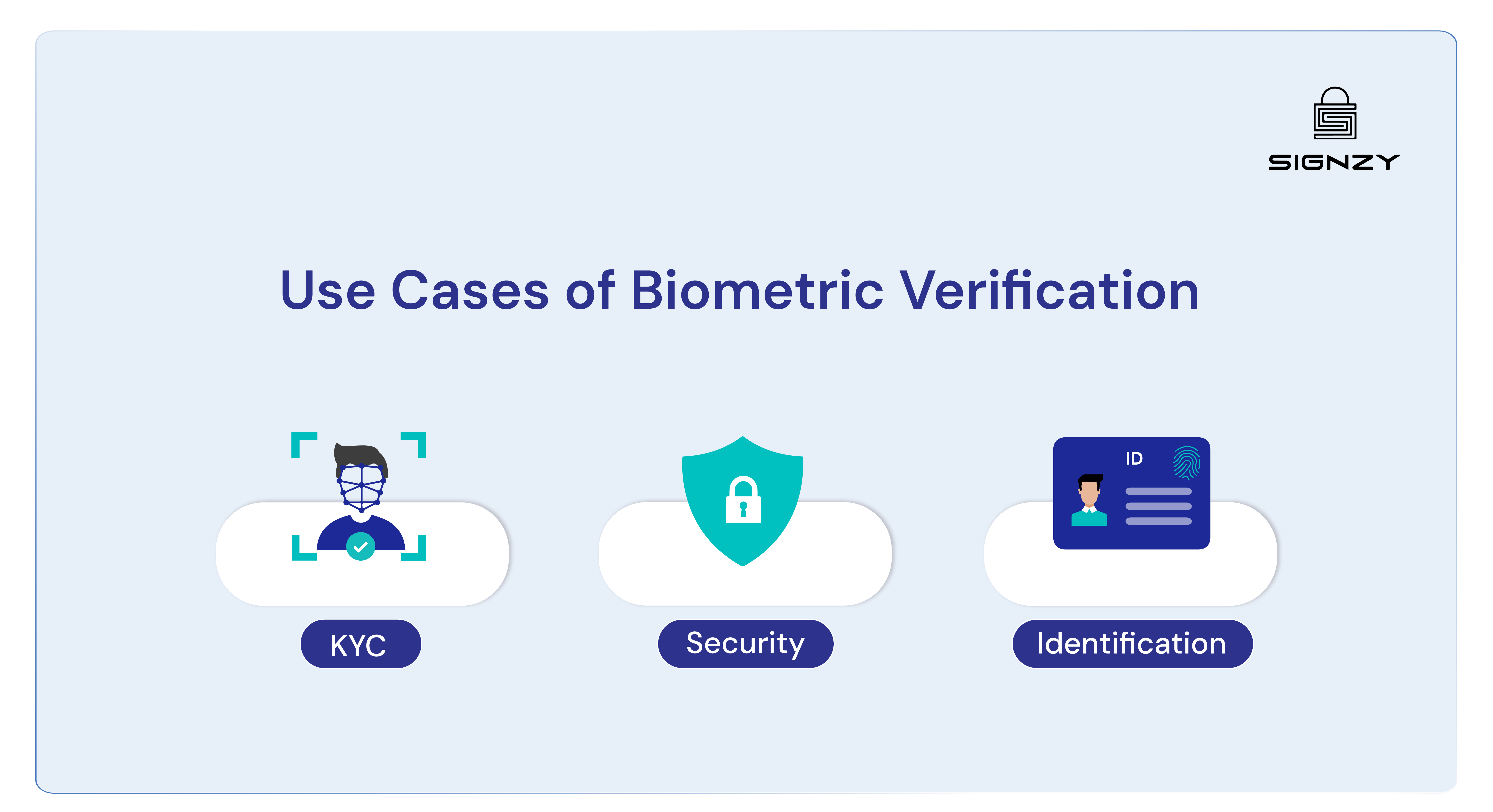
As we mentioned, most consumer electronics use biometric authentication as a way to unlock devices. This has led to patterns and passwords being replaced by their biometric alternatives. The uses don’t stop here though.
Biometric verification has found use cases in the following ways as well:
- KYC: Banks, lenders, and even government organizations use biometric verification as a way to complete Know Your Customer (KYC) procedures. These entities typically use your fingerprints and facial features as a way to verify your identity.
You might have come across certain platforms that ask you to upload a picture of your identification, along with a selfie. With the help of highly trained AI models, these platforms cross-check your facial features against the proof of identity.
Biometric verification allows you to complete KYC procedures anywhere, without having to visit these entities in person.
- Security: Biometric verification is often used by banking and other financial apps as a measure of security. Many devices that these apps are installed on already have a fingerprint reader, a facial scanner, or both.
These apps use these readers and scanners to act as a last line of defense. You may have often noticed that your phone requires you to scan your fingerprint or face before making any payments using your bank’s app. This protects your finances from unverified use in case your device is lost or stolen.
- Identification: Airports often use biometric verification to cross-check a person’s identity against an existing database. This helps avoid misuse of lost tickets, as well as helps keep track of the passengers moving through international borders.
💡 Related Blog:

How Does Biometric Verification Work?
Every biometric verification follows the same basic steps:
- Enrollment: the system captures the biometric, such as a selfie, a fingerprint scan, or a voice recording, or takes the photo from an ID document.
- Template creation: software turns the sample into a mathematical template. Most systems store this template rather than the raw image.
- Live capture: when the person needs to verify, the system captures a new sample and checks that it comes from a live person, not a photo, mask, or injected video.
- Comparison: the new template is compared with the stored one, and the system returns a similarity score.
- Decision: if the score passes the threshold set for that use case, the identity is confirmed. Borderline results can go to manual review.
The most common types are:
- Facial recognition: used in selfie-to-ID matching during online KYC and in airport e-gates.
- Fingerprint recognition: used to unlock phones, authorize payments, and in national ID systems.
- Voice recognition: used by some banks and call centers, though AI voice cloning has made it the easiest of the three to attack.
For a step-by-step process aimed at businesses, see our guide to biometric verification for business onboarding, and for the selfie-based approach, read about selfie identity verification.
How Signzy Can Help
Signzy has a wide range of APIs that you can use to integrate biometric verification into your platform. With biometric verification, your business can scale beyond traditional geographical boundaries and enforce security, avoid fraud, and verify consumer identity anywhere across the globe.
Signzy’s APIs ensure a fast and seamless verification process so that you don’t lose any customers due to lengthy or complex onboarding processes. We also offer Optical Character Recognition (OCR) API that can extract essential data from images of identification documents.
Conclusion
Biometric verification makes identity checks faster and harder to fake than passwords or manual document review, and it lets customers verify themselves from anywhere. As deepfake and injection attacks grow, the quality of liveness and injection detection now matters as much as the face match itself.


FAQ
What is a biometric check?

How is biometric verification done?
Is biometric verification safe?
What is the difference between biometric verification and biometric authentication?
Can biometric verification be fooled by deepfakes?
Agrima Dwivedi
Agrima is an Associate Product Marketer at Signzy, currently working in the B2B fintech space. She brings over two years of experience in copywriting and content writing, which laid the foundation for product marketing. Today, she leverages both creative and strategic skills to drive go-to-market efforts and build user-focused marketing strategies.

Related Blogs
View all

Biometric Verification for Businesses: Methods, Implementation, Pros and Cons

How deepfakes bypass biometric verification? 6 methods exposed (2026)

Selfie Identity Verification: How It Works and Why Liveness Matters

Injection Attack Detection: The Certificate You Have Covers the Wrong Attack
The best in business


The global API marketplace for KYC, KYB, & AML
Explore the end-to-end verification stack trusted by 1,000 businesses.
Get in touch