





Signzy vs. Jumio: Which identity verification is best?

 Open in ChatGPT
Key Highlights
- Jumio built an industry-standard identity verification processing 1 billion+ transactions with extensive document coverage and a 30+ million identity fraud network. Signzy takes a broader approach, consolidating identity, business verification, AML screening, and transaction monitoring into one platform rather than specializing in verification alone.
- Implementation speed differs significantly: Signzy deploys in 48-72 hours with 340+ modular APIs and transparent usage-based pricing. Jumio requires longer enterprise sales cycles with custom pricing ranging from $0.30 to $2.50+ per transaction.
- For teams needing fast deployment with consolidated compliance, Signzy integrates KYC, KYB, and monitoring in 48-72 hours with regional database access across the US, theUS Middle East, India, and LATAM. Serving 500+ companies, including Fortune 30 banks.
- Quick comparison: Signzy versus Jumio
- Signzy
- Signzy certifications and accolades
- What does Signzy do differently from Jumio?
- What users are saying about Signzy?
- Jumio
- Jumio certifications and accolades
- Jumio advantages
- Jumio pricing
- What users are saying about Jumio?
- Does Signzy or Jumio work better for my region?
- What if I need to verify both people and businesses?
- Which platform makes sense for my specific use case?
- How to get started with Signzy?
- FAQ
We know teams are often evaluating us alongside Jumio. It's probably the most common comparison we see. Both Signzy and Jumio handle identity verification well, but we've taken different approaches to solving the same core problems.
In this Signzy vs Jumio comparison, we'll walk through the key differences in our platforms - overview, features, pricing, and more. Our goal is to give you the straight facts so you can make the best decision for your specific use case, whether that's them or us.

Quick comparison: Signzy versus Jumio
| Aspect | Signzy | Jumio |
|---|---|---|
| Implementation Timeline | 48-72 hours for integration | Undisclosed |
| Platform Focus | Full-stack compliance (KYC + KYB + AML + monitoring) | Identity verification (KYC focused) |
| Business Verification and Transaction Monitoring | Available within the platform | Requires separate vendor integration |
| Regional Integration | Database access in the US, the Middle East, India, LATAM, and Canada | Document recognition across 200+ countries |
| Pricing Model | Economical. Usage-based, pay as you use | Custom enterprise |
| API Architecture | 340+ modular APIs in the marketplace | Standard API suite |
Signzy
Signzy operates as a full-stack compliance platform rather than a point solution for identity verification. Since 2015, the company has been building what most organizations have to piece together from three or four different vendors: KYC for individuals, KYB for businesses, AML screening, and transaction monitoring, all accessible through a single platform.
The platform now serves over 500 global companies, including 10+ Fortune 30 enterprises, major banks, and payment processors operating across 150+ countries.
Where most competitors treat verification as a one-time check at onboarding, Signzy treats it as an ongoing process. Identity checks, business validation, PEP screening, and behavioral monitoring all flow through unified workflows that compliance teams can configure themselves.
Implementation typically wraps up in 48 to 72 hours instead of the 3 to 6-month cycles you see with traditional enterprise verification platforms.
Signzy certifications and accolades
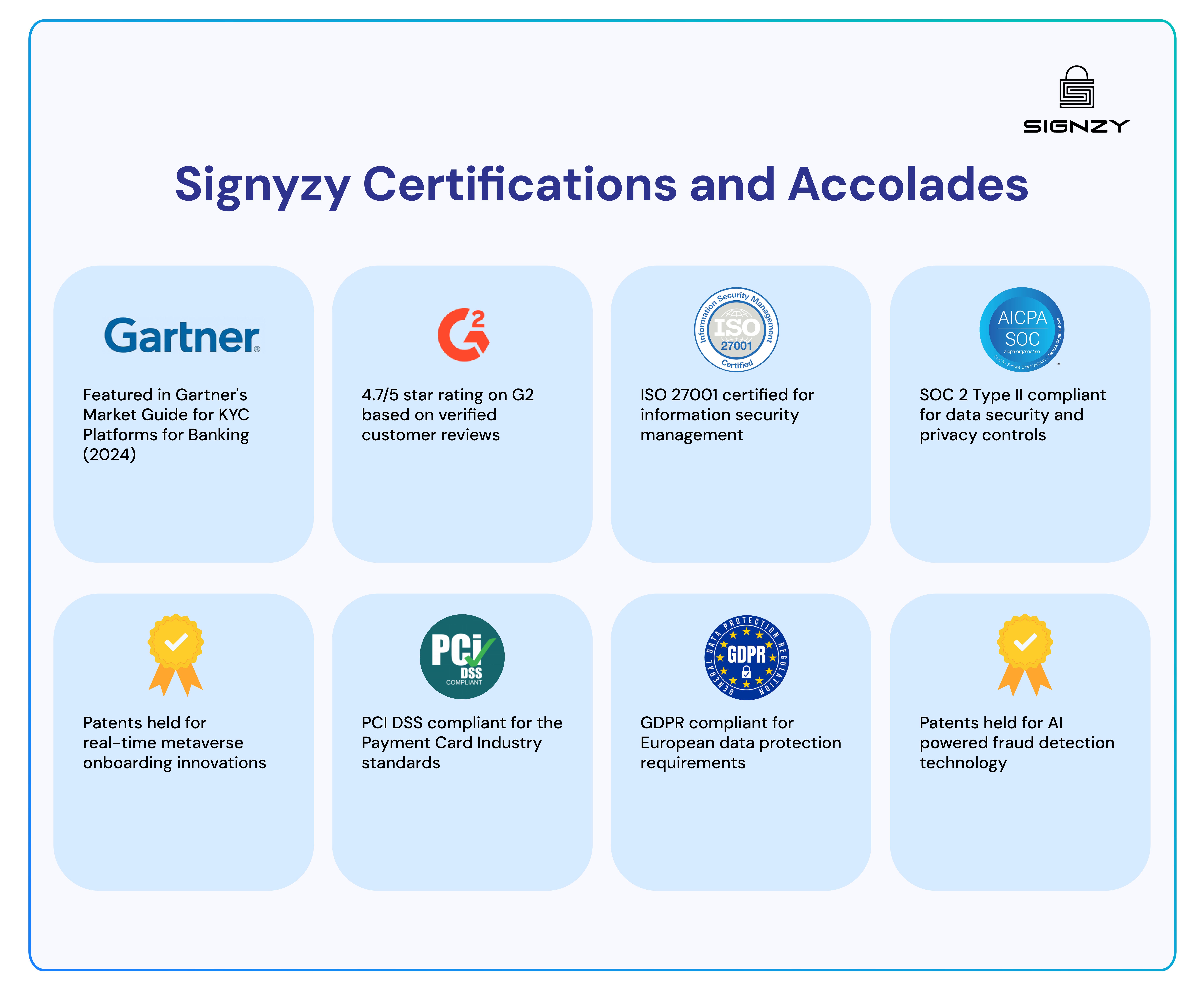
- Featured in Gartner's Market Guide for KYC Platforms for Banking (2024)
- ISO 27001 certified for information security management
- SOC 2 Type II compliant for data security and privacy controls
- PCI DSS compliant for the Payment Card Industry standards
- GDPR compliant for European data protection requirements
- Patents held for AI-powered fraud detection technology
- Patents held for real-time metaverse onboarding innovations
- 4.7/5 star rating on G2 based on verified customer reviews
What does Signzy do differently from Jumio?
1. Individual identity verification
Signzy handles real-time document scanning for over 5,000 ID types across 150+ countries, with OCR working in 50+ languages. What's different about Signzy is how it handles real-world conditions. The system optimizes for low-bandwidth environments, so verification actually works on 3G connections where competing platforms tend to degrade or fail completely. This becomes important if you're operating in emerging markets where internet connectivity isn't reliable.
2. Biometric verification and advanced liveness checks
The biometric face matching includes both liveness detection and deepfake prevention. As generative AI makes synthetic video super convincing, Signzy's models analyze micro-expressions and compression artifacts that reveal when someone's using an AI-generated face instead of their real one. Basic liveness detection misses these newer fraud vectors entirely.
3. Business entity verification
This is where Signzy diverges most clearly from what Jumio offers. The platform handles company registry validation, beneficial owner identification, director background checks, and business bank account verification across 180+ countries, and it does this through direct connections to government databases rather than just scanning uploaded documents.
Here's why that matters: most identity platforms, Jumio included, verify individuals well but stop there.
When you need to confirm that a business entity actually exists, owns the bank account it claims, and has legitimate beneficial owners, you're typically integrating a second vendor to handle that.
Signzy consolidates both into one workflow. So you can validate a company's Delaware registration and the CEO's driver's license in the same flow, or confirm a UAE trade license while running KYC checks on all the listed directors.
4. Regional compliance infrastructure

Signzy built dedicated "stacks" for major markets with direct connections to local government databases and compliance-specific workflows.
- United States: Secretary of State business registries across all 50 states, SSN validation, and state-level licensing checks where applicable.
- Middle East: Emirates ID check, UAE trade license verification, GCC compliance workflows for cross-border operations.
- India: Aadhaar biometric authentication, PAN validation through Income Tax systems, GST registration confirmation, Digilocker document retrieval, Video KYC compliant with RBI guidelines.
- Latin America: CURP validation in Mexico, RFC verification, CNPJ checks in Brazil.
- Canada: GST/HST registration validation, provincial business registry access, and corporate registry searches across territories.
5. AML screening and transaction monitoring
Real-time screening runs against global sanctions lists and PEP databases at onboarding. What distinguishes Signzy is the transaction monitoring layer that continues after verification completes.
The platform analyzes transaction patterns, velocity changes, geographic anomalies, and behavioral shifts that signal money laundering or fraud post-onboarding.
With Jumio, you verify identity cleanly at signup. If that person later exhibits mule account behavior or structuring patterns, you need separate monitoring infrastructure. Signzy consolidates both verification and ongoing surveillance, which matters significantly for financial institutions where regulatory obligations extend beyond the moment of onboarding.
6. Extensive API marketplace
The API marketplace contains 340+ modular verification services. Developers can select specific APIs rather than accepting bundled packages.
This modularity means starting narrow and expanding incrementally. Launch with basic identity verification, add business checks when you onboard your first merchant, introduce AML screening when you cross regulatory thresholds, all without re-architecting your integration.
Response times average under 3 seconds.
7. Contract execution infrastructure
Signzy’s Contract360 helps with legally compliant e-signatures and eStamping within the same platform. For financial services where signed documentation forms part of regulatory compliance, this eliminates the handoff to separate contract management systems.
The entire flow from identity capture through contract execution remains in one platform, one audit log, one vendor relationship.
Signzy pricing
Signzy delivers exceptional value through economical, usage-based pricing with very low minimum commits. Our straightforward pricing model charges only for the APIs and services you actually use.
The combination of faster implementation (48-72 hours vs. 3-6 months) and lower operational overhead means your total cost of ownership remains predictable and affordable, allowing you to allocate more resources to core business growth rather than vendor management.
What users are saying about Signzy?
The integration with Signzy was very easy. As an insurtech platform, we are using a couple of api services in our digital platform to smooth the journey, and the data that we got through api are very accurate and correct, and the responses of APIs are quite fast. They have an ample of services for kyc verification, data pull, OCR, document verification, etc.
— Amit S. on G2.

Working with Signzy has been a game-changer. Their team isn't just responsive; they're deeply invested in helping us solve real onboarding and compliance challenges. The flexibility of their product, the speed of execution, and their commitment to partnership have set a new bar for us.” - Steve Sauve, CPO, ASAPP Financial Technology.
Signzy's sandbox account is the best; we can test a bunch of APIs on the portal itself…Customer support is really good.
— Sarthak G. on G2.
As we scaled across the US, we needed a verification partner that could keep up with both volume and regulatory expectations. Signzy delivered on both. Our KYC flow became noticeably smoother, drop-offs reduced by nearly 20%.
— CRO, U.S.-based Neobank.
Jumio
Jumio has operated as an identity verification standard in the industry since 2010, processing over 1 billion transactions across 200+ countries and territories.
The company's core strength lies in its document coverage. Jumio has also expanded its capabilities strategically through acquisitions, including Beam Solutions for AML transaction monitoring and 4Stop for data source orchestration, which broadens what the platform can handle beyond pure identity verification.
Jumio certifications and accolades
- ISO 27001 certified for information security management
- SOC 2 Type II compliant for data security and privacy controls
- 30+ million verified identities in a fraud prevention network
- Multiple industry awards for innovation and reliability in identity verification
Jumio advantages
1. Document coverage
Jumio supports over 5,000 ID types across 200+ countries with an extensive database of document templates and security features. This breadth of coverage means the platform can handle virtually any government-issued document globally, including historical versions of documents and regional variations that smaller providers often miss.
The document database includes detailed templates for security features, holograms, microprinting, and other anti-counterfeiting measures specific to each document type.
2. Advanced fraud detection network
The 30+ million identity network enables cross-customer fraud detection that works at a scale most platforms cannot match. When someone attempts to use a stolen or synthetic identity across multiple Jumio customers, the pattern becomes visible in aggregate data even if each individual verification attempt looks legitimate in isolation.
3. Biometric authentication strength
Jumio's liveness detection, face matching technology, and anti-spoofing capabilities represent mature, well-tested implementations that have been refined through processing billions of verifications. The biometric models have been trained on an enormous dataset of real-world attempts, including sophisticated spoofing attacks, which improves accuracy.
The combination of automated biometric verification with manual review backup provides reliability that pure automation sometimes struggles to match, particularly for edge cases or unusual verification scenarios.
Jumio pricing
Jumio operates on a custom enterprise pricing model tailored to each organization's specific needs and transaction volumes. Their pricing structure typically ranges from $0.30 to $2.50+ per transaction. The platform includes additional services like AML screening, enhanced features, and premium support tiers that are priced separately.
This approach allows for customized solutions but requires a more involved evaluation process to understand the total investment required.
What users are saying about Jumio?
We have used just their ID verification product, and it's been OK so far. A couple of weeks ago, we got an email from their numbskull VP that they will increase their minimum license fee from 2500 USD to 25000 USD. Yes, you are reading right; 10 fold…Just an FYI post for those considering KYC products.
— salThepal1 on Reddit
I like that it can pass or fail quickly, but also has a human to review the system
— G2 user.
I got a violation saying my funds are frozen, and I've been placed on an order volume limit until I complete the Jumio ID Verification. Everyone, when I submit my ID, it says verification failed literally 1-2 minutes later. I've tried so many times, and nothing works.
— GuyMuz on Reddit.
Does Signzy or Jumio work better for my region?
Both platforms verify IDs globally. Jumio covers 200+ countries, Signzy covers 150+ countries. The difference is depth versus breadth.
Signzy built regional stacks for the US, the Middle East, Latin America, India, and Canada. This means querying Secretary of State registries, Emirates ID systems, Aadhaar databases, and CURP records directly rather than just scanning documents.
Jumio recognizes documents well everywhere, but lacks these deep local integrations.
If you only verify individual IDs, both work. If you need business verification or local database checks, Signzy's regional infrastructure covers more ground.
What if I need to verify both people and businesses?
Signzy handles both individual KYC and business KYB in unified workflows. Jumio focuses on individual identity verification. For business checks, you'd integrate a second vendor like Middesk or Alloy, creating two contracts, two integrations, and data across separate systems.
If you verify both individuals and businesses, or might need business verification later, Signzy eliminates the multi-vendor complexity. With Jumio, you plan for multiple vendors from the start.
Which platform makes sense for my specific use case?
↪ Fintech launching in multiple countries
Signzy's regional stacks and 48-72 hours deployment timeline make more practical sense here. You can configure local compliance requirements for each market without rebuilding your integration every time you expand. The modular pricing means you're not paying for global coverage you haven't used yet.
Jumio works but requires longer implementation and typically needs supplementary vendors for market-specific requirements.
↪ Neobank with ongoing AML monitoring needs
Signzy includes transaction monitoring and continuous AML screening in the same platform, which matters significantly for financial institutions where regulatory obligations extend past the onboarding moment. You're watching for suspicious patterns, velocity changes, and behavioral shifts that signal problems developing over time.
With Jumio, you verify identity cleanly at signup, but you need a separate vendor for ongoing monitoring, which creates integration complexity and data synchronization challenges between systems.
↪ Crypto exchange dealing with high-risk customers
Both platforms handle fraud detection well, though they approach it differently.
- Jumio's 30+ million identity network catches repeat fraudsters across their customer base effectively, which provides real value for industries facing organized fraud rings.
- Signzy offers more flexible risk rules that you can adjust yourself through the no-code platform, and includes transaction monitoring for post-onboarding fraud detection.
If your primary concern is catching known fraudsters at signup, Jumio's network effects help. If you need ongoing monitoring and want operational control over risk rules, Signzy provides more flexibility.
↪ Marketplace verifying individual users only
Either platform handles this use case adequately. Jumio has broader document recognition if you regularly see unusual ID types from obscure jurisdictions. Signzy typically proves more cost-effective at scale with transparent usage-based pricing and faster implementation.
↪ B2B platform onboarding businesses
Signzy handles company verification, beneficial owner checks, and business document validation natively in the same workflows where you verify individual identities. You can confirm a business exists in state registries, validate its bank account, and run KYC on all listed owners in one integrated flow.
Jumio focuses on individual identity verification, so you'd need to integrate a second vendor like Middesk or Alloy for the business verification portion, which doubles your vendor relationships and creates integration complexity.
↪ Enterprise with 6+ month implementation runway
Both platforms become viable when timeline pressure disappears.
Jumio's market leadership, Gartner recognition, and established enterprise relationships make procurement approval easier in large organizations.
Signzy's faster iteration, vendor consolidation, and cost efficiency provide operational advantages once you're live.
The choice depends on whether your operations team values flexibility and cost predictability.
↪ Startup needing to launch in 30 days
Signzy is the only realistic option here. Implementation wraps in 48 to 72 hours versus an undisclosed timeline for Jumio. When you're racing to market or trying to capture early momentum, the timeline difference often determines whether you launch successfully or miss your window entirely.
How to get started with Signzy?
Signzy's architecture makes getting started faster than traditional verification platforms because the heavy lifting is already done.
The 340+ API marketplace means you're not building verification infrastructure from scratch. Instead, you're selecting pre-built capabilities that already connect to government databases, AML watchlists, and biometric systems across 150+ countries.
Whether you need basic identity checks or complex workflows combining KYC, KYB, and transaction monitoring, the APIs are production-ready and documented.
Start by booking a demo here. Signzy's team walks through your specific verification requirements. They'll map your use case to the relevant APIs and provide transparent pricing based on your expected volume.
You get sandbox access to test the APIs in your development environment. During integration, you work through a dedicated Slack channel with technical support that responds in hours.
Most teams go from initial conversation to processing live verifications within 48 to 72 hours, with usage-based pricing that only charges for actual verification volume.


FAQ
Which platform has a better developer experience?

Are both platforms compliant with global regulations?
What kind of support do you get with each platform?
Which platform is better for global businesses?
Saurin Parikh
Saurin is a Sales & Growth Leader at Signzy with deep expertise in digital onboarding, KYC/KYB, crypto compliance, and RegTech. With over a decade of professional experience across sales, strategy, and operations, he’s known for driving global expansions, building strategic partnerships, and leading cross-functional teams to scale secure, AI-powered fintech infrastructure.

Related Blogs
View all![9 Best Identity Verification Software for 2026 [US Guide]](https://cdn.sanity.io/images/blrzl70g/production/5ff0079f1de485dd7d67cea676b5877b8d019e34-2821x663.png)

![10 Best KYC Software Providers of 2026 [US Guide]](https://cdn.sanity.io/images/blrzl70g/production/008b1ea8636a5a1febcd10331269d51c5c29090e-3985x933.jpg)


The best in business


The global API marketplace for KYC, KYB, & AML
Explore the end-to-end verification stack trusted by 1,000 businesses.
Get in touch