





16 Ways to Verify Address Without Utility Bills – 2026

 Open in ChatGPT
🗒️ Key Highlights
- Traditional utility bills are not the only option for address verification. Sixteen alternative methods exist, including bank statements, government IDs, insurance documents, tax records, and rental agreements, providing flexibility for customers with diverse living situations.
- Address verification is important for preventing fraud, meeting KYC and AML regulatory requirements. Red flags like non-existent addresses, document tampering, inconsistencies across documents, and high-risk locations require enhanced scrutiny during the verification process.
- Signzy's automated verification system provides real-time database validation, fraud detection, and compliance-ready audit trails, enabling businesses to scale verification efficiently while maintaining accuracy.
- Why address verification matters
- How to verify addresses without utility bills? 16 alternative ways explored
- What to not accept as address proof?
- Rules and regulations around address verification
- How to spot suspicious address documents? Red flags explored
- How to conduct address verification at scale using Signzy
- FAQ
Not everyone can pull out a utility bill when you ask for one. Some of your customers live with family. Others have everything bundled into their rent. And let’s be honest – some just don’t keep track of these things anymore.
Meanwhile, your business still needs to verify addresses – regulators expect it.
But sticking to old-school verification methods means you’re probably turning away good customers or slowing down their onboarding.
ALL because they can’t produce that one specific document you’re asking for.
And guess what?
Not one, not two, not even ten – there are 16 possible alternative methods! (you read that right)
Let’s not drag on further – you want solutions, this guide details them – and it starts here. (nuts-and-bolts first).
Why address verification matters
Because address verification helps prevent fraud and meets regulatory requirements for customer identification. When businesses fail to verify addresses properly, they’re basically leaving their front door open to identity theft and financial crime.
A mismatch between a claimed address and reality can be a sign of potential fraud. That’s exactly why regulators take this so seriously, particularly in financial services.
And while some might see it as a hassle, proper address verification actually supports several critical business functions:
Open in ChatGPT- It ensures sensitive documents and communications reach the right person
- It helps maintain accurate customer databases for service delivery
- It protects against costly chargebacks and fraudulent accounts
- It builds customer trust through demonstrated security measures
Of course, there’s also the compliance angle – KYC (Know Your Customer) and AML (Anti-Money Laundering) regulations – let’s keep it for later and directly jump into alternative methods you can use to verify addresses without utility bills.
How to verify addresses without utility bills? 16 alternative ways explored
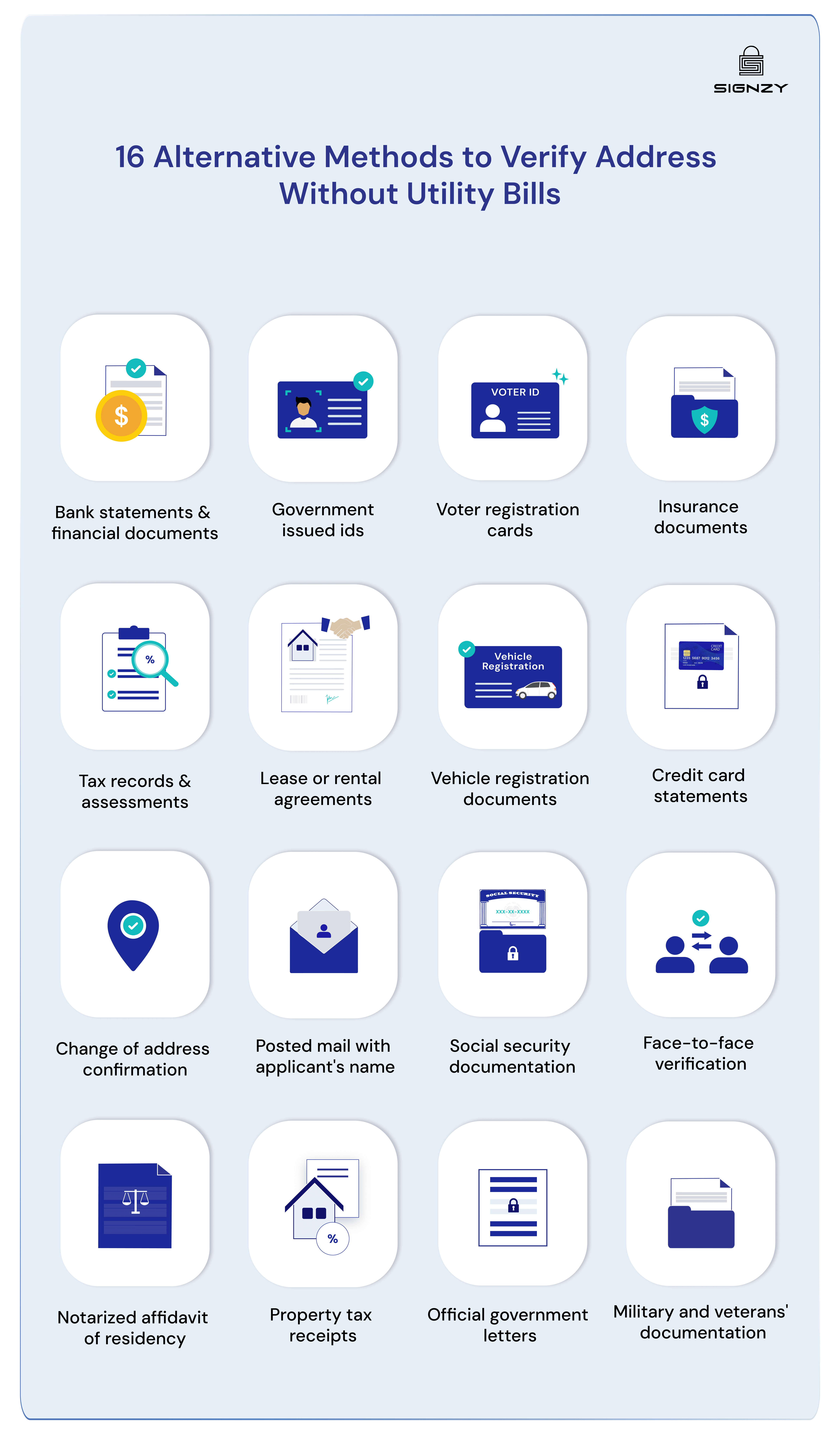
1. Bank statements and financial documents
Monthly bank statements are often the first choice when utility bills aren’t available – and for good reason. Look for statements from the past three months, as older ones might not meet verification standards.
If your customer provides electronic statements, that’s perfectly fine too. What really matters is that they show the complete legal name, current residential address, and the issuing bank’s information clearly. And remember, while account balance details might be visible, they’re not relevant for address verification.
2. Government-issued IDs
Here’s something many verification teams overlook: not all government IDs serve the same purpose. A driver’s license or state ID typically shows the most current address information, as people tend to update these when they move.
But here’s the catch – some regulations actually prevent using the same ID document for both identity and address verification. So it’s worth checking your local requirements first.
3. Voter registration cards
Voter registration cards often work better than you might expect. They’re government-issued and go through a verification process before being issued. Just keep in mind that they follow election cycles, so there might be a lag in address updates. Still, if the card shows the current address, it’s as good as any other government document for verification purposes.
4. Insurance documents
Insurance documents offer reliable address verification because insurance companies maintain strict standards for customer information. Whether it’s home, auto, or health insurance, these documents work well as long as they’re current. Watch for current policy statements, insurance cards, or official correspondence.
Something worth noting: while digital copies are usually acceptable, they need to display all the key elements – policyholder name, current address, policy number, and insurance company details.
5. Tax Records and assessments
Tax documents come directly from government agencies, which makes them highly reliable. They could be annual tax returns, property tax statements, or official tax correspondence. Also, while these documents are extremely reliable, they are typically updated annually. So if someone’s moved recently, they might need additional current documentation to support their new address.
6. Lease or rental agreements
These documents work exceptionally well when they’re properly executed. Look for complete lease agreements that show tenant names, property addresses, lease term dates, and all required signatures.
Even month-to-month agreements work well, but they should be current. But note – the document should clearly connect the person to the address through a legally binding agreement.
7. Vehicle registration documents
Vehicle registrations are particularly useful because people typically keep them updated to stay legal on the road. These documents come from DMV or equivalent agencies, making them quite reliable.
When reviewing vehicle registrations, check that the name and address match other provided documents. Sometimes you’ll see business addresses listed – in these cases, request additional documentation showing the residential address.
8. Credit card statements
Much like bank statements, credit card statements can also work as a solid address proof. They should be from the past three months and clearly show the cardholder’s name and current billing address. Many credit card companies provide electronic statements now – these are perfectly acceptable as long as they contain all the necessary information and come directly from the credit card issuer.
9. Change of address confirmation
USPS change of address confirmations works particularly well for recent moves. They’re valid for 30-90 days after the confirmation date, making them ideal for temporary verification. The key advantage? They show both the old and new addresses, creating a clear trail. Just remember to verify when the change took effect, as this impacts the document’s validity period.
10. Posted mail with applicant’s name
Official mail can serve as address verification when it comes from recognized senders like government agencies or financial institutions. The mail should be from the past three months and show clear postmarks. Something important to note: personal correspondence or marketing materials typically don’t qualify – the focus is on official, traceable mail.
11. Social security documentation
Official Social Security Administration documents work well because they’re government-issued and regularly updated. Whether it’s benefit statements or Medicare correspondence, these documents typically meet verification requirements. Just ensure they’re recent and show the current physical address rather than a P.O. box.
12. Face-to-face verification
While this method might seem old-fashioned in our digital age, it’s actually quite effective for certain businesses. It involves customers presenting their identification documents in person, allowing for immediate verification. Banks and financial institutions often prefer this method for opening accounts.
13. Notarized affidavit of residency
Sometimes, it is used as a backup option when standard documents aren’t available. A notarized affidavit includes a sworn statement about the person’s residence, verified by a licensed notary public. But keep in mind that many organizations consider this a supporting document rather than standalone proof. It often works best when combined with other forms of address verification.
14. Property tax receipts
These documents work particularly well for homeowners. Property tax receipts combine official status with direct property ownership, making them quite reliable for address verification. When reviewing these documents, check that they’re current and show both the owner’s name and property address clearly. They’re especially useful because local tax authorities maintain accurate records for billing purposes.
15. Official government letters
Letters from government agencies provide strong address verification when they’re recent. These might come from tax authorities, social services, or other official departments. The key requirements? They should be on official letterhead, dated within the last three months, and show both the recipient’s name and physical address.
Many government departments now send official digital correspondence – these are just as valid as traditional letters when they contain the right information.
16. Military and veterans’ documentation
While not in our original list, military documentation deserves mention. Active duty military personnel and veterans often have unique living situations. Military orders, veterans’ benefits letters, and military ID cards with address information all serve as valid proof of address. These documents work well because they’re government-issued and regularly updated through official channels.
What to not accept as address proof?
Address verification requires reliable, official documentation. But not every document with an address on it meets proper verification standards.
Many documents that seem legitimate at first glance actually don’t provide the level of verification needed for regulatory compliance. This matters because proper address verification helps prevent fraud and ensures you’re meeting your KYC obligations.
Here’s what you should not accept as proof of address:
Open in ChatGPT- Personal letters or statements from family, friends, or employers
- Handwritten or informal rental agreements
- Digital bills or screenshots without official letterhead
- Documents older than three months
- Social media profiles or online accounts
- Package delivery labels or shipping receipts
- Business cards or company letterheads
- E-commerce order confirmations
- Hotel bills or temporary accommodation receipts
- Self-printed documents, even with correct information
- Personal email correspondence
- Mobile phone screenshots of bills or statements
- Gym membership cards
- Library cards
- Magazine or newsletter subscription
When verifying addresses, always stick to official documents from recognized institutions. If a document seems questionable, it’s better to request additional proof than risk non-compliance.
Rules and regulations around address verification
Financial institutions and many other businesses must follow specific regulations to verify customer addresses as part of their compliance obligations.
These regulations aim to prevent financial crime, identity theft, and money laundering while protecting both businesses and customers. Different industries and regions might have varying requirements, but most share common foundations in KYC and AML protocols.
- Bank Secrecy Act (BSA): Requires financial institutions to verify customer identity and address as part of their customer due diligence program. Regular updates and monitoring of customer information are mandatory.
- Customer Due Diligence Rule (CDD): Mandates that financial institutions must identify and verify the identity of customers, including their addresses, when opening new accounts.
- FINRA Rule 2090 (Know Your Customer): Requires member firms to verify customer information, including addresses, to ensure proper account handling and risk assessment.
- Anti-Money Laundering (AML) Directives: Specify that businesses must maintain accurate customer address information and verify any changes to prevent financial crimes.
| Regulation | Jurisdiction | Key Address Verification Requirement |
|---|---|---|
| Bank Secrecy Act (BSA) | United States | Financial institutions must verify customer identity including address as part of CDD |
| CIP Rule (31 CFR 1020.220) | United States | Must obtain residential or business street address before account opening |
| Customer Due Diligence (CDD) Rule | United States | Identify and verify identity of customers and beneficial owners |
| FINRA Rule 2090 | United States | Member firms must verify customer information including addresses |
| AML Directives (4th, 5th, 6th) | European Union | Businesses must maintain accurate customer address information |
| Address Confidentiality Programs | United States | Protected individuals may use sponsoring agency address |
| NIST SP 800-63-4 (Draft) | United States | Stricter remote identity proofing standards including biometrics |
In practice, these regulations mean businesses need documented processes for address verification, regular updates of customer information, and secure storage of verification records.
💡 Related Blog:

How to spot suspicious address documents? Red flags explored
Before we start, just note that these red flags do not automatically mean fraud. They simply indicate situations that need a closer look.
🚩 Non-existent or unverifiable addresses
Some addresses simply do not exist. You might see street names that are not in any postal database, or number ranges that make no sense for a particular street. These addresses often sound reasonable at first, but they fail when checked against official records.
Cross-reference every address against postal databases. Most modern systems do this automatically. If an address cannot be verified through standard postal services, that is your first sign something might be wrong.
🔒 Signzy Advantage: Signzy’s Database Validation API can help you conduct real-time database verification checks addresses against multiple authoritative sources instantly, catching non-existent locations before they reach your manual review queue.
We process thousands of loan applications daily across multiple regions. The address verification API reduced our manual review time by 60% while improving data quality across our entire system. The international coverage is exceptional and saves us considerable operational costs.
— Head of Credit Operations, Digital Lending Platform

🚩 Mail drops and commercial receiving locations
UPS stores, private mailbox facilities, and virtual offices serve legitimate purposes. However, they also hide where someone actually lives. When you see these addresses, you are looking at a mail forwarding service rather than a residential location.
Many verification databases track known commercial mail receiving locations. When these addresses appear, ask for additional documentation showing the actual home address.
🚩 Incomplete or vague address information
Real addresses have specific details. When you see an address missing an apartment number in a building that clearly has multiple units, that raises questions. Partial street names or vague descriptions like "near the post office" are not sufficient.
Complete addresses include everything needed to locate the exact residence. This means unit numbers, building names, and proper street information. Incomplete details often mean someone is trying to be deliberately vague.
🚩 Inconsistencies across multiple documents
When customers submit several documents, the addresses should match. Different street numbers across documents are a problem. So are varying apartment numbers or different city names.
Minor differences in formatting are normal. "Street" versus "St." does not matter. However, actual differences in address components need explanation. Sometimes people have legitimate reasons, like a recent move. Those situations require documentation.
🔒 Signzy Advantage: The system compares address information across all submitted documents simultaneously, flagging mismatches instantly while maintaining a complete audit trail for compliance.
False positives were killing our onboarding conversion rates and frustrating legitimate customers. Signzy's verification API validates addresses intelligently without creating friction. Our approval rates improved by 25% immediately, and customer complaints about address validation dropped to almost zero.
— CTO, NexGen Fintech
🚩 High-risk geographic locations
Some areas have higher fraud rates based on historical data. This does not mean everyone from those locations is suspicious. It means verification teams should apply extra scrutiny to applications from these areas.
Geographic risk alone should not cause rejection. Many legitimate customers live in areas with elevated fraud statistics. Use high-risk locations as a trigger for enhanced due diligence, not automatic denial.
🚩 Outdated documentation beyond acceptable timeframes
Most regulations require documents from the past three months. Older documents might show previous addresses rather than current ones. A six-month-old bank statement does not prove someone lives at that address today.
Check dates carefully. Statement dates, issue dates, and validity periods all matter. When customers provide old documents, request current alternatives that prove present residence.
🚩 Poor quality or illegible documents
Deliberately blurred documents, extremely low resolution images, or strategically cropped files can hide alterations. Some customers genuinely have poor scanning equipment. However, consistent quality problems across multiple attempts suggest something else.
Request clear copies showing all relevant information. This includes letterheads, dates, and official markings. Legitimate customers can usually provide better versions when asked. Persistent problems warrant alternative verification methods.
🔒 Signzy Advantage: Signzy’s OCR uses smart document processing technology which assesses image quality automatically and prompts customers to resubmit unclear documents immediately, improving verification success rates on the first attempt.
How to conduct address verification at scale using Signzy
Manual address verification works fine when you are processing ten applications daily. Your team can carefully review each document, check details, and make solid decisions. But what happens when volume jumps to 1,000 or 10,000 verifications? Processing slows to a crawl, costs multiply, and frustrated customers abandon applications halfway through. Meanwhile, overwhelmed teams rushing through reviews miss the fraud indicators that careful examination would catch.
The real challenge is about maintaining rock-solid verification standards across thousands of cases while keeping costs reasonable and customers happy.
That requires more than hiring additional staff. It demands intelligent automation that delivers both speed and accuracy without compromise.
↪ Automated document processing across 200+ countries 🌍
Signzy's OCR technology extracts address information from over 10,000 document formats in under 30 seconds. The system recognizes bank statements, government IDs, insurance documents, and tax records automatically.
Whether your customers submit physical documents or digital copies, the platform handles both with equal precision across 180+ countries and 50+ languages.
We deal with documents in 15 languages across multiple jurisdictions for cross-border transactions. This OCR handles them all reliably with minimal errors. It's eliminated the need for manual translation and verification in most cases, saving substantial costs.
— VP Compliance, Cross-Border Remittance Provider
↪ Real-time database validation and fraud detection 🎯
Once extracted, address data gets cross-referenced against multiple authoritative databases simultaneously. Government records, postal services, and business registries are all checked in real-time to confirm addresses actually exist. The system automatically flags non-existent locations, commercial mail drops, and high-risk areas before they reach your team.
↪ Compliance-ready verification with complete audit trails ✅
Every verification creates documentation that meets BSA, CDD, and AML regulatory standards automatically. The platform logs which documents were submitted, what checks were performed, and exactly how decisions were reached.
This complete audit trail becomes invaluable during regulatory examinations. Integration typically takes just two to four weeks through straightforward APIs that work alongside your existing systems without requiring a complete technology overhaul.
Signzy has already verified over 100 million users for 500+ global companies while maintaining sub-three-second response times.
Our Gartner-recognized One Touch KYC operates across 100+ countries, and verifies users in seconds by running document checks, face matching, liveness detection, and AML screening simultaneously.
Ready to see how it works for your specific verification needs? Book a demo to explore the platform, discuss your requirements, and discover why leading financial institutions trust Signzy for verification at scale.


FAQ
What if my customer’s name on the proof of address is slightly different?

Are digital statements as valid as paper ones?
Do all verification methods work for international customers?
What if a customer has absolutely no traditional proof of address?
What is the best way to verify an address digitally without any documents?
How can students, immigrants, or gig workers prove their address without utility bills?
What are the penalties for failing to verify customer addresses properly?
Roshan Kumar
Roshan leads product strategy for Identity and Fraud Verification at Signzy Technologies, where he oversees the development of secure, scalable ID Verification, Automated CKYC, and AI-powered Video KYC solutions for regulated banks and fintechs. With over five years of hands-on experience in KYC and API banking and a strong engineering background, he focuses on building platforms that ensure seamless and compliant onboarding across the BFSI sector. His expertise spans designing and implementing solutions that address evolving regulatory requirements and industry challenges.

Related Blogs
View all




The best in business


The global API marketplace for KYC, KYB, & AML
Explore the end-to-end verification stack trusted by 1,000 businesses.
Get in touch