





11 Best KYB verification solutions in Canada, Ranked [2026 Guide]

- Summary of KYB solutions in Canada
- What is a KYB verification solution?
- Must-have features of KYB verification solutions in the Canadian environment
- 11 Best KYB verification solutions in Canada, ranked
- #1. Signzy: Best Canada-specific KYB solution with Global Scalability
- #2. Sumsub
- #3. Ondato
- #4. Trulioo
- #5. Shufti Pro
- #6. Persona
- #7. iDenfy
- #8. Socure
- #9. Moody’s (Orbis / Entity Compliance Suite)
- #10. The KYB
- #11. IDMERIT
- Where Signzy fits in Canadian KYB Verification and compliance onboarding
- FAQ
If you’re running a platform that needs to onboard businesses in Canada, you probably hit the KYB verification wall sooner or later. It’s not something you can skip anymore, especially if you're in fintech, lending, payments, crypto, or anything that falls under FINTRAC rules.
The hard part is figuring out which KYB solution actually works well with Canadian data. Some tools say they support Canada, but the moment you try BN validation or GST/HST checks, things fall apart. Others are great, but feel like they were built only for big banks.
So this guide breaks things down simply, what works, what doesn't, and which options fit different kinds of teams and budgets without overcomplicating everything.
Summary of KYB solutions in Canada
- This ranking evaluates 11 KYB verification platforms based on Canadian registry support (federal + provincial), tax identifier validation (BN, GST/HST), beneficial ownership resolution, AML screening capabilities, integration flexibility, and verified user feedback from G2, Capterra, TrustRadius, and Trustpilot.
- Signzy (#1) leads for Canadian compliance with native BN/GST-HST validation, provincial and federal registry checks across all territories, AI-powered fraud detection, and modular pay-what-you-use pricing. Supports 180+ countries with 2-5 minute verification times, strong fit for teams needing both Canadian depth and global scalability without forced feature bundles.
- Full-suite platforms (Sumsub #2, Ondato #3, Persona #6) combine KYB, KYC, AML screening, and workflow automation in one system. Best for organizations wanting unified compliance infrastructure with customizable verification flows, though setup requires more configuration than standalone KYB tools.
- Enterprise-grade solutions (Trulioo #4, Moody's Orbis #8, Socure #7) offer deep corporate intelligence, complex ownership mapping, risk scoring models, and audit-ready reporting. Designed for financial institutions, banks, and heavily regulated businesses handling multinational entities or sophisticated ownership structures, often overkill for startups.
- Mid-market focused tools (Shufti Pro #5, iDenfy #10, IDMERIT #11) provide Canadian registry verification, document validation, and AML screening with straightforward API integration. Practical for SaaS platforms, fintechs, and mid-sized businesses needing functional verification without enterprise complexity or pricing.
- Specialized solutions (The KYB #9) focus exclusively on business verification with strong ongoing monitoring capabilities, ideal when tracking corporate status changes, ownership updates, and sanctions exposure matters more than building full onboarding workflows.
What is a KYB verification solution?
A KYB (Know Your Business) solution is software that helps companies verify the legitimacy of another business before working with them. Instead of manually looking up tax records, incorporation details, ownership, or government filings, a KYB platform pulls this data from official registries and validates it automatically.
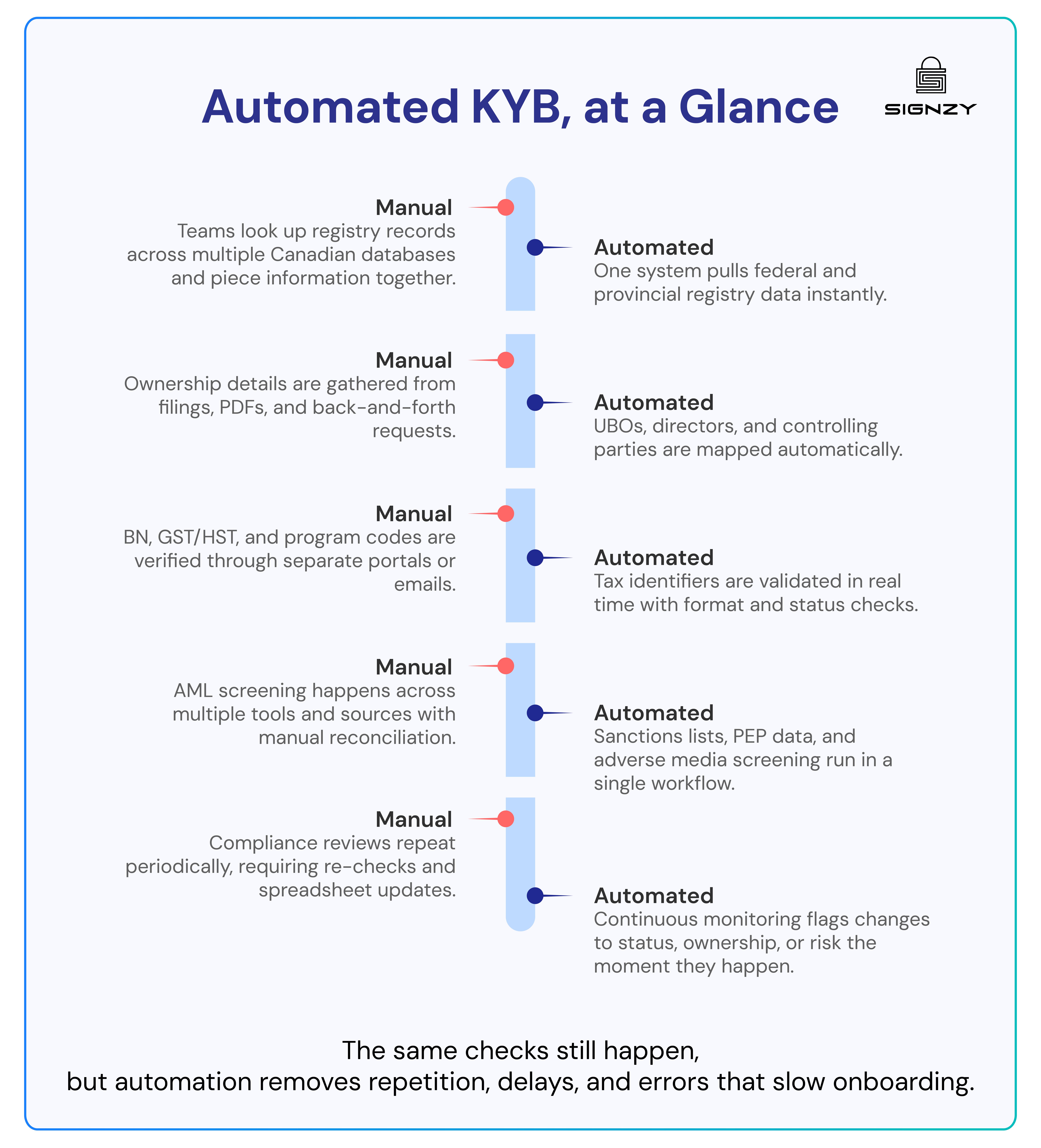
In Canada, regulated industries such as banking, fintech, lending, payments, crypto, and investments are mandatorily required to conduct KYB verification before onboarding under the Proceeds of Crime (Money Laundering) and Terrorist Financing Act (the Act).
It protects against fraud, shell companies, sanctions violations, and money laundering. In simple terms, KYB stops businesses from accidentally onboarding the wrong company.
Must-have features of KYB verification solutions in the Canadian environment
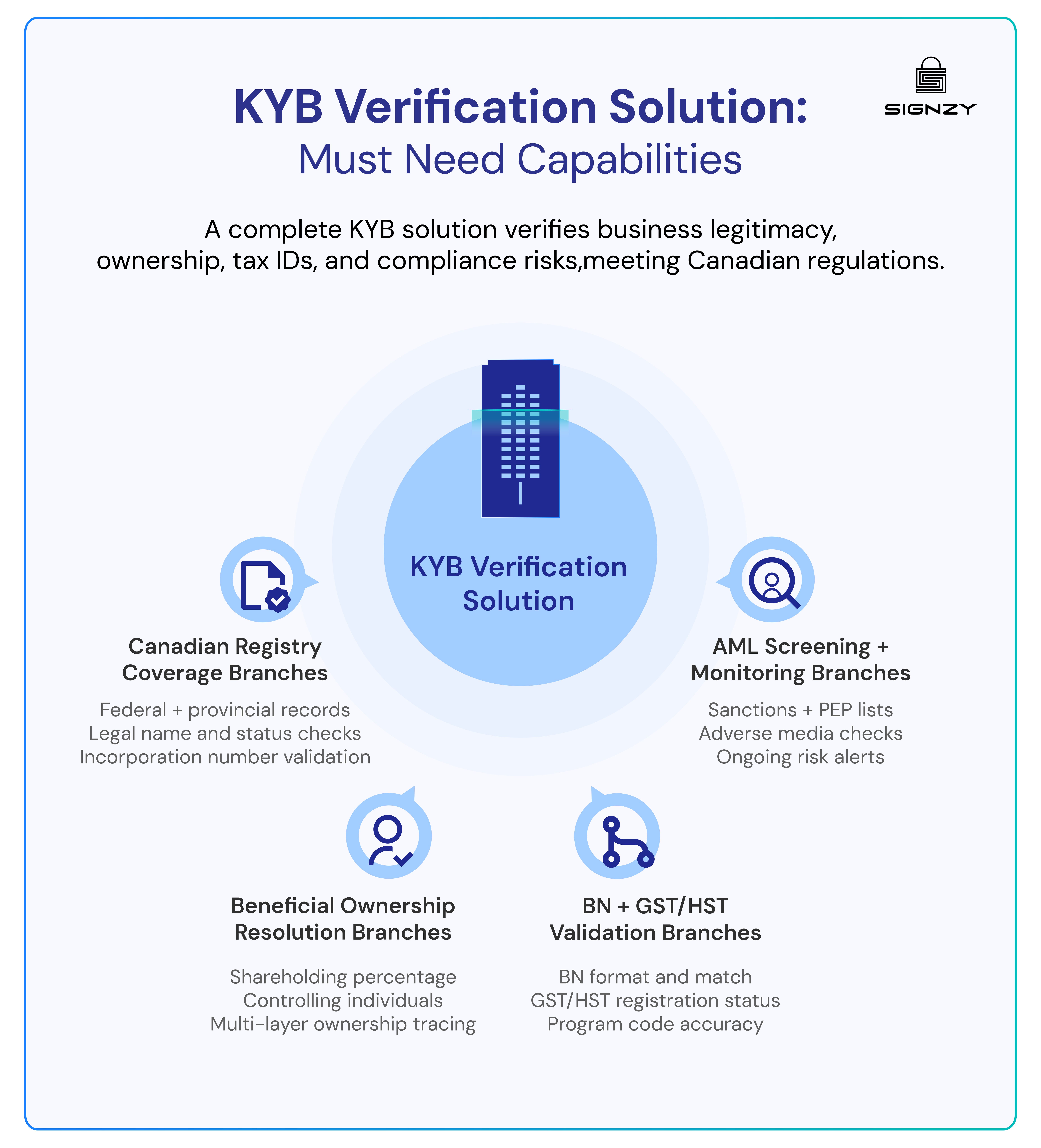
Before choosing a KYB tool, it's important to make sure it supports the way compliance actually works in Canada. Regulations, identifiers, and registry structures here aren't identical to those in the U.S., EU, or APAC.
Below are the four core capabilities that matter most in a Canadian context.
↠ Canadian registry support (federal and provincial)
A good KYB solution should verify businesses across both Corporations Canada and provincial registries, such as British Columbia, Ontario, Quebec, and Alberta, because not all companies incorporate federally. It should confirm incorporation status, registration numbers, entity type, directors, and whether the business is active or dissolved.
↠ Beneficial ownership and UBO mapping
FINTRAC guidance expects businesses to verify who really controls or benefits from a company, not just the legal name on paper. A KYB tool should be able to identify directors, shareholders, majority controllers, and any indirect ownership links, especially where ownership is layered across multiple entities or countries.
↠ BN, GST/HST, and tax-identifier validation
In Canada, tax identifiers play a much bigger role in business verification than in many other regions. Just matching a legal name isn’t enough.
Under the Proceeds of Crime (Money Laundering) and Terrorist Financing Act (the Act), you need to confirm the Business Number (BN) and whether the business is actually registered for GST/HST or related tax programs.
- Business Number (BN) Verification: A proper KYB tool should validate the nine-digit BN, check its formatting, confirm it belongs to the business in question, and match it against official government records to avoid false associations or incorrect submissions.
- GST/HST Registration Confirmation: Verification should confirm whether a business is actually enrolled in GST/HST and whether the registration is active. This helps prevent onboarding businesses claiming tax registration when they’re not eligible or operating legally.
- Program Account & Format Matching: KYB tools should verify structure and linkage between tax program types (like RT, RP, RC) and ensure the business isn’t using a recycled or misreported number that doesn’t match its legal record.
Once these identifiers are validated, onboarding becomes more accurate, easier to audit, and substantially harder to exploit through misrepresentation or identity spoofing.
↠ AML screening and ongoing monitoring
A Canadian-aligned KYB solution must support AML expectations: screening businesses and related individuals against sanctions, PEP (Politically Exposed Persons) lists, watchlists, and adverse media. Just verifying a business once isn’t enough; monitoring should continue and alert the compliance team if a business’s risk status changes over time.
11 Best KYB verification solutions in Canada, ranked
This list of the best KYB verification solutions in Canada is prepared after evaluating all providers based on Canada-specific registry & tax-ID support, global coverage, compliance/AML features, flexibility/modularity, and suitability for different business sizes. However, more weight was given to user feedback available on platforms like G2, Capterra, TrustRadius, Trustpilot, and more.
Before we discuss details, here's a quick comparison table you can refer to if you are short on time:
| Rank | KYB Solution | Why It’s Ranked Here |
|---|---|---|
| 1 | Signzy | Strong Canadian support with BN and GST HST validation, provincial and federal registry checks, modular pricing, and global scalability. Good balance of capability and ease of use. |
| 2 | Sumsub | Full compliance platform combining KYB, KYC, AML, and workflow automation. Useful for teams that want everything in one system. |
| 3 | Ondato | Broad onboarding and compliance suite with entity verification, ownership tracing, AML screening, and ongoing monitoring. |
| 4 | Trulioo | Enterprise-level platform offering deep registry matching, monitoring, and audit reporting suitable for financial institutions. |
| 5 | Shufti Pro | Mix of Canadian and international registry and identity verification with AML screening. Good for teams onboarding across borders. |
| 6 | Persona | Highly customizable workflows with embedded KYB and KYC modules. Best for companies with non-standard onboarding needs. |
| 7 | Socure | KYB combined with strong fraud scoring and machine learning risk models. Useful when prevention and compliance need equal weight. |
| 8 | Moody’s Orbis | Deep corporate intelligence and ownership mapping suited to institutions onboarding complex or multinational entities. |
| 9 | The KYB | Simple focused KYB tool for registry checks, UBO mapping, and continuous status monitoring. |
| 10 | iDenfy | Lightweight KYB and AML verification with document validation and liveness features. Practical for mid-market and SaaS teams. |
| 11 | IDMERIT | KYB and AML solution with Canadian registry support and API based onboarding. Best for teams wanting predictable verification without heavy configuration. |
#1. Signzy: Best Canada-specific KYB solution with Global Scalability
Signzy is an AI-based verification platform built for regulated onboarding, with KYB coverage that supports Canadian business records at both the federal and provincial levels. Our Canadian support includes registry-based verification across British Columbia, Ontario, Quebec, Alberta, and every other province and territory.
Apart from provincial registry IDs, Signzy also supports GST/HST number verification and business-number (BN) checks, along with ownership validation. Hence, we can say Signzy is a perfect fit for firms that must satisfy Canadian compliance frameworks (e.g., under FINTRAC) while also dealing with cross-border entities.
Signzy's design philosophy emphasises modularity, meaning companies can pay only for the components they use. For example, if a business only needs registry verification, that's an option. If they need the full stack (KYB, KYC, AML, identity verification, document checks, screening, or ongoing monitoring), they can enable the complete suite.
We started using Signzy just for basic registry checks and ended up rolling out the entire stack because every module removed another manual headache. Six months in, we’ve cut verification effort by roughly 70%.
— CTO, B2B Lending Startup.

As of 2025, Signzy has crossed 600 global enterprise clients, with more than 10 Fortune 30 companies using the platform. The company has handled 25M+ verifications, earned recognition from Gartner, and was ranked 11th in Everest Group’s 2025 FCC technology leaderboard.
GST/HST validation was the part we struggled with the most before. Our old provider charged us for features we never used and still couldn’t handle provincial differences. With Signzy, it finally feels accurate and not overpriced. Reliable options are rare in this space, so finding one that actually works has been a relief. Honestly, we’re grateful.
— Compliance Analyst, Canadian Financial Services Platform.
Signzy - Key features
- Canada-Grade Registry + Tax Record Validation: Verifies federal and provincial registry IDs, Business Numbers (BN), GST/HST data, incorporation records, and legal status for Canadian businesses.
- Global Coverage + Scalability (180+ countries): While offering deep Canadian support, Signzy’s business verification and UBO-resolution APIs also work across 180+ jurisdictions. Useful for multinational clients or cross-border operations.
- Automated Document & Business-Record Matching: Cross-checks submitted business documents with registry and tax-database data to confirm legitimacy, ownership, and compliance readiness.
- Lightweight API & Integration-First Design: Built for rapid integration into web or mobile onboarding flows; suitable for SaaS platforms, fintechs, and marketplaces.
- Audit-Ready Compliance Reports & Ongoing Monitoring: Generates structured compliance records, ownership history logs, and delivers ongoing re-verification capability. Super valuable under regulatory regimes like FINTRAC.
Related Blogs

#2. Sumsub
Sumsub positions itself as an all-in-one compliance platform for businesses needing KYC, KYB, AML, fraud controls, and automated workflows under one system. Overall, the experience is generally regarded as flexible and technically strong, but unlike Signzy’s out-of-the-box nature, setup takes deliberate effort because of the number of moving parts.
User sentiment online varies from praise for automation to frustration with support responsiveness during escalations. One TrustPilot review stated:
Most good companies have support agents who genuinely want to understand the situation and can help. But this is not the case with Sumsub for now.
With that said, let’s now see what Sumsub has to offer.
Sumsub - Key features
- Custom Policy Automation & Workflow Builder: Allows compliance teams to create rule-based verification flows without engineering dependency, adjusting steps based on entity risk.
- Automated Business Identity Verification (Registry-Backed): Runs structured KYB checks, including legal entity data, filings, and registration status pulled from authoritative business sources.
- Ownership & UBO Resolution System: Identifies directors, shareholders, and controlling parties, including layered structures, for compliance and onboarding.
- Multi-Product Verification Stack (KYB + KYC): Handles individuals and businesses in one ecosystem, simplifying cross-entity onboarding for mixed customer bases.
#3. Ondato
Ondato sits in the category of full-suite verification platforms designed for organizations that deal with regulated onboarding or financial compliance requirements. It supports both identity and business verification, but the KYB element is one of its stronger areas with company registry matching, ownership tracing, AML screening, and repeat monitoring options.
The general impression is that Ondato works well once everything is configured correctly and tends to scale better than lightweight solutions. If your goal is to verify Canadian businesses, international suppliers, or any entity needing AML checks tied to regulatory obligations, Ondato fits that use case fairly well alongside Signzy.
Ondato - Key features
- UBO & Representative Identification: Maps beneficial owners, directors, and authorized agents with optional KYC validation and identity confirmation.
- Sanctions, PEP & AML Screening: Screens businesses and associated individuals against enforcement databases, politically exposed persons listings, and reputational risk signals.
- Configurable Intake & Review Workflows: Let compliance teams adjust onboarding steps, screening thresholds, and additional verification layers based on risk or entity type.
- Dashboard + API Integration: Offers both a UI for manual review and an API for fully automated onboarding flows or embedded corporate account activation.
#4. Trulioo
Trulioo is one of the more established verification platforms with a focus on helping financial services, fintech, and regulated businesses onboard companies while handling compliance requirements automatically.
Public feedback is generally strong, though there are a few frustrations from end-users who encountered cases where rules felt stricter than expected. We came across one Canada-related comment as well, which read,
Refuses Government ID that is listed as acceptable by the Financial Consumer Agency of Canada…and insists on selected types they like.
That doesn’t mean it performs poorly overall, but it signals potential friction in edge cases or CX-sensitive industries where rivals like Signzy excel.
Also, it’s closer to infrastructure than a simple plug-in, which is either perfect or overkill depending on the team. In simple terms, it leans toward the enterprise side.
Trulioo - Key features
- Business Registry Verification (Deep Lookup): Pulls verified corporate records, formation details, registration status, and cross-references them with multiple authoritative datasets for accuracy.
- Compliance Reporting & Audit Support: Generates standardized regulatory-style evidence trails, activity logs, and compliance reports aligned with industry expectations.
- Ongoing Entity Monitoring: Tracks updates to corporate status, sanctions matches, ownership changes, or new risk events automatically.
#5. Shufti Pro
Shufti Pro is one of the few platforms, alongside Signzy, that publicly state support for Canadian compliance requirements and accept Canadian ID formats, registry data, and AML alignment needed for industries monitored under FINTRAC rules.
The overall tone from user feedback is generally positive, especially around global coverage and setup flexibility. The rougher experiences tend to mention verification friction, mostly around document scanning and selfie capture steps, taking longer or failing unexpectedly. One review described it plainly: failures during the process were "too shaky" on mobile and required multiple attempts. These issues appear more related to UX consistency than accuracy.
For companies verifying Canadian entities or onboarding mixed Canadian and international B2B users, Shufti Pro is a strong contender, especially if you want a single verification vendor instead of piecing multiple tools together. However, if you care about UX consistency as well, rivals like Signzy and Sumsub can be a better match.
Shufti Pro - Key features
- Corporate Registry & Entity Verification: Searches business records, confirms official status, and retrieves registration data for validation and compliance due diligence.
- Document Verification with OCR & Integrity Checks: Extracts business and identity data from official filings, certificates, or supporting records and checks for tampering or formatting inconsistencies.
- AML, PEP & Sanctions Screening: Screens entities and connected persons against high-risk lists and enforcement signals aligned with compliance expectations like FINTRAC.
#6. Persona
Persona is one of the more flexible verification platforms on the market, built for companies that want control over how onboarding works instead of depending on preset verification flows.
While Persona doesn’t market itself specifically as “Canada-first,” many teams choose it because its workflow builder aligns well with the risk-based approach seen in FINTRAC-related compliance frameworks. That matters if your onboarding requirements shift depending on entity type, geographical risk, or revenue profile.
Persona - Key features
- No-Code Verification Flow Builder: Let's compliance and risk teams create branching onboarding rules and conditional workflows without requiring engineering involvement.
- Ownership + Role Identification System: Resolves directors, shareholders, and controlling parties to support AML, UBO requirements, and financial regulatory obligations.
- Embedded KYB/KYC Modules: Allows verification steps to occur directly inside your product rather than redirecting users to an external flow.
- Compliance Logging & Case Management: Generates audit-ready records, review history, and decision trails that align with regulated onboarding expectations like those seen in Canada.
#7. iDenfy
iDenfy offers automated KYB, identity verification, fraud controls, and AML screening aimed at companies that want a straightforward solution without a heavy enterprise setup.
The platform supports verification of Canadian entities as part of its global coverage and includes ownership screening, registry matching, and ongoing due diligence components that align with compliance requirements commonly seen in Canadian regulated industries.
It tends to appeal to mid-market fintechs, SaaS platforms, and startups onboarding businesses that need to validate legitimacy while reducing manual review.
User sentiment around iDenfy is mixed but generally usable. Some users appreciate its fast turnaround and automation, while others highlight rough patches in usability. One person described their experience on TrustPilot saying,
They REQUIRE taking fresh pics instead of uploading… browser not supported… taking a picture of my passport was a nightmare.
Still, iDenfy holds its place in the KYB space as a practical and affordable option with meaningful compliance coverage, especially when the priority is efficiency and fraud prevention rather than heavy customization.
iDenfy - Key features
- Automated Business Registry Verification: Confirms incorporation data, business status, officer records, and registration details using authoritative business databases.
- Ownership & Beneficial Interest Mapping: Identifies directors, shareholders, and controlling parties to satisfy KYB and AML requirements tied to regulated onboarding.
- Device & Cross-Platform Verification Support: Enables onboarding on desktop and mobile devices, including live capture steps for authenticity validation.
- Document & Liveness Protection Layer: Uses real-time checks to prevent spoofing, manipulated uploads, or identity fraud during onboarding.
#8. Socure
While Socure is well known for advanced identity and fraud modeling, its KYB product has grown into a full verification stack. The platform sits in the upper tier of compliance and risk-intelligence platforms. It’s widely adopted in fintech, banking, payments, lending, and enterprise environments where onboarding decisions rely on more than basic verification checks.
What makes Socure stand out is how heavily it leans on data science. Instead of only checking business records, it scores risk signals, patterns, and anomalies. This helps when onboarding isn’t just compliance-driven, but also tied to fraud prevention or creditworthiness.
Socure best fits companies scaling onboarding volume while needing strong compliance and risk controls, especially when identity, business verification, and fraud modeling all tie into the same workflow.
Socure - Key features
- KYB with Risk-Driven Scoring Model: Combines corporate registry lookups with machine-learning-based risk scoring to assess onboarding eligibility and fraud likelihood.
- Identity + Business Unified Verification: Merges KYC and KYB workflows so onboarding decisions consider both entity-level and individual-level risk signals.
- Compliance Logging, Monitoring & Reporting: Generates audit-ready verification records, risk decisions, and ongoing monitoring output for regulated onboarding environments.
#9. Moody’s (Orbis / Entity Compliance Suite)
Moody’s sits in a different category compared to most verification vendors. Instead of being “just a KYB tool,” it feels more like a corporate intelligence system that happens to power compliance.
Moody’s offers extremely detailed business data, entity linkages, ownership hierarchy, parent-subsidiary mapping, and risk intelligence that goes far beyond a normal registry lookup. For large financial institutions, banks, insurers, or heavily regulated businesses in Canada, that level of intelligence becomes valuable when dealing with complex entities, multinationals, layered trust structures, or foreign ownership.
But yes, Moody’s isn’t usually the first choice for startups or smaller fintechs. It shines in environments where the cost is justified by risk exposure or regulatory pressure. If your onboarding environment ranges from local small businesses to complex international corporations, Moody’s may not be the best fit as compared to Signzy or Persona.
Moody’s - Key features
- Deep Entity Intelligence & Corporate Structure Mapping: Tracks parent companies, subsidiaries, cross-border ownership, and multi-layered entity relationships using high-quality structured data.
- Global Ownership & Beneficial Control Resolution: Identifies controlling relationships and indirect influence, supporting requirements for regulated onboarding under AML frameworks.
- Compliance-Ready Output & Governance Records: Produces structured audit trails and reporting aligned to regulated onboarding environments, including Canadian compliance expectations.
#10. The KYB
The KYB is built as a focused business-verification platform rather than a full identity ecosystem. One of the platform’s core strengths is ongoing monitoring. Instead of conducting verification just once, the system can alert teams when a business changes status, directors, sanctions exposure, or legal standing.
That’s particularly useful for industries under Canadian AML frameworks where periodic review isn’t optional.
The KYB - Key features
- Canada-Focused Business Registry Validation: Confirms incorporation details, legal status, officers, and registration numbers across federal and provincial systems.
- UBO & Director Verification Workflow: Resolves ownership structures and controlling parties, supporting AML obligations and financial-grade onboarding.
- Perpetual KYB Monitoring System: Tracks changes in legal status, ownership, or enforcement records, allowing ongoing compliance maintenance.
- Modular Add-Ons & Scalable Structure: Allows teams to start with simple entity checks and move into deeper compliance as risk or volume grows.
#11. IDMERIT
IDMERIT offers KYB, KYC, and AML verification in one system, with support for verifying Canadian businesses through provincial registries, federal incorporation data, and BN/GST records.
The platform appeals to teams that want predictable onboarding flows without investing in large compliance operations. It verifies legal existence, validates documents, screens entities and connected individuals, and can run ongoing due diligence.
IDMERIT works best for companies scaling modestly, onboarding Canadian businesses and international ones, and wanting a single vendor rather than stitching many together.
IDMERIT - Key features
- Canadian Business Registry Verification: Validates legal entity data, corporate status, registry ID, and federal tax identifiers.
- Document Verification & Data Extraction: Validates uploaded documents and extracts structured data for audit and storage.
- API & Platform Integration for Scale: Designed for embedding into product onboarding rather than forcing a manual-only approach.
- Compliance Output & Case Review Tools: Offers dashboards, verification evidence, and review logs aligned with regulated onboarding expectations.
Where Signzy fits in Canadian KYB Verification and compliance onboarding
Canadian KYB verification isn't just about confirming a business exists. You need to validate Business Numbers properly, check GST/HST registration status, pull incorporation records from both federal and provincial registries, and resolve beneficial ownership in ways that satisfy FINTRAC requirements. A lot of global platforms treat Canada like any other market and miss the details. They can't handle BN formatting correctly, don't know the difference between Corporations Canada and provincial incorporation, or skip proper GST/HST checks.
Signzy built these capabilities in from the start, with modular pricing so you're only paying for what you actually use.
Another challenge appears when teams start to integrate KYB tool. To ensure your satisfaction, Signzy lets you begin small instead of rolling out everything within a week.
A lot of teams start with basic registry checks and BN or GST/HST validation. Once that works smoothly, they layer in AML screening or ownership verification. The nice part is you don’t have to buy the full platform upfront just to test the basics.
Developers can plug the API into a sandbox and run checks pretty quickly, while compliance teams adjust the settings without constantly waiting on engineering changes. It keeps everyone moving instead of being stuck in a long implementation cycle.
It also helps that Signzy works the same way whether you're onboarding only Canadian businesses or dealing with global registrations later. So you don’t hit a wall if the business grows beyond one region or compliance category.
If you're curious and want to see how it fits your onboarding flow, book a short no-obligation demo here.


FAQ
What is the Proceeds of Crime and Terrorist Financing Act?

Which industries in Canada must perform KYB checks?
What information is verified in a KYB process?
How long does KYB verification usually take?
Who oversees KYB and compliance requirements in Canada?
Saurin Parikh
Saurin is a Sales & Growth Leader at Signzy with deep expertise in digital onboarding, KYC/KYB, crypto compliance, and RegTech. With over a decade of professional experience across sales, strategy, and operations, he’s known for driving global expansions, building strategic partnerships, and leading cross-functional teams to scale secure, AI-powered fintech infrastructure.

Related Blogs
View all![Business Verification in Canada: Complete Guide [2026]](https://cdn.sanity.io/images/blrzl70g/production/72a7dd392f01378e66cfb0289fb556774b71174c-2560x600.webp)



![Canada GST Verification: Free + Paid Methods [2026]](https://cdn.sanity.io/images/blrzl70g/production/fdd0ff72c124b92e2e687333525a1e3521a1ff5d-2821x663.png)
The best in business


The global API marketplace for KYC, KYB, & AML
Explore the end-to-end verification stack trusted by 1,000 businesses.
Get in touch