





Canada GST Verification: Free + Paid Methods [2026]

 Open in ChatGPT
🗒️ Key Highlights
- The entire tax credit system relies on businesses doing proper due diligence – the CRA treats invalid GST numbers as major fraud red flags.
- While the official GST/HST Registry provides accurate verification, it becomes a significant bottleneck for businesses with multiple suppliers.
- Signzy's API automation eliminates manual GST verification bottlenecks by processing bulk checks against official CRA registries, turning hours of work into instant validation.
- What is GST/HST Verification in Canada?
- Canada Revenue Agency (CRA) requirements for GST number verification
- How to verify a GST number in Canada?
- How to verify a GST number using the official CRA registry?
- How often should you verify supplier GST/HST numbers?
- What happens when you skip GST verification?
- Best practices for GST number verification in Canada
- QST Registry, quick glance
- Simplify GST verification in Canada with Signzy
- FAQ
Every business owner knows their major costs, like payroll, rent, and inventory. But what if an invisible expense was quietly draining your profits every month? For many Canadian businesses, it is.
This cost comes from denied Input Tax Credits (ITCs), all because of one unchecked detail on supplier invoices: an invalid GST number. Every time you pay an invoice with a bad number, you lose the right to claim that tax back.
This guide is about making that invisible expense visible and then eliminating it for good.
We’ll walk you through the simple, official way to verify every supplier’s GST number so you can be confident you’re getting back every dollar your business is owed. Before anything, here’s definition and quick summary to ensure we are on same page.
What is GST/HST Verification in Canada?
GST/HST verification is the process of confirming that a supplier's GST/HST registration number is valid, active, and correctly matched to their legal business name in the Canada Revenue Agency's official registry. This verification ensures businesses can legitimately claim Input Tax Credits on purchases and protects them from penalties during CRA audits.
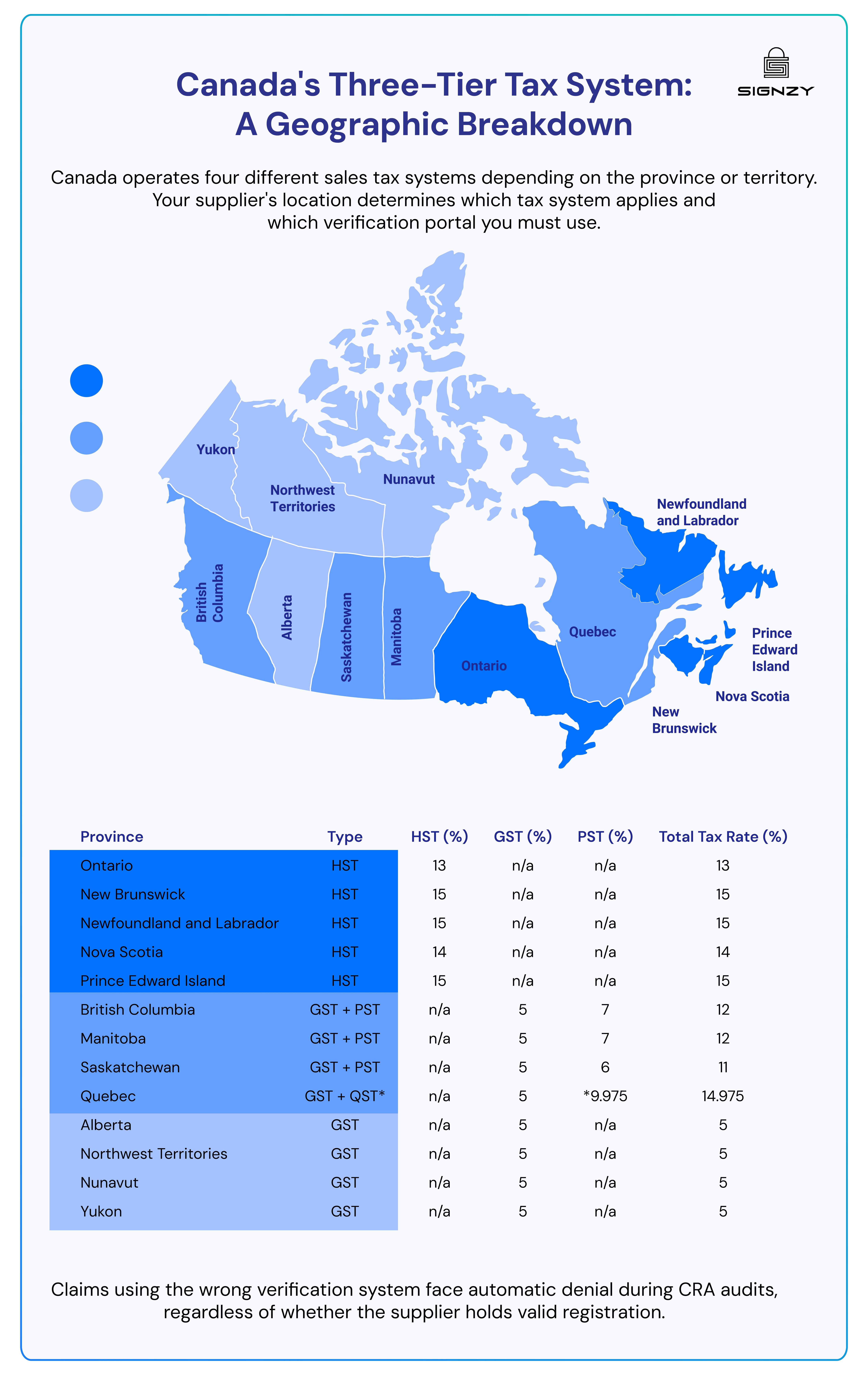
Below’s a quick overview of Canada’s GST/HST system:
| Governing Body | Canada Revenue Agency (CRA) |
|---|---|
| Legal Framework | Excise Tax Act |
| Primary Purpose | Validate supplier registration status before claiming Input Tax Credits (ITCs) |
| Verification Method | GST/HST Registry (official CRA database) or third part API solutions like Signzy for high-volume requirements |
| Information Required | 9-digit Business Number, legal business name, transaction date |
| Registration Number Format | 15 characters (123456789RT0001) - 9-digit BN + "RT" + 4-digit account reference |
Canada Revenue Agency (CRA) requirements for GST number verification
Under the Excise Tax Act, businesses claiming input tax credits must meet specific verification and documentation requirements established by the CRA.
💡 Related Blog:

Obtain valid GST/HST registration numbers
Paragraph 169(4)(a) of the Excise Tax Act requires registrants to obtain “sufficient evidence” before claiming input tax credits.
The Input Tax Credit Information (GST/HST) Regulations prescribe the following:
- For purchases under $30: Supplier's name or trade name, invoice date (or date tax was paid/payable), and total amount paid or payable.
- For purchases of $30 to $149.99: All above information plus the supplier's GST/HST registration number and either the tax amount or a statement that the total includes GST/HST.
- For purchases of $150 or more: All previously listed information plus the recipient's name (or authorized representative), payment terms, and a description of each supply.
Verify registration status
While the Excise Tax Act does not explicitly require businesses to verify supplier registration numbers before claiming input tax credits, the CRA will deny claims where invalid or false numbers appear on invoices. The tax authority expects businesses to ensure the registration numbers they use are accurate and valid.
The official verification method is the CRA's GST/HST Registry, available at no cost. Businesses may also contact the CRA Business Enquiries line at 1-800-959-5525 for verbal or written confirmation of a supplier's registration status. Alternatively, businesses wanting to automate the entire process (including collection, validation, and verification) can sign up for Canada GST/HST verification API like Signzy.
Match business names correctly
The CRA enforces strict matching between the business name on invoices and the name registered to that GST/HST number in the CRA's database.
When names do not match, the CRA regularly disallows input tax credits. This creates complications where businesses operate under trade names or "doing business as" designations. If a supplier has not provided the CRA with their trade name, discrepancies between the legal name and trade name can result in denied credits.
Verify the transaction date
Registration verification must confirm that the supplier held active GST/HST registration on the specific date the taxable supply occurred. GST/HST registration can expire, be revoked, or become inactive. The GST/HST Registry allows users to enter transaction dates to verify registration status at that precise moment.
The CRA expects businesses to maintain records demonstrating that suppliers were registered when the tax was charged, not merely that they held registration at some point.
How to verify a GST number in Canada?
There are three methods available for GST verification in Canada:
- Phone verification: Calling the CRA Business Enquiries line at 1-800-959-5525
- CRA GST/HST Registry: The official online tool provided by the Canada Revenue Agency
- Third-party services: Automated verification tools that connect to the CRA database. For example, Signzy’s Canada GST verification API.
The sections below explain how to use each method, what information you need before starting, and how to interpret the verification results.
How to verify a GST number using the official CRA registry?
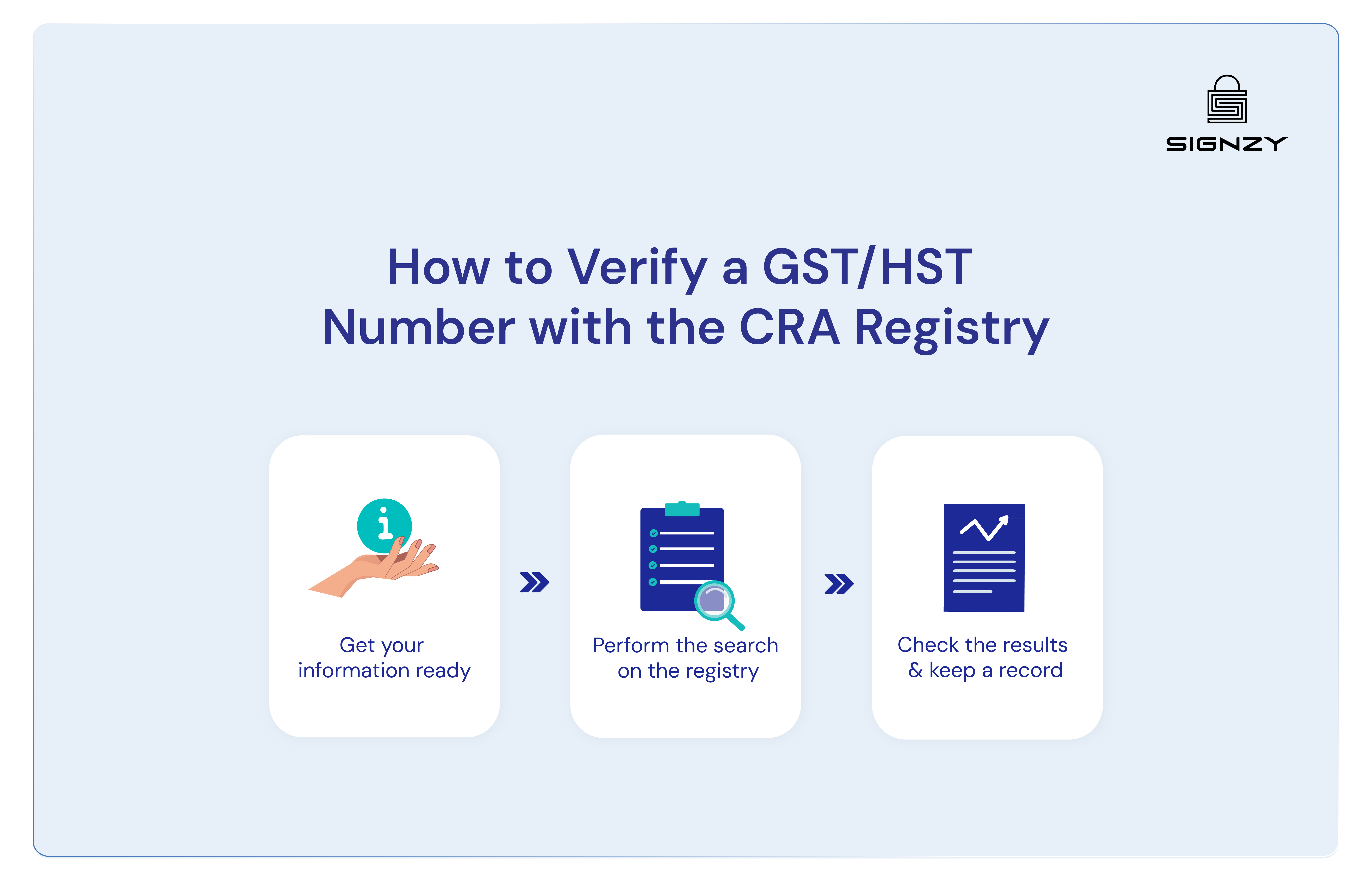
You verify a GST number by using the Canada Revenue Agency's free online GST/HST Registry. Here are exact steps to verify:
- Collect the supplier's nine-digit GST/HST number, exact legal business name as registered in Canada, and the transaction date from your invoice
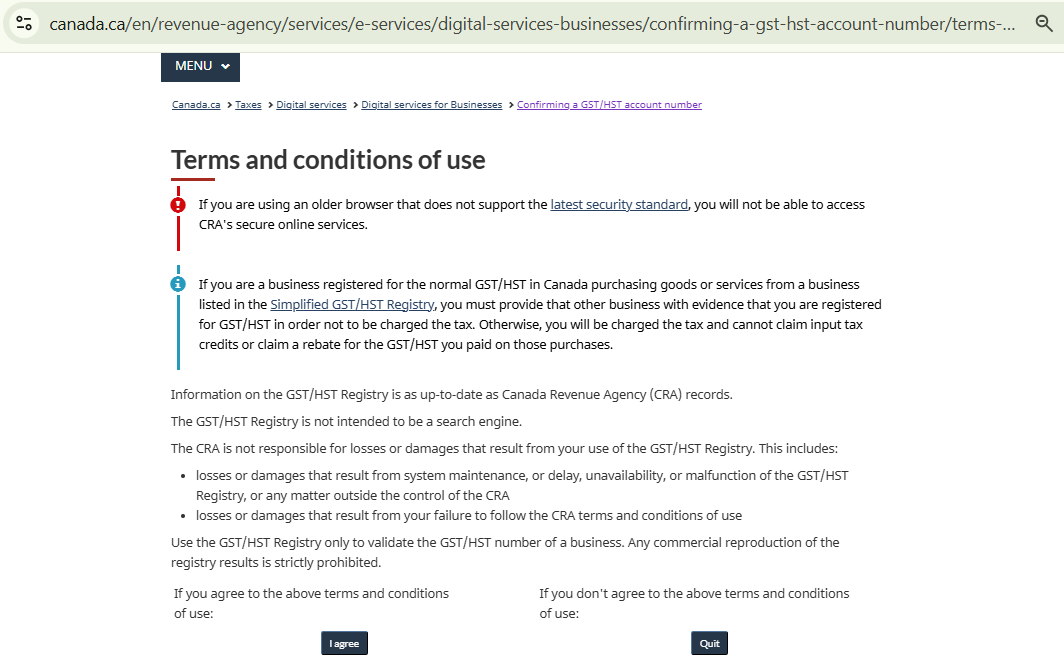
- Go to the CRA's GST/HST Registry page: (https://www.canada.ca/en/revenue-agency/services/e-services/digital-services-businesses/confirming-a-gst-hst-account-number/terms-conditions-use.html)
- Read the terms and conditions, and if you are ready, accept the terms and condition
- Enter only the first nine digits of the GST/HST account number (ignore the "RT" letters and numbers after)
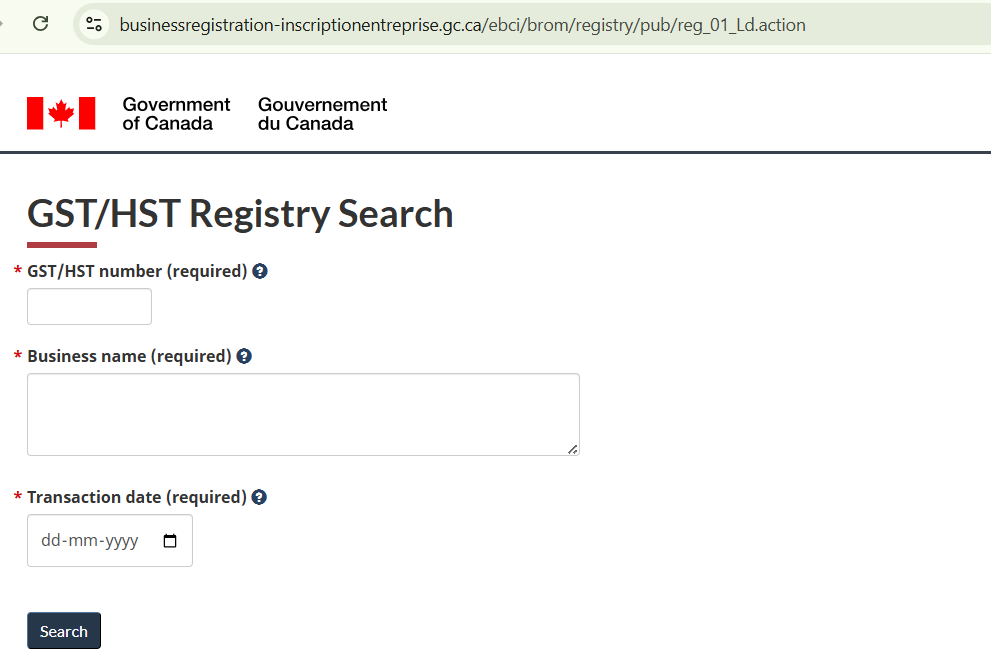
- Enter the required details
- Click search and the system immediately tells you if the registration is valid for that date
- Print or save a screenshot of the confirmation page as proof of due diligence for Canadian tax compliance
If you get a "not registered" result but believe the supplier is registered, contact them to confirm the exact legal name or call the Canada Revenue Agency at 1-800-959-5525
The main limitation is scalability. This manual process works for a few suppliers but becomes impractical when you're onboarding multiple vendors or processing high invoice volumes monthly across Canada.
To automate this process entirely, you can sign up for Canada GST verification APIs from providers like Signzy. These APIs solve the problem by connecting directly to the CRA database, eliminating manual data entry while maintaining the same accuracy as the official Canada Revenue Agency registry.
How often should you verify supplier GST/HST numbers?
Verify every new Canadian supplier before processing their first payment. For existing suppliers, re-verify annually as a minimum best practice. Annual verification protects you from claiming credits when a supplier has deregistered. For high-value transactions over $10,000, verify again even if you recently checked. Higher-risk suppliers in industries with compliance issues warrant quarterly or semi-annual checks.
If you notice warning signs like suspiciously low prices, inconsistent business information, or unusual invoice formatting, verify immediately with the CRA regardless of your last check date.
What happens when you skip GST verification?
When the Canada Revenue Agency audits your business and discovers invalid or unverified GST numbers on your invoices, you lose the right to claim input tax credits on those purchases. This means you absorb the full cost of GST/HST paid, turning what should have been a recoverable expense into a permanent loss that directly impacts your bottom line.
That is the main punishment. Now, let’s discuss other consequences.
Denied input tax credits
The CRA denies input tax credit claims when invoices contain invalid, false, or expired GST/HST registration numbers.
When your input tax credits are denied, you must repay the full amount you claimed, plus interest calculated from the date you originally claimed the credit. For example, if you claimed $50,000 in ITCs over a year using suppliers with invalid registration numbers, you would owe the CRA $50,000 plus accumulated interest.
The business effectively pays the GST/HST twice, once to the supplier and again when the CRA denies the credit.
Interest charges compound daily
The CRA charges interest on unpaid amounts at the prescribed rate, which is the basic rate plus 4%. This interest compounds daily from the date the amount became due. The basic rate follows the average rate on 90-day Treasury Bills, rounded up to the nearest whole percentage.
For a denied ITC claim of $50,000, interest at even 6% annually would add $3,000 per year. If the CRA discovers the issue three years later during an audit, you would owe approximately $9,000 in interest on top of the original $50,000.
This interest is non-deductible for Canadian income tax purposes, making it a pure additional cost to your business.
Audit triggers and ongoing CRA scrutiny
The CRA's automated systems now flag GST/HST inconsistencies instantly. When you file returns with input tax credit claims, the system cross-references your supplier GST numbers against the official registry. Patterns of invalid numbers trigger compliance reviews and audits.
Once flagged, your business may face ongoing CRA monitoring, meaning future returns receive heightened scrutiny. This increases the likelihood of additional audits and compliance verification requests, consuming management time and resources that could be spent on business operations.
Legal and professional fees for disputes
Challenging denied input tax credits requires filing objections with the CRA and potentially appealing to the Tax Court of Canada.
This process demands professional tax advice from lawyers and accountants who specialize in GST/HST disputes. Legal fees for defending a significant ITC denial can easily run into tens of thousands of dollars.
While some businesses succeed in overturning CRA decisions by demonstrating good faith efforts and proper documentation, the legal process itself represents a substantial unbudgeted expense that could have been avoided through proper verification procedures.
Best practices for GST number verification in Canada
✔️ Verify every new supplier before processing the first payment: This establishes due diligence from the start of the business relationship and protects your input tax credit claims with the Canada Revenue Agency.
✔️ Conduct AML and PEP screening alongside GST verification: Tax compliance alone doesn't guarantee legitimate business relationships. Screening suppliers against Anti-Money Laundering watchlists and Politically Exposed Persons databases adds another layer of protection against fraud in Canada.
✔️ Choose a provider with a complete KYB suite: Costs can skyrocket when you subscribe to multiple verification services separately. However, only a few providers offer modular structures where you pay only for what you use. Signzy is one of them, allowing you to combine GST verification with business registry checks, UBO verification, and AML screening without paying for unused features.
Coverage across all 13 provinces and territories matters. We have clients everywhere, including Yukon and Nunavut. Other providers only covered major provinces. Signzy actually reaches the whole country.
— VP Compliance, Payments Platform (500+ employees)

✔️ Re-verify high-value suppliers annually: Registration status can change throughout the year in Canada. Annual verification protects you from claiming credits when suppliers have deregistered with the CRA.
✔️ Save verification results with timestamps: Print or download confirmation screens from every GST/HST Registry search. This documentation proves your due diligence if the Canada Revenue Agency audits your input tax credit claims.
✔️ Automate verification for volume operations: If you're onboarding multiple vendors monthly or processing hundreds of invoices, manual verification becomes unsustainable. API integration saves time and eliminates human errors from transposed numbers or misspelled business names.
✔️ Verify immediately when warning signs appear: Suspiciously low prices, inconsistent business information, or unusual invoice formatting warrant immediate verification regardless of when you last checked the supplier's GST status in Canada.
✔️ Integrate verification into your approval workflows: Don't make verification a separate task. Build it into your vendor onboarding and invoice approval processes so checks happen automatically before contracts are signed or payments are issued across Canadian provinces.
QST Registry, quick glance
The Quebec Sales Tax (QST) is separate from the federal GST/HST system in Canada, which means Quebec suppliers have different registration numbers that must be verified through Revenu Québec rather than the Canada Revenue Agency.
What is a QST registration number?
A QST registration number has 16 characters: ten digits, followed by the letters "TQ", and then four more digits (for example: 1234567890TQ0001). The last four digits identify specific divisions of a corporation, with TQ0001 being the most commonly used extension. Some suppliers only provide the first ten digits on invoices, in which case you should contact them to obtain the complete number if verification requires it.
Where do you verify QST numbers?
You verify QST registration numbers through Revenu Québec's online validation tool, not the Canada Revenue Agency's GST/HST Registry. The two systems are completely separate, and using the federal CRA registry for Quebec suppliers will give incorrect results and could lead to denied input tax refund claims in Canada.
Quebec business registrations used to require separate lookups from federal ones. Signzy handles both in one system. Saves us about 15 minutes per business verification, which adds up fast when you're onboarding 50+ merchants weekly.
— KYB Analyst, Financial Services (200+ employees)
How do you verify a QST number?
- Go to Revenu Québec's QST registration validation page on their website
- Enter the QST registration number (start with the first ten digits)
- The system will indicate whether the number is valid and registered
- If the validation requires additional characters beyond the first ten digits, the system will notify you and you'll need to obtain the full 16-character number from your supplier
- Save or print the validation results as proof of due diligence for your records
What about Selected Listed Financial Institutions (SLFI)?
If the QST registration number contains only nine digits, does not include "TQ", and matches the GST/HST number, the business is a Selected Listed Financial Institution (SLFI). In this case, the QST registration is administered by the Canada Revenue Agency rather than Revenu Québec. To validate these numbers, call the CRA at 1-800-959-5525 instead of using Revenu Québec's system.
Simplify GST verification in Canada with Signzy
Signzy's Canada GST Verification API connects directly to the Canada Revenue Agency database, providing real-time validation that integrates seamlessly into your existing workflows.
The platform validates GST/HST numbers for specific transaction dates, helping Canadian businesses prevent fraud and maintain compliance.
Real-time GST number validation
Signzy's API validates GST/HST numbers instantly against the official CRA database. The system checks three critical elements:
- Whether the GST/HST number is valid and currently registered
- If the business name matches the registration on file with the Canada Revenue Agency
- Whether registration was active on your specific transaction date
This eliminates manual lookups and prevents input tax credit errors that appear during CRA audits.
Fraud prevention and risk management
Flag shell or deregistered entities in real time before money or goods change hands. The system identifies fake or expired GST numbers commonly used in fraudulent transactions across Canada. When a supplier provides an invalid number, the API immediately alerts your team, preventing contracts with illegitimate businesses.
Invoice processing
Auto-validate every GST/HST number while processing invoices in Canada. The integration eliminates manual lookups and prevents input tax credit errors at audit time. When your accounting team processes supplier invoices, the system verifies registration status automatically before payment approval, ensuring you only claim credits on legitimate tax charges.
B2B partner and supplier due diligence
Give procurement and finance teams instant assurance that new or existing suppliers, distributors, and resellers hold an active GST account in Canada. The verification strengthens due diligence workflows by confirming:
- Active GST/HST registration status
- Business legitimacy with the Canada Revenue Agency
- Compliance across all Canadian provinces and territories
The system handles both GST and HST registrations, adapting to the tax structure in each province.
Most importantly, Signzy’s APIs packaging is probably the best feature for this kind of automation.
Rather than building something from scratch or sticking with manual verification, you can plug into existing solutions that already do the work and scale with you. Plus, you only pay for what you use.
We’ve actually tackled this exact problem for our clients and built our Canada GST Verification API specifically for businesses dealing with high-volume GST checks. If you are looking to streamline the manual GST checking, book a demo here to learn more about how you can free your AP team’s time.


FAQ
Who needs to register for GST/HST in Canada?

What happens to my Input Tax Credits if I use an invalid GST number?
What is the difference between GST and HST in Canada?
What is the difference between a Business Number and a GST/HST number in Canada?
Is it my responsibility to verify supplier GST numbers or theirs?
Can I claim ITCs if the supplier's GST registration was inactive during my transaction?
Does the business name on invoices need to match exactly with CRA records?
Do foreign businesses buying from Canadian suppliers need to verify GST/HST numbers?
Saurin Parikh
Saurin is a Sales & Growth Leader at Signzy with deep expertise in digital onboarding, KYC/KYB, crypto compliance, and RegTech. With over a decade of professional experience across sales, strategy, and operations, he’s known for driving global expansions, building strategic partnerships, and leading cross-functional teams to scale secure, AI-powered fintech infrastructure.

Related Blogs
View all![Business Verification in Canada: Complete Guide [2026]](https://cdn.sanity.io/images/blrzl70g/production/72a7dd392f01378e66cfb0289fb556774b71174c-2560x600.webp)




The best in business


The global API marketplace for KYC, KYB, & AML
Explore the end-to-end verification stack trusted by 1,000 businesses.
Get in touch