





What is SSN in Background Verification?

 Open in ChatGPT
🗒️ Key Highlights
- SSNs are central to background verification in the U.S., powering everything from identity confirmation and address history mapping to criminal record searches, credit checks, and fraud detection.
- Conducting SSN-based background checks involves a clear sequence of steps, each legally governed, and organizations must handle SSN data with strict security and compliance practices throughout.
- Signzy's SSN Verification API helps organizations run these checks faster and within a single compliance workflow, with teams going live in as little as 2 days.
- What is a Social Security Number (SSN)?
- What is the role of SSN in background verification?
- What does an SSN trace show?
- How is SSN used in different background checks?
- Is it legal to ask for an SSN for background verification?
- What are the privacy and security concerns with SSN checks?
- Best practices: How should SSNs be handled safely?
- How to conduct background verification with SSN?
- How does Signzy make SSN background verification faster and more reliable?
- FAQ
Every hiring decision carries some level of risk. The question is how much of it is avoidable. For organizations operating in the United States, the Social Security Number has become one of the most reliable tools for reducing that risk during background verification. It connects a candidate's identity to decades of records across jurisdictions and databases in a way that no other identifier can.
But using SSNs in background checks is not as simple as collecting a number and running a search. There are legal obligations to meet, security responsibilities to uphold, and a specific sequence of steps that determines how thorough and defensible the check actually is.
This guide walks through all of it, from what an SSN is and what it reveals, to how the verification process works and what organizations need to keep in mind when handling this data.
What is a Social Security Number (SSN)?
A Social Security Number is a nine-digit identifier issued by the U.S. Social Security Administration to citizens, permanent residents, and eligible temporary residents.
Originally created to track earnings and manage Social Security benefits, the SSN has grown far beyond its initial purpose. Today, it serves as one of the most widely used personal identifiers across financial systems, government agencies, healthcare institutions, and employment processes.
Because it is unique to each individual and tied to a lifetime of records, it has become a foundational piece of identity verification in the United States.
What is the role of SSN in background verification?
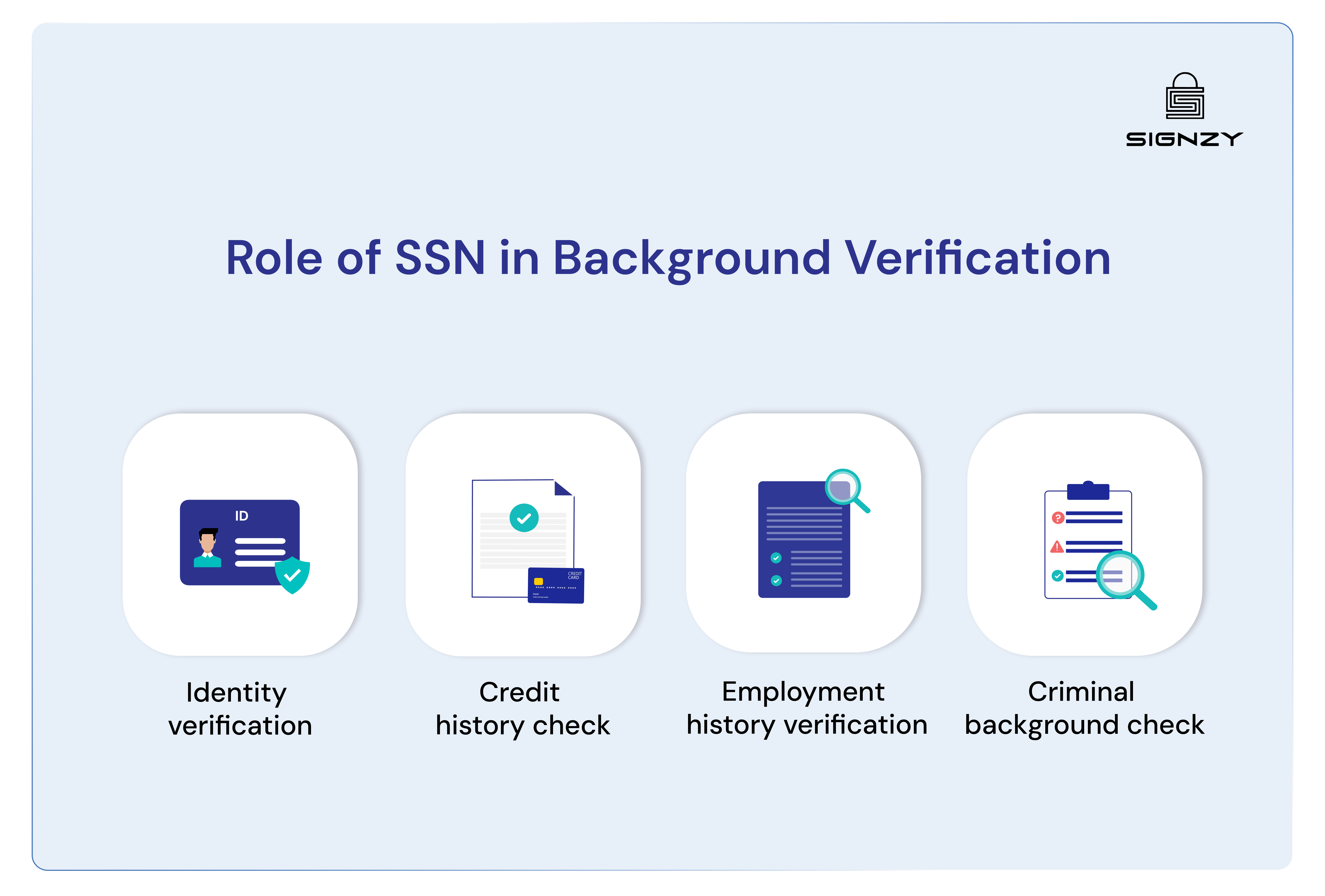
When an employer or organization initiates a background check, the SSN is often the first piece of information they rely on. It acts as an anchor, connecting a person's identity to the records associated with them across multiple databases and jurisdictions.
Here is how the SSN plays a role across different aspects of the verification process.
↪ Identity confirmation
The SSN helps verify that the person being screened is exactly who they claim to be. It cross-references the name, date of birth, and other provided details against federal and state records to flag any inconsistencies or potential identity theft before the check even begins.
This step is particularly important because many people share common names, and relying on a name alone can lead to misidentification. The SSN acts as a tiebreaker, ensuring the right person's records are being reviewed.
If the number does not match the identity details provided, it raises an immediate flag that the candidate's information may be inaccurate, incomplete, or deliberately falsified.
↪ Address history mapping
Each SSN carries a trail of addresses linked to it over time through credit bureaus, tax filings, and utility records. Background screeners use this to build a geographic profile of where a candidate has lived. This then determines which jurisdictions need to be searched for criminal, civil, or other records.
This matters because criminal records in the United States are not held in a single centralized database. They are distributed across counties and states, so knowing where a person has actually lived, rather than just where they say they have lived, is important for conducting a thorough and legally defensible search.
↪ Criminal record searches
In some cases, individuals with criminal histories may use name variations or slight date of birth discrepancies to obscure their past. Cross-referencing against the SSN adds a layer of accuracy that name-based searches alone cannot provide, making it significantly harder for records to be missed or incorrectly attributed.
↪ Credit history access
For roles that involve financial responsibility, the SSN is used to pull credit reports through authorized channels under the Fair Credit Reporting Act. Without it, obtaining an accurate and complete credit report is not reliably possible.
Employers in banking, accounting, or any role with access to sensitive financial assets often treat this as a non-negotiable part of their screening process.
The report itself can surface a range of financially relevant information, including:
- Outstanding debts and repayment patterns
- Bankruptcies and the circumstances around them
- Tax liens or civil judgments filed against the individual
- Patterns of financial mismanagement that may be relevant to the role
↪ Employment and education verification
While employment and education verifications are typically done through direct contact with institutions or third-party verification services, the SSN plays an important supporting role. It is used as a matching identifier to confirm that the records belong to the candidate and that there are no discrepancies between what was provided and what is on file.
This makes the SSN a useful cross-check against the information a candidate provides on their resume or application, helping employers spot gaps or inconsistencies that warrant a closer look.
↪ Sanctions and watchlist screening
For certain industries and roles, the SSN is also used to run checks against government and regulatory watchlists. This includes databases like the Office of Foreign Assets Control list, the Office of Inspector General exclusion list, and various other federal and state debarment registries.
The SSN helps ensure that the match being flagged actually belongs to the candidate in question, reducing the chance of false positives that can arise when searches are run on name alone.
↪ Fraud and red flag detection
Beyond pulling specific records, the SSN itself can reveal potential fraud signals when analyzed carefully. Screeners look at a range of indicators that the number may be associated with suspicious activity:
- Issued before birth: If the SSN was issued before the candidate's reported date of birth, it is a clear inconsistency that needs to be explained
- Multiple names on one SSN: This can indicate identity theft, where someone else's number is being used, or data errors that need resolution
- Multiple SSNs tied to one individual: While sometimes explainable, this pattern can also suggest deliberate identity manipulation
- SSN belonging to a deceased person: Credit bureaus flag numbers associated with individuals who have passed away, and their use by someone else is a serious red flag
- SSN never reported to credit bureaus: A number with no credit or address history attached to it may indicate a synthetic identity, where a valid SSN is paired with fabricated personal details
What does an SSN trace show?
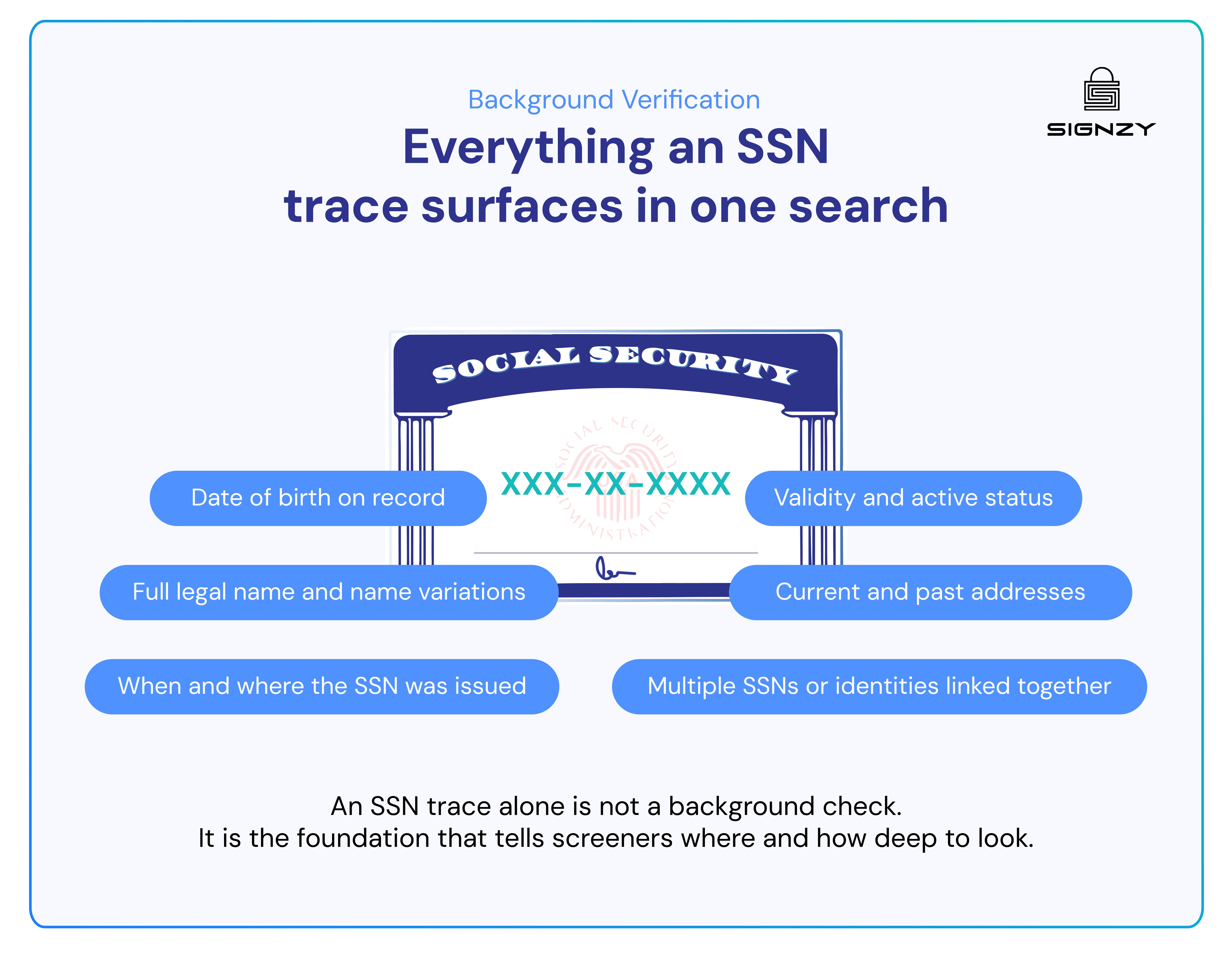
An SSN trace is often the starting point of any background check, and it is more of an investigative tool than a record in itself. An SSN trace typically returns:
- Full legal name and any name variations used historically, including maiden names or aliases
- Date of birth associated with the number as recorded across databases
- Current and past addresses linked to the SSN, often going back several decades
- When and where the SSN was issued, which can sometimes indicate if a number was issued before the individual's reported birth year, is a potential red flag
- Whether the SSN is valid and active, confirming it has not been reported as belonging to a deceased individual
- Multiple SSNs associated with one identity or vice versa, which can signal fraud or data entry errors that need further investigation
How is SSN used in different background checks?
The SSN does not function the same way across every type of background check. Its role shifts depending on the depth and purpose of the screening being conducted.
- In a standard pre-employment check, it primarily drives the identity verification and address history lookup that frames the rest of the search.
- In financial background checks, it becomes the key to accessing credit reports through bureaus like Equifax, Experian, and TransUnion.
- In federal checks or government clearance processes, the SSN is used to query more sensitive national databases that are not accessible in routine commercial screenings.
- In tenant screening, landlords use it to pull credit and eviction history.
In each context, the SSN is less about the number itself and more about what it unlocks, acting as a universal key that opens the door to a person's recorded history within a given system.
Is it legal to ask for an SSN for background verification?
Yes, it is legal for employers to request an SSN for the purpose of conducting background verification in the United States, provided they follow the rules set out under the Fair Credit Reporting Act and applicable state laws. However, the request must be tied to a legitimate, job-related purpose, and candidates must provide written consent before any check is initiated.
Employers are also expected to handle the number responsibly once collected (more on this in the next two sections). Some states have additional restrictions on when and how SSNs can be collected, so compliance requirements can vary depending on where the organization operates.
💡 Related Blog:

What are the privacy and security concerns with SSN checks?
Collecting and processing SSNs comes with real risks that organizations need to take seriously, both for legal compliance and for the protection of the individuals they screen.
- Data breach exposure: SSNs stored in employer or vendor systems are high-value targets for cybercriminals. A single breach can expose hundreds or thousands of individuals to identity theft, with consequences that can last for years.
- Unauthorized access and misuse: Without strict access controls, SSNs collected during hiring can be accessed by personnel who have no legitimate need for them, raising the risk of internal misuse or accidental exposure
- Third-party vendor risk: Many organizations rely on background screening vendors to process SSNs on their behalf. If those vendors do not maintain strong security standards, the risk does not stay with them. It flows back to the employer.
- Over-collection beyond hiring: SSNs collected for background checks are sometimes retained in HR systems long after the verification is complete, creating ongoing liability for data that no longer serves an active purpose
- Discrimination and profiling risks: If SSN data is used beyond its intended scope, for instance, to infer immigration status or make assumptions about a candidate's background, it can expose organizations to discrimination claims and regulatory scrutiny
- Candidate distrust: Candidates are increasingly aware of identity theft risks. Asking for an SSN without clearly explaining why it is needed and how it will be protected can erode trust and deter qualified applicants.
Handling SSN data responsibly is also a reflection of how seriously an organization takes the privacy and dignity of the people it works with.
Best practices: How should SSNs be handled safely?
✅ Collect SSNs only after a formal background check consent form has been signed by the candidate
✅ Limit access to SSN data strictly to personnel who are directly involved in the verification process
✅ Use encrypted channels and secure platforms when transmitting or storing SSN information
✅ Avoid storing SSNs in general HR systems, email threads, or shared drives where access is not tightly controlled
✅ Establish a clear data retention policy that defines how long SSNs are kept and ensures they are securely deleted once verification is complete
✅ Train HR and recruiting staff on the legal obligations and internal protocols around SSN handling
✅ Provide candidates with a transparent privacy notice that explains what their SSN will be used for, who will have access to it, and how it will be protected
How to conduct background verification with SSN?
Conducting a background check using an SSN is not a single action but a sequence of steps, each building on the one before it. Done correctly, it creates a reliable, legally compliant picture of a candidate's history. Here is how the process typically unfolds.
Step 1. Get written consent from the candidate
This is non-negotiable and must happen before anything else. Under the Fair Credit Reporting Act, candidates must be formally informed that a background check will be conducted and must provide explicit written authorization before any check begins.
The consent form should clearly state what types of checks will be run and how their SSNs will be used. Organizations that skip or rush this step open themselves up to legal liability that no amount of screening results is worth.
Step 2. Collect the SSN securely
Once consent is in place, the SSN should be collected through a secure, encrypted channel, whether that is a purpose-built background check platform or a verified onboarding system.
It should never be requested over email, a shared form, or any unencrypted medium. Access to the submitted number should be restricted from the moment it is collected.
Step 3. Run the SSN trace
This is where the actual verification begins. The SSN trace queries credit bureau data and other aggregated sources to validate the number, confirm it matches the identity details the candidate provided, and return a history of names and addresses tied to that SSN.
It is also the step that surfaces early red flags before the rest of the check even begins, things like:
- The SSN belonging to a deceased individual
- The number having been issued before the candidate's reported date of birth
- Multiple identities linked to a single SSN, or vice versa
- No address or credit history attached to the number at all
These signals do not automatically disqualify a candidate, but they do need to be investigated before moving forward.
🟢 Platforms like Signzy's SSN Verification API automate this entire trace in a single call, flagging these red flags instantly without any manual lookup.
The previous SSN verification service had a 48-hour turnaround. Candidates would accept other offers while waiting. Signzy helped us conduct real-time verifications and can complete the onboarding on the same day.
— Onboarding Specialist, Tech Platforms (400+ employees)

Step 4. Map the address history and define the search scope
Based on what the SSN trace returns, the screener identifies every jurisdiction where the candidate has lived. This step is more consequential than it sounds.
Criminal and civil records in the United States are maintained at the county and state level, not in a single national database. A candidate who has lived across multiple states will have records distributed across all of them, and the address history from the SSN trace ensures none of those locations are missed, including ones the candidate may not have mentioned.
Step 5. Run the relevant record searches
With the scope defined, the appropriate checks are run across all identified jurisdictions. What gets searched will depend on the role and the organization's screening policy, but typically includes county and state criminal record searches, federal database checks, sex offender registry checks, and sanctions or watchlist screenings.
Throughout this phase, the SSN continues to serve as the matching anchor, making sure any records that surface are correctly attributed to the right person and not to someone who happens to share a similar name.
🟢 Signzy can help you combine these searches within a single compliance workflow, so screeners are not juggling multiple vendors to cover different jurisdictions or check types. In addition, the platform's pay-as-you-go pricing means you are not locked into features or volumes you do not need.
Step 6. Verify employment, education, and credentials
Using the SSN as a reference identifier, screeners confirm the accuracy of what the candidate has disclosed about their work history, educational background, and any professional licenses.
Some employment history databases index records by SSN, which means this step can surface past employers the candidate did not voluntarily include on their application. Gaps and inconsistencies flagged here are worth following up on directly.
Step 7. Review findings and act on them the right way
Once all checks are complete, the results are compiled and reviewed. If adverse information is found and the organization intends to act on it, the FCRA requires a specific process to be followed.
The candidate must be given a copy of the report, a summary of their rights, and a reasonable window to dispute any inaccuracies before a final decision is made. This step is where a lot of organizations cut corners, and it is also where a lot of compliance violations happen. Getting it right is as important as getting the screening right.
How does Signzy make SSN background verification faster and more reliable?
For organizations that run background checks at any meaningful volume, doing SSN verification manually or through fragmented tools quickly becomes a bottleneck. Signzy's SSN Verification API is built to remove that friction entirely.
Our payroll processor flagged 8 mismatched SSNs in one quarter, which triggered an inquiry and delayed everyone's W-2s. We brought in Signzy to verify upfront, and have cut our SSN-related compliance incidents by ~95% since then.
— Payroll Director, Investment Banking Firm
It automatically handles:
- Returning the name and address history associated with the SSN
- Confirming whether the number is valid and active
- Checking that the SSN is not linked to a deceased individual or issued before the applicant's birth date
- Flagging whether the number of identities tied to that SSN exceeds an acceptable threshold
What sets Signzy apart is that SSN verification sits within a broader KYC and AML compliance suite. Organizations are not just verifying a number in isolation. They are running that check as part of a connected identity verification workflow that can include document verification, biometric checks, criminal screening, and watchlist screening, all from a single platform.
Most teams are up and running within 2 days, with no lengthy implementation or procurement cycles to slow things down.
If you are evaluating SSN verification for your background check process, book a demo to see how it fits into your existing workflow.


FAQ
Is SSN verification allowed under U.S. privacy laws like the GLBA or FCRA?

Can I verify an SSN without knowing the full number?
How often should businesses perform SSN verification?
Saurin Parikh
Saurin is a Sales & Growth Leader at Signzy with deep expertise in digital onboarding, KYC/KYB, crypto compliance, and RegTech. With over a decade of professional experience across sales, strategy, and operations, he’s known for driving global expansions, building strategic partnerships, and leading cross-functional teams to scale secure, AI-powered fintech infrastructure.

Related Blogs
View all

![10 Best SSN Verification Services: Features Compared [2026]](https://cdn.sanity.io/images/blrzl70g/production/48620bfb8e6520ba651a76bd880b2fd9b5400d1e-1366x320.webp)


The best in business


The global API marketplace for KYC, KYB, & AML
Explore the end-to-end verification stack trusted by 1,000 businesses.
Get in touch