





Data Residency Laws by Country: International Guide [2026]

 Open in ChatGPT
🗒️ Key Highlights
- Data residency determines where customer information physically lives on servers and gets processed. Laws, customer trust, performance optimization, and government control make compliance essential for businesses operating across borders.
- Data residency regulations vary by region, ranging from mandatory localization to flexible transfer models with adequacy requirements. Knowing where data can be stored enables compliant operations across multiple markets.
- Signzy's identity verification APIs integrate seamlessly with regional data residency frameworks, helping businesses confirm customer identities while meeting local storage requirements across multiple jurisdictions.
- What is data residency?
- Why is data residency important?
- Global data residency laws by Countries
- #1. United States’s data residency laws
- #2. United Kingdom’s data residency laws
- #3. European Union’s data residency laws
- #4. Canada’s data residency laws
- #5. India’s data residency laws
- #6. UAE’s data residency laws
- Other regions focusing on data residency
- How can Signzy help streamline data residency compliance?
- FAQ
Imagine sending a letter to your friend in another country.
Simple enough, right? But when that letter contains sensitive business information, suddenly, the rules change. The envelope can’t just travel anywhere. It needs to follow specific paths, stop at certain locations, and maybe even stay within particular borders.
That’s what happens with digital data today.
When your business collects customer information, those digital “letters” need to follow precise rules about where they can be stored. And yes, these rules change depending on which country’s mailbox you’re trying to reach.
So, when a European customer shares their details with your US-based company, or when a Middle Eastern business partner sends sensitive data to your Asian branch: Where exactly can this information live? Which servers can host it? What rules apply?
You’ll have answers to all your questions by the final paragraph. Let’s dive in directly.
What is data residency?
Data residency is where an organization’s data physically lives and gets processed. When you store information on servers, those servers exist in a specific country or region. That's data residency.
Your customer fills out a form, their information gets saved on a server in, say, Germany or Canada or wherever your data center happens to be. Data residency is just the answer to "where is this data actually stored?"
Why is data residency important?
Data residency matters because laws require it and customers expect it. More specifically, there are four main reasons:
- You need to follow the law: Different countries have rules about where data can be stored. The USA has GLBA and HIPAA. Europe has GDPR. India has its own requirements. Break these rules and you're looking at serious fines.
- It builds trust with customers: People want to know their data is protected and handled according to their local laws. When you can tell customers their information stays in their country, they feel more comfortable doing business with you.
- Performance improves: Data stored closer to users loads faster. Your European customers will have a better experience pulling data from European servers than from servers on another continent.
- Governments want control: Many countries want data generated within their borders to stay there. It makes enforcement easier and keeps their citizens' information under their jurisdiction.
Even if we keep everything aside, the financial stakes are significant as well. Organizations that don’t meet data residency requirements might face substantial fines. We’re talking millions in penalties. For example, in 2023, Meta faced fines of €1.2 billion ($1.3 billion) for data transfer violations.
Global data residency laws by Countries
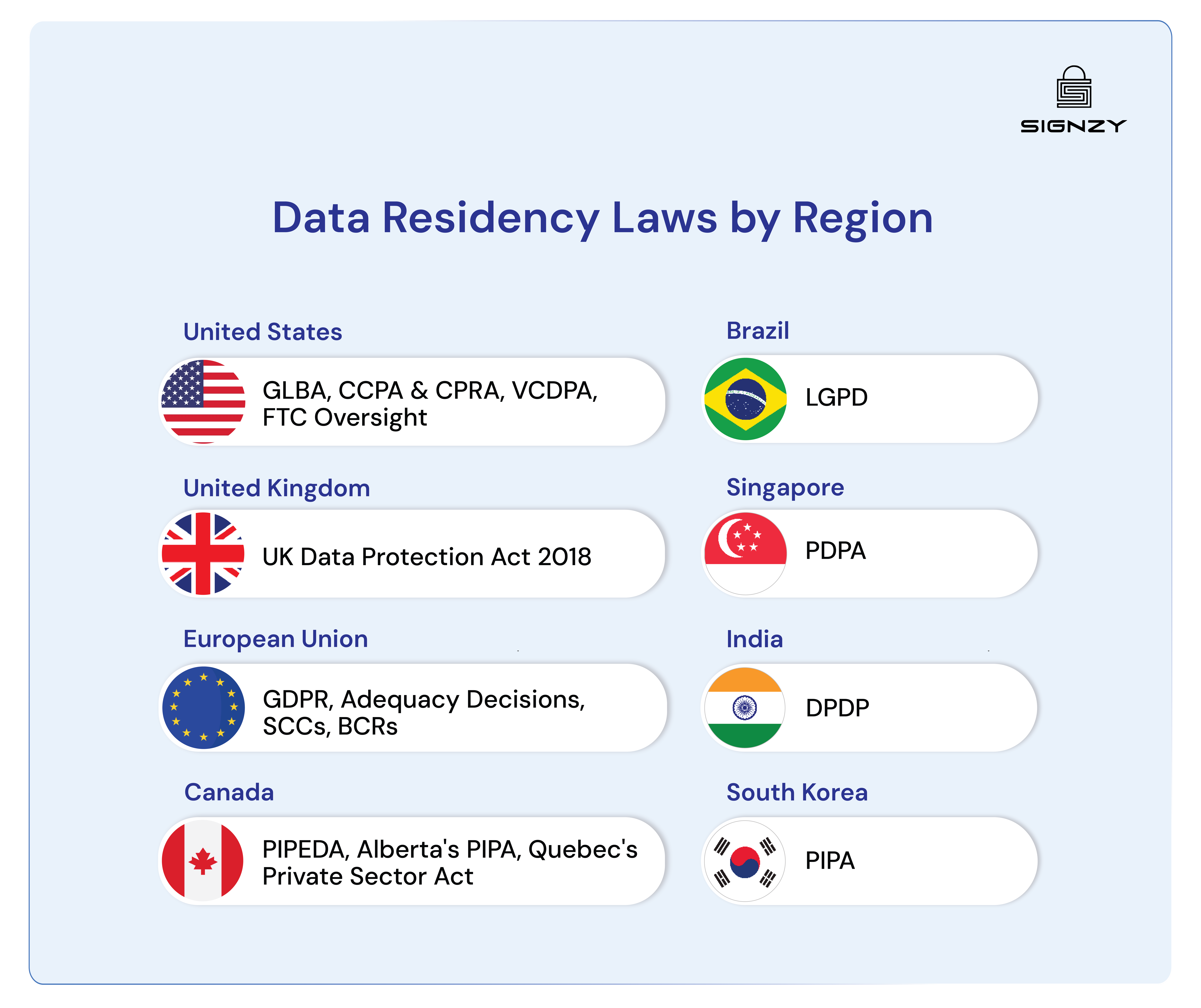
Here’s a quick overview of global data residency laws:
| Region | Laws (Official Docs) | Key Provisions | Caveats |
|---|---|---|---|
| United States | GLBA, CCPA & CPRA, VCDPA, FTC Oversight | Financial institutions must explain data-sharing and allow opt-outs; State laws grant consumer rights for access, deletion, and opt-outs; No federal data localization mandate. | No federal law; compliance varies by industry and state, making regulations complex. |
| United Kingdom | UK Data Protection Act 2018 | Independent adequacy framework for transfers; Requires ICO registration and Data Protection Officers for major processors; No mandatory UK storage. | Post-Brexit, UK follows GDPR principles but has its own adequacy framework. |
| European Union | GDPR, Adequacy Decisions, SCCs, BCRs | Adequacy system for approved countries; Standard Contractual Clauses for non-adequate destinations; No EEA storage mandate but requires adequate protection. | Complex compliance for non-EEA transfers; additional safeguards required; fines up to 4% of global revenue. |
| Canada | PIPEDA, Alberta's PIPA, Quebec's Private Sector Act | Requires equivalent protection for international transfers; Provincial notification requirements; Purpose limitation and consent rules. | No absolute localization but strict cross-border transfer limits; compliance varies by province. |
| India | DPDP Act 2023, RBI Payment Data Rules | Open transfer policy with government blacklist mechanism; Payment data must stay in India; Industry regulators can impose stricter rules. | New law with May 2027 compliance deadline; no countries blacklisted yet; penalties up to INR 250 crore. |
| UAE | Federal Decree Law No. 45/2021 (PDPL) | Approved destination framework; Financial and payment data must be stored locally; Free zones have separate regimes. | Complex landscape with mainland and free zone differences; adequacy list maintained by UAE Data Office. |
| Brazil | LGPD | Requires documentation of storage locations, security compliance, and regular assessments; Similar to GDPR approach. | Modeled after GDPR; mandates detailed documentation and security measures. |
| Singapore | PDPA | Mandates record-keeping, security assessments, and compliance demonstrations. | Businesses must continuously prove compliance with documentation and security checks. |
| South Korea | PIPA | Requires comprehensive documentation, security records, and regular audits of storage facilities. | Strictest in Asia; mandates extensive audits and security checks. |
| China | Cybersecurity Law, PIPL | Mandatory localization for critical infrastructure; Cross-border transfers require security assessments and government approval. | World's strictest requirements; limited exceptions for international transfers. |
| Australia | Privacy Act, Australian Privacy Principles | No mandatory localization; Accountability-based approach; Requires reasonable protection steps regardless of location. | Flexible framework emphasizing safeguards over geography; similar protections or contractual terms needed for overseas transfers. |
Let’s examine how major global markets approach data residency in detail and what specific rules businesses need to follow in each location.
#1. United States’s data residency laws
The United States takes a fragmented approach to data privacy, with different rules applying to specific industries rather than one unified national law.
The Federal Trade Commission oversees privacy enforcement at the federal level, while individual states have started creating their own comprehensive frameworks.
At the federal level, sector-specific regulations dominate the landscape.
What are the United States’ key data residency provisions?
- Financial sector requirements under GLBA: The Gramm-Leach-Bliley Act governs banks, insurance companies, and other financial entities. These organizations must disclose how they share customer information, give people the option to prevent third-party sharing, and maintain robust security programs to protect financial data.
- California's consumer-centric model: California Consumer Privacy Act, strengthened by the California Privacy Rights Act in 2023, gives state residents significant power over their information. People can find out what data companies hold, request deletion of their records, stop businesses from selling their information, and exercise these rights without facing retaliation.
- Virginia's threshold approach: Virginia Consumer Data Protection Act applies selectively based on business size. Companies must meet the law if they handle data from 100,000+ Virginia residents annually, or from 25,000+ residents while earning most revenue from data sales. Covered businesses must assess privacy risks, get clear permission for sensitive data use, and respond to consumer requests within 45 days.
- No federal data localization mandate: Unlike many countries, the US doesn't require businesses to store data within American borders. Information can flow internationally without geographic restrictions at the federal level, though sector regulators may impose specific requirements.
Compliance requirements
Financial institutions must implement comprehensive information security programs under GLBA. State privacy laws require businesses to honor consumer rights requests, conduct privacy assessments for high-risk activities, and maintain reasonable security practices. The FTC can pursue enforcement actions for deceptive privacy practices or inadequate data security, with penalties varying by violation severity and company size.
#2. United Kingdom’s data residency laws
The UK rebuilt its data protection framework after leaving the European Union, creating the UK Data Protection Act 2018. This law maintains GDPR's core principles while establishing Britain's independent regulatory system.
Organizations handling UK resident data must register with the Information Commissioner's Office. Public sector bodies and large-scale data processors typically need dedicated Data Protection Officers to oversee compliance.
What are the United Kingdom’s key data residency provisions?
- Independent adequacy framework: Britain developed its own system for approving international data transfers after Brexit. Companies can freely send data to countries the UK recognizes as providing strong protection. The UK also honors adequacy decisions made before it left the EU.
- Transfer mechanisms for other destinations: Organizations wanting to move data to countries without adequacy status need proper safeguards. This typically means using standard contractual terms, implementing binding corporate rules for multinational groups, or obtaining explicit individual consent with clear risk warnings.
- Special category protections: The framework includes enhanced safeguards for particularly sensitive information and specific provisions governing how law enforcement and intelligence agencies handle data.
- No mandatory UK storage: The law doesn't require data to physically reside on UK servers. Organizations can store information anywhere that meets transfer requirements.
Compliance requirements
Organizations must report serious data breaches to the ICO within 72 hours and keep detailed breach records. The Information Commissioner wields substantial enforcement authority, including issuing fines for non-compliance. Registration with the ICO is mandatory for most data controllers, with annual fees based on organization size and turnover.
#3. European Union’s data residency laws
The European Union's General Data Protection Regulation establishes one of the world's most comprehensive data protection frameworks. While GDPR covers many aspects of privacy, its data residency provisions specifically address where EU resident data can be stored and processed.
Data moves freely within the European Economic Area without restriction. Moving information outside the EEA triggers additional requirements to ensure continued protection.
What are the European Union’s key data residency provisions?
- European Commission adequacy system: The Commission evaluates non-EU countries to determine if their privacy protections match European standards. Organizations can transfer data freely to approved countries without additional safeguards. Countries on this list include Japan, South Korea, the UK, Canada, and several others.
- Standard Contractual Clauses for non-adequate countries: When moving data to countries without adequacy status, companies must implement approved contractual terms. These legally binding agreements ensure the receiving party maintains GDPR-level protections.
- Binding Corporate Rules for multinationals: Large organizations operating across borders can develop internal privacy policies approved by EU regulators. These rules allow data movement within the corporate group while maintaining consistent protections.
- Case-by-case assessments and consent: Organizations can also conduct individual evaluations of specific transfers or obtain explicit consent from people, though consent alone rarely suffices for routine business transfers.
- No EEA storage mandate: GDPR doesn't require data to stay physically within European borders. The focus is on ensuring adequate protection wherever data resides, not on geographic location itself.
Compliance requirements
The practical effect is that many organizations choose EEA-based storage to simplify compliance. Major cloud providers have built European data centers allowing customers to specify exact storage locations.
Organizations must document their transfer mechanisms and be prepared to demonstrate adequate safeguards during regulatory audits. Non-compliance can result in fines up to 4% of global annual revenue.
#4. Canada’s data residency laws
Canada operates a two-tiered privacy system with federal legislation supplemented by provincial laws. This creates varying requirements depending on where businesses operate and which jurisdictions' residents they serve.
The Personal Information Protection and Electronic Documents Act forms the federal foundation for privacy and cross-border data rules.
What are Canada’s key data residency provisions?
- Equivalent protection requirement: PIPEDA restricts international data transfers to countries offering comparable privacy and security safeguards. This limits data flows to nations without comprehensive protection frameworks, particularly affecting transfers to the United States where no federal privacy law exists.
- Purpose limitation and consent: Organizations can only use data for its original collection purpose. Any different use requires getting fresh permission from individuals. This restriction affects data residency decisions since storing data abroad for different purposes needs separate consent.
- Provincial notification requirements: Alberta's Personal Information Protection Act requires businesses to inform people when their data will leave Canada for processing. Quebec's Private Sector Act goes further, mandating privacy assessments and protective measures before any out-of-province transfers.
- No absolute localization mandate: Canadian law doesn't force data to stay within the country. Instead, it requires organizations to ensure adequate protection follows the data wherever it goes.
Compliance requirements
Organizations must obtain meaningful consent before collecting personal information and protect it throughout storage and transmission. When transferring data internationally, businesses need agreements ensuring foreign processors maintain Canadian privacy standards. Provincial requirements add complexity for companies operating across multiple Canadian jurisdictions, requiring different notices and assessments depending on location.
#5. India’s data residency laws
India's Digital Personal Data Protection Act (DPDP), passed in 2023, represents the country's first standalone law focused on personal data protection. Implementation began in November 2025 when the government released the final rules.
Organizations processing digital personal data of people in India must comply, regardless of where the organization is based. This includes foreign companies offering products or services to Indian customers.
What are India’s key data residency provisions?
- Open transfer policy with exceptions: The law doesn't require organizations to keep data inside India. Companies can transfer personal information anywhere in the world unless the government specifically blocks certain countries. This differs from stricter frameworks that require local storage.
- Dynamic restriction mechanism: Indian authorities maintain the power to announce restricted countries at any time. When this happens, sending data to those locations becomes forbidden. The government hasn't published any restricted countries yet.
- Payment industry follows separate rules: Banking regulators impose their own requirements on payment companies. These businesses must keep all transaction records, customer details, and payment information on Indian servers, with no exceptions.
- Short window for overseas processing: Companies can briefly process payment information abroad for tasks like detecting fraud. However, they must erase it from foreign systems and move it back to India within a day.
- Industry regulators set higher bars: Specific sectors like banking, insurance, and telecommunications have their own data storage rules from sector regulators. When these conflict with the DPDP Act, the stricter requirement wins.
Compliance requirements
Large organizations handling significant amounts of data get classified as Significant Data Fiduciaries. These entities face enhanced duties like hiring dedicated privacy officers and running risk assessments.
India's Data Protection Board handles enforcement and can levy fines upto INR 250 crore. Organizations have until May 2027 to achieve full compliance.
💡 Related Blog:

#6. UAE’s data residency laws
The UAE enacted Federal Decree Law No. 45 in 2021, establishing nationwide personal data protection standards. The law took effect in January 2022, though it operates alongside independent frameworks in special economic zones.
Any business handling information about people physically present in the UAE must follow these rules. This includes data about citizens, residents, and even short-term visitors.
What are UAE’s key data residency provisions?
- Approved destination framework: Organizations can only send personal information to countries that UAE regulators have reviewed and approved. The UAE Data Office maintains this list and evaluates whether foreign jurisdictions offer comparable protections.
- Financial institutions face absolute requirements: Banks and other licensed financial entities must house all customer records and transaction monitoring information on servers physically located in the UAE. Moving this data abroad requires permission from the Central Bank plus consent from customers.
- Payment companies must store locally: Businesses running payment systems or card networks must keep payment information in the country for at least five years. Regulators verify compliance through periodic reporting and inspections.
- Economic zones operate independently: Dubai International Financial Centre and Abu Dhabi Global Market run their own privacy regimes modeled after European standards. These zones maintain separate lists of acceptable countries, and moving data between mainland UAE and these zones requires safeguards.
Compliance requirements
Companies must document their data handling practices comprehensively, including where information flows, how long it's kept, and what security controls protect it. The UAE Data Office can request these records for review.
When breaches occur, companies must notify regulators immediately and inform affected people if their privacy faces risk. Fines can reach up to AED 5 million depending on violation severity.
Other regions focusing on data residency
Several other countries have established their own data residency frameworks worth noting:
- Brazil's Lei Geral de Proteção de Dados (LGPD) and Singapore's Personal Data Protection Act (PDPA) share similar approaches. Both laws require organizations to maintain detailed documentation of data storage locations and demonstrate robust security measures. Organizations must prove compliance through clear record-keeping and regular assessments.
- South Korea's Personal Information Protection Act (PIPA) focuses on documentation and security requirements for data storage. PIPA mandates organizations to maintain comprehensive records of their data storage locations and requires regular audits of these facilities to ensure compliance.
- China's Cybersecurity Law and Personal Information Protection Law (PIPL) impose some of the world's strictest data localization requirements. Critical information infrastructure operators must store personal information and important data collected within China on domestic servers. Cross-border transfers require security assessments and, in many cases, government approval. Companies handling large volumes of Chinese citizen data face mandatory local storage with limited exceptions.
- Australia's Privacy Act takes a different approach, not mandating data localization but requiring organizations to take reasonable steps to protect personal information regardless of storage location. When transferring data overseas, businesses must ensure the receiving country has substantially similar privacy protections or put contractual safeguards in place. The Australian Privacy Principles emphasize accountability over geography.
How can Signzy help streamline data residency compliance?
Complying with data residency rules is only part of the challenge. You also need to verify customers securely, no matter where they're located or where their data needs to be stored.
Data residency tells you where information should live. Identity verification tells you whose information you're storing in the first place. Signzy's verification APIs bridge both requirements, letting you confirm customer identities while respecting regional data storage rules.
When your identity verification process accounts for local regulations upfront, managing where data gets stored becomes much easier. Learn more.


FAQ
Q: How is data residency different from data sovereignty?

Q: Can cloud services help with data residency compliance?
What happens if we accidentally store data in the wrong region?
Q: Does data residency affect data backups?
Q: Can we process data in one region but store it in another?
Shivam Agarwal
Shivam heads the go-to-market strategy at Signzy. He holds the CFA charter and a strong background in financial operations, PE analysis and strategy. His prior roles include business strategy and private-equity analysis in the financial services and fintech domain, giving him deep insight into client needs, risk-adjusted economics and monetisation models for compliance & identity verification platforms.

Related Blogs
View all




The best in business


The global API marketplace for KYC, KYB, & AML
Explore the end-to-end verification stack trusted by 1,000 businesses.
Get in touch