




![10 Best KYC Software Providers of 2026 [US Guide]](https://cdn.sanity.io/images/blrzl70g/production/008b1ea8636a5a1febcd10331269d51c5c29090e-3985x933.jpg)


10 Best KYC Software Providers of 2026 [US Guide]
- US businesses need KYC solutions with deep domestic data connections, including credit bureaus, SSN validation, and state DMV systems, rather than platforms optimized for international markets with limited American identity infrastructure depth.
- US businesses spend $61 billion annually on KYC and financial crime compliance, with 79% reporting increased KYC software costs year-over-year. Choosing the right provider directly impacts both compliance effectiveness and cost efficiency.
- KYC providers range from US-focused specialists with deep credit bureau relationships to global platforms covering 200+ countries, with implementation timelines spanning 48 hours to several months and pricing models from transparent per-check fees to custom enterprise contracts.
- Signzy's Gartner-recognized One Touch KYC deploys within 48 hours and completes verification in under 1 minute through parallel processing. It combines modular APIs with no-code workflow configuration for rapid implementation across 150+ countries.
US financial institutions and fintechs now spend a combined $61 billion annually on KYC and financial crime compliance, with 99% of organizations reporting year-over-year cost increases. The US identity verification market alone is valued at over $4 billion in 2025 and is projected to reach $8 billion by 2030, growing at a 13.5% CAGR.
Behind these numbers is a simple reality: every bank, fintech, payment processor, and crypto platform operating in the US must verify customer identities to meet Bank Secrecy Act and USA PATRIOT Act requirements, and the technology they choose determines both their compliance posture and their customer experience.
Choosing a KYC verification provider gets complicated fast. Not because the technology is difficult to understand, but because every platform solves the problem differently. Some built their systems around the US identity infrastructure with deep credit bureau connections. Others prioritized verifying documents from every country. Some bet on speed through parallel processing, others on accuracy through hybrid human review.
This guide looks at 10 providers currently operating in the US market. We've focused on how each platform actually works, what makes it different, and which situations it handles best. You'll find detailed breakdowns of each provider's verification approach and the features that matter most for US compliance.
Whether you're evaluating options for the first time or reconsidering your current setup, the goal is to give you enough context to match solutions to your actual requirements instead of just comparing spec sheets.
Related Solutions
What is the KYC verification solution?
A KYC verification solution is software that automates the process of confirming customer identities to meet regulatory compliance requirements and prevent fraud. These platforms use ID verification, biometric authentication, database checks, and AML screening to validate that customers are who they claim to be during onboarding and throughout the customer lifecycle.
For US businesses, KYC verification is not optional. The Bank Secrecy Act's Customer Identification Program (CIP) requires financial institutions to collect and verify the name, date of birth, address, and identification number of every customer at account opening. The Customer Due Diligence (CDD) rule extends this to identifying beneficial owners of legal entity customers and developing risk profiles for ongoing monitoring.
Modern KYC solutions go well beyond basic document checks. The best platforms combine multiple verification layers: document OCR and forensic analysis, facial recognition and liveness detection, SSN validation, credit bureau cross-referencing, sanctions and PEP screening, adverse media monitoring, and ongoing transaction monitoring. The goal is to verify identity at onboarding and then continuously assess risk throughout the customer lifecycle. For a detailed comparison of how KYC fits within the broader AML compliance framework, see Signzy's AML vs KYC guide.
What to look for in KYC verification solutions? Must-have features for the US environment
The US market runs on a specific identity infrastructure that doesn't exist elsewhere. SSN validation, state-specific driver's licenses, credit bureau integrations, and consortium data create verification pathways unique to America.
Choosing a solution means understanding which capabilities actually support US compliance requirements versus features designed for markets with entirely different identity systems.
🟢 US data source integration
American verification depends on domestic data infrastructure. Solutions need direct connections to US credit bureaus, state DMV systems, SSN verification databases, and mobile carrier data. International platforms often lack depth in US identity data, forcing manual reviews that slow onboarding. Without native US data relationships, verification accuracy drops, and legitimate customers get falsely rejected.
Key data sources for US KYC include:
| Data source | What it verifies | Why it matters |
|---|---|---|
| Credit bureau records (Equifax, Experian, TransUnion) | SSN-name-DOB-address match, credit history | Most comprehensive US identity data source; covers 200M+ consumers |
| SSN verification (eCBSV, credit header, third-party APIs) | SSN ownership, deceased status, issuance date | Primary US identifier; synthetic identity fraud detection depends on SSN depth |
| State DMV records | Driver's license authenticity, address, photo | Available in 41+ states; provides government-issued identity confirmation |
| Mobile carrier data | Phone number ownership, account tenure, SIM swap history | Detects account takeover and SIM swap fraud |
| OFAC/sanctions lists | Sanctions, PEP, adverse media matches | Required under BSA for all financial institutions |
🟢 Regulatory compliance coverage
Federal regulations under the Bank Secrecy Act and USA PATRIOT Act define specific verification requirements. Solutions must support Customer Identification Program compliance, Enhanced Due Diligence protocols, appropriate record retention, and audit trails satisfying examiner requests. State-level regulations add complexity since requirements vary by jurisdiction, requiring platforms that adapt verification based on location.
Key 2026 regulatory developments affecting KYC solutions:
- FinCEN CDD exceptive relief (February 2026): Financial institutions no longer need to re-verify beneficial owners at each new account opening, though initial identification and ongoing monitoring requirements remain.
- Proposed risk-based AML/CFT program rules (April 2026): Federal regulators are codifying risk-based programs with enhanced FinCEN consultation and information-sharing requirements.
🟢 Scalability and performance
Verification systems face unpredictable volume swings from product launches, marketing campaigns, and seasonal patterns. Solutions either scale automatically or become bottlenecks. Key considerations include:
- Processing capacity handling concurrent requests without degradation
- Response time consistency regardless of load
- Infrastructure redundancy prevents verification downtime
- Geographic distribution reduces latency across US regions
- Volume pricing that scales reasonably without cliff effects
Organizations outgrowing their verification platform face expensive migrations.
🟢 Fraud detection capabilities
Document verification catches obvious fakes but misses sophisticated attacks using stolen genuine credentials or synthetic identities. Effective solutions analyze device fingerprints, behavioral patterns, network characteristics, and cross-reference attempts against fraud databases. Real-time risk scoring routes suspicious cases for review while clearing low-risk customers instantly, balancing security with conversion rates.
10 Best KYC verification solution providers of 2026 [US]: How we ranked these and reference table
To compile this comprehensive ranking of KYC providers, our team conducted extensive research analyzing multiple factors, including technical capabilities, integration flexibility, scalability, compliance framework coverage, and more.
Additionally, we incorporated user feedback from multiple sources, including G2 reviews, Reddit discussions, and industry forum conversations, to understand real implementation experiences beyond marketing claims.
We did not conduct direct interviews with the providers; instead, we focused on independent analysis of available information to maintain objectivity in our assessment and recommendations.
| KYC Provider | Description | Key Strength |
|---|---|---|
| Signzy | A full-cycle KYC platform working with 1000+ global clients, including 10+ Fortune 500 companies like Microsoft, Meta, FedEx, Citi, Mastercard, and more. across 240+ countries, with Gartner-recognized One Touch KYC running document verification, face matching, liveness detection, and AML screening in parallel, backed by native US data depth including SSN validation. | One Touch KYC completes verification in seconds through simultaneous multi-layer processing. |
| GBG IDology | North American specialist with 99% US revenue, combining a verification suite with knowledge-based authentication and cross-industry consortium intelligence. | Deep US data relationships with credit bureaus and authoritative American identity sources |
| KYC Hub | Connects to extensive data sources with preset rules for automated decisions, template workflows, and network risk mapping. | Rules-based automation minimizes manual review through standardized decision frameworks. |
| Jumio | Platform supporting 5,000+ document types globally, though implementation complexity and cost structures vary significantly depending on the scope of deployment. | Network intelligence from billions of verifications creates an evolving fraud pattern database. |
| Trulioo | Connects 450+ data sources across 195 countries through a unified API, handling diverse document types with intelligent regional routing. | Normalizes global verification systems into standardized API access across markets |
| Veriff | Supports documents from 230+ countries with a choice between automated or AI-plus-human verification approaches. | Dual verification models allowing choice between pure automation or specialist oversight |
| LexisNexis Risk Solutions | Combines public records expertise with a digital intelligence platform, processing 110 million daily decisions across behavioral biometrics and device analysis. | Merges traditional data with behavioral intelligence for a dual-layer verification approach |
| Shufti Pro | Hybrid verification across 230+ countries, processing diverse document types with zero-shot learning and on-premise deployment options. | Pay-as-you-go pricing at $0.20 per verification with no minimums |
| Persona | Identity infrastructure with a no-code workflow builder and customizable flows emphasizing business user control over verification logic. | Workflow flexibility, allowing non-technical teams to modify verification without developers. |
| Sumsub | Full-cycle platform analyzing behavioral data points with transaction monitoring alongside initial verification, emphasizing lifecycle fraud detection. | Extends protection beyond onboarding with device intelligence and ongoing monitoring |
Let’s now explore all our picks in detail.
1. Signzy
Signzy is a comprehensive KYC and identity verification platform recognized by Gartner's Market Guide for KYC Platforms for Banking 2024 for One Touch KYC innovation. The platform combines document verification, face matching, liveness detection, AML screening, and database checks into a single solution that completes verification in seconds.
What distinguishes Signzy is its modular architecture: organizations can deploy the full end-to-end suite or integrate standalone APIs for specific components like document OCR, address validation, or bank account verification.
“The integration with Signzy was very easy, as an insurtech platform, we are using a couple of API services in our digital platform to smooth the journey, and the data that we got through api are very authentic and correct, and the responses of APIs are quite fast." — Amit S., Product Manager at an enterprise with 1000+ employees, G2 Verified Review.
The system processes up to 1 million queries hourly, covers 190+ countries with 150+ data source integrations, and provides no-code workflow configuration. Implementation typically completes within 48 hours, significantly faster than the 6+ months traditional KYC systems require.
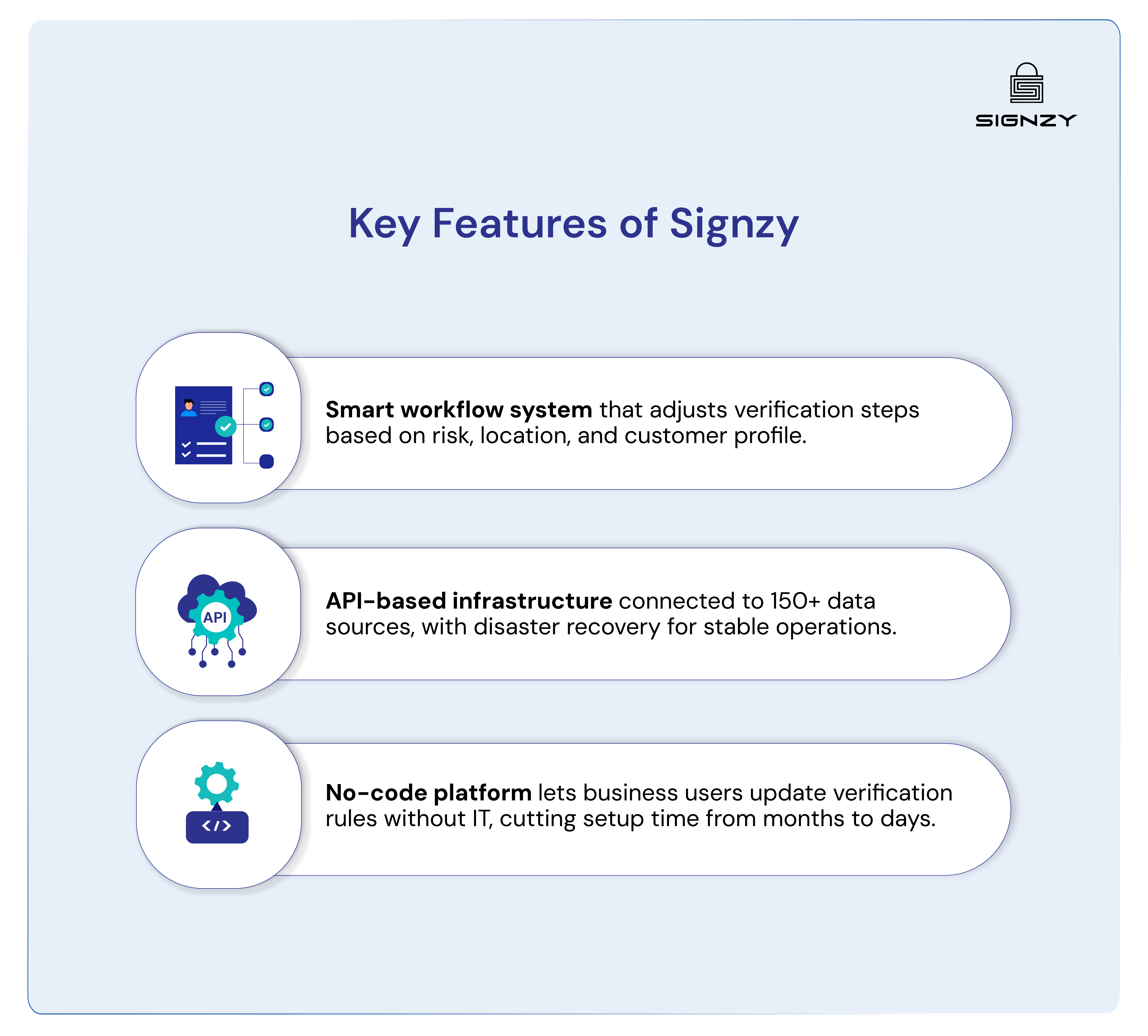
KYC features of Signzy
- One Touch KYC Innovation: Runs multiple verification processes simultaneously rather than sequentially, performing image quality analysis, forgery detection, face matching, OCR extraction, liveness detection, and auto ID classification in parallel to complete full verification in seconds instead of traditional multi-step workflows.
- US Market Verification Tools: Provides driver's license verification across 41 US states, Social Security Number validation through name and date of birth matching, last-4-SSN lookups with phone verification, and Employer Identification Number checks for verification pathways specific to American markets.
- No-Code Workflow Builder: Enables compliance teams to configure verification flows, adjust risk thresholds, and modify onboarding logic through a visual interface without technical resources, reducing implementation from months to weeks and eliminating IT bottlenecks for verification updates.
- Full-Cycle Verification Platform: Connects initial identity verification with ongoing transaction monitoring and account behavior analysis, tracking users from onboarding through their entire activity lifecycle to detect fraud that occurs after accounts are verified.
Signzy pros
✔️ Gartner-recognized One Touch KYC completes full verification in under 30 seconds via parallel processing: Document OCR, face matching, liveness detection, forgery detection, and AML screening run simultaneously rather than sequentially, directly reducing onboarding drop-off versus multi-step linear verification flows.
✔️ 48-hour implementation vs. the industry norm of 6+ months: Modular API architecture and pre-built SDKs allow organizations to go live without extended IT cycles, a material advantage for fintechs with aggressive launch timelines or compliance teams responding to regulatory deadlines.
✔️ No-code workflow builder lets compliance teams modify verification logic without developer involvement: Risk thresholds, fallback pathways, and onboarding steps can be adjusted through a visual interface, removing IT bottlenecks that delay responses to regulatory changes or new product requirements.
✔️ US-specific verification infrastructure including driver's license checks across 41 states and SSN validation: Native connections to American identity data infrastructure reduce false rejections for US customers that commonly occur on platforms built primarily for international markets.
✔️ Full-cycle coverage from KYC onboarding through AML transaction monitoring in one platform: Identity verification, ongoing transaction monitoring, deepfake fraud detection, and mule account scoring are available under a single integration, reducing the vendor count needed to cover the compliance lifecycle.
✔️ Capacity of up to 1 million API queries per hour across 190+ countries: Infrastructure scales to enterprise volumes without per-tier throttling, supporting both high-growth fintechs and large financial institutions processing verifications across multiple geographies concurrently.
Signzy cons
❌ Pricing is not publicly listed: Quote-based commercial model requires a sales engagement before cost evaluation is possible, which creates friction for early-stage companies or procurement teams running competitive RFPs.
❌ Human review fallback capacity is not independently benchmarked: Platforms like Veriff and iDenfy publish specific SLAs and staffing details for their hybrid human-in-the-loop review models. Signzy does not publicly document equivalent reviewer capacity or turnaround commitments for edge cases.
❌ Network intelligence from cross-industry fraud pattern databases is less mature than Jumio or LexisNexis: Jumio's 1 billion+ verification history and LexisNexis's 78 billion annual transaction dataset create fraud signal depth that a newer platform cannot yet replicate at the same scale.
2. GBG IDology
GBG IDology operates exclusively in the North American identity verification market, with 99% of its revenue coming from US customers. UK-based GBG acquired the company for $300 million in 2019, adding 15 years of US-focused identity verification expertise to its global portfolio.
KYC features of GBG IDology
- ExpectID Verification System: Combines document authentication, database checks, and consortium data into a single verification workflow, with configurable confidence thresholds that let you apply different verification standards for different customer types while maintaining complete audit trails for compliance documentation.
- Dynamic Knowledge-Based Authentication: Generates verification questions based on authenticated data from sources including credit history, previous addresses, and financial relationships, creating challenges that require information not typically available through data breaches or public records.
GBG IDology pros
✔️ 99% US revenue concentration reflects deep domestic identity data infrastructure: Direct relationships with US credit bureaus, state DMV systems, and authoritative American data sources produce higher match rates for US customers than international platforms with shallow domestic data connections.
✔️ Dynamic Knowledge-Based Authentication uses authenticated financial and address history: KBA questions draw from credit history, previous addresses, and financial relationships rather than publicly available data, creating verification challenges that remain effective even after common data breach exposures.
✔️ ExpectID combines document authentication, database checks, and consortium data in one workflow: Multi-source verification with configurable confidence thresholds supports tiered verification standards across different customer risk profiles while maintaining complete audit trails for compliance documentation.
✔️ 15+ years of North American compliance market experience: Long track record with US financial institutions reduces vendor due diligence friction and provides implementation credibility that newer platforms cannot offer to conservative regulated buyers.
GBG IDology cons
❌ Exclusively North American focus with no meaningful international coverage: Organizations with any non-US verification requirements cannot consolidate on GBG IDology and must maintain separate vendors for international customers, adding cost and integration complexity.
❌ Limited self-service workflow configuration for compliance teams: Adjusting verification logic typically requires engagement with GBG's implementation team rather than being configurable through a no-code dashboard, slowing compliance teams' ability to respond to regulatory changes independently.
❌ Smaller global footprint relative to parent company GBG's broader product portfolio: Despite GBG's international presence, IDology's US-only capabilities mean organizations cannot leverage a single vendor relationship for both domestic and international verification needs.
❌ Less emphasis on post-onboarding lifecycle fraud detection: The platform's strength is initial identity verification. Organizations requiring integrated ongoing transaction monitoring or account behavior analysis after onboarding need supplementary solutions.
3. KYC Hub
KYC Hub positions itself around automation and rules-based processing, connecting to over 100,000 global data sources, including direct corporate registry integrations. Organizations can configure risk thresholds, set up conditional verification paths, and automate approval or rejection decisions based on criteria they define.
The system combines document verification, database checks, face matching, adverse media monitoring, and ongoing risk scoring into workflows that compliance teams can build and modify through visual interfaces.
KYC features of KYC Hub
- Template-Based Workflow System: Provides pre-built verification templates and visual workflow builders, allowing compliance teams to create custom processes, define conditional logic, set risk thresholds, and automate routing decisions without technical implementation or developer resources.
- Adverse Media Monitoring: Searches media sources for negative news, regulatory actions, criminal proceedings, and reputational risks associated with customers or beneficial owners, flagging compliance concerns that don't appear in standard watchlist or sanctions databases.
Biometric Face Verification: Analyzes 50+ facial data points to compare selfies against ID document photos, performing biometric verification to confirm the person presenting identification matches the document holder, with liveness checks to prevent photo-based spoofing.
What are the top use cases of KYC verification solutions?
KYC verification supports industries where linking digital accounts to real identities satisfies regulations, prevents fraud, or establishes operational trust. Use cases span from heavily regulated financial services to platforms simply wanting confidence that users are who they claim to be.
👉 Financial Services and Banking: Banks and neobanks verify customers during account opening to meet Bank Secrecy Act requirements, screen against sanctions lists, detect synthetic identities, and enable digital onboarding without branch visits while satisfying Customer Identification Program obligations.
👉 Fintech and Digital Payments: Payment platforms verify users to comply with money transmission regulations, prevent account takeovers, screen against sanctions, satisfy banking partner requirements, and maintain frictionless signup experiences that customers expect from digital services.
👉 Cryptocurrency and Digital Assets: Crypto exchanges verify traders to meet evolving AML regulations, prevent illicit transactions, screen sanctions lists, maintain banking relationships, and implement Enhanced Due Diligence for high-value transactions across varying jurisdictional requirements.
👉 Online Gaming and Gambling: Gaming platforms verify players to comply with gambling regulations, confirm legal age requirements, prevent self-excluded gamblers from bypassing restrictions, detect bonus abuse, and identify multi-accounting that threatens platform integrity.
KYC Hub pros
✔️ Rules-based automation with configurable thresholds minimizes manual review volume: Compliance teams can define conditional logic, set risk thresholds, and automate approval or rejection decisions based on their own criteria, reducing operational overhead in high-volume onboarding environments.
✔️ 100,000+ global data sources including direct corporate registry integrations: Extensive data source connectivity supports both individual KYC and business KYB verification through a single platform, reducing the number of point solutions needed in the compliance stack.
✔️ Template-based workflow system allows non-technical teams to deploy pre-built verification flows: Pre-configured templates for common compliance use cases reduce implementation time and allow compliance teams to launch verification programs without building flows from scratch.
✔️ Adverse media monitoring searches regulatory actions, criminal proceedings, and reputational risks: Negative news screening surfaces compliance concerns that do not appear in standard sanctions or watchlist databases, supporting enhanced due diligence obligations for higher-risk customers.
KYC Hub cons
❌ Less brand recognition and market presence than enterprise-grade incumbents: KYC Hub is a newer, smaller platform, which may extend vendor approval timelines for regulated financial institutions with formal security and compliance vetting processes.
❌ Rules-based decisioning requires careful initial configuration to avoid high false-positive rates: Poorly calibrated thresholds can produce excessive manual review queues or incorrectly decline legitimate customers, requiring ongoing tuning that demands compliance team attention and operational resources.
❌ Biometric and liveness detection capability is less mature than dedicated identity verification specialists: The facial data point analysis and liveness checking described in the platform may not match the accuracy benchmarks of purpose-built biometric verification platforms like Jumio or Veriff.
❌ Limited publicly available performance benchmarks or independent audit data: Compliance teams evaluating the platform for regulated use cases have less third-party validation data available compared to Gartner-recognized vendors or platforms with published accuracy statistics.
4. Jumio
Jumio processes identity verification through a platform that has handled over 1 billion verifications since its 2010 founding in Palo Alto. The system recognizes 5,000+ ID templates from 200+ countries and territories, supporting verification in 140+ languages. Jumio's approach centers on continuous verification rather than point-in-time checks, building what it calls an Identity Graph with 30 million+ identities that tracks verification patterns and fraud signals across the customer lifecycle.
KYC features of Jumio
- Document Intelligence System: Analyzes 5,000+ ID types by examining visible and non-visible security features, including holograms, watermarks, microprinting, and UV elements, with automated extraction of machine-readable zones and detection of alterations like hole punches that indicate cancelled documents.
- Network Intelligence Engine: Correlates verification patterns across industries through data from billions of processed transactions, identifying emerging fraud methodologies and attack patterns by analyzing connections between verification attempts, device fingerprints, and behavioral signals.
- Jumio Identity Graph: Connects 30 million+ verified identities with consent-based data from both legitimate users and known fraudsters, revealing patterns and relationships that single-transaction analysis misses by providing context from previous verifications and cross-customer connections.
Jumio pros
✔️ 5,000+ ID type recognition from 200+ countries with certified liveness detection: Extensive document template library reduces false rejections for international customers presenting non-standard or regional identity documents, directly improving global onboarding conversion rates.
✔️ Identity Graph tracking 30 million+ verified identities across the customer lifecycle: Consent-based cross-customer data reveals fraud patterns and identity reuse that single-transaction analysis cannot detect, providing risk context from prior verifications across industries.
✔️ Network intelligence from 1 billion+ processed verifications creates an evolving fraud signal database: Historical transaction data at this scale enables detection of emerging fraud methodologies before they become widespread, giving compliance teams earlier visibility into new attack patterns.
✔️ Automated detection of physical document security features including holograms and UV elements: Analysis of both visible and non-visible security features reduces reliance on human review for document authenticity checks, maintaining accuracy at scale across high-volume onboarding.
✔️ 140+ language support across verification flows: Broad language coverage reduces friction for non-English speaking customers during document capture and verification, supporting global product expansion without separate regional verification implementations.
Jumio cons
❌ Premium pricing positions it out of reach for smaller organizations: Enterprise-grade pricing with volume commitments makes Jumio economically unsuitable for early-stage fintechs or low-volume compliance programs where per-verification costs need to be predictable and low.
❌ Complex setup and integration timeline: Enterprise deployments with full Identity Graph and network intelligence configuration typically require extended implementation periods, making it a poor fit for organizations needing rapid go-live timelines.
❌ Less flexibility for non-technical compliance teams to modify workflows: Adjusting verification logic or risk thresholds typically requires developer involvement, creating bottlenecks for compliance teams that need to iterate quickly on onboarding rules.
❌ Overkill for organizations with primarily domestic US customer bases: The breadth of global document coverage and network intelligence infrastructure adds cost and complexity that organizations verifying predominantly US identity credentials may not need.
5. Trulioo
Trulioo operates a verification platform called GlobalGateway that connects to 450+ data sources across 195 countries, covering 5 billion people and 700 million business entities. The company positions itself as a normalization layer for global identity verification, providing standardized API access to heterogeneous verification methods that vary significantly across different markets. Trulioo supports 14,000+ document types and verification in 43 languages through a single integration. However, a verified user noted:
"Trulioo attempts to provide services for many countries, but it feels like they overextend to provide quantity, not quality, and thus, many regions they attempt to service for identity verification result in consistently poor match rates. Also, it does not have the functionality to conduct ongoing list screening." — Paulo D. on G2.
These concerns about verification accuracy in certain regions and missing ongoing monitoring capabilities highlight potential gaps.
✔️ Signzy addresses both issues with proven match rates across 190+ countries and built-in ongoing monitoring features through their AML transaction detection system.
KYC features of Trulioo
- Person Match Algorithm: Handles name variations, transliterations, and formatting differences across languages and cultural naming conventions, matching identity information despite inconsistencies in how names appear across different databases and document types.
- Modular Verification Architecture: Combines data verification, document verification, fraud intelligence, and electronic identification into configurable workflows, allowing layered verification approaches that adapt to specific risk scenarios, compliance requirements, or regional constraints.
- Regional Match Rate Optimization: Applies market-specific verification strategies based on local identity infrastructure, adjusting verification methods for emerging markets with limited digital records, established markets with comprehensive databases, and everything in between.
Trulioo pros
✔️ 450+ data sources across 195 countries through a single unified API: One integration provides access to a globally normalized verification layer, eliminating the need to build and maintain separate regional vendor integrations as organizations expand into new markets.
✔️ 14,000+ document types supported across 43 languages: Broad document coverage handles diverse identity credential formats including emerging market documents that more narrowly focused platforms frequently cannot process accurately.
✔️ Person Match algorithm handles name variations and transliterations across cultures: Intelligent name matching across different cultural naming conventions and language scripts reduces false rejections that occur when identity data inconsistencies exist across documents and databases.
✔️ Modular architecture combines data verification, document verification, and fraud intelligence: Layered verification approaches can be configured for specific risk scenarios or regional compliance requirements without rebuilding the integration.
Trulioo cons
❌ Inconsistent match rates across regions, particularly in markets with limited digital identity infrastructure: Verified user feedback on G2 notes that regional coverage quality varies significantly, with some markets producing poor verification outcomes despite being listed as supported.
❌ No built-in ongoing list screening or transaction monitoring: The platform handles initial identity verification but does not support continuous AML monitoring or post-onboarding watchlist rescreening, requiring organizations to source a separate solution for lifecycle compliance.
❌ Country coverage breadth does not consistently translate to verification quality: A large number of supported markets is a marketing strength but real-world accuracy in lower-priority markets may be insufficient for regulated institutions with stringent false-rejection thresholds.
❌ Enterprise pricing with limited transparency: Custom pricing based on volume and market configuration makes cost comparison difficult during vendor evaluation, and costs can escalate significantly when verifying across multiple high-complexity jurisdictions.
6. Veriff
Veriff supports 12,000+ government-issued documents from 230+ countries and territories, with verification flows available in 48 languages. The Estonian company takes a distinctive approach by offering customers a choice: fully automated AI processing for speed and cost efficiency, or a hybrid model where algorithms handle routine cases while trained specialists review edge cases. This flexibility lets organizations decide whether they prioritize pure automation or want human oversight for complex situations.
KYC features of Veriff
- Dual Verification Architecture: Offers both fully automated AI-driven processing and hybrid verification where edge cases route to human specialists, letting organizations choose their balance between maximum speed and enhanced accuracy based on industry requirements and risk tolerance.
- Assisted Image Capture: Guides users through document and selfie capture with real-time feedback, automatically identifying document types and notifying users immediately about image quality issues like blur, glare, or framing problems to reduce failed attempts and resubmissions.
- Video Session Recording: Captures background video during verification sessions as an optional security layer, providing additional context for fraud investigation and manual review cases by recording the environment and user behavior throughout the verification process.
Veriff pros
✔️ Dual verification architecture offers choice between fully automated AI and hybrid human-specialist review: Organizations can select pure automation for speed and cost efficiency or route edge cases to trained specialists, allowing risk tolerance and industry requirements to drive the model rather than vendor defaults.
✔️ 12,000+ government-issued documents from 230+ countries in 48 languages: Wide document coverage reduces drop-off for international users encountering verification flows that cannot recognize their identity credentials, supporting global onboarding without regional gaps.
✔️ Assisted image capture with real-time user feedback reduces failed attempts and resubmissions: Automatic document type detection and instant notifications about blur, glare, or framing issues during capture guide users to successful submissions on the first attempt, improving conversion rates.
✔️ Video session recording as an optional security layer for high-assurance scenarios: Background video capture during verification provides additional context for fraud investigation and manual review, giving compliance teams richer evidence for dispute resolution or regulatory examination.
Veriff cons
❌ Pure automation model sacrifices accuracy on edge cases compared to deeper human-in-the-loop platforms: Organizations that choose the fully automated track trade accuracy on complex or unusual document scenarios for speed, which may increase false rejection rates in markets with non-standard ID formats.
❌ Pricing scales quickly for organizations needing hybrid human review at volume: The specialist review model adds cost per verification that compounds significantly at enterprise volumes, making total cost of ownership less predictable than flat-rate automation-only platforms.
❌ Limited US-specific identity data layer beyond document verification: Veriff's strength is document and biometric verification. Native integration with US credit bureaus, SSN validation, or state DMV systems for database-layer identity confirmation is not a primary capability.
❌ Less robust post-onboarding monitoring and lifecycle fraud detection compared to Sumsub or Signzy: The platform focuses on the onboarding verification event. Organizations requiring continuous AML monitoring or transaction-level fraud detection after account creation need supplementary solutions.
7. LexisNexis Risk Solutions
LexisNexis Risk Solutions operates identity verification through its ThreatMetrix platform, which processes 110 million authentication decisions daily across 1.4 billion tokenized digital identities. The company applies its background in public records and legal data to identity verification, combining physical identity information with digital behavior analysis through device fingerprinting, network pattern recognition, and transaction monitoring.
KYC features of LexisNexis Risk Solutions
- ThreatMetrix Digital Identity Platform: Examines device fingerprints, network characteristics, and behavioral signals in real time, analyzing over 1,000 data points per transaction to assess risk based on patterns collected across billions of global transactions beyond standard document verification.
- Behavioral Biometrics Through BehavioSec: Captures typing patterns, mouse movements, device orientation, and navigation behaviors to create behavioral profiles, detecting situations where legitimate credentials are being used by unauthorized individuals.
- Digital Identity Network: Aggregates transaction intelligence from 78 billion annual transactions across financial services, e-commerce, telecommunications, and gaming sectors, identifying fraud patterns that span multiple industries through shared anonymized data.
LexisNexis Risk Solutions pros
✔️ ThreatMetrix analyzes 1,000+ data points per transaction across device fingerprint, network, and behavioral signals: Multi-dimensional real-time risk scoring goes substantially beyond document verification, flagging sophisticated fraud attempts that use legitimate credentials or clean devices.
✔️ 110 million daily authentication decisions across 1.4 billion tokenized digital identities: Massive transaction volume creates network intelligence that improves fraud detection accuracy over time, with each decision contributing to pattern recognition that benefits all clients in the network.
✔️ BehavioSec captures typing patterns, mouse movements, and device orientation to create behavioral profiles: Behavioral biometrics detect unauthorized use of legitimate credentials, addressing account takeover scenarios that evade standard identity verification entirely.
✔️ 78 billion annual transactions across financial services, e-commerce, telecom, and gaming create cross-industry fraud signal visibility: Multi-sector data sharing surfaces fraud patterns that originate in one industry and migrate to another, providing earlier detection than single-industry platforms.
LexisNexis Risk Solutions cons
❌ Implementation complexity is significant for organizations without dedicated compliance engineering teams: The depth of ThreatMetrix configuration, behavioral biometric integration, and data network connectivity requires substantial technical resources to deploy and tune effectively.
❌ Enterprise pricing reflects the platform's institutional positioning: LexisNexis Risk Solutions is priced for large financial institutions and enterprise clients. The cost structure is prohibitive for mid-market fintechs or organizations with moderate verification volumes.
❌ Primary strength is fraud intelligence rather than document verification breadth: Organizations requiring extensive international document type recognition or global registry coverage may find LexisNexis's document verification layer less comprehensive than Jumio or Trulioo.
❌ Behavioral biometrics require session data accumulation before profiles mature: New customer accounts generate limited behavioral data, meaning the full accuracy benefit of BehavioSec only materializes after users have interacted with the platform across multiple sessions.
8. Shufti Pro
Shufti Pro verifies identities across 230+ countries, processing 3,000+ document types in over 150 languages. Founded in 2017, the platform combines automated AI processing with human review fallback, particularly for unusual document formats or damaged IDs. Verification typically completes within 15-60 seconds, and the company offers an on-premise deployment option for organizations with strict data residency requirements.
KYC features of Shufti Pro
- Hybrid AI and Human Review: Routes standard verification requests through automated processing while directing complex cases, unusual document formats, damaged IDs, and edge scenarios to human reviewers, maintaining accuracy across diverse document conditions and quality levels.
- Electronic Identity Verification: Performs database checks across 60+ markets using layered verification logic, cross-referencing names, ID numbers, phone numbers, and addresses against multiple authoritative databases to validate identity information without requiring document uploads.
Shufti Pro pros
✔️ Transparent pay-as-you-go pricing at $0.20 per verification with no minimums: Published per-verification pricing without volume commitments or minimum monthly fees makes cost forecasting straightforward and accessible for organizations at any stage of growth.
✔️ Hybrid AI plus human review across 230+ countries processing 3,000+ document types: Automated processing handles standard cases while human reviewers cover unusual document formats, damaged IDs, and edge scenarios, maintaining accuracy across diverse real-world document conditions.
✔️ On-premise deployment option for strict data residency requirements: Organizations in jurisdictions with data sovereignty regulations or internal policies prohibiting cloud data transfer can deploy Shufti Pro infrastructure within their own environment, a capability few competitors offer.
✔️ Electronic identity verification across 60+ markets without requiring document uploads: Database-layer verification using layered name, ID number, phone, and address cross-referencing reduces friction for customers in markets with high-quality digital identity databases.
Shufti Pro cons
❌ Less established enterprise compliance track record than larger incumbents: Organizations with formal vendor due diligence processes for regulated institutions may find Shufti Pro's compliance pedigree and reference customer base less robust than platforms like Jumio or LexisNexis.
❌ US-specific identity data depth is limited relative to domestic specialists: Native connections to US credit bureaus, SSN validation, and state DMV systems are less deep than platforms purpose-built for the American identity infrastructure.
❌ Verification accuracy on edge cases may require more human review escalations: At $0.20 per verification, the low base price may reflect lower automation accuracy on complex or non-standard documents relative to premium AI platforms, potentially increasing manual review costs at scale.
❌ Limited post-onboarding lifecycle monitoring capabilities: The platform focuses primarily on point-in-time identity verification. Ongoing transaction monitoring, continuous AML rescreening, and behavioral fraud detection require integration with separate solutions.
9. Persona (WithPersona)
Persona approaches identity verification as an infrastructure problem rather than a compliance checkbox. The San Francisco company built a platform where business users can design verification workflows through drag-and-drop editors without writing code. This matters because compliance requirements change constantly, and waiting for developer resources to update verification logic creates bottlenecks.
Persona supports government ID verification, biometric checks, database lookups, and watchlist screening, but the real differentiator is how everything connects through customizable workflows and automated decision rules. However, Nilesh N., CTO at an enterprise company, shared concerns on G2:
"OpenAI is using it for verification, 3 people on my team tried verifying with 5 IDs each, and it simply would not work.” — CTO, enterprise company (1000+ employees).
This suggests potential reliability issues during the verification process that could frustrate end users and impact conversion rates.
KYC features of Persona
- No-Code Workflow Builder: Provides a drag-and-drop interface for creating verification workflows that trigger based on events, ingest data from multiple sources, apply custom business logic, and execute follow-up actions across Persona and external systems without requiring developer involvement.
- Modular Verification Library: Offers government ID checks, selfie verification with liveness detection, database lookups, watchlist screening, phone and email verification, and document upload with OCR that can be mixed and matched per use case and risk profile.
- Cross-Linking Detection: Identifies connections between users by analyzing shared devices, network patterns, behavioral similarities, and data correlations to detect fraud rings, multi-accounting schemes, and coordinated abuse before accounts are approved.
Persona (WithPersona) pros
✔️ No-code drag-and-drop workflow builder designed for non-technical business users: Compliance and product teams can create, modify, and deploy verification flows without engineering support, enabling rapid iteration on onboarding logic without sprint backlogs.
✔️ Cross-linking detection identifies fraud rings through shared device and behavioral signals: Connections between accounts based on shared devices, network patterns, and behavioral similarities are surfaced automatically, catching coordinated multi-accounting and fraud ring behavior before accounts are approved.
✔️ Modular verification library allows mix-and-match per risk profile: Government ID checks, selfie liveness, database lookups, watchlist screening, phone verification, and document OCR can be selectively combined per customer segment or product line without building separate verification pipelines.
✔️ Strong adoption among high-profile US technology platforms: Deployment at companies like OpenAI signals developer-friendly APIs and technical reliability at scale for US-focused digital products.
Persona (WithPersona) cons
❌ Documented verification failures at enterprise scale reported on G2: A CTO at an enterprise company noted that 3 team members each tried verifying with 5 IDs and the system would not complete verification, indicating potential reliability issues that could directly impact onboarding conversion rates.
❌ Limited out-of-the-box AML and transaction monitoring capability: Persona is primarily an identity verification and workflow platform. Organizations needing integrated ongoing AML screening or post-onboarding transaction monitoring require additional vendors.
❌ Pricing scales steeply at higher verification volumes: Per-verification pricing that is manageable at startup scale can become a significant cost driver for enterprises processing hundreds of thousands of monthly verifications without volume discount clarity.
❌ Narrower global document coverage than specialists like Jumio or Trulioo: While Persona supports international use cases, its document recognition breadth across emerging market document types is less extensive than platforms purpose-built for global verification.
10. Sumsub
Sumsub provides identity verification with particular emphasis on the full customer lifecycle rather than just onboarding. According to Sumsub's internal data, 76% of fraud attempts occur after initial verification, which shapes its product focus on transaction monitoring and ongoing fraud prevention alongside initial KYC checks.
KYC features of Sumsub
- Device Intelligence Integration: Partners with Fingerprint to analyze device behavior and network-level data beyond basic IP tracking, detecting VPN usage, incognito mode, developer tools, remote access software, and other signals that indicate suspicious device usage or spoofing attempts.
- Reusable KYC System: Allows verified users to share their verification status across platforms and services with consent, reducing repeated verification friction for users while maintaining compliance standards through shared verification tokens.
- Deepfake and Synthetic Identity Detection: Applies AI algorithms trained on known synthetic identity patterns and deepfake characteristics, analyzing facial features, document consistency, and behavioral signals to identify AI-generated or manipulated identity materials.
Sumsub pros
✔️ Full-lifecycle fraud detection extending beyond initial onboarding: Sumsub's internal research indicates 76% of fraud attempts occur after initial verification, and the platform addresses this with device intelligence, transaction monitoring, and ongoing behavioral analysis throughout the customer lifecycle.
✔️ Fingerprint-powered device intelligence detects VPN, incognito mode, and remote access spoofing: Partnership with Fingerprint enables analysis of network-level and device behavior signals beyond basic IP tracking, catching sophisticated spoofing attempts that evade standard document verification.
✔️ Reusable KYC tokens reduce repeat verification friction across platforms: Verified users can share their verification status across services with consent, improving user experience in ecosystems where customers interact with multiple products.
✔️ Deepfake and synthetic identity detection trained on known AI-generated patterns: AI models analyze facial features, document consistency, and behavioral signals specifically to identify AI-generated or manipulated identity materials, addressing an increasingly common fraud vector.
✔️ Coverage across 220+ countries with 140,000+ proofs processed daily: High-throughput infrastructure supports global enterprise volumes across diverse document types and jurisdictions within a single platform integration.
Sumsub cons
❌ Higher pricing compared to mid-market alternatives: Enterprise-tier pricing with feature-based add-ons makes Sumsub less accessible for early-stage companies or organizations with limited monthly verification volumes.
❌ Limited manual review options relative to platforms with dedicated human review teams: Organizations handling complex edge cases or high-assurance regulated scenarios may find fully automated workflows insufficient without a robust human-in-the-loop fallback.
❌ Implementation complexity increases with customization depth: Highly configurable workflows require more significant technical investment to set up correctly, which can extend go-live timelines for teams without dedicated compliance engineering resources.
❌ US-specific identity data depth is thinner than domestic specialists: Sumsub's strength is global coverage breadth. Organizations primarily serving US customers with credit bureau checks, SSN validation, and DMV data needs may find domestic-focused platforms more accurate.
How to pick the best KYC verification solution provider?
Selecting a KYC provider is ultimately a decision about matching your organization's specific requirements to a platform's actual capabilities, not its marketing claims. Here's a practical evaluation framework:
| Evaluation criteria | What to assess | Questions to ask |
|---|---|---|
| US data depth | Credit bureau connections, SSN validation, state DMV access | Does the platform connect natively to US credit bureaus, or does it rely solely on document verification? |
| Compliance coverage | CIP, CDD, EDD, BSA, PATRIOT Act support | Does the platform support the full AML compliance lifecycle, including ongoing monitoring and SAR workflows? |
| Implementation timeline | Time from contract to production | Can you go live in days/weeks, or does implementation require months of engineering work? |
| Workflow flexibility | No-code vs. developer-required changes | Can compliance teams modify verification logic independently, or does every change require a developer? |
| Total cost of ownership | Per-check pricing, volume tiers, hidden fees | What is the all-in cost at your projected volume, including integration, support, and any minimum commitments? |
| Fraud detection depth | Beyond document verification | Does the platform detect synthetic identities, device fraud, and behavioral anomalies, or only verify documents? |
| Ongoing monitoring | Post-onboarding capabilities | Does the platform support continuous AML screening, transaction monitoring, and event-driven reviews? |
| Scalability | Volume handling and pricing structure | What happens to performance and pricing when verification volume doubles or triples? |
↪ Match verification methods to your customer base. If you're serving US customers primarily, prioritize platforms with direct connections to American credit bureaus, SSN validation, and state DMV systems. Global document recognition matters less than domestic data depth when most of your users hold US identity credentials and expect instant verification.
↪ Evaluate implementation timelines and verification speed. Implementation timelines vary significantly across providers. Signzy deploys within 48 hours, with verification results returning in under 30 seconds once live, while other platforms may require weeks or months for integration. Consider whether your launch timeline, developer availability, and business urgency support extended implementation periods or require rapid deployment.
↪ Understand total cost beyond per-verification pricing. Ask vendors specifically about charges for failed verifications, manual review cases, premium verification methods, and minimum monthly commitments. A lower per-verification rate becomes expensive when hidden costs emerge, while transparent pricing models let you accurately forecast expenses as volume scales.
↪ Assess flexibility for changing compliance requirements. Regulations evolve, and your verification needs will change as you enter new markets or launch different products. Evaluate whether compliance teams can modify verification rules without developer involvement, how quickly vendors adapt to new regulations, and whether the architecture supports adding verification methods as requirements expand.
How to get started with Signzy
Signzy's implementation process prioritizes speed without sacrificing customization.
“As a neobank, we’d been struggling with a verification flow that was slow and costly. Switching to Signzy made a noticeable difference. Drop-offs went down more than 30%, and we brought down our operational costs by almost 40%. But honestly, the best part was working with their team - they jumped in with recommendations and helped us smooth out the rough edges.”
The platform's modular architecture and API-first design let you deploy verification capabilities quickly while maintaining control over workflow configuration and integration depth.
- Schedule a demo to discuss your verification requirements, compliance obligations, target markets, and integration preferences. The team helps identify which verification components match your needs, whether that's the full KYC suite or standalone APIs for specific functions.
- Receive sandbox environment access with API keys, comprehensive technical documentation, and integration guides.
- Test verification flows with sample data to understand response formats, error handling, and webhook configurations before production deployment.
- Set up conditional logic, define fallback pathways, and customize verification steps without developer involvement.
- Connect Signzy's APIs to your authentication flow, onboarding process, or main compliance system using the provided SDKs for mobile platforms or REST API endpoints for backend integration.
- Move to live verification with real customer data, typically within 48 hours of starting integration.
- Monitor verification performance through the dashboard, adjust workflows based on pass rates, and scale capacity as volume grows without infrastructure changes.
Schedule a demo here to discuss your compliance needs and see Signzy's verification platform in action.
FAQ
How much do KYC solutions typically cost?

Can KYC solutions be integrated with existing business systems?
What documentation do businesses need to prepare before implementing KYC?
How do KYC solutions impact customer experience?
What is the difference between KYC and KYB?
What are the penalties for KYC non-compliance in the US?
How is AI changing KYC verification in 2026?
Can one KYC platform handle both US and international verification?
Spread the knowledge!
Found this useful ? Share what you learned!



Saurin Parikh
Saurin is a Sales & Growth Leader at Signzy with deep expertise in digital onboarding, KYC/KYB, crypto compliance, and RegTech. With over a decade of professional experience across sales, strategy, and operations, he’s known for driving global expansions, building strategic partnerships, and leading cross-functional teams to scale secure, AI-powered fintech infrastructure.




![10 Best SSN Verification Services: Features Compared [2026]](https://cdn.sanity.io/images/blrzl70g/production/48620bfb8e6520ba651a76bd880b2fd9b5400d1e-1366x320.webp)