





Signzy's Gold Loan Compliance Firewall: Automate RBI LTV Enforcement

By Madhu Srinivas
 Open in ChatGPT
Key Highlights
- RBI's new gold loan directions take effect April 1, 2026, introducing standardized documentation, tiered LTV limits, photo-linked valuations, dual eSignatures, end-use verification, and strict collateral return timelines with financial penalties for non-compliance.
- Manual compliance processes fail at scale due to documentation inconsistencies across branches, LTV calculation errors, fragmented audit trails, and the inability to enforce end-use verification, creating regulatory exposure during inspections.
- Signzy's compliance firewall automates enforcement by blocking non-compliant loans at origination, ensuring standardized templates, automatic LTV calculations, tamper-proof audit trails, and mandatory checkpoints.
On June 6, 2025, the Reserve Bank of India issued comprehensive directions for lending against gold and silver collateral, changing how these loans must be originated, documented, and managed.
The compliance deadline is April 1, 2026, and it applies to all regulated entities: commercial banks, NBFCs, housing finance companies, and cooperative banks.
Recent data shows the gold loan market has surged noticeably, with 71.3% year-on-year growth reported in December 2024. However, the RBI has raised concerns about operational irregularities observed during supervisory examinations of gold loan portfolios.
The new framework harmonizes rules across different types of lenders and strengthens borrower protection.
Everything about gold loan origination is changing. And with less than four months to prepare, the focus shifts from understanding the requirements to implementing them efficiently.
That's where Signzy's compliance firewall comes in, turning regulatory mandates into automated system-level controls that work across hundreds of branches.
Before anything, let’s see what’s changing.
The Reserve Bank of India issued new comprehensive directions for gold lending on June 6, 2025 (and updated on September 29, 2025), which are set to come into effect from April 1, 2026.
What do lenders need to know about RBI's new gold loan directions?

Previous guidelines were scattered across different circulars for different types of lenders, but these directions apply uniformly to all regulated entities: commercial banks, NBFCs, housing finance companies, and cooperative banks.
The regulator wants to harmonize the framework. Hence, several things are changing:
- Documentation needs to be standardized: Every branch of a lender must use the same templates. No more local variations or branch managers tweaking formats. The loan agreement, valuation certificate, and disclosure documents must follow a uniform standard across the organization.
- Borrowers get a Key Fact Statement in the RBI format: This document spells out everything: charges, LTV ratio, what happens during an auction, timelines for collateral release, and other details. It's meant to ensure transparency and help borrowers understand what they're signing up for.
- Valuation certificates must include photos: When gold is pledged, the lender creates a certificate (physical or digital) that records the purity, gross weight, net weight after deductions, any damage to the ornament, and the calculated value. A photo of the collateral is attached. One copy goes to the borrower, one stays with the lender. This creates a clear record that can be verified later.
- Electronic signatures are mandatory: Both the borrower and lender must sign documents electronically using Aadhaar-linked eSign. The system captures timestamps and IP addresses for audit purposes. This makes the documentation legally enforceable and reduces disputes.
- LTV limits are now tiered: Instead of a flat percentage, the RBI has introduced three tiers based on loan amount: 85% for loans up to ₹2.5 lakh, 80% for loans between ₹2.5 and 5 lakh, and 75% for loans above ₹5 lakh. These limits must be maintained throughout the loan period, not just at origination.
- Collateral must be returned within seven working days: Once a borrower repays the loan, the lender has seven working days to return the pledged gold. If there's a delay (and it's the lender's fault), the penalty is ₹5,000 per day. This has real consequences for operational inefficiency.
- End-use verification is now mandatory: Before disbursing the loan, lenders must verify and document why the borrower needs the money. The system should not allow disbursal until this step is completed. It's a control mechanism to prevent misuse.
Lenders need to implement all these new guidelines by April 1, 2026.
Our branch managers were struggling with the tiered LTV calculations. Since implementing Signzy, we've had zero LTV breaches across 85 branches in six months. The system just doesn't allow mistakes to happen.
— Chief Operating Officer, Urban Cooperative Bank

How can Signzy help with gold loan compliance?
Signzy addresses the RBI's gold loan compliance requirements through a technology-driven approach. Basically, the platform shifts compliance from a manual, branch-dependent process to an automated, centrally controlled system.
Rather than hoping that hundreds of branches follow updated SOPs correctly, Signzy makes non-compliance structurally impossible by embedding regulatory requirements directly into the loan origination workflow.
The solution works in two fundamental ways:
- Automated enforcement of RBI mandates: The platform applies regulatory requirements automatically at origination. Central master templates, auto-calculated LTV ratios, photo-linked certificates, and mandatory end-use verification create hard stops that prevent non-compliant processing.
- Immutable audit trails and compliance proof: Every action is captured with timestamps, signatures, and documentation in a tamper-proof format. When inspections happen, lenders can produce complete evidence for any loan within minutes.
The following sections explain how Signzy's compliance firewall works in practice, the specific use cases it addresses, and why leading banks and NBFCs have chosen this approach over traditional digitization efforts.
Related Blog

What is Signzy's compliance firewall for gold loans?
Signzy's compliance firewall is a system-level enforcement technology that prevents non-compliant gold loans from being processed.
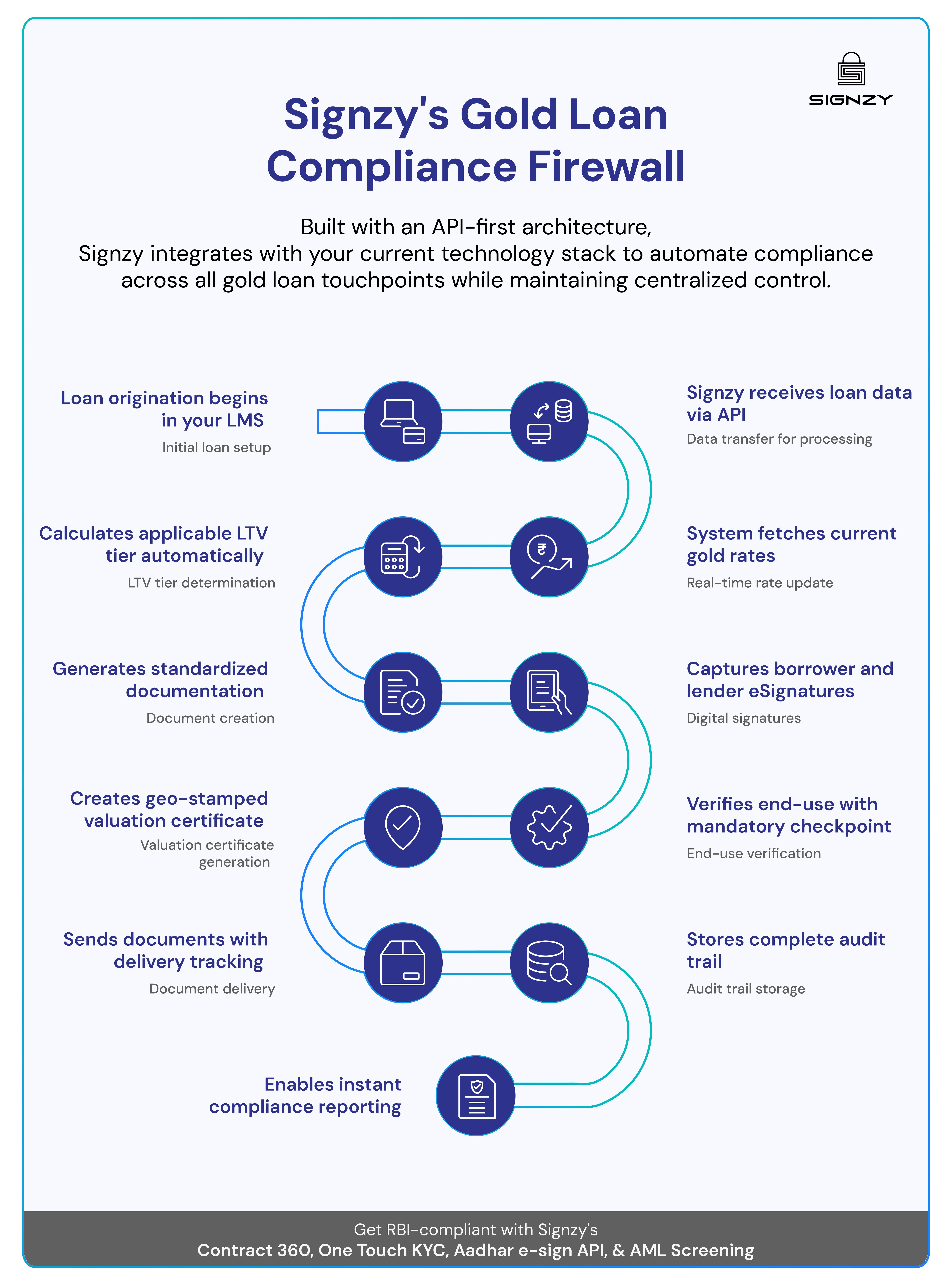
Instead of checking compliance after a loan is disbursed, it enforces RBI requirements at each stage of origination and blocks progression if any requirement is not met. So, when a loan application begins, Signzy’s suite of products work together.
At the heart of this enforcement system is Contract 360, Signzy's digital contract management platform that generates all loan documentation from centrally controlled templates. Every loan agreement, valuation certificate, and Key Fact Statement is produced in RBI-compliant format with zero possibility of branch-level editing.
Besides Contract 360, Signzy’s offers multiple other tools make journey more seamless:
- One Touch KYC verifies borrower identity instantly through document OCR, biometric checks, and liveness detection, ensuring the person pledging gold is who they claim to be. Our One Touch KYC was even recognized by Gartner.
- Aadhaar eSign API captures legally valid electronic signatures from both borrower and lender with timestamps and IP addresses, creating IT Act compliant dual signatures that eliminate paperwork.
- NDD (Negative Due Diligence) checks run AML screening against sanctions lists and PEPs, while performing digital integrity checks on email, phone, IP address, and geo-location to flag high-risk users before disbursal.
If any checkpoint is incomplete, the system blocks further processing.
There is no manual override. A branch cannot skip a step, use an outdated template, or disburse without completing end-use verification.
The loan either meets all requirements or it does not proceed.
This approach differs from traditional systems, where compliance is validated retrospectively, often during audits. By that point, fixing gaps is costly, and remediation is complex. The firewall makes compliance a precondition for disbursal rather than a post-facto check.
What are the most common use cases of Signzy's compliance firewall?
The following scenarios show how the platform addresses practical compliance gaps that manual or semi-automated systems struggle to solve.
⚖️ Enforcing tiered LTV limits across distributed branch networks
The RBI's three-tier LTV framework creates calculation complexity that manual processes cannot handle reliably at scale. A loan that starts at ₹2 lakh with 85% LTV becomes subject to 80% LTV when a top-up pushes it to ₹3 lakh.
Branch staff using spreadsheets or calculators frequently make errors during these transitions, especially when factoring in accrued interest for bullet repayment loans or adjusting for gold price fluctuations.
Signzy's no-code platform enforces this LTV compliance automatically:
- Automatic tier identification: The system identifies the applicable LTV tier (85%, 80%, or 75%) based on total loan amount as soon as details are entered.
- Real-time recalculation for top-ups: When a top-up is requested, the platform recalculates against the current collateral value and enforces the correct threshold instantly.
- Hard blocks on breaches: If a request exceeds permissible LTV, the application is blocked with a clear explanation, and no manual override is possible.
- Bullet loan adjustments: For bullet repayment loans, the system factors in the total amount payable at maturity when calculating LTV, preventing common miscalculations.
This automation ensures that LTV breaches, which trigger RBI supervisory action and risk-weight penalties, simply do not occur across branch networks.
📄 Standardizing documentation across hundreds of branches
One of the most common compliance failures in gold lending is documentation inconsistency. Different branches develop their own versions of loan agreements, and over time, these templates diverge from the RBI-mandated format.
When an inspection happens, auditors find that Branch A uses a different Key Fact Statement than Branch B, or collateral descriptions vary in detail. Fixing this requires manually reviewing thousands of loan files and recreating compliant documentation.
Signzy's Contract 360 solves this by centralizing templates at the platform level. The loan agreement, valuation certificate, KFS, and all borrower communications are generated from master templates that branches cannot edit.
If the regulator updates disclosure requirements, the compliance team updates the master template once, and the change applies across all branches instantly.
🔍 Creating tamper-proof audit trails for regulatory inspections
RBI inspections require lenders to produce evidence that specific loans originated compliantly. In manual or semi-digital systems, this documentation is often fragmented across physical files, email threads, SMS logs, and multiple software systems.
Signzy's firewall generates immutable audit trails as a byproduct of normal operations.
- When a valuation certificate is created, the photo, weight details, purity reading, and officer signature are captured together and linked with a timestamp.
- When documents are sent to the borrower via Contract360, delivery confirmation is recorded automatically.
- When the borrower signs electronically, the Aadhaar eSign capture includes a timestamp and IP address.
All of this data is stored in a structured, tamper-proof format.
The photo-linked valuation certificates solved a major problem for us. We had disputes on 3-4% of returned collateral. After Signzy, it dropped to less than 0.5%. Everything is documented upfront.
— VP Compliance, Large NBFC.
🚫 Preventing disbursal without end-use verification
The RBI now mandates that lenders verify and document the purpose of the loan before disbursal.
In practice, branch staff may capture the stated purpose in a free-text field but fail to obtain supporting documentation, or they may skip the step entirely under pressure to meet disbursal targets.
Signzy enforces end-use verification via three rules:
- Mandatory checkpoint before disbursal: After all loan origination steps are complete, the system prompts for end-use information and blocks further progression until it is provided.
- Documentation upload requirement: If supporting documents are needed (invoice for business purchase, medical bills for healthcare), the system requires upload before the disbursal button becomes active.
- Zero bypass capability: Branch staff cannot skip this step even under time pressure or performance targets, ensuring 100% portfolio compliance.
⏱️ Managing collateral return timelines and penalty avoidance
Borrowers are supposed to get their pledged gold back within seven working days of repaying the loan. If the lender delays, there are ₹5,000 per day in penalties. Tracking this manually across hundreds of branches is difficult because repayment happens in one system, the gold sits in a vault, and someone has to coordinate the handover.
Signzy sends alerts to the branch and the borrower. If the deadline is approaching, it escalates to managers. This keeps delays from turning into penalty situations.
🔄 Handling renewals and top-ups within LTV compliance
When borrowers want to renew their loan or take a top-up, the lender has to check whether it's allowed under the current LTV limits. This means looking at the gold price today, what's already outstanding, any accrued interest, and which LTV tier applies.
Signzy does all these calculations automatically. It pulls current gold prices, figures out what's permissible, and either approves or blocks the request with an explanation.
For bullet loans, it won't allow renewal until the accrued interest is cleared.
Why do banks and NBFCs choose Signzy for compliance?
🟢 Proven operational results: 92% reduction in TAT, 66% reduction in drop-off, 80% reduction in onboarding costs across 55M+ monthly onboardings.
🟢 Enterprise-grade client portfolio: Works with 10+ Fortune 30 companies and 1400+ customers across the globe, including HDFC Bank, Citibank, Axis Bank, Emirates NBD, and HSBC.
🟢 Industry recognition and validation: Gartner recognized for innovations, ranked 11th by Everest Group among the best fintech startups globally.
🟢 Deep regulatory expertise: Over 55 use cases solved for digital onboarding across regulated financial institutions.
🟢 Strategic partnerships: Collaborations with KPMG, Microsoft, FIS, Infosys Finacle, and NPCI strengthen the platform's enterprise capabilities.
🟢 Modular architecture: Start with gold loan compliance, add KYC, KYB, and other modules as compliance needs expand.
🟢 No-code platform: Build and modify workflows without writing code, reducing implementation time and IT dependency.
🟢 Strategic partnerships: Collaborations with KPMG, Microsoft, FIS, Infosys Finacle, and NPCI strengthen the platform's enterprise capabilities.
🟢 Comprehensive API suite: 340+ APIs enable seamless integration with existing core banking and loan management systems.
Get RBI-compliant with Signzy's Contract 360, One Touch KYC, Aadhar e-sign API, and AML Screening.
That’s a wrap for now.
We know that compliance transformation can feel overwhelming, especially with a firm deadline ahead. The good news is that you don't have to figure this out alone. Signzy's team has helped institutions just like yours navigate exactly this challenge, and we're here to make the process as straightforward as possible.
If you want to see how the compliance firewall actually works, how it handles tiered LTV calculations in real time, or how it creates those audit-ready trails that auditors love, we'd be happy to walk you through it. Drop us a line here (Implementation typically takes 48 hours).


FAQ
What are the RBI's new gold loan compliance requirements?

When do the new gold loan regulations come into effect?
What is the three-tier LTV framework for gold loans?
What happens if lenders don't comply with the new gold loan rules?
Madhu Srinivas
Madhu is the Chief Risk and Compliance Officer at Signzy. Before joining Signzy, he was the CEO and cofounder of Difenz - a risk management platform acquired by Signzy. Madhu enjoys talking about governance, fraud prevention, and compliance risks in India.

Related Blogs
View all

RBI's 2025 Gold Loan Compliance Overhaul: What You Should Know

Bringing KYC to Every Corner of India with RBI: Video KYC, Security, and More
![AML Regulations India: Laws, Regulators, and More [2026 Guide]](https://cdn.sanity.io/images/blrzl70g/production/eba10e392ea6647d3a8aa7460e7407e9fea46658-5693x1334.png)
AML Regulations India: Laws, Regulators, and More [2026 Guide]

Top 10 KYC Verification Solution Providers in India (2026)
The best in business


The global API marketplace for KYC, KYB, & AML
Explore the end-to-end verification stack trusted by 1,000 businesses.
Get in touch