





Cryptocurrencies: The journey from a ban to tight regulations

Cryptocurrency in India has undergone a sea of regulatory changes. It started with the RBI issuing a circular in April 2018, restricting all entities regulated by it from dealing in virtual currencies or providing services for facilitating any person or entity in dealing with or settling in virtual currencies. Then in 2020, the circular was struck down by the Hon’ble Supreme Court on grounds of being disproportionate in nature.
Since then, there have been several steps taken towards the direction of regulating cryptocurrencies. By way of Notification S.O. 1072(E) dated 07 March 2023, cryptocurrencies were effectively brought within the Anti Money Laundering (“AML”), Combating the Financing of Terrorism (“CFT”), Combating Proliferation Financing (“CPF”) regulatory framework, requiring them to comply with due diligence and reporting obligations similar to other reporting entities. Notification S.O. 4877(E) dated November 09, 2023 notified Financial Integrity Unit, India (“FIU-IND”) as the regulator of cryptocurrencies.
These changes effectively meant that cryptocurrency companies, defined legally as Virtual Digital Asset Service Providers (“VDASPs”), effectively had similar KYC and reporting obligations as banks and other financial institutions.
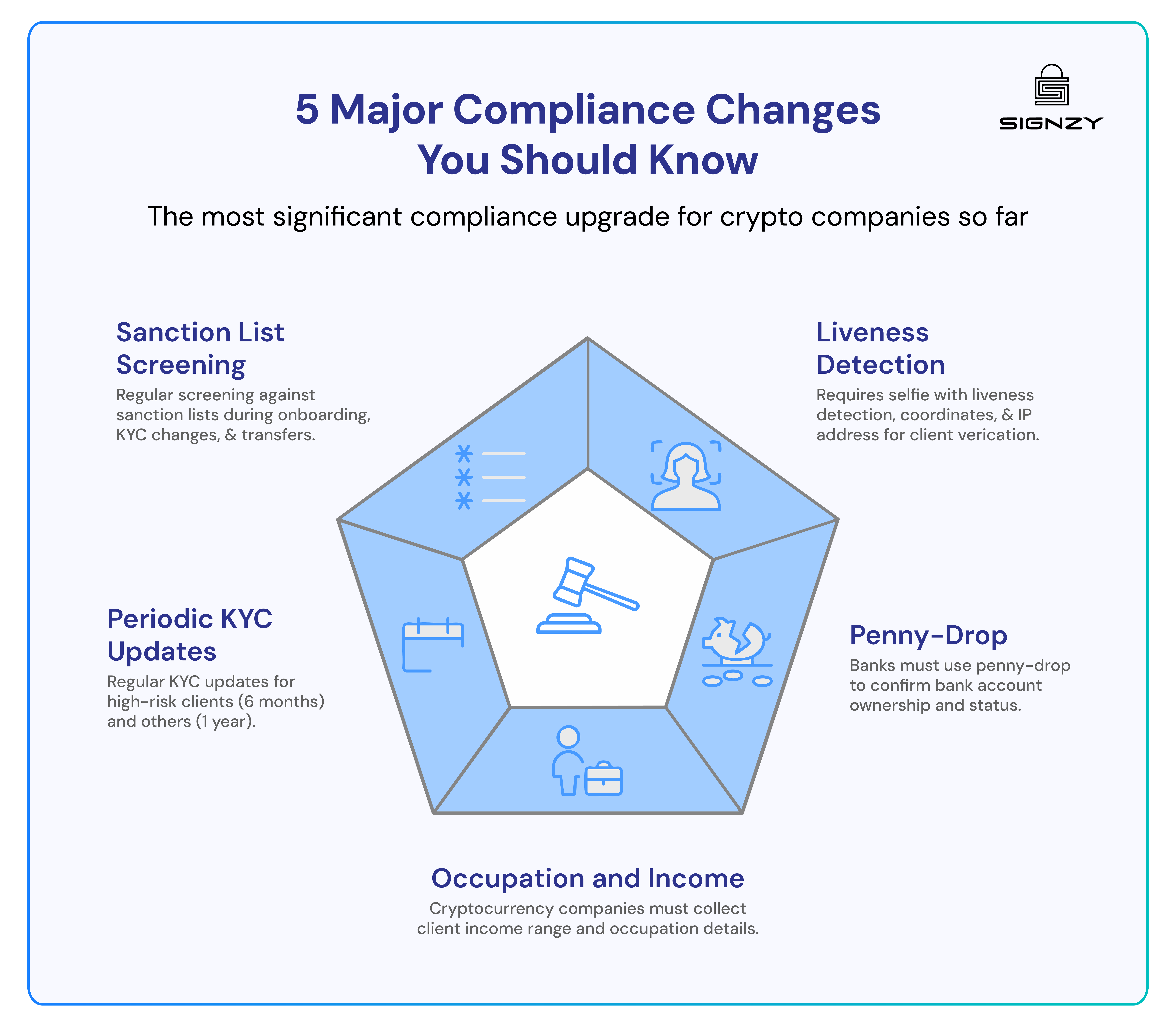
On 8 January 2026, the FIU-IND took further steps towards regulating cryptocurrency. The guidelines released by the FIU-IND (“Guidelines””), inter alia, mandated liveness detection at the time of KYC, penny-drop mechanism and income/profession checks. This is perhaps the biggest step in the direction towards regulating the cryptocurrency industry. This blog highlights 5 of the biggest changes made pursuant to the Guidelines

Key Compliance Updates For Crypto Businesses in India
Liveness Detection:
The Guidelines for the first time introduces the concept of liveness detection for cryptocurrency companies.The Guidelines now require cryptocurrency companies to collect selfie of clients with liveness detection, latitudinal and longitudinal coordinates with date and timestamps and the IP address of such clients. This is a new requirement that did not previously exist.
Penny-Drop:
The Guidelines dictate that for bank account verification, banks are required to perform a penny-drop mechanism for the purpose of confirming both ownership and operational status of the account.
Occupation and Income Range:
The Guidelines also require cryptocurrency companies to collect details about the income range and occupation of its clients.
Periodic KYC Updates:
As per the Guidelines, cryptocurrency companies are required to carry out KYC updation for clients assessed as high risk clients at least once in 6 months and for all other clients at least once in a year. In case there is no change in the KYC information, a self declaration needs to be obtained from the client. In case there is change in the KYC information, the cryptocurrency company would need to carry out due diligence equivalent to that applicable for on-boarding a new client including verification.
Regular Sanction List Screening:
Sanction list screening needs to happen on a more regular basis. This includes screening during each of the following situations:
- time of onboarding;
- during change in KYC details;
- change in sanction lists;
- time of transfer from one wallet to another.
How Signzy can help
Signzy has solutions for each of the changes that have been made. Signzy has industry leading solutions for liveness check, penny-drop solutions and sanction list screening. Additionally, Signzy has unique solutions that can help determine the income and occupation details of individuals.


Yashdeep Agarwal
Yashdeep is the product lead for Signzy’s flagship KYC Suite (One Touch KYC) and the governance, risk, and compliance product suite at Signzy, building 0-to-1 global platforms that handle identity verification, beneficial-owner discovery, regulatory screening and ongoing monitoring across fintech and banking clients. Previously a founder and engineer with 5+ years of experience, he now brings product-engineering and compliance-workflow expertise together to scale secure, audit-ready onboarding systems internationally.

Related Blogs
View all![Cryptocurrency in India: KYC and AML Regulations [2026 Guide]](https://cdn.sanity.io/images/blrzl70g/production/18545a41d280d59abb7e03914da49843c1606b4e-2821x663.jpg)

Cryptocurrency in India: KYC and AML Regulations [2026 Guide]
![AML Regulations India: Laws, Regulators, and More [2026 Guide]](https://cdn.sanity.io/images/blrzl70g/production/eba10e392ea6647d3a8aa7460e7407e9fea46658-5693x1334.png)
AML Regulations India: Laws, Regulators, and More [2026 Guide]

Bringing KYC to Every Corner of India with RBI: Video KYC, Security, and More

Signzy's Gold Loan Compliance Firewall: Automate RBI LTV Enforcement
The best in business


The global API marketplace for KYC, KYB, & AML
Explore the end-to-end verification stack trusted by 1,000 businesses.
Get in touch