





How to Prepare for SEBI's NRI Re-KYC? Rules + Automation Ideas

 Open in ChatGPT
Key Highlights
- SEBI's December 10, 2025, circular removes physical presence requirements for NRI Re-KYC but introduces mandatory GPS geo-tagging, country validation, anti-spoofing controls, and audit-grade evidence logging that most legacy KYC platforms cannot deliver at scale.
- The mandate unlocks access to 15.85 million NRI passport holders globally and enables intermediaries to reduce Re-KYC costs per transaction noticeably while increasing conversion rates through automated digital workflows.
- Signzy's One-Touch KYC provides SEBI-compliant infrastructure with automated GPS validation, real-time spoofing detection across 14,000+ document types in 190+ countries, and audit-ready evidence generation, enabling brokers, AMCs, and fintechs to conduct NRI Re-KYC under 30 seconds.
If your institution handles NRI client accounts, you need to conduct Re-KYC for those clients. SEBI has specific requirements for this process, and recent updates have changed how digital verification can be done.
On December 10, SEBI issued a relaxation circular that simplifies the digital Re-KYC process for NRI clients. The new circular removes certain geo-tagging restrictions, which means your institution can now process Re-KYC digitally even when the client is located outside India. This should reduce delays and improve completion rates.
Below, we will cover what has changed in the requirements in more detail and how you can use automation to scale your NRI Re-KYC operations compliantly. Let’s start

What's new in SEBI's Re-KYC requirements for NRIs?
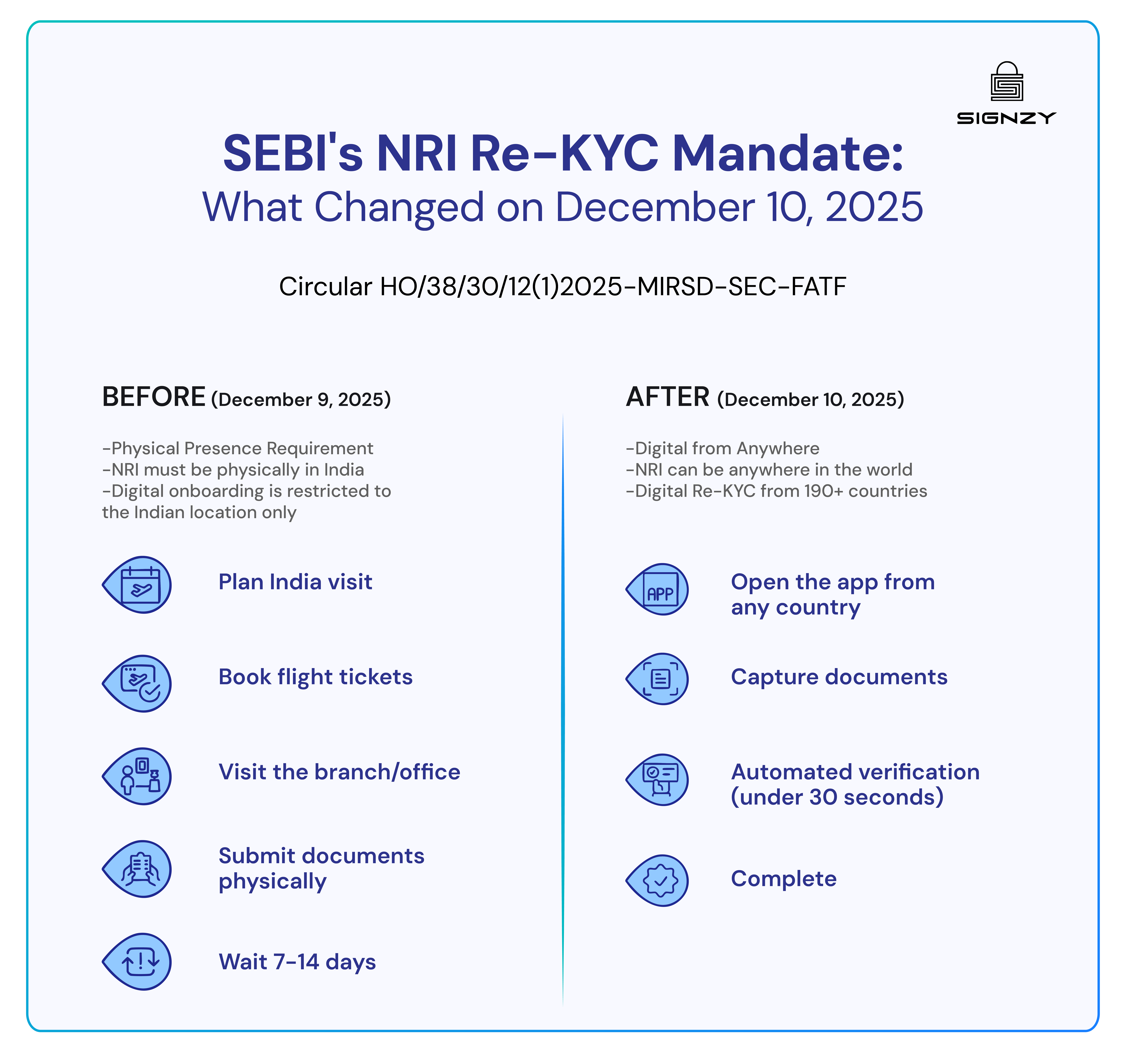
NRIs no longer need to be physically present in India to complete digital Re-KYC. That is the headline change from SEBI's December 10, 2025, circular HO/38/30/12(1)2025-MIRSD-SEC-FATF. Para 51 of the Master Circular on KYC dated October 12, 2023, was modified.
The requirement of physical location being in India shall be relaxed for NRI clients to undertake due diligence through digital mode.” – SEBI

However, this relaxation comes with stricter technical requirements. SEBI has replaced the physical presence mandate with four mandatory rules:
- GPS geo-tagging: Capture precise latitude and longitude coordinates for every Re-KYC session with timestamp verification.
- Country-level location validation: Ensure GPS coordinates match the country listed in the client's Proof of Address.
- Anti-spoofing controls: Prevent connections from spoofed IP addresses, VPNs, proxies, emulators, and GPS manipulation attempts.
- Audit-grade evidence logging: Maintain immutable records of GPS data, IP addresses, device information, timestamps, and decision rationale for regulatory inspections.
Essentially, SEBI is saying: you can serve NRIs digitally from anywhere in the world, but your technology must prove beyond doubt that the person is who they claim to be and is located where they say they are.
This change opens up digital Re-KYC access for 15.85 million NRI passport holders, but only for intermediaries whose platforms can enforce the new compliance controls in real time.
Who needs to comply with SEBI's NRI Re-KYC mandate?
Any SEBI-registered intermediary serving NRI clients must comply with the new Re-KYC requirements. If your business holds NRI accounts that require periodic verification, you are directly impacted. Here is who needs to act immediately:
↪ Stock brokers and depository participants: NRIs with demat accounts require periodic Re-KYC to maintain active trading status. For brokers and DPs, SEBI compliance is non-negotiable. The new mandate allows you to serve NRI clients digitally without requiring them to visit India.
↪ Asset management companies (AMCs): NRI mutual fund investors represent high lifetime value customers who expect seamless experiences. Periodic Re-KYC is mandatory to keep accounts active. The December 2025 mandate enables you to digitize this process completely, eliminating the friction of physical verification.
↪ Wealth management platforms: Wealth platforms serving global Indians with India-focused portfolios face unique challenges. Your clients demand premium experiences and have zero tolerance for clunky Re-KYC processes. The new SEBI mandate allows you to meet their expectations with digital-first flows.
↪ Fintechs and neo-banks serving NRIs: Digital-native NRI customers expect app-based everything. For fintechs, abandonment during KYC is an existential threat. SEBI's December 2025 mandate opens the door to frictionless NRI Re-KYC.
The challenge is the same across all these businesses. Your platform needs to capture GPS data, validate locations, block spoofing attempts, and maintain audit logs. Before discussing how to automate those parts, let’s understand how this relaxation can translate into a greater market expansion opportunity.
How can businesses benefit from SEBI’s new Re-KYC rules for NRIs?
For intermediaries with the right infrastructure, this update can benefit businesses in four main ways:
📉 Slash operational costs by up to 99 percent
Manual Re-KYC costs up to ₹1,000 per user. This includes physical documentation, in-person verification, courier charges, and ops team time. Digital Re-KYC using India's Digital Public Infrastructure (Aadhaar, DigiLocker, real-time verification) costs very minimal.
The math is simple. If you process 10,000 NRI Re-KYC requests annually, manual processes cost you ₹1 crore. Digital processes cost ₹60,000. The savings compound as your NRI base grows.
Signzy advantage: Automates the entire flow with AI-powered document verification, liveness detection, and instant validation, eliminating manual processing costs.
🚀 Reduce processing time from 2 weeks to under 30 seconds
Traditional Re-KYC involves document collection, multiple back-and-forth exchanges across time zones, manual verification, and approval workflows. This takes 7 to 14 days.
Digital Re-KYC happens in one session under 30 seconds (instant compared to 7-14 days). Faster processing means happier customers and lower support costs.
Signzy advantage: One-Touch KYC delivers instant completion with zero manual intervention through automated OCR, GPS capture, and country validation.
📈 Reduce NRI abandonment through friction elimination
India specific data shows 25% of users abandon bank applications during the marketing to app journey, and another 46% drop off during fintech KYC processes. This means out of 100 NRI prospects, only around 35 complete the journey, resulting in a 65% total loss.
The more steps you add, the more people quit. Manual Re-KYC has multiple friction points: upload documents, wait for review, resubmit if rejected, schedule verification calls, and repeat the cycle.
Digital Re-KYC removes all friction. One session, automated checks, instant approval. Conversion rates improve significantly, with abandonment prevention of 65%. This improvement more than doubles the number of NRIs who complete Re-KYC and remain active customers.
Signzy advantage: Zero friction design with automated document verification, real time validation, and AI powered OCR achieves 65% abandonment prevention, transforming your NRI acquisition funnel.
🌍 Serve NRIs across the globe
Before December 2025, you had two bad options for NRI Re-KYC.
- Require physical presence in India, which limits your market to NRIs who happen to be visiting.
- Managing paper-based processes through agents is slow, expensive, and error-prone.
Now you can serve NRIs wherever they live. US, UAE, UK, Singapore, Canada, Australia. Your addressable market just expanded from "NRIs currently in India" to "all NRIs globally." The only constraint is whether your platform can validate their location and documents according to SEBI's rules.
Signzy advantage: Supports 14,000+ identity documents across 190+ countries with automatic format recognition and jurisdiction-specific validation.
🛡️ Pass SEBI audits without scrambling
SEBI audits check three things. Did you capture the GPS correctly? Did you prevent spoofing? Can you prove it?
Legacy systems store data across multiple tools. GPS in one place, documents in another, IP logs somewhere else. When auditors ask for evidence, your team spends days compiling files and hoping nothing is missing.
Compliant digital Re-KYC stores everything in one immutable audit trail:
- GPS coordinates matched to the PoA country
- IP validation logs showing no VPN/proxy usage
- Device fingerprints confirming no emulation
- Timestamps proving session authenticity
Signzy advantage: Generates downloadable evidence packages automatically, with every data point SEBI requires for inspections.
An NRI client tried completing Re-KYC through a VPN, and Signzy blocked it automatically. The system flagged the session before it even entered our workflow. That kind of real-time fraud prevention would have taken us months to build ourselves.
— Risk Manager, Depository Participant
⚡ Scale to 100,000 NRIs without adding ops headcount
Manual processes scale linearly with volume. If you have 5 people handling 10,000 Re-KYC requests, you need 10 people for 20,000 requests and 50 people for 100,000. Your costs grow in lockstep with volume.
Digital Re-KYC scales exponentially. The infrastructure handles 10,000 or 100,000 requests at nearly the same cost. Your ops team shifts from processing documents to handling exceptions only. Growth no longer requires proportional hiring.
Signzy advantage: Handles 55M+ onboardings monthly across 1,400+ customers, proving infrastructure can scale without operational overhead.
How to automate your NRI Re-KYC operations with Signzy?
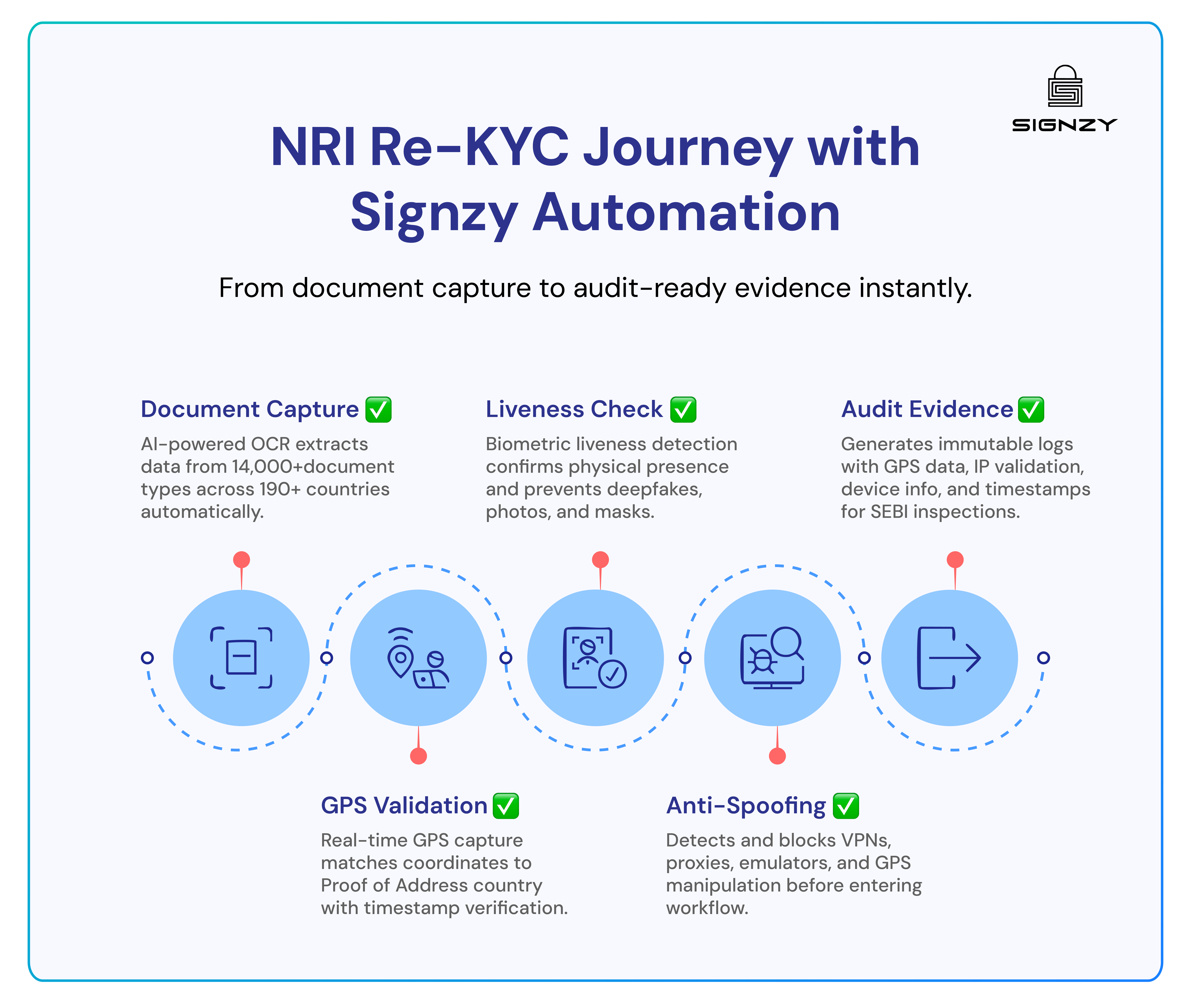
The technical requirements SEBI outlined create an integration problem that most intermediaries underestimate. You need a GPS capture that works across Android and iOS. Location validation that understands 190+ country boundaries. Spoofing detection that catches new techniques. Audit logs are structured exactly how regulators expect them.
Building this in-house means months of development and ongoing maintenance. Buying separate tools from multiple vendors means integration headaches and no single source of truth for audits.
Signzy solves this by functioning as your complete compliance infrastructure layer.
1. Multiple verification steps happen simultaneously.
SEBI's mandate requires several checks working together. Document verification, GPS validation, liveness detection, anti-spoofing, and audit logging all need to happen in sequence, with data flowing between steps.
Signzy handles this orchestration automatically. When an NRI starts Re-KYC, the platform:
- Captures their document and extracts data through OCR
- Validates GPS coordinates against the address country
- Runs liveness checks to confirm physical presence
- Detects spoofing attempts in real time
- Generates audit-ready evidence packages
Your engineering team makes API calls. The platform handles everything else. This means no middleware logic to build and maintain. No gaps between verification steps where compliance can break.
2. One-Touch KYC brings everything together in a single flow
Signzy's One-Touch KYC is the product that delivers this complete verification experience. It combines document OCR, biometric checks, liveness detection, AML screening, and database verification into one seamless customer journey.
For NRIs, this means completing Re-KYC instantly through their phone. For your business, it means one integration that handles identity verification, fraud prevention, and compliance requirements simultaneously. Instead of connecting multiple tools and hoping they work together, you get a unified verification flow that meets SEBI's technical requirements out of the box.
3. Anti-spoofing runs automatically on every session.
VPNs, proxies, emulators, and GPS manipulation are common fraud techniques. Signzy detects these in real time without manual intervention.
The platform checks IP reputation to flag VPNs and proxies, analyzes device data to catch emulators, validates GPS signal integrity to identify spoofed coordinates, and runs liveness detection to prevent deepfakes and photo attacks. Sessions that fail these checks get blocked before entering your workflow.
Your operations team only reviews exceptions, not every application.
SEBI's GPS and anti-spoofing requirements seemed impossible to implement quickly. Signzy had everything built in: location validation, VPN detection, audit logs, etc. We went live in 2 days instead of the 3 months our tech team estimated for building in-house.
— CTO, Wealth Management Platform.
4. Audit evidence gets generated automatically for every session
SEBI inspections require proof. You need to show GPS data, IP validation, device information, timestamps, and decision logic for each Re-KYC session.
Signzy generates immutable logs automatically. Every verification creates a complete evidence package that is downloadable and formatted for regulatory review. You stay inspection-ready without manual documentation work.
5. Expanding compliance operations does not mean adding more vendors
NRI Re-KYC might be your immediate need, but compliance requirements grow. You may need AML screening next quarter, transaction monitoring next year, or business verification for NRI-owned entities later.
Signzy operates as a complete API marketplace. The same platform handling Re-KYC also provides AML checks, sanction screening, bank statement analysis, and transaction monitoring. When the compliance scope expands, you activate new capabilities through the same integration.
This eliminates vendor management overhead. One relationship, one API structure, one support team, one audit trail across all compliance functions.
If you serve NRI clients and need to upgrade your Re-KYC infrastructure before SEBI audits begin, Signzy can help you deploy compliant digital flows in 48 hours.
To know more, book a demo here.


FAQ
How often do NRIs need to complete Re-KYC under current regulations?

What happens if an NRI's GPS location shows a different country than their registered address?
Do intermediaries need RBI approval to implement digital NRI Re-KYC under this mandate?
Are there specific countries where this digital Re-KYC process does not apply?
Yashdeep Agarwal
Yashdeep is the product lead for Signzy’s flagship KYC Suite (One Touch KYC) and the governance, risk, and compliance product suite at Signzy, building 0-to-1 global platforms that handle identity verification, beneficial-owner discovery, regulatory screening and ongoing monitoring across fintech and banking clients. Previously a founder and engineer with 5+ years of experience, he now brings product-engineering and compliance-workflow expertise together to scale secure, audit-ready onboarding systems internationally.

Related Blogs
View all

What Is Reverification? Meaning, Triggers, and KYC Rules (2026)
![What Is Document Verification? Process, Benefits & Compliance Guide [2026]](https://cdn.sanity.io/images/blrzl70g/production/a544730083916aa0a50dff554d16418c000306d4-2560x600.webp)
What Is Document Verification? Process, Benefits & Compliance Guide [2026]

Complete List of Acceptable KYC Documents + Verification Solution

How to verify users of different nationalities for global businesses
The best in business


The global API marketplace for KYC, KYB, & AML
Explore the end-to-end verification stack trusted by 1,000 businesses.
Get in touch