





How To Conduct Bank Account Verification? Ultimate Guide [2026]

 Open in ChatGPT
Key Highlights
- NACHA requires validating first-use ACH accounts, CIP mandates identity verification for financial institutions, and GDPR demands data minimization and consent.
- Micro-deposits cost $0.75 but cause 20% abandonment and 2-3 day delays. Instant verification costs $1.50 but completes in seconds with 5% drop-off. Document verification is thorough but slow, with 20-30% abandonment, best for high-risk industries.
- Signzy offers bank verification across 200+ countries with MuleShield fraud detection, consent-based compliance, and transaction monitoring under one roof.
- What is bank account verification?
- How does bank account verification work?
- Why is bank account verification important?
- When is bank account verification required?
- What regulatory requirements apply to bank account verification?
- Bank account verification: Build vs buy analysis
- How to prevent fraud during bank account verification?
- How to handle data protection during bank account verification?
- 4 Best bank account verification solution platforms - 2026
- Implementing Signzy for bank account verification
- FAQ
Asking customers to verify their bank accounts can feel awkward. You're essentially saying "prove this account is really yours" without sounding like you don't trust them. And on your end, you're trying to balance security with not making the process so annoying that people abandon their carts.
I've spent the last few years working with companies trying to nail this process, and honestly? Most are overthinking it. Bank account verification doesn't need to be complicated, but it does need to be done properly. So let's break down how to actually do this.

What is bank account verification?
Bank account verification is the process of confirming that a bank account exists, is active, and belongs to the person or business claiming ownership of it. In other words, think of it as checking someone's ID before handing them something valuable, except in this case, you're verifying their bank account before sending money to it or accepting payments from it.
While some manual methods are available, almost all businesses accomplish this through a bank account verification API like Signzy or Plaid that automates the entire validation process.
Now that we've covered the core definition, let's talk about what you're here for: the different methods of bank account verification and how to choose the right one. Topics like use cases, vendor options, and data compliance are coming up as well, but let's start with how the process actually works.
How does bank account verification work?
Bank account verification confirms an account is legitimate through one of four methods: micro-deposits that test account access, instant verification through banking APIs, automatic database lookups, or document uploads.
The method you pick determines your verification speed, cost per attempt, and how much friction customers experience. Let's break down each approach:
Method 1: Micro-deposit verification
Micro-deposit verification sends two small amounts (typically between $0.01 and $0.99) to the customer's bank account, then asks them to confirm those exact amounts. It's the oldest method in the book, dating back to early PayPal days, and it works because only the real account holder can see those deposits in their transaction history.
The verification is complete once the customer reports back the correct amounts, proving they have access to the account.
Here’s how micro-deposit bank account verification works:
- Customer provides their bank account and routing number through your platform
- Your system initiates two small ACH credit transactions (randomized) to that account
- Customer waits 1-3 business days for deposits to appear in their bank statement
- Customer logs back into your platform and enters the two exact amounts they received
- Your system matches the amounts against what was sent
In the end, if the amounts match, the account is verified or vice versa.
Many end users have shared negative experiences with micro-deposit verification, with one Reddit user noting,
The micro-deposit verification creates absolute chaos. The emails sent to your account do not specify the first/second deposit, resulting in confusion. My resident portal is powered by PLAID, and after three erroneous attempts, my bank account for BILT is blocked and unable to be added to the resident portal again.

Some users mistake these deposits for scams entirely. Another Reddit user described his grandparents' experience:
My grandparents got two micro-deposits from a PayPal account. Then, a few days later, they were directly debited 10k out of their bank account via a PayPal account. They have sorted it out and reported it to PayPal and their bank. But how on earth does this scam work? They're adamant they haven't clicked anything or confirmed anything to allow.
Micro-deposit verification cost structure
The per-verification cost looks deceptively cheap at $0.50-$1.00 for the two ACH transactions, but that's only the visible expense. The real cost shows up in conversion drop-off and support overhead. Here's what 1,000 monthly verifications actually cost:
Direct ACH fees run $750. But 200 customers drop off during the wait (20% abandonment rate), which at a conservative $100 lifetime value, equals $20,000 in lost revenue. Failed verifications from closed or invalid accounts (roughly 2% failure rate) waste another $15 in ACH fees with zero recovery.
Your "cheap" $0.75 per verification method just cost you $20,765 in total monthly impact, or $20.77 per attempted verification when you factor in opportunity cost. That's why high-growth companies abandon this method quickly despite the low sticker price.
Micro-deposit bank account verification pros and cons
✅ Lowest upfront cost, around $0.50 per verification attempt, including ACH fees
✅ Works with virtually any US bank account, including small credit unions, with zero API integrations
❌ 2-3 day delay kills urgency, 35-40% of customers never return to complete verification
❌ Creates two additional touchpoints where customers can drop off (checking bank + coming back)
❌ Generates significant support volume from confused customers who can't find deposits or mistype amounts
❌ Failed verifications still cost you the ACH fees, and you're paying twice if you reverse the deposits
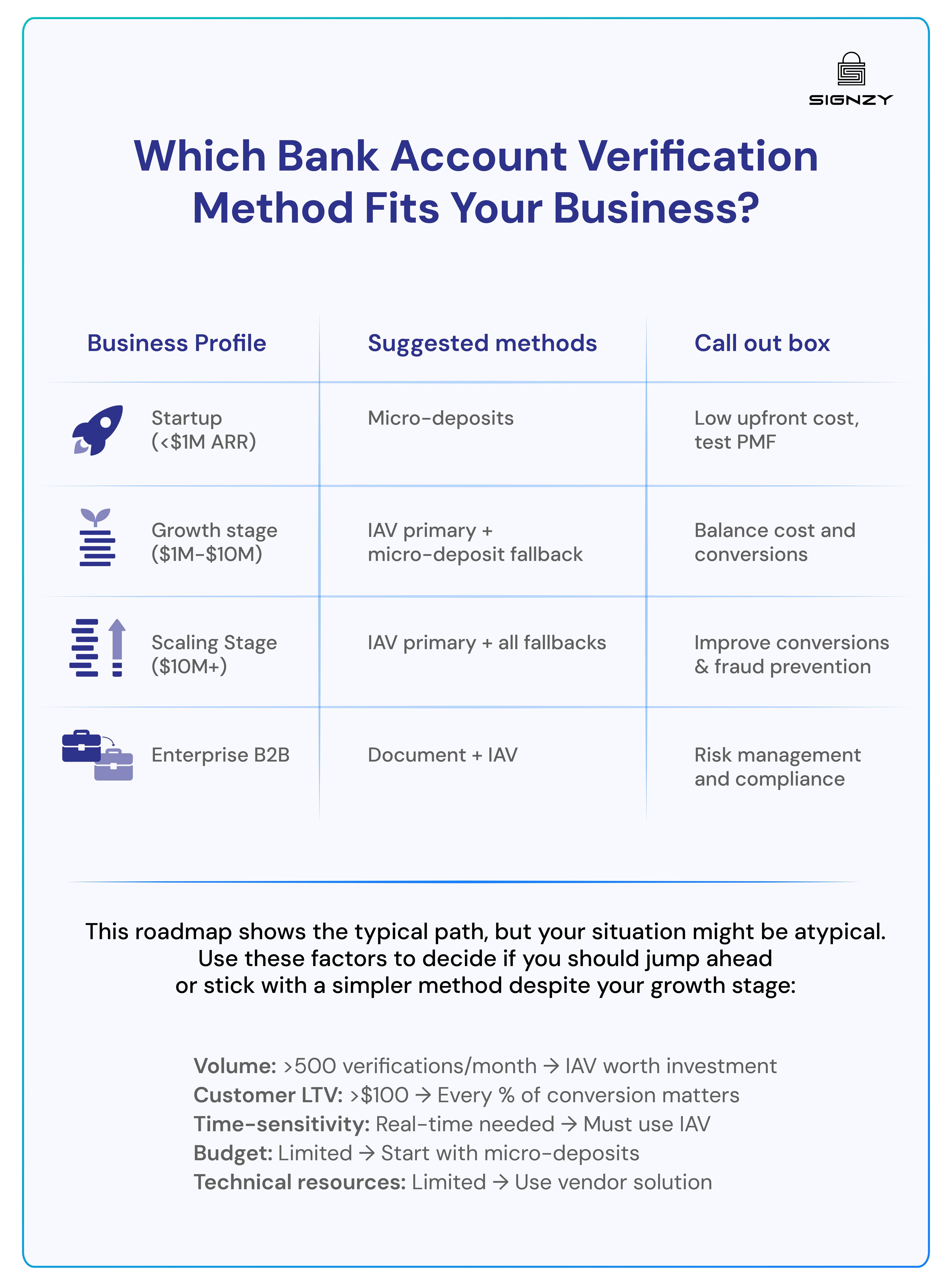
💰 Best for: Startups and low-volume businesses (under 500 verifications/month) where upfront costs matter more than conversion rates, or when your customer base is comfortable with traditional banking timelines.
Method 2: Instant account verification (IAV)

Instant Account Verification connects directly to the customer's online banking credentials to verify account ownership in real-time. Instead of waiting days for deposits, customers log into their bank through a secure interface, grant temporary access, and verification happens in 10-30 seconds.
Companies like Signzy, Plaid, Stripe, and Yodlee pioneered this approach by building integrations with thousands of banks, turning what used to be a multi-day process into an instant one.
We were bleeding trial users at the payment verification stage. They'd complete signup, hit the bank verification step, see 'wait 2-3 business days,' and that was it. Even with reminder emails, most never came back to finish. Signzy's instant verification removed that gap completely. We saw meaningful improvement in our trial conversion rate (~9-10%) after onboarding them.
— Chief Risk Officer at Financial Services platform (USA)
The verification is complete the moment the system confirms the account exists, is active, and matches the customer's identity, all pulled directly from the bank's API or screen-scraped data.
Here's how instant account verification works:
- Customer clicks "verify instantly" and is presented with a bank selection interface showing major banks
- Customer selects their bank and is redirected to a secure login screen (either the bank's actual OAuth flow or a replicated interface)
- Customer enters their online banking credentials: username and password, sometimes with MFA
- The IAV provider authenticates with the bank, retrieves account details (account number, routing number, account holder name, account status)
- System validates that the retrieved information matches what the customer provided
- Account is verified instantly, and the customer is redirected back to your platform
The entire flow takes 30-60 seconds when it works smoothly.
Instant account verification (IAV) cost structure
The sticker price is higher: typically $0.50-$2.00 per successful verification, depending on your provider and volume. But the economics flip when you factor in conversion rates.
Here's what 1,000 monthly verifications actually cost with IAV:
Direct API fees run $1,500 (assuming $1.50 per verification with an 85% success rate = 850 successful verifications). The remaining 150 customers fall back to micro-deposits, adding another $112.50.
But here's the difference: even if taking the higher end, only 50 customers drop off (5% abandonment vs 20% with micro-deposits), which at $100 lifetime value equals $5,000 in lost revenue. Support tickets drop to 20-30 (vs 150+ with micro-deposits) at $10 each, adding $250.
Your $1.50 per verification method costs $6,862.50 in total monthly impact, or $6.86 per attempted verification. Net savings vs micro-deposits: $13,902.50 per month. The "expensive" method just saved you money.
Instant account verification pros and cons
✅ 85-90% success rate with verification completing in under 60 seconds, keeping customers engaged
✅ Dramatically reduces drop-off. Customers verify in one session instead of returning days later
✅ Minimal support burden since there's no confusion about deposit amounts or timing
✅ Provides additional data like account balance and transaction history for fraud prevention and underwriting
❌ Higher per-transaction cost at $0.50-$2.00 per verification compared to $0.75 for micro-deposits
💰 Best for: Growth-stage companies (500+ verifications/month) where conversion rates directly impact revenue, or any business where real-time onboarding matters, lending platforms, crypto exchanges, and marketplaces with time-sensitive transactions.
Method 3: Automatic bank account validation
In this method, you perform a bank account number lookup against banking databases without requiring customer action beyond providing their account information. The system automatically verifies bank account number details, routing numbers, and account holder names against real-time banking databases. This happens in 1-3 seconds through APIs that connect to bank verification networks.
The verification confirms the account is real, and the name matches, but it doesn't prove the customer actually controls the account; that's the tradeoff for speed.
Here's how automatic bank account validation works:
- Customer provides their routing number, account number, and full legal name through your platform
- Your system sends this data to a bank account verification API (providers like Signzy or Socure)
- The API queries banking networks and account databases to validate that the routing number corresponds to a real bank
- System checks if the account number exists at that institution and retrieves the account holder's name on file
- Name matching algorithm compares the provided name against bank records (fuzzy matching handles nicknames, middle names, suffixes)
- Instant response returned: verified, unverified, or partial match requiring manual review
The entire process takes 2-5 seconds from submission to result.
Automatic bank account validation cost structure
Pricing sits between micro-deposits and IAV at $0.30-$1.00 per lookup, but the hidden cost is in what you're not getting: proof of account control. Here's what 1,000 monthly verifications actually cost with automatic validation:
Direct API fees run $700 (assuming $0.70 per validation). Coverage is typically 75-85% of accounts, so 150-250 accounts require fallback to micro-deposits or IAV, adding $187.50 in additional costs. The bigger issue: without proving account control, fraud rates run 2-3x higher than IAV. If 30 fraudulent accounts slip through at $200 average loss, that's $6,000 in fraud losses. Drop-off remains low at 5-8% since it's frictionless, costing roughly $6,000 in lost customers.
Your $0.70 per verification method costs $12,887.50 in total monthly impact, or $12.89 per attempted verification. The speed advantage comes with risk exposure that IAV doesn't have.
Automatic bank account validation pros and cons
✅ Fastest method at 2-5 seconds with zero customer friction beyond initial data entry
✅ No customer confusion or support tickets about deposits, logins, or waiting periods
✅ Works well as first-pass validation before triggering more expensive IAV or micro-deposits
❌ Doesn't prove account control. Validates data accuracy, but not that the customer owns the account
❌ Higher fraud risk since stolen account details will validate successfully
❌ 15-25% of accounts aren't in validation databases, requiring secondary verification methods
💰 Best for: Low-risk transactions where speed matters more than proving ownership, initial screening before more robust verification, or combining with other fraud signals like device fingerprinting and transaction monitoring.
Method 4: Document-based verification
Document-based verification requires customers to upload proof of bank account ownership, typically a bank statement, voided check, or screenshot of their online banking showing account details.
A human reviewer or automated OCR system examines the document to confirm the account number, routing number, and account holder name match what the customer provided. This method trades speed for certainty, particularly in high-risk scenarios where proving account ownership through documentation provides an audit trail.
The verification is complete once the document is reviewed and details are confirmed to match, which can take minutes with automation or hours with manual review.
Here's how document-based verification works:
- Customer is prompted to upload a bank document (accepted formats: PDF bank statement, JPG of voided check, screenshot of account details)
- System performs basic validation, file type, image quality, document freshness (usually requires statements from the last 60-90 days)
- OCR technology extracts text from the document, identifying the account number, routing number, and account holder name
- Automated checks verify that extracted data matches what the customer provided in the initial form
- Flagged documents or low-confidence OCR results are routed to human reviewers for manual verification
- The reviewer confirms account details, checks for signs of tampering or forgery, and approves or rejects
Manual review adds 2-24 hours to the process. Automated-only flows can complete in 2-5 minutes but sacrifice accuracy.
Document-based verification cost structure
The economy depends heavily on automation sophistication. Fully manual review costs $3-$8 per verification due to labor, while automated OCR with human backup runs $1-$3.
Here's what 1,000 monthly verifications actually cost with a hybrid approach:
Direct costs run $2,000 (assuming $2.00 per verification with 70% automated, 30% manual review). Document rejection rate sits at 15-25% due to poor image quality, outdated statements, or information mismatches. Those 200 rejections require resubmission, adding support costs of $1,500 (200 tickets × $7.50). Customer drop-off hits 20-30% because uploading documents feels invasive and time-consuming, costing $25,000 in lost customers at $100 LTV.
The $2.00 per verification method costs $28,500 in total monthly impact, or $28.50 per attempted verification. The thoroughness comes at the expense of conversion and operational overhead.
Document-based verification pros and cons
✅ Provides the strongest proof of account ownership with an auditable documentation trail
✅ Catches sophisticated fraud attempts where fraudsters have stolen account numbers but can't produce statements
✅ Useful for high-value transactions or regulated industries requiring documentation
❌ Highest customer friction, uploading documents feels intrusive and kills mobile conversion
❌ 20-30% abandonment rate as customers balk at document requirements or lack access to statements
❌ Document quality issues (blurry photos, partial screenshots) create rejection loops that frustrate customers
💰 Best for: High-risk industries (lending, crypto, gambling) where regulatory requirements mandate documentation, enterprise B2B payments where $10K+ transactions justify the friction, or as secondary verification after suspicious activity is detected.
Why is bank account verification important?
Bank account verification prevents the expensive cascade that starts with failed payments: ACH return fees, customer service tickets, lost revenue from churned customers, and potential fraud losses.
One unverified account that turns out to be fraudulent can cost you thousands in chargebacks and dispute fees. Scale that across hundreds or thousands of transactions, and you're looking at material damage to your bottom line and your relationship with payment processors.
When is bank account verification required?
Bank account verification is required whenever a payment failure, fraud incident, or compliance issue would cost more than the friction of asking customers to verify.
It's not about verifying every transaction.
Instead, you should know when an unverified account creates real business risk. Here's where verification becomes essential.
ACH/Direct debit payment processing
You need verification when pulling money from customer accounts because unverified debits fail constantly. Every failed ACH transaction costs you $3.5-$5.50 in return fees, depending on the failure reason, creates angry customers who are hit with overdraft charges, and damages your relationship with your bank.
If your administrative return rate exceeds 3% (wrong account numbers, closed accounts, invalid routing numbers), banks label you high-risk, and NACHA launches formal inquiries. Keep unauthorized returns below 0.5% and overall returns below 15%, or risk fines and suspension from the ACH network. Verification keeps your failure rate under 1% and saves you from explaining to customers why their payment bounced.
1. Payroll and vendor disbursements
Verification matters here because money sent to the wrong account is almost impossible to get back. Send an employee's paycheck to a closed account, and you've got legal problems, tax headaches, and a very unhappy employee. Send $50,000 to a fake vendor account, and that money is simply gone.
Verification catches typos, finds closed accounts, and confirms names match before you send money. For payroll, verify during onboarding, and you're set for years. For vendors, verify on the first payment and again whenever they change their bank details (a common fraud tactic).
2. Lending and underwriting platforms
Lenders need verification to make better loan decisions and prevent fraud. It does multiple things at once:
- Confirms income: Bank deposits show real salary payments, not forged pay stubs
- Shows financial health: Spending patterns and account balance reveal how borrowers actually manage money
- Prevents disbursement fraud: Ensures loan money goes to the actual borrower's account
- Sets up repayments: Verified accounts mean fewer failed payments and lower default rates
Personal loan companies, buy-now-pay-later services, and business lenders all verify accounts because it simultaneously helps them underwrite better and prevent fraud.
3. Subscription and recurring billing
Subscriptions need verification to stop customers from accidentally churning. When payments fail on unverified accounts, customers often don't notice until their service stops working:
- Fewer failed payments: Verified accounts fail 40-60% less often
- Less churn: 20-30% of customers never update their payment info after a failure, so they just cancel
- Lower costs: Every payment retry costs money in processing fees
- Better experience: Customers hate finding out their subscription lapsed because of a bounced payment
SaaS companies, streaming services, and membership sites that verify upfront see 15-25% less churn just by fixing payment problems before they happen.
4. Peer-to-peer payment services
P2P apps need verification to stop a simple scam: criminals link stolen bank accounts, receive real money from unsuspecting users, then withdraw everything before anyone notices the fraud. Without verification, your platform becomes a tool for moving stolen money.
5. Crypto on/off ramps
Crypto exchanges require the strictest verification because crypto transactions can't be reversed, but bank payments can. The scam is devastating: criminals deposit money from stolen bank accounts, buy crypto, send it to untraceable wallets, and disappear. By the time the bank reverses the fraudulent deposit 3-5 days later, the crypto is long gone.
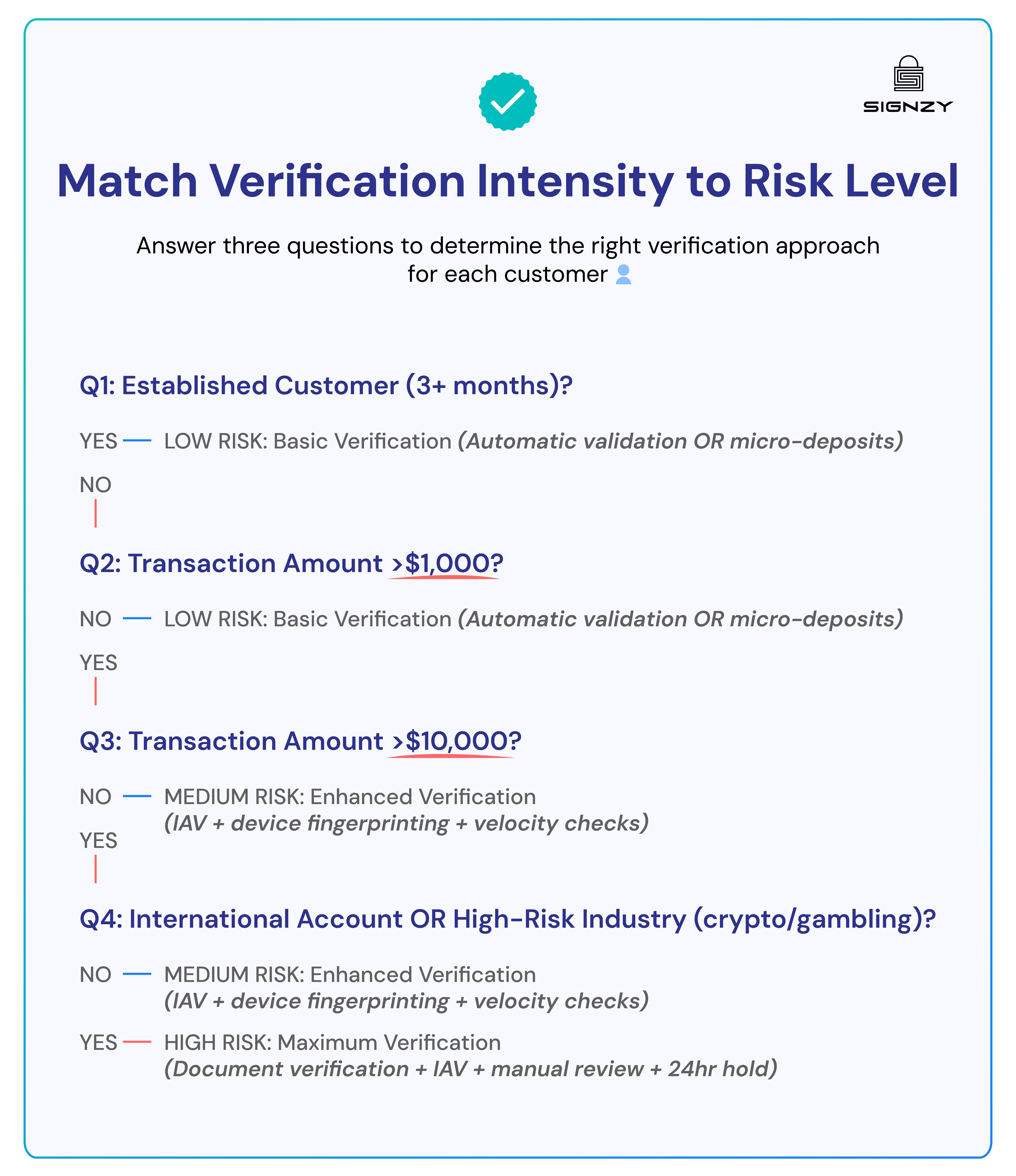
Verification before accepting any bank deposits isn't optional. It's how platforms stay in business. Exchanges use instant verification or document checks, often requiring both for deposits over $10,000. Some also use progressive levels: basic verification for $500/week, enhanced for $25,000/week, and full documents for unlimited amounts.
The process is annoying for users, but the alternative is becoming a money laundering hub, which gets you shut down by regulators and banks.
What regulatory requirements apply to bank account verification?
The requirements aren't uniform across industries or geographies, but certain regulations consistently apply when you're collecting, storing, or processing bank account data.
1. Customer Identification Program (CIP) requirements
Financial institutions in the United States operate under Customer Identification Program rules that came out of the USA PATRIOT Act. These rules require you to verify customer identity before opening accounts using risk-based procedures. You need to collect basic information: name, date of birth, address, and taxpayer ID number.
The verification can happen through documents like government-issued IDs or through non-documentary methods like database checks. Records must be kept for five years after account closure, including any discrepancies you found during verification.
While this directly applies to banks and credit unions, payment processors and fintech companies usually need similar verification to keep their banking partners compliant and happy.
2. NACHA account validation rules
NACHA requires financial institutions to validate first-use consumer account numbers when processing online ACH debits. The rule became mandatory in March 2021 after an enforcement delay. The minimum standard is straightforward: confirm the account exists and can accept ACH entries. N
ACHA doesn't mandate specific methods, so you can use micro-deposits, instant verification APIs, or commercially available validation services. The key point is that you can't just send a transaction and hope it works. If you use micro-deposits, the customer must actively confirm the amounts. Simply not getting a return isn't enough to consider verification complete.
The rule exists because web-initiated ACH fraud was climbing, and validation significantly reduces fraudulent transaction attempts.
3. Cross-border considerations
Operating internationally means juggling overlapping requirements simultaneously. A US fintech serving European customers needs GDPR compliance for EU users while meeting CIP requirements for domestic accounts. You'll deal with multiple regulators: data protection authorities for privacy, financial regulators for payment processing, and sector-specific bodies depending on your industry.
The regulatory landscape keeps shifting, so building flexible systems and monitoring updates isn't optional.
4. GDPR data protection requirements
GDPR compliance treats bank account details as personal data requiring protection. This includes account numbers, routing numbers, and any transaction information you collect.
If you're processing data for EU residents, GDPR applies regardless of where your business is located. You need a legal basis for processing, usually contract performance, when customers are paying you.
The 72-hour breach notification rule is strict: if account data gets exposed, you report it to authorities within three days. Retention limits matter too. You can keep data for tax and accounting purposes, typically six to ten years, but must delete it when no longer needed.
Bank account verification: Build vs buy analysis
The build vs. buy decision for bank account verification comes down to economics, and more importantly, opportunity cost.
Building in-house sounds appealing because you control everything and avoid per-transaction fees. But the real costs hide in places most teams underestimate: maintaining bank integrations that break without warning, staying compliant with evolving regulations, and handling edge cases across thousands of financial institutions.
Additionally, you’d find yourself dedicating engineering resources to non-core infrastructure instead of product features that drive revenue.
| Factor | Build in-house | Buy from the vendor |
|---|---|---|
| Upfront cost | $150,000-$300,000 (6-12 months development) | $10,000-$20,000 (2-4 weeks integration). |
| Annual maintenance | $50,000 (engineering time, infrastructure) | Included in transaction fees |
| Compliance updates | $15,000-$30,000/year (regulatory changes, audits) | Included, vendor handles compliance |
| Bank integrations | $100,000+ (build and maintain connections) | Included, 8,000-12,000 banks supported |
| Transaction cost | None (after build) | $0.50-$2.00 per verification |
| Time to market | 6-12 months | 2-4 weeks |
| Team burden | High (ongoing maintenance) | Low (API calls only) |
| Scalability | Manual effort to add banks | Automatic as the vendor adds coverage |
| Breakeven point | ~100,000 verifications/month | N/A |
The economics usually point toward buying unless you're processing 100,000+ verifications monthly or have truly unique requirements that vendors can't meet. Even then, most companies still buy because the engineering opportunity cost of building and maintaining verification infrastructure exceeds the transaction fee savings.
Your team should be building features that differentiate your product, not reimplementing what Signzy and Plaid already do reliably at scale.
How to prevent fraud during bank account verification?
Stolen accounts, fake identities, and money laundering all start with someone trying to link a fraudulent bank account to your platform. The trick is using multiple detection layers, so when one method misses something, another catches it.
1. Velocity checks
Velocity checks count how many verification attempts happen from the same source in a short time. A real customer tries once, maybe twice if they made a typo. A fraudster testing stolen credentials will hammer your system with dozens of attempts.
To implement:
- Set limits per user (3 attempts in 24 hours before flagging)
- Track by device fingerprint (catches users creating multiple accounts)
- Monitor per IP address (identifies attack sources)
- Count failures across your entire platform (spots organized fraud rings)
- Create exceptions for known business users who verify multiple accounts legitimately
The goal is catching automated attacks without frustrating real customers who genuinely made a mistake.
2. Device fingerprinting
Device fingerprinting creates a unique ID for each phone or computer by looking at browser settings, screen size, installed fonts, and other technical details. If the same stolen account gets tested from 20 different devices in an hour, that's fraud.
The implementation: use a fingerprinting service that creates device IDs, then count how many different accounts each device tries to verify. One device, ten accounts in a day? That's not normal behavior. The smarter fraudsters use emulators to fake different devices, but these tools leave traces. A "mobile" device with a desktop screen resolution isn't real. Flag these inconsistencies and block the device entirely.
3. IP analysis
IP analysis looks at where verification requests come from and flags risky patterns. Data center IPs mean bots. VPNs hide locations. Foreign IPs that don't match billing addresses need investigation.
Don't block VPN users automatically since travelers and privacy-focused customers use them. Treat VPN usage as one warning sign that triggers extra checks when combined with other suspicious signals.
4. Transaction monitoring
Transaction monitoring is where you catch the sophisticated fraud that looked clean during verification. Watch for patterns that emerge after approval: someone verifies an account, receives a large deposit within hours, then immediately withdraws everything to external accounts. Or they verify bank account numbers once, but then send small amounts to 50 different recipients in a day, which looks like money laundering.
To tackle it, you can set up alerts for unusual volume (10 transactions in an hour from an account that normally does one per week), odd timing (transactions at 3 AM from a business account), or suspicious destinations (transfers to accounts in high-risk jurisdictions).
How to handle data protection during bank account verification?
When regulators investigate breaches involving bank verification data, the first questions they ask are whether you needed to collect all that data and why you kept it so long. Hence, we can’t ignore this section.
Below’s a quick rundown of data protection areas you need to keep in mind when conducting bank account verification.
| Area | Common Requirement | Laws to Check |
|---|---|---|
| Data Collection Minimization | Collect only the routing number, account number, and account holder name for verification. Avoid collecting unnecessary data like full SSN, detailed transaction history, or account balances unless specifically required for your use case. | GDPR (Article 5), CCPA, PCI DSS, state privacy laws |
| Data Retention | Delete raw account data within 90 days after verification completes. Retain only transaction IDs and verification outcomes (pass/fail). For financial records required by law, keep audit logs but delete sensitive details like full account numbers. | GDPR (Article 5, 17), SOX (7 years for financial records), Bank Secrecy Act (5 years), state data retention laws |
| Data Sharing | Share account details only with direct verification vendors under Data Processing Agreements. Encrypt data in transit and at rest. Never share with marketing platforms, analytics tools, or non-essential third parties. Tokenize account numbers before internal database storage. | GDPR (Article 28, 44-50), CCPA, GLBA, Payment Card Industry standards, contractual obligations |
To summarize: Design your verification flow to collect the minimum, verify quickly, and purge aggressively. Every data point you don't collect is one less thing to protect and one less liability during an audit.
4 Best bank account verification solution platforms - 2026
| Tool | Best For | G2 Score |
|---|---|---|
| Signzy | Enterprises and startups want global verification with fraud prevention | 4.7/5 |
| Plaid | North American-focused businesses | 4.2/5 |
| Stripe Financial Connections | Existing Stripe users | 4.4/5 |
| iDenfy | Compliance-focused verification | 4.9/5 |
#1: Signzy
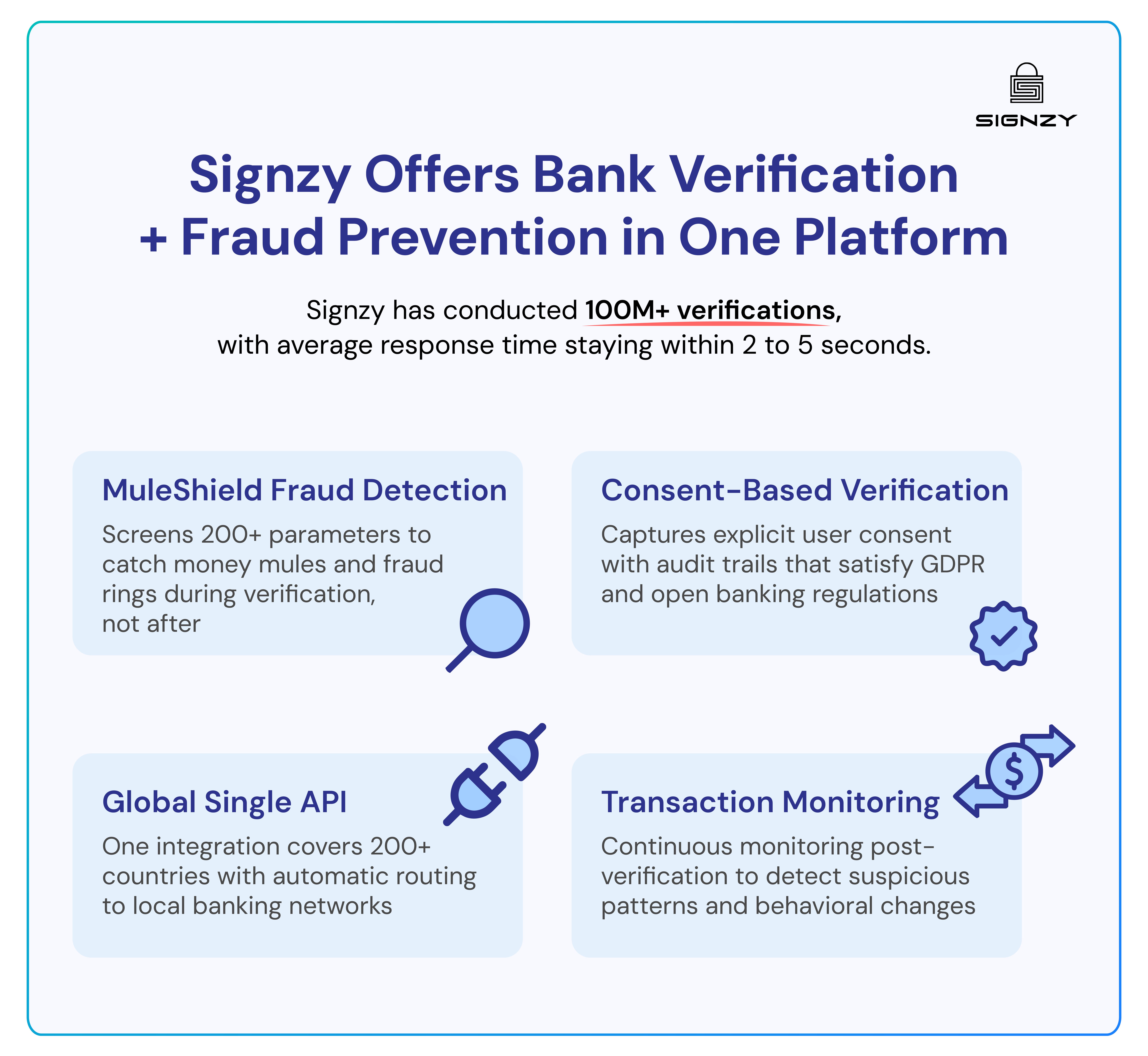
Signzy provides bank account verification across 200+ countries with integrated fraud detection and compliance tools. The platform combines instant verification, consent-based validation, and transaction monitoring in a single API suite, making it useful for businesses that need verification plus ongoing risk management rather than just one-time account checks.
Feature #1: Real-time verification with MuleShield integration
🔪 Common challenge: Money mule accounts cost financial institutions billions annually because fraudsters use legitimate-looking accounts to move illegal funds. Traditional verification confirms an account exists, but doesn't catch mules who use real credentials.
Signzy addresses this by combining instant account verification with MuleShield, their money mule detection system. During verification, the platform checks over 200 parameters, including device fingerprints, behavioral patterns, transaction velocity, and relationship mapping, to spot mule activity before approval.
This means you're not just verifying an account is real, you're screening for organized fraud rings using that account to launder money.
Feature #2: Consent-based verification for regulatory compliance
🔪 Common challenge: Regulatory bodies increasingly require explicit user consent before accessing financial data, creating friction in verification flows. Businesses struggle to balance compliance requirements with conversion rates.
Signzy's consent-based verification captures user permission before retrieving bank data, with the consent flow integrated directly into the verification API. The system logs consent timestamps and terms for audit trails that satisfy GDPR, open banking regulations, and local data protection laws across different jurisdictions.
Users authenticate through secure banking credentials while maintaining control over what data is shared, meeting both regulatory standards and customer expectations for privacy.
Feature #3: Unified API for global coverage
🔪 Common challenge: Operating across multiple countries typically means integrating with dozens of different verification providers, each with unique formats, documentation, and compliance requirements. This creates technical debt and inconsistent user experiences.
Signzy consolidates this through a single API that handles country-specific verification methods automatically. The platform supports IBAN validation for Europe, IFSC codes for India, ACH routing for the US, and local formats for 200+ countries.
Every time we expanded to a new country in Southeast Asia, we needed another vendor. It was a mess. Luckily, we came across Signzy. They cover all 11 countries we're in now with one integration. Took us 4 days to get a visa to live in the UAE. With our old setup, that would've been 6 weeks minimum. Finally feels manageable.
— CTO at Crypto platform (Singapore)
Businesses integrate once, then Signzy routes requests to the appropriate banking networks and returns standardized responses regardless of geography. This eliminates the need to manage multiple vendor relationships and adapt to regional banking infrastructure differences.
Signzy pros and cons
✅ Single integration covers 200+ countries with standardized API responses
✅ Built-in fraud detection through MuleShield catches money mules during verification
✅ Fast implementation with sandbox environment and pre-built workflows
✅ Combines verification with transaction monitoring and risk assessment in one platform
💰 Best for: Banks, fintechs, and payment processors operating across multiple countries who need verification bundled with ongoing fraud monitoring and AML compliance, particularly those handling high-risk industries like lending, crypto, or marketplaces.
#2: Plaid
Plaid specializes in instant bank account verification for North America and Europe, connecting to over 12,000 financial institutions through its Auth API. The platform is widely used by fintech apps, payment processors, and neobanks that prioritize speed and developer experience over comprehensive fraud detection.
One operational friction point involves credential management and customer recovery flows. When customers forget their banking passwords or need to reset credentials, Plaid's security protocols can create significant delays that directly impact your conversion funnel. A G2 reviewer explained the impact:
My number one issue is if someone forgets or needs to reset their login credientals we have to wait 24-72 hours to get that customer through our system again because of PLAID.
This 24-72 hour lockout period means customers who mistype their password or trigger security flags can't complete verification for days. During that window, you're losing conversions and fielding support tickets for an issue you can't resolve directly.
Plaid - Key features
- Connects directly to the user's online banking credentials for real-time account validation in under 10 seconds, eliminating the 2-3 day wait of micro-deposits
- Automatically pulls accurate account details to prevent manual entry errors that cause failed ACH transactions
- Retrieves real-time account balances to verify sufficient funds before initiating payments or debits
- Provides up to 24 months of transaction data for income verification, underwriting, and fraud analysis
Plaid pros and cons
✅ Lightning-fast integration with excellent documentation and developer tools
✅ Read-only access and bank-grade encryption provide strong security for user credentials
❌ Limited coverage outside North America and Europe makes it unsuitable for global operations
❌ Some users report 24-72 hour account lockouts when credentials need resetting, causing friction
❌ No built-in fraud detection beyond basic verification, requiring separate tools for AML/KYC
❌ Banks occasionally drop support or change APIs, causing temporary verification failures
💰 Best for: US-based startups and payment apps serving consumers who have accounts at major banks supported by Plaid banking infrastructure.
#3: Stripe Financial Connections
While the integration is seamless, Stripe's operational processes can create issues when disputes arise. The company's handling of chargeback evidence and communication with banks has drawn criticism from merchants who find themselves losing disputes despite having proper documentation. Eduardo T. shared his experience on G2,
My main concern is with Stripe's dispute resolution system…In my case, the customer had already been fully refunded before the chargeback was opened, with settlement confirmation and ARN provided. Stripe, however, failed to pass this evidence to the issuing bank, which resulted in the bank assuming no refund was made and deciding the dispute incorrectly against my business.
This matters for verification because Stripe controls both your payment processing and account verification in one platform. When operational issues arise, you can't switch verification providers without potentially disrupting your entire payment infrastructure.
Stripe Financial Connections - Key features
- Works natively with Stripe payments, payouts, and Connect platforms without additional authentication or separate vendor contracts
- Combines bank verification with ID document checks and facial matching for comprehensive identity confirmation
- Accepts government IDs, passports, and driver's licenses from 195+ countries for international customer verification
- Flags suspicious patterns like VPN usage, mismatched geolocation, or documents that fail authenticity checks
Stripe Identity pros and cons
✅ Zero integration friction for existing Stripe customers, adding verification with a few lines of code
✅ Unified billing and support through Stripe eliminates vendor management overhead
✅ Strong fraud protection built on Stripe's machine learning models trained on billions of transactions
❌ Pricing can be higher than standalone verification providers, especially at volume
❌ Limited flexibility for businesses not using Stripe's payment infrastructure
❌ Account closures can happen suddenly with minimal warning if Stripe detects policy violations
❌ Less coverage of smaller banks and credit unions compared to Plaid’s bank verification network
💰 Best for: Businesses already processing payments through Stripe who want to add identity and account verification without introducing new vendors, particularly e-commerce platforms, marketplaces, and SaaS companies with existing Stripe integrations.
#4: iDenfy
iDenfy provides bank account verification as part of a broader KYC and compliance platform focused on regulated industries. The solution combines automated checks with optional manual review for high-risk cases, making it suitable for businesses with strict regulatory requirements.
iDenfy - Key features
- Built specifically for businesses in heavily regulated sectors like banking, crypto, and gambling, where audit trails and documentation are critical
- Combines bank account validation with document checks, facial recognition, liveness detection, and AML screening in configurable workflows
- Provides human reviewers for edge cases where automated checks are inconclusive, ensuring fewer false rejections
- Let's businesses set their own verification thresholds and decision logic based on transaction value, user history, or jurisdiction
iDenfy pros and cons
✅ Strong focus on compliance documentation and audit trails for regulatory examinations
✅ Flexible workflows that can be adjusted based on risk level or customer segment
❌ Slower verification times when cases are routed to manual review (2-24 hours)
❌ Higher operational costs due to the human review component
❌ User experience can feel heavy-handed compared to fully automated instant verification
💰 Best for: Crypto exchanges, online gambling platforms, and high-risk businesses requiring thorough verification with strong audit trails and the option for manual
Implementing Signzy for bank account verification
Getting Signzy up and running is faster than you might think. Most businesses integrate our bank account verification modules within 2-4 days. You start with sandbox access, where your developers can test the API without touching real customer data. We provide clear documentation, code examples, and pre-built widgets you can drop into your existing flow.
Initially, we were just checking if accounts were real, not if they were being used fraudulently. Turns out valid accounts can still be fraudulent if they're mules. We weren't checking for that at all. That's when we came across Signzy. The MuleShield integration really worked out for us. We caught 89 suspicious accounts within the first month. Would recommend them any day!
— Compliance lead at Stock brokerage platform (UAE)
If you're verifying accounts across multiple countries, need fraud detection built in, or want verification tied to transaction monitoring, book a demo with Signzy. We'll show you exactly how it works for your business and give you a realistic timeline based on your setup.


FAQ
What information is needed to verify a bank account?

How much does bank account verification cost?
Is bank account verification legally required?
What's the difference between instant verification and micro-deposits?
Can you verify international bank accounts?
Yashdeep Agarwal
Yashdeep is the product lead for Signzy’s flagship KYC Suite (One Touch KYC) and the governance, risk, and compliance product suite at Signzy, building 0-to-1 global platforms that handle identity verification, beneficial-owner discovery, regulatory screening and ongoing monitoring across fintech and banking clients. Previously a founder and engineer with 5+ years of experience, he now brings product-engineering and compliance-workflow expertise together to scale secure, audit-ready onboarding systems internationally.

Related Blogs
View all
![10 Best AML Screening Softwares for Compliance [US 2026 Rankings]](https://cdn.sanity.io/images/blrzl70g/production/d1a6f7f481379dc0d4ee752980ff4c2d089b69ca-725x170.png)



The best in business


The global API marketplace for KYC, KYB, & AML
Explore the end-to-end verification stack trusted by 1,000 businesses.
Get in touch