





10 Best AML Screening Softwares for Compliance [US 2026 Rankings]

 Open in ChatGPT
🗒️ Key Highlights
- AML software automates money laundering detection by monitoring transactions, screening against sanctions lists, and flagging suspicious activity. Effective solutions balance comprehensive threat detection with operational efficiency to avoid overwhelming compliance teams.
- Top AML platforms vary significantly in capabilities. Enterprise solutions offer sophisticated AI-powered detection and case management, while specialized providers excel in regional compliance, identity verification, or blockchain analytics depending on organizational needs.
- Signzy consolidates AML screening, transaction monitoring, KYC verification, and risk assessment into one platform with daily watchlist updates across 200+ jurisdictions.
- What is AML software?
- What to look for in AML software? Core features explored
- Methodology: How are the best AML softwares picked?
- TL;DR: Best AML Softwares, at a Glance
- 10 Best AML softwares compared: Overview, features, and more
- How to pick AML software for your company?
- Signzy for smarter AML screening
- FAQ
I’ve spent years watching compliance officers battle the same problems: drowning in false positives, struggling to explain risk decisions to regulators, and juggling multiple systems that refuse to talk to each other. The sad reality? In 2026, most AML software still treats compliance as a checkbox exercise rather than the complex risk management challenge it actually is.
That frustration led us to develop our own solution and inspired this no-nonsense guide to the AML software landscape. Yes, you’ll find Signzy listed here, but I’ve applied the same critical lens to our platform that I’ve used for every other provider. After all, even the best solution isn’t right for every organization.
Before moving further, I would like to disclose those lenses.

What is AML software?
AML software is a technology banks and financial companies use to spot money laundering. The software monitors customer transactions, checks names against sanctions lists, and alerts teams when something doesn't look right. Basically, it automates the detective work that compliance officers used to do manually, letting them focus on investigating the suspicious activities.
What to look for in AML software? Core features explored
Effective AML software needs certain core capabilities to meet regulatory requirements and actually detect financial crime. Missing any of these creates compliance gaps.
↪ Watchlist and sanctions screening: The software must check customers and transactions against multiple databases including OFAC sanctions lists, PEP registers, and adverse media sources.
↪ Risk-based customer profiling: Software should assign risk ratings to customers based on multiple factors including geography, business type, transaction patterns, and relationship length. These profiles determine monitoring intensity and help prioritize compliance resources.
↪ Real-time transaction monitoring: The system needs to analyze transaction patterns as they occur, comparing them against established customer baselines and regulatory thresholds. This includes monitoring for structuring (breaking large amounts into smaller transactions), rapid movement of funds, and transactions involving high-risk jurisdictions.
↪ Regulatory reporting capabilities: The platform must generate required filings like SARs, CTRs (Currency Transaction Reports), and other jurisdiction-specific reports. It should also maintain detailed records for regulatory examinations, typically going back several years.
Strong AML software balances comprehensive coverage with operational efficiency. The goal is catching real threats without overwhelming compliance teams with irrelevant alerts.
Methodology: How are the best AML softwares picked?
This ranking was developed by evaluating key aspects of each AML solution, including feature completeness, scalability, flexibility, and ease of implementation. Solutions were assessed on their ability to adapt to various business sizes and regulatory environments, with particular attention to integration options.
User feedback was also incorporated from multiple sources including G2, Capterra, and relevant industry forum discussions on platforms like Reddit, where compliance professionals openly share their experiences with these tools.
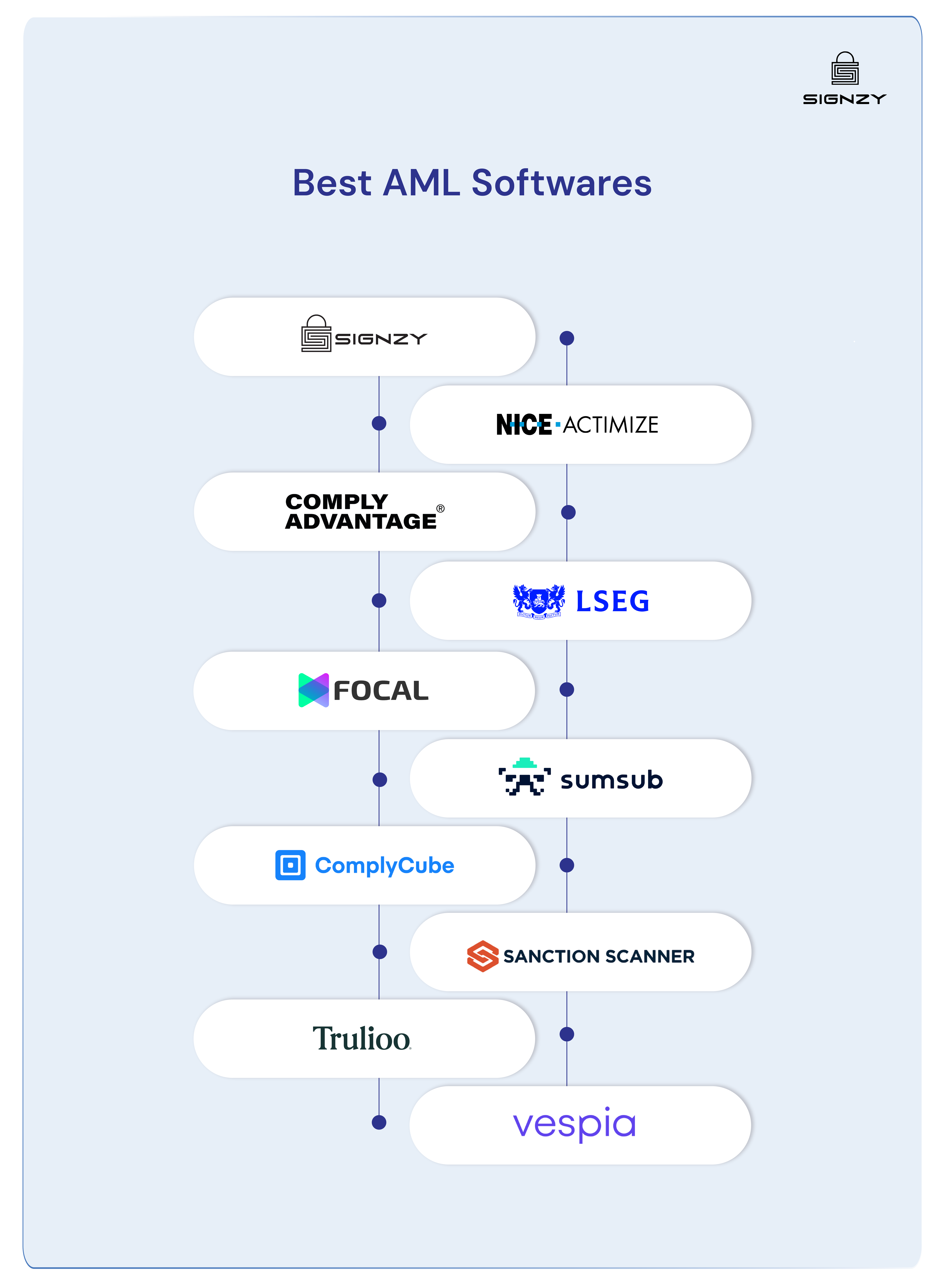
TL;DR: Best AML Softwares, at a Glance
| Solution | Description | Key Features |
|---|---|---|
| Signzy | API-based compliance platform for transaction monitoring | – API-first setup – Enhanced due diligence – Watchlist screening |
| NICE Actimize | Enterprise AML with AI-powered detection | – Entity-focused risk view – Suspicious activity monitoring (SAM) – ActOne case management |
| ComplyAdvantage | AI-driven fraud and AML risk detection | – Real-time global risk data – Graph-based AI detection – API-first setup |
| LSEG (Refinitiv) | Risk intelligence with vast data coverage | – World-Check database – Transaction monitoring – Digital onboarding tools |
| FOCAL by Mozn | MENA-specific AML solution with custom algorithms | – Arabic/Latin name matching – Localized due diligence – Custom risk scoring |
| Sumsub | Full-stack verification platform | – ID and business verification – KYC/AML/KYB tools – Global compliance ready |
| ComplyCube | All-in-one identity and AML compliance platform | – Automated workflows – Multi-channel verification – ID and biometric checks |
| Sanction Scanner | Budget-friendly AML for businesses of any size | – Global database checks – Adjustable risk levels – Tier-based pricing |
| Trulioo | Global identity verification with broad market reach | – Access to international data – Pay-as-you-go model – Cross-border verification |
| Vespia | KYB/AML platform focused on business identity verification | – Analyzes business structures – Ongoing risk monitoring – Verifies beneficial owners |
10 Best AML softwares compared: Overview, features, and more
Now that you’ve seen the overview, let’s dig into the details of all the best AML softwares.
1. Signzy
Signzy consolidates AML compliance with identity verification and fraud detection into a single platform that eliminates the vendor sprawl common in financial compliance.
The platform processes verification requests across 180+ countries with documented performance metrics: 100M+ users verified, sub-3-second API response times, and 2x improvement in fraud detection rates compared to standalone solutions.
💡 Standout Features
Feature #1: Unified KYC and AML Screening
The platform combines document verification, biometric authentication, and AML screening in a single workflow. When a customer submits identification, the system simultaneously validates the document across 10,000+ formats, performs liveness checks to prevent presentation attacks, and screens the individual against PEP databases, sanctions lists, and adverse media sources.
This happens in under 3 seconds, which matters for customer conversion rates. Organizations get a complete risk assessment at onboarding instead of running separate checks that delay account opening or create gaps in compliance coverage.
Feature #2: Real-time Transaction Monitoring with behavioral analytics
Transaction monitoring runs continuously using both rule-based detection and machine learning pattern recognition. The system flags structuring, layering, and unusual transaction sequences while learning from investigator feedback to reduce false positives.
Feature #3: MuleShield Money Mule Detection
Signzy’s proprietary product, MuleShield, analyzes 200+ data points to identify accounts being used as conduits for illicit funds. The system checks phone vintage and porting history, email breach records, employment verification, digital footprints across social and e-commerce platforms, and behavioral patterns that indicate coordinated fraud activity.
Detection happens at onboarding and throughout the customer lifecycle, catching dormant accounts that suddenly activate with pass-through transactions or multiple profiles controlled from the same device.
MuleShield is honestly impressive. It flagged an entire fraud network we never would have connected manually. Seventeen accounts across different states, all opened within three weeks, similar patterns. We were reviewing each one individually and seeing nothing suspicious. Signzy's network analysis connected the dots immediately.
— Risk Director, Cryptocurrency Exchange

Organizations using MuleShield report 72% higher detection rates and 400,000+ mule accounts identified, preventing those accounts from being used to launder fraud proceeds.
2. NICE Actimize
For organizations with complex global operations, NICE Actimize uses The Suspicious Activity Monitoring (SAM) system. It employs some of the most sophisticated risk detection algorithms in the business, though deployment can be resource-intensive. However, smaller organizations might find the solution somewhat overengineered for their needs.
💡Standout Feature: The Detection and Research Tool (DART) enables self-service investigations with intuitive visualization tools that transform complex financial networks into actionable intelligence.
3. ComplyAdvantage
ComplyAdvantage’s graph network detection technology approaches financial crime from a relationship-based perspective, connecting entities and transactions in ways traditional systems simply cannot.
What’s particularly impressive is how ComplyAdvantage delivers advanced capabilities without overwhelming users. Their UI strikes the perfect balance between comprehensive data display and usability, making it accessible for compliance staff with varying technical backgrounds.
💡Standout Feature: Real-time risk database with hourly updates and early warning capabilities outpaces competitors by delivering critical information when it matters most.
4. LSEG (Refinitiv)
When it comes to the sheer depth and breadth of risk intelligence, LSEG’s solutions are hard to beat. The World-Check database serves as the backbone of their offering, providing remarkably comprehensive coverage of global risk entities.
However, where LSEG truly shines is in their digital onboarding solutions. The company has successfully transformed traditionally cumbersome KYC processes into streamlined, customer-friendly experiences without compromising on compliance rigor. The platform lacks some of the AI sophistication found in other entrants, relying more on established methodology.
💡Standout Feature: Enhanced due diligence capabilities deliver good depth of investigation for high-risk clients.
5. FOCAL by Mozn
FOCAL deserves recognition for its specialized approach to AML compliance in emerging markets, particularly across the MENA region. Their name-matching algorithms for Arabic and Latin-text characters solve a problem many global platforms handle poorly.
The system’s fraud detection capabilities demonstrate deep market understanding, identifying region-specific financial crime patterns that more generalized solutions might miss. For organizations with significant MENA exposure, FOCAL offers capabilities that generic global solutions simply can’t match.
💡Standout Feature: Customizable risk scoring tailored specifically for regional compliance requirements creates a truly localized approach to global standards.
6. Sumsub
Sumsub approaches AML compliance from the identity verification angle, offering exceptional tools for ensuring customers are who they claim to be. Their verification flow achieves impressive conversion rates while maintaining strict compliance standards. However, transaction monitoring capabilities aren’t quite as robust as dedicated AML platforms, making it more suitable as part of a broader compliance tech stack.
💡Standout Feature: Lightning-fast verification processing creates a seamless customer experience while maintaining thorough AML checks.
7. ComplyCube
ComplyCube stands out for transforming labor-intensive compliance processes into efficient, automated workflows. Their AI-powered document verification technology achieves impressive accuracy rates without constant human intervention.
The platform offers strong integration capabilities, fitting neatly into existing onboarding processes. However, its case management tools lack some of the sophistication found in enterprise-focused solutions.
💡Standout Feature: Cross-channel identity verification combining document, biometric, and database checks creates a robust system that’s difficult to circumvent.
8. Sanction Scanner
Sanction Scanner focuses on core screening capabilities with minimal setup time. The platform’s adjustable risk parameters allow organizations to calibrate sensitivity based on their specific risk appetite and regulatory requirements. While it lacks some of the advanced analytics offered by premium solutions, it provides excellent value for organizations with straightforward compliance needs.
💡Standout Feature: A customizable alert system allows compliance teams to set organization-specific thresholds, dramatically reducing false positives without compromising security.
9. Trulioo
Trulioo excels in global identity verification, offering exceptional coverage across diverse markets. Their international database access enables rapid verification across jurisdictions, making them particularly valuable for organizations with globally distributed customers.
The platform’s pay-as-you-go option provides flexibility for organizations with variable verification volumes. However, integration requires technical resources, and the solution works best when paired with dedicated case management tools.
💡Standout Feature: Market-leading international coverage enables consistent verification standards across diverse regulatory environments.
10. Vespia
Vespia represents the next generation of AML platforms. Their AI-powered approach to business verification demonstrates particular promise, especially for organizations dealing with complex corporate structures.
The platform’s continuous monitoring capabilities ensure compliance doesn’t end at onboarding, flagging suspicious behavior throughout the customer lifecycle. While still developing their market footprint, Vespia’s innovative approach earns them a spot among established players.
💡Standout Feature: Business verification technology that excels at unraveling complex ownership structures to identify ultimate beneficial owners with remarkable accuracy.
How to pick AML software for your company?
Here's what actually matters when making this decision.
Match the solution to your transaction patterns
Don't buy enterprise-grade transaction monitoring if you process 1,000 monthly payments. Equally, don't try to scale a basic screening tool for complex corporate banking operations. Look at your actual transaction volume, types, and complexity over the past year.
If you handle cross-border wire transfers with multiple intermediary banks, you need relationship mapping and network analysis. If you're running a domestic payments app, you probably don't.
The right fit means the software handles your current volume without performance issues and can scale to maybe 3x that volume. Anything beyond that, and you're paying for capacity you'll never use or capabilities that don't match your risk profile.
🟢 Signzy Advantage: Our APIs scale with your business growth. Start with 1,000 screenings monthly and expand to millions without performance degradation or infrastructure changes. 100M+ users already verified through Signzy with 97% API accuracy, ensuring reliable screening at any scale.
Every month we'd get slammed with alerts before quarter-end. My team worked weekends trying to keep up, and most alerts were garbage. Signzy's filtering changed that completely. We're focusing on actual threats now instead of investigating every minor deviation. Team morale is significantly better too.
— Fraud Prevention Lead, Fintech Lending Platform
Prioritize integration speed over feature completeness
The best AML software is the one that actually goes live. Platforms requiring six months of implementation and custom development work create compliance gaps during deployment. Choose solutions with pre-built connectors for your core systems and API-first architecture that your team can actually implement.
Test this during evaluation. Ask vendors for implementation timelines based on your specific tech stack, not generic estimates. Request references from companies with similar systems. If the vendor can't show successful integrations with your existing infrastructure, keep looking.
Evaluate vendors on investigator efficiency
Most vendors tout their detection capabilities. What matters more is how efficiently your compliance team can work through alerts.
During demos, have your actual compliance staff test the investigation workflow with realistic scenarios. Can they quickly access supporting documentation? Does the case management system actually reduce their workload, or does it add steps? Software that generates perfect alerts but requires hours per investigation will bury your team.
🟢 Signzy Advantage: Advanced filtering and machine learning algorithms reduce false positives significantly while maintaining detection accuracy.
Signzy for smarter AML screening
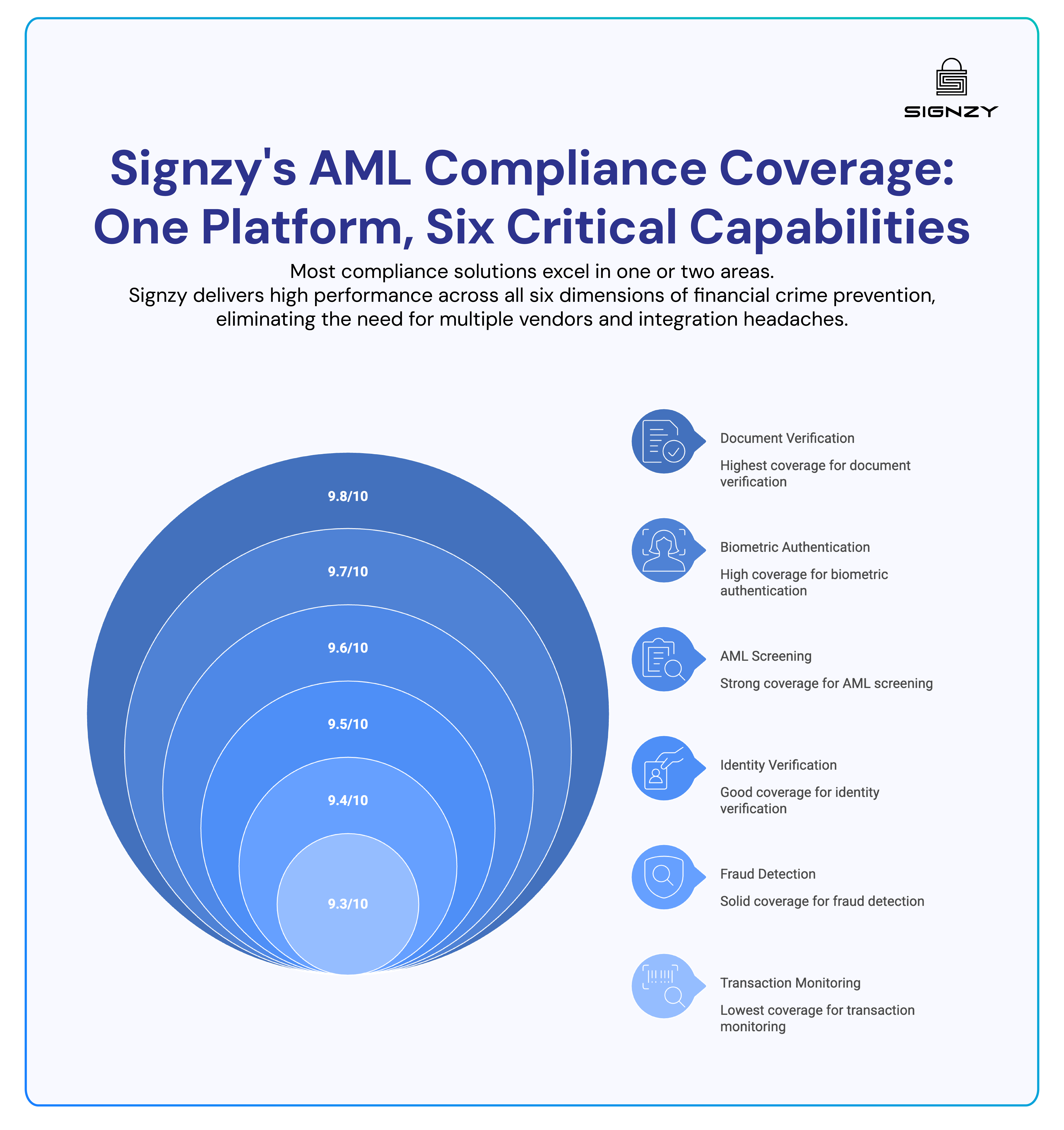
AML compliance fails in two predictable ways: outdated screening data that misses recent sanctions, and fragmented systems that turn simple workflows into integration nightmares. Signzy solves both.
↪ Daily watchlist updates across 200+ jurisdictions
Most AML platforms update their databases weekly or monthly. That creates compliance gaps when regulators add new sanctions or someone gets designated as a PEP between update cycles. Signzy refreshes watchlist data daily across more than 200 jurisdictions, which means you're screening against current information, not last week's or last month's lists.
This matters particularly for companies operating internationally. A customer who clears screening on Monday might appear on a sanctions list by Wednesday. Weekly updates mean you won't catch that change for days. Daily updates flag it immediately, before the next transaction processes or the next regulatory examination happens.
↪ Unified platform eliminates integration chaos
Traditional AML setups force you to juggle multiple vendors and manage separate integrations for different compliance needs. Signzy consolidates your entire compliance stack:
- KYB Verification: Identity verification for individuals and business verification for entities, including document authentication and database checks.
- Risk Assessment APIs: Automated risk scoring that pulls data from screening results, transaction history, and verification outcomes to generate comprehensive risk profiles.
- Bank Account Verification: Validate account ownership and status to prevent fraud and ensure accurate customer financial information.
- Criminal Screening: Access criminal records from federal, state, and local sources to identify potential risks during onboarding and ongoing monitoring.
- UBO Checks: Trace beneficial ownership structures to identify ultimate owners behind complex corporate hierarchies.
All these capabilities connect through a single API integration. When you screen a customer for AML risks, verify their identity, assess their risk level, and monitor their transactions, the data flows automatically between systems because they're part of the same platform.
↪ Go modular based on your needs
You don't need everything at once. Start with standalone AML screening if that's your immediate compliance requirement. Add transaction monitoring when volumes increase. Layer in KYB verification when you start onboarding businesses. Integrate risk assessment APIs as your risk models mature.
Integration was supposed to take six months based on our last vendor disaster. Signzy had us running in production in 3 days. Their API actually worked with our legacy core banking system without custom development. Honestly shocked everyone on our tech team and compliance loved how fast we went live.
— CTO, Regional Credit Union
Each capability works independently, so you're not forced into an all-or-nothing decision. But when you do need additional features, they're already built into the platform you're using.
To try Signzy first-hand, book a demo here.


FAQ
How frequently should AML software be updated?

How long does AML software implementation typically take?
Can AML software completely eliminate manual reviews?
Do all AML solutions work internationally?
Gaurav Gupta
Gaurav Gupta is the Global Product Head at Signzy, leading the strategy and development of the company’s KYC, KYB, AML, and digital onboarding products used by banks, fintechs, and financial institutions across global markets. He specializes in building scalable compliance and verification platforms, transforming complex regulatory and risk workflows into seamless, automated product experiences. Gaurav works at the intersection of product, engineering, and AI.

Related Blogs
View all

![AML Watchlist Screening Guide: Regulations, Tools, and More [2026]](https://cdn.sanity.io/images/blrzl70g/production/d6f119be39abfc6cd718c86eb5a401ddc6d44e66-1920x450.png)


The best in business


The global API marketplace for KYC, KYB, & AML
Explore the end-to-end verification stack trusted by 1,000 businesses.
Get in touch