





What is CKYCRR? Meaning, Function, and More [2026 Guide]

 Open in ChatGPT
Key Highlights
- CKYCRR establishes a centralized KYC repository managed by CERSAI under the Prevention of Money Laundering Act, allowing customers to complete verification once and use their 14-digit KIN across all financial institutions without repeated documentation.
- The system operates through a five-step process where institutions upload verified data, CKYCRR generates unique identifiers, and other entities retrieve information with customer consent, ensuring automatic updates sync across the entire network seamlessly.
- By deploying Signzy, institutions achieve first-time-right submission rates exceeding 99% while maintaining enterprise-grade security through Mutual TLS authentication, JWE encryption, and automated Aadhaar masking that eliminates compliance exposure from manual processes.
- What does CKYCRR mean?
- What is the difference between CKYCRR and CKYC?
- What is the purpose of CKYCRR?
- Why is CKYCRR important in banking?
- What is the legal framework of CKYCRR?
- How does CKYCRR work under CERSAI 2.0?
- Which documents are required for CKYCRR?
- What are the benefits of CKYCRR?
- What is CKYCRR 2.0 Update?
- How to implement CKYCRR 2.0?
- How can Signzy help with CKYCRR 2.0 compliance?
- FAQ
Central Know Your Customer Records Rules (CKYCRR) represents one of India's most significant regulatory frameworks for financial institutions, yet the recent transition to CKYCRR 2.0 has created an infrastructure crisis that many business leaders underestimated. What regulators positioned as a system upgrade is actually a complete platform replacement that renders existing KYC workflows obsolete.
Over 7,166 reporting entities regulated by RBI, SEBI, IRDAI, and PFRDA must now comply with a system that validates data in real time and demands technical capabilities that legacy Core Banking Systems simply cannot provide.
The first step toward readiness is understanding the system itself. Let's start by understanding what CKYCRR means, its full form, and how this regulatory framework fundamentally impacts financial operations.

What does CKYCRR mean?
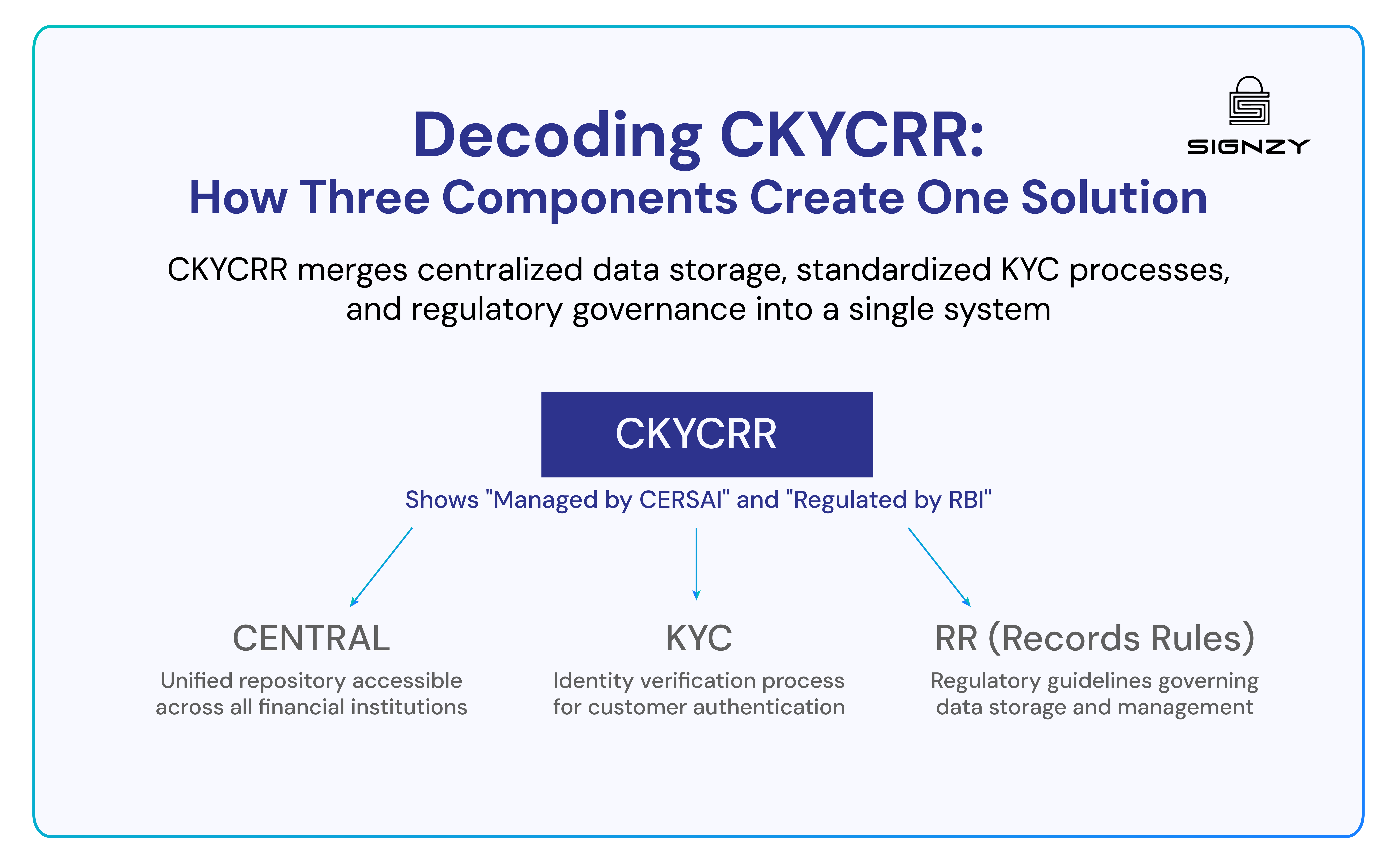
CKYCRR stands for Central Know Your Customer Records Rules. It's a regulatory framework established by the Reserve Bank of India that creates a centralized system for storing customer identification records across the financial sector.
The CKYCRR full form explains its purpose quite clearly:
- “Central” refers to the unified nature of the system
- “Know Your Customer” points to the identity verification process
- “Records Rules” indicates the regulatory guidelines governing how this information is managed.
The system operates through a Central KYC Registry, which acts as the repository for all these records. This record includes your basic identification details, address proof, and other necessary documents that financial institutions require for compliance.
What is the difference between CKYCRR and CKYC?
CKYCRR and CKYC are closely related but refer to different aspects of the same system. Understanding the distinction helps clarify how the centralized identification framework actually works.
CKYCRR, or Central Know Your Customer Records Rules, is the regulatory framework itself. It's the set of rules and guidelines laid down by the Reserve Bank of India that governs how the centralized KYC system should operate. Think of it as the rulebook that defines what information needs to be collected, how it should be stored, who can access it, and what standards must be followed.
CKYC, on the other hand, stands for Central Know Your Customer. This refers to the actual records or the centralized repository where your verified identity information is stored. When you complete your KYC at any financial institution, your details get uploaded to the CKYC registry. It's the practical implementation of what CKYCRR mandates.
In simpler terms, CKYCRR is the law, and CKYC is the system built to follow that law. The rules tell institutions what they must do, while the registry is where they do it.
What is the purpose of CKYCRR?
CKYCRR was designed to solve the redundancy and inefficiency that plagued India's financial identification system.
- It eliminates the need for customers to submit KYC documents repeatedly at different financial institutions, saving time and reducing paperwork.
- It creates a uniform standard for identity verification across banks, insurance companies, mutual funds, and other financial entities, ensuring consistency in compliance.
- It reduces operational costs for financial institutions by allowing them to access verified records instead of conducting fresh verification processes for each customer.
- It enhances security and accuracy by maintaining a single, centralized record that reduces the chances of discrepancies or fraudulent documentation.
- It speeds up the account opening and onboarding process, making financial services more accessible and convenient for customers.
- It helps regulatory authorities monitor and ensure compliance more effectively by centralizing records in one accessible location.
The overall purpose boils down to making the financial system more efficient for everyone involved while maintaining strong compliance and security standards.
Why is CKYCRR important in banking?
For banks and financial institutions, CKYCRR represents a shift in how they build relationships with customers. The traditional onboarding process was lengthy and often frustrating for both parties. Customers had to wait days or even weeks for account activation, while banks invested significant resources in verification teams and document management. CKYCRR removes these friction points by providing instant access to pre-verified customer data.
What is the legal framework of CKYCRR?
CKYCRR operates within a comprehensive legal structure that combines multiple pieces of legislation to create a unified approach to customer identification in India's financial sector.
The foundation rests primarily on two acts.
- The Prevention of Money Laundering Act, 2002 (PMLA): Provides the anti-money laundering framework that makes KYC mandatory for financial institutions. This act came into force in 2005 and establishes the requirement for regulated entities to verify customer identities and maintain records.
- The Securitisation and Reconstruction of Financial Assets and Enforcement of Security Interest Act, 2002 (SARFAESI): provides the legal backing for CERSAI, the organization that actually operates the Central KYC Registry. Section 20 of SARFAESI authorized the creation of CERSAI as the central registry administrator.
These acts work together with the RBI Master Direction on Know Your Customer, which serves as the operational guideline for how financial institutions must implement KYC requirements.
Key Provisions
- Regulated entities must upload KYC details for individual accounts opened from January 1, 2017, onward.
- Legal entities like companies and trusts require mandatory KYC submission from April 1, 2021
- Institutions can retrieve existing records from CKYCRR when customers provide their KYC identifier with explicit consent.
- Updated customer information must be submitted to CKYCRR within seven days of receiving changes.
- Risk-based categorization divides customers into high-risk (update every 2 years), medium-risk (every 8 years), and low-risk (every 10 years)
- Customer Due Diligence procedures require verification of identity, address, and beneficial ownership information.
- Existing KYC-compliant customers do not need fresh verification when opening additional accounts with the same institution.
Key Notifications of CKYCRR
- Ministry of Finance notification dated January 1, 2017, authorized CERSAI to function as the Central KYC Records Registry
- RBI notification dated December 18, 2020, extended CKYCRR requirements to legal entities effective April 1, 2021
- November 2024 RBI amendment aligned procedures with updated Prevention of Money Laundering Rules.
- June 2025 circulars introduced extended timelines for low-risk customers and structured reminder systems to prevent account inoperability.
- Multiple amendments to the RBI Master Direction on KYC refined the framework with provisions for digital KYC, Aadhaar-based verification, and enhanced due diligence requirements.
How does CKYCRR work under CERSAI 2.0?
CKYCRR creates a streamlined pathway for customer verification that removes redundancy from the financial system. The process operates through five steps:
Step #1: Institution searches existing records
When a customer approaches a financial institution to open an account or avail services, the institution first searches CKYCRR using the customer's PAN, Aadhaar number, or mobile number to check if a verified KYC record already exists. This search happens before requesting any documents from the customer.
If an existing record is found, the institution can retrieve it directly with customer consent, eliminating the need for fresh documentation.
If no record exists, the process moves to record creation.
Step #2: New record creation and upload
For customers without existing CKYCRR records, the institution collects standard KYC documents, including identity proof, address proof, and a recent photograph. After verifying these documents against official databases, the institution uploads the verified information to CKYCRR through the CERSAI portal.
In CKYCRR 1.0, this happened through scheduled batch file uploads. In CKYCRR 2.0 (more on this later in the article), institutions submit data through real-time APIs using standardized JSON formats with instant validation that rejects incomplete or incorrectly formatted submissions immediately.
Step #3: System generates a unique identifier
CKYCRR processes the uploaded information and generates a unique 14-digit KYC Identifier, commonly known as KIN. This number becomes the customer's permanent identification code within the centralized KYC system. CERSAI sends this identifier through SMS and email to the customer's registered contact details.
The customer can use this identifier across all financial institutions without repeating the documentation process. This number remains valid throughout the customer's lifetime unless the record is deactivated.
Step #4: Retrieval by other institutions
When the customer approaches a different financial institution for opening accounts or accessing services, they provide their KYC Identifier along with explicit consent for data access. The new institution retrieves complete verified information directly from CKYCRR using the identifier.
Step #5: Updates and lifecycle synchronization
When a customer updates information at any financial institution, such as changing address, phone number, or adding new identity documents, that institution uploads the modified details to CKYCRR.
The registry then pushes electronic notifications to all other financial entities where the customer has existing relationships. However, automatic synchronization depends on institutional infrastructure.
Modern systems with middleware solutions like Signzy can listen for these unsolicited updates and sync changes to internal Core Banking Systems automatically. Legacy systems without API connectivity require manual downloads and integration, creating gaps where internal records become outdated until staff manually refresh them.
Which documents are required for CKYCRR?
CKYCRR documents include standard identification and address proofs that customers submit once for verification across all financial institutions. At the core, customers need to provide documents that prove their identity and address.
Collect at least one valid proof of identity and one proof of address from these:
- Proof of Identity: PAN card, Aadhaar card, passport, Voter ID card, Driving license, NREGA job card.
- Proof of Address: Passport, Voter ID card, Driving license, Aadhaar card, utility bills (electricity, water, telephone, piped gas - not more than 2 months old), Bank account statement, rent agreement.
- Additional documents: Recent passport-size photographs, signature specimen.
What are the benefits of CKYCRR?
🟢 Faster customer onboarding: Financial institutions can onboard customers in real time without waiting for document verification delays. A mutual fund investor can complete registration and start investing within minutes instead of the traditional three to five-day processing period.
🟢 Lower operational costs: Banks reduce storage and management costs associated with physical document archives. Instead of maintaining separate filing systems and dedicated staff for document retrieval, institutions simply access the centralized registry.
🟢 Convenience for mobile customers: Customers moving between cities or changing banks avoid the frustration of gathering documents repeatedly. Someone relocating for a job can open a new bank account at their destination without carrying physical proof from their previous location.
🟢 Fraud detection across institutions: The system catches discrepancies across institutions that might indicate fraudulent activity. If someone tries to open accounts with different addresses at multiple banks simultaneously, the centralized records flag the inconsistency.
🟢 Reduced burden on vulnerable groups: Senior citizens and rural customers benefit from reduced branch visits. Once their KYC is registered at one institution, they can access services from others without repeatedly traveling to submit paperwork.
🟢 Better credit and risk assessment: Financial institutions gain clearer visibility into customer relationships across the sector. This helps them make better lending decisions and offer appropriate products based on a more complete financial profile.
What is CKYCRR 2.0 Update?
CKYCRR 2.0 is an upgraded version of CKYCRR. Announced in the Union Budget 2025, the revamped system now operates through real-time API connectivity with instant validation, facial recognition-based de-duplication, mandatory Aadhaar masking, and strict document quality standards.
The official statement, given by CERSAI's MD and CEO in their Apr-Jun 2025 newsletter, reads as follows:
The new CKYCRR will leverage cutting-edge technologies, including AI-based matching algorithms and face match technology, to significantly improve the accuracy and efficiency of KYC verification…This comprehensive update to the CKYCRR will enable financial institutions to onboard customers faster and more securely, while also providing individuals with more control over their KYC data.

CKYCRR vs CKYCRR 2.0: Key Differences
| Aspect | CKYCRR 1.0 | CKYCRR 2.0 |
|---|---|---|
| Submission Method | Bulk file uploads | Real-time API calls |
| Validation Timing | Days after submission | Instant at submission |
| Error Discovery | Delayed bulk rejections | Immediate field-level failures |
| Document Quality | Lenient standards accepted | Strict DPI specifications |
| Privacy Handling | Manual Aadhaar masking | Automated mandatory masking |
| Data Format | CSV and XML | Structured JSON only |
| Security Layer | Basic IP whitelisting | Mutual TLS authentication |
| Encryption Standard | Simple XML protection | JWE with RSA-OAEP |
| Duplicate Detection | ID number matching | Facial recognition technology |
| Match Resolution | Auto-merged or ignored | Visual approval required |
| Customer Authentication | Mobile OTP only | Multiple verification modes |
| Update Notifications | None from registry | Automatic push alerts |
| CBS Integration | Native batch support | Requires a middleware layer |
| Processing Window | End-of-day batches | Continuous real-time processing |
| Rejection Impact | Discover later, resubmit | Customer drops immediately |
| Workflow Speed | Days to weeks | Seconds to minutes |
| Verification Proof | Self-reported only | Source-verified flags available |
How to implement CKYCRR 2.0?
Implementation requires coordinated technical and operational transformation across three phases:
- Phase 1: Technical Connectivity: Deploy data transformation middleware such as Signzy to convert legacy CBS formats into CKYC 2.0 compliant JSON with Mutual TLS authentication and OAuth 2.0 token management
- Phase 2: Operational Readiness: Establish maker-checker workflows with automated Aadhaar masking, visual de-duplication interfaces, and straight-through processing that triggers CKYC uploads on approval
- Phase 3: Lifecycle Management: Configure intelligent listeners to capture unsolicited CERSAI updates, auto-sync changes to internal systems after customer consent, and maintain audit trails for regulatory compliance
Phase 1 alone can consume months when building data transformation layers from scratch. Middleware solutions such as Signzy eliminate this bottleneck with universal data transformers that accept any legacy format and output CERSAI-compliant JSON. Alongside, it can handle the security protocols and automated workflows required in subsequent phases.
Below’s a detailed look at how Signzy can help with CKYCRR 2.0.
How can Signzy help with CKYCRR 2.0 compliance?
Signzy acts as an intelligent middleware layer that bridges legacy Core Banking Systems to CERSAI 2.0, transforming what would be a 6-8 month infrastructure rebuild into just a 48 to 72-hour integration. Key capabilities include:
⚡ Real-time API orchestration manages structured JSON data exchange with CERSAI, eliminating manual uploads and custom transformation layers that typically consume months of development effort.
🎯 First-time-right data validation auto-sanitizes customer information before submission through AI rule engines, reducing CERSAI API rejection rates from 60% to under 1% and preventing customer drop-offs at onboarding.
🖼️ Image and identity intelligence automatically crops, de-skews, and enhances document uploads to meet strict DPI requirements while neural networks mask Aadhaar numbers instantly, ensuring 100% privacy compliance without human intervention.
🔄 De-duplication and record hygiene provide visual comparison interfaces with confidence scores for probable facial matches, enabling one-click merge or create-new decisions that resolve duplicates before submission rather than after rejection.
📡 Lifecycle sync capabilities act as 24/7 listeners capturing unsolicited CERSAI updates when customers modify records elsewhere, automatically syncing changes back to CBS and LMS systems after obtaining consent to keep internal records current without operational overhead.
Signzy gave us enterprise-grade capabilities at a fraction of the cost. Their straight-through processing reduced our onboarding TAT from 48 hours to under 5 minutes, giving us a competitive edge against legacy banks.
— COO, Fintech Startup.
Financial institutions looking to transition to CKYCRR 2.0 without operational disruption can explore Signzy’s Agentic CKYC Platform to see how automated monitoring, intelligent remediation workflows, and real-time compliance orchestration simplify end-to-end adherence to regulatory requirements. Schedule a demo with Signzy to understand exactly how your institution can comply with evolving CKYC requirements at scale.


FAQ
What is the meaning of CKYCRR?

What is CKYCRR Full Form in Banking?
Is CKYCRR mandatory?
What is the CKYCRR Record?
What is the CKYCRR Bearing Number?
Why is CKYC fetched?
Roshan Kumar
Roshan leads product strategy for Identity and Fraud Verification at Signzy Technologies, where he oversees the development of secure, scalable ID Verification, Automated CKYC, and AI-powered Video KYC solutions for regulated banks and fintechs. With over five years of hands-on experience in KYC and API banking and a strong engineering background, he focuses on building platforms that ensure seamless and compliant onboarding across the BFSI sector. His expertise spans designing and implementing solutions that address evolving regulatory requirements and industry challenges.

Related Blogs
View all

Demystifying CKYC: A Step-by-Step Guide to Completing the Process

Top 10 KYC Verification Solution Providers in India (2026)

Bringing KYC to Every Corner of India with RBI: Video KYC, Security, and More

Identity Verification v.s. Identity Authentication: Similarities and key differences
The best in business


The global API marketplace for KYC, KYB, & AML
Explore the end-to-end verification stack trusted by 1,000 businesses.
Get in touch