





Why Lite Domain Checks Strengthen Compliance Pipelines and Audit Trails

- What is a Lite Domain Check?
- Why Lite Domain Checks Add Value in Compliance Pipelines
- The Hidden Risks of Skipping Lite Domain Checks
- Compliance Pipelines Are About Balance
- Case Example: Banking Onboarding
- How Lite Domain Checks Strengthen Audit Trails
- Practical Tips for Implementing Lite Domain Checks
- The Future of Domain Screening in Compliance
- FAQ
In compliance, details matter. Whether you’re a fintech onboarding thousands of new users, a healthcare provider protecting patient data, or an e-commerce company building trust, the most minor gaps can quickly spiral into costly risks. One such detail that often goes overlooked is domain verification.
Most teams know the importance of robust domain screening, verifying whether an email domain is valid, safe, and compliant with regulatory requirements. But what about a lite domain check? Is it even worth the effort when it’s just a basic signal?
The answer: Absolutely. Even a lite domain check adds measurable value to compliance pipelines and audit trails. It’s a low-cost, high-return step that helps you reduce compliance costs, strengthen audit trails, and avoid regulatory penalties.

In this post, we’ll explore:
- What does a lite domain check mean?
- How it strengthens compliance pipelines and audit trails.
- Real-world risks of ignoring it.
- Why regulators increasingly expect domain screening as part of KYC and AML processes.
- How businesses can implement lightweight but effective checks.
What is a Lite Domain Check?
Think of domain verification as a spectrum. At one end, you have full-scale domain screening, deep investigations into domain ownership, age, infrastructure, and risk signals. At the other end, you have a lite domain check, a quick validation of whether the email domain exists, is formatted correctly, and isn’t an obvious red flag like a disposable or temporary service.
A lite domain check may include:
- Verifying that the domain exists (DNS records are live).
- Ensuring it’s not a throwaway email provider.
- Checking basic age signals (brand-new domains can indicate risk).
- Identifying whether the domain is tied to known malicious activity.
It’s simple, fast, and inexpensive. But its value compounds once it’s integrated into compliance pipelines.
Why Lite Domain Checks Add Value in Compliance Pipelines
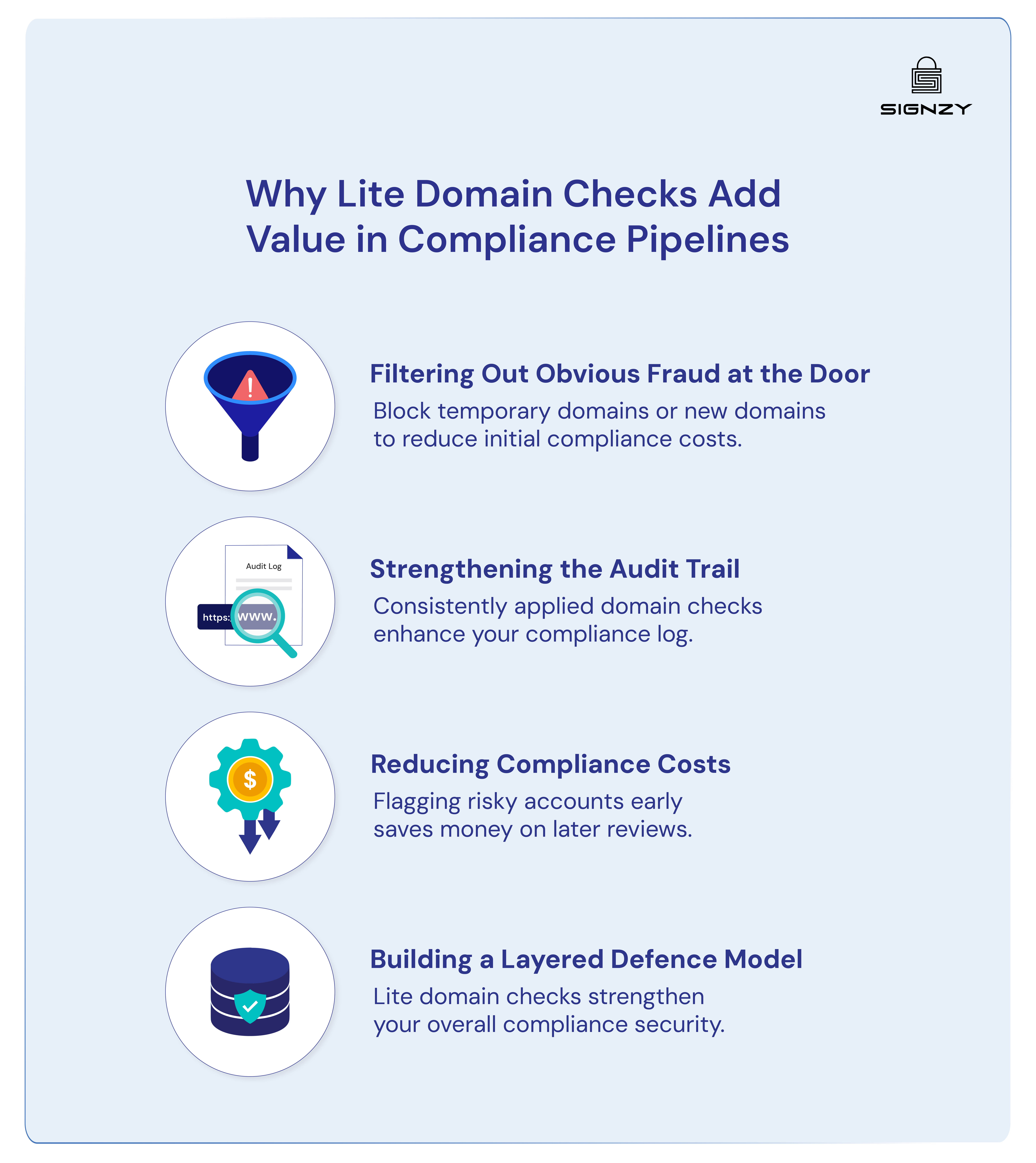
1. Filtering Out Obvious Fraud at the Door
Compliance teams spend enormous resources on due diligence, KYC verification, AML monitoring, and ongoing checks. If a fraudulent actor slips through at the very first point of contact (say, with a disposable email domain), you’re already fighting an uphill battle.
A lite domain check can flag these low-effort fraud attempts instantly. By blocking temporary domains or domains less than a week old, you reduce downstream compliance costs and avoid wasted reviews.
2. Strengthening the Audit Trail
When regulators conduct audits, they’re not just looking at outcomes; they’re looking at process integrity. Did you take reasonable steps to verify user identities? Can you prove that every account went through proper screening?
Even a basic domain verification entry strengthens your audit trail because it shows that domain checks were consistently applied. This kind of log builds trust: it proves your pipeline didn’t skip the fundamentals and that your compliance process is thorough.
3. Reducing Compliance Costs
Every compliance review has a price tag, whether it’s staff hours, escalations, or reporting. The earlier you identify a risky account, the less you spend cleaning up later.
Take a simple example:
- Without domain checks: a fake account makes it through, triggering KYC verification and eventually landing on a manual review desk.
- With lite domain checks: that same account is flagged at the first step because the email domain is disposable or too new. The fraud attempt never reaches the expensive parts of your compliance pipeline.
Catching bad actors early doesn’t just strengthen compliance pipelines; it directly saves money.
4. Building a Layered Defence Model
Modern compliance pipelines rely on a layered security approach. No single check is enough, but together, they create a strong net. A lite domain check may not catch sophisticated fraud, but it raises the baseline of security and prevents your advanced systems from being overloaded with trivial cases.
Think of it like a sieve: you don’t use a fishing net to catch sand, you use a filter first. Domain checks are that filter.
The Hidden Risks of Skipping Lite Domain Checks
It can be easy for teams to assume that lite domain checks are “too simple to make a difference.” But overlooking them introduces subtle risks that quietly build up over time and weaken overall compliance health.
When lite checks are skipped, organisations face problems such as:
- Audit trail gaps: Without consistent domain verification, it becomes harder to prove that proper steps were taken during compliance reviews.
- Increased fraud exposure: Disposable or brand-new domains are often the first tool fraudsters use to bypass onboarding.
- Metric distortion: Fake sign-ups inflate growth numbers, distorting compliance reporting and business KPIs.
- Higher downstream costs: Manual reviews pile up, increasing operational strain.
Ignoring lite domain checks doesn’t save you time; it only shifts the burden downstream.
Compliance Pipelines Are About Balance
Not every organisation needs full-scale domain intelligence for every account. But every organisation benefits from some level of domain screening. A lite check is that balance, catching the obvious, leaving the complex cases for deeper investigation.
In fact, regulators increasingly view even basic signals as non-negotiable. When financial institutions face audits, the question isn’t “did you use advanced AI to check every domain?” It’s “did you take reasonable, consistent steps to prevent risk?” Lite checks prove that you did.
Case Example: Banking Onboarding
Consider a digital bank onboarding new users:
- Without lite domain checks, A fraudster uses multiple disposable domains to open fake accounts. They pass the early KYC because the ID is well forged. Weeks later, suspicious transactions trigger AML alerts, escalating into a costly investigation.
- With lite domain checks, Disposable domains are flagged at signup. Most fraudulent attempts are rejected instantly, reducing load on KYC systems. Audit logs show that domain verification was part of every account’s onboarding journey.
The difference? Thousands of dollars saved, smoother audit trails, and stronger compliance credibility.
How Lite Domain Checks Strengthen Audit Trails
Audit trails thrive on consistency. Every step logged builds a narrative regulators can follow. By including domain checks, even lite ones, your audit trail benefits in three ways:
- Transparency: Regulators see that every user is subject to the same baseline screening.
- Traceability: Logs show not just outcomes but also signals used for decision-making.
- Accountability: If fraud slips through, you can demonstrate that reasonable steps were taken.
In other words, audit trails aren’t just about what you found; they’re about what you checked.
Practical Tips for Implementing Lite Domain Checks
- Integrate at Signup - Place domain verification right at the first user interaction. Don’t let fake domains even enter your compliance pipeline.
- Log Every Check - Even if the result is “pass,” store it in your compliance database. Audit trails gain value from completeness, not just red flags.
- Use Disposable Domain Blacklists - Maintain an updated list of throwaway providers to block the most obvious risks.
- Add Simple Age Rules - New domains under 30 days old should be flagged for higher scrutiny.
- Layer with Other Signals - Domain checks are powerful but not standalone. Combine them with IP screening, device fingerprinting, and document verification.
The Future of Domain Screening in Compliance
As fraud evolves, regulators are tightening expectations. Lite checks today may become mandatory checks tomorrow. Financial institutions, healthcare providers, and e-commerce platforms that implement them now stay ahead of both compliance and fraud curves.
More importantly, domain verification scales. What begins as a light check can evolve into a full screening when needed. The key is to build it into the pipeline from the start, so compliance and audit teams always have domain intelligence at their fingertips.
At the end of the day, compliance pipelines aren’t only about avoiding penalties. They’re also about building customer trust, protecting core systems, and keeping operations smooth.
A lite domain check may feel like a minor step in that journey, but its impact can be significant blocking obvious risks early, reducing compliance costs, and strengthening audit trails with minimal effort:
- Catching obvious fraud at the door.
- Strengthening audit trails with consistent logs.
- Reducing compliance costs downstream.
- Demonstrating diligence to regulators.
In short, lite domain checks are the low-hanging fruit of compliance pipelines, simple, effective, and increasingly essential.
The next time someone asks whether a lite domain check is worth it, the answer is simple: yes, because even the smallest step strengthens the entire compliance chain.


FAQ
What is a lite domain check?

How does a lite domain check help in compliance pipelines?
Why are lite domain checks important for audit trails?
Are lite domain checks enough on their own?
Do regulators require domain checks for compliance?
Can lite domain checks reduce compliance costs?
What industries benefit most from lite domain checks?
Roshan Kumar
Roshan leads product strategy for Identity and Fraud Verification at Signzy Technologies, where he oversees the development of secure, scalable ID Verification, Automated CKYC, and AI-powered Video KYC solutions for regulated banks and fintechs. With over five years of hands-on experience in KYC and API banking and a strong engineering background, he focuses on building platforms that ensure seamless and compliant onboarding across the BFSI sector. His expertise spans designing and implementing solutions that address evolving regulatory requirements and industry challenges.

Related Blogs
View all

How Domain Intelligence Strengthens Your Sales Funnel

What Is Domain Verification? Use Cases, Automation, and More

Real-Time Fraud Detection at Checkout: Why Domain Age Signals Risky Orders

Best Practices for Large-Scale URL Screening with Limited Latency
The best in business


The global API marketplace for KYC, KYB, & AML
Explore the end-to-end verification stack trusted by 1,000 businesses.
Get in touch