





Stopping AI Fake IDs: Advanced ID Verification Guide

 Open in ChatGPT
🗒️ Key Highlights
- AI-generated fake IDs are synthetic identity documents created using artificial intelligence that combine stolen personal information with fabricated details, enabling fraudsters to bypass traditional verification and commit large-scale financial crimes.
- Effective prevention requires live capture with liveness detection to block digital fakes, AI-powered deepfake detection analyzing pixel patterns, and cross-validation of MRZ, barcodes, and biometric data across multiple independent sources.
- Signzy's advanced verification combines multi-layered document authentication with AI-powered deepfake detection to stop synthetic identities before they infiltrate your platform.
Fake IDs have plagued businesses for decades, but artificial intelligence has fundamentally changed the game. What once required specialized skills, expensive equipment, and days of work can now be accomplished in minutes for less than the cost of lunch.
Platforms like OnlyFake generate sophisticated fake identity documents for just $15, producing thousands daily with security features convincing enough to fool traditional verification systems.
Over half of American businesses reported encountering fake ID documents in 2023, while US lenders face $3.3 billion in exposure to synthetic identities.
But here's what many businesses don't realize: while AI has made creating fake IDs easier, it's also made detecting them more effective. Modern verification technology uses the same AI capabilities to spot the digital fingerprints that synthetic identities leave behind.
Below, we will explore how AI-generated fake IDs work, which industries face the highest risk, and most importantly, the practical methods your business can implement to stop them before they cause damage.
Related Solutions

What is an AI-generated fake ID?
An AI-generated fake ID is a completely fabricated identity document created using artificial intelligence tools rather than traditional forgery methods like Photoshop or physical alterations. Google’s Nano Banana is a hot topic now. If you surf social media, you know how accurately such AI image generation models can produce images including identities.
For example, see this LinkedIn post of Yaswanth Sai Palaghat, who created a fake ID of Aryabhatta using AI:
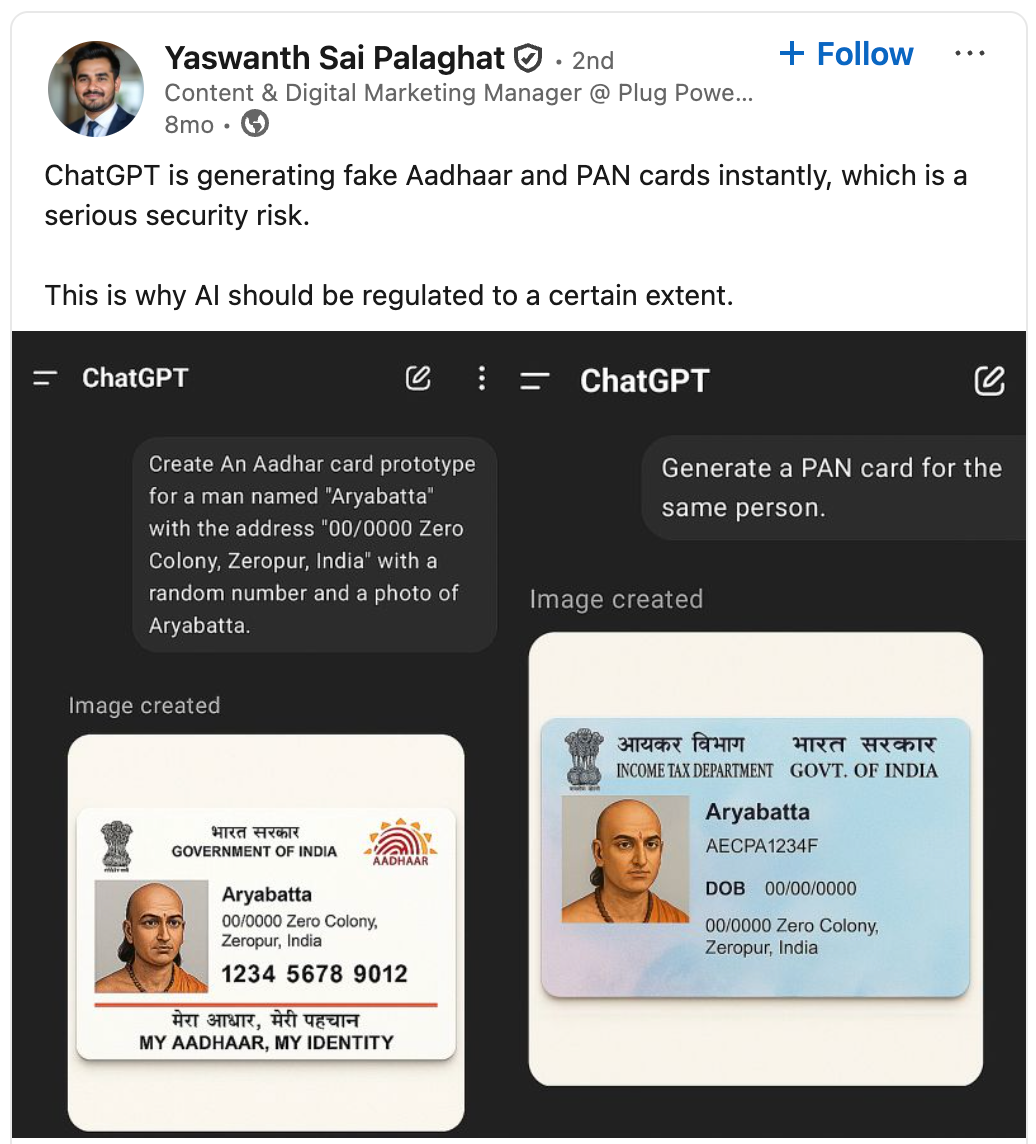
As he shared, AI has generated core Indian identity verification documents with a nice accuracy.
These fake IDs combine stolen personal information, like Social Security numbers, names, and photos scraped from social media, with fabricated details to create what's called a "synthetic identity."
How does AI create fake IDs?
AI creates fake IDs by training on thousands of real identity documents to learn their exact structure, then generating new fake documents from scratch in seconds using stolen or fabricated personal information.
For a detailed process, read below:
- Training on real documents: AI models analyze genuine passports, driver's licenses, and ID cards to learn fonts, layouts, security features, and formatting standards for different countries and states.
- Data input: Criminals enter stolen information like names, dates of birth, Social Security numbers, and photos (often scraped from social media) into AI platforms.
- Instant generation: The AI produces a photorealistic fake ID in minutes, complete with holograms, watermarks, barcodes, and machine-readable zones that match official formats.
- Realistic staging: Advanced systems add background textures (bed covers, car seats, tables) to make the fake ID look like it was photographed in real-life conditions rather than digitally created.
Unlike traditional forgery, AI can generate thousands of fake IDs per day by simply uploading spreadsheets of personal data, making fraud scalable and cheap.
According to a survey conducted by IDScan.net,
7% of high school students admitted to owning a fake ID. The number grew to 69% in the case of college students, who admitted to owning or having used a fake ID.

While in these cases, the fake IDs were mostly used to buy alcohol or get into clubs, fake IDs are also used to commit credit card, loan, or other financial fraud.
One primary offender in this fake ID crisis was OnlyFake.
What is the OnlyFake crisis?
404 Media, a news outlet, did an exposé on the underground online platform called OnlyFake. The platform could allegedly generate photos of fake IDs using “neural networks” for only $15.
While a lot of experts believed that OnlyFake did not use AI for the complete ID generation process, it was believed that AI was used to create a large number of renders of fake IDs. These renders were then worked on manually to create convincing images of fake IDs like driver’s license, passports and more.
Allegedly, the site’s users could either input data like name, address, pictures and generate an OnlyFake ID, or use a pre-generated render already present on the website.
How to fight against fake ID frauds? 4 Best methods explored
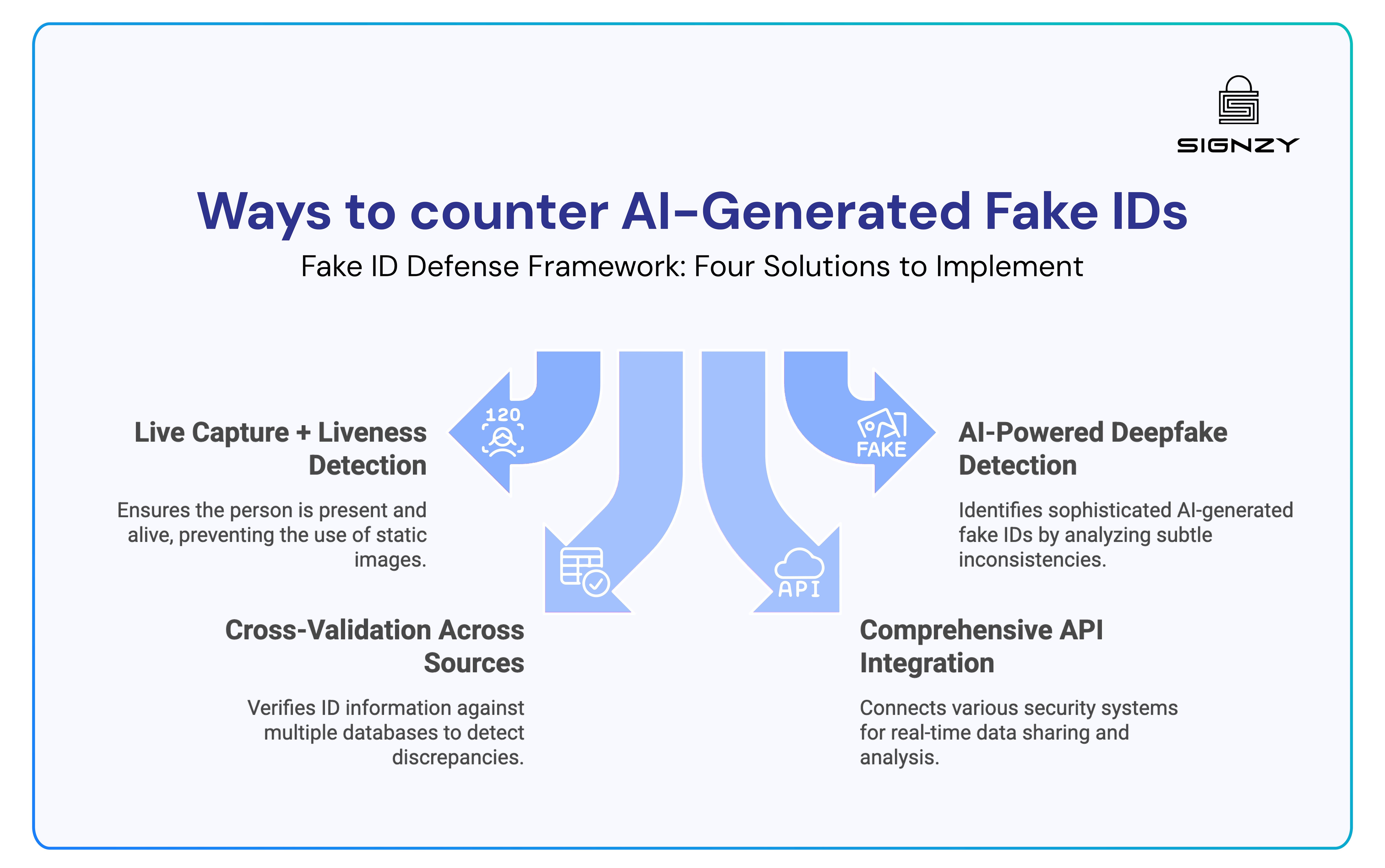
The simplest and most effective first step to stop fake ID fraud is requiring live capture with liveness detection, which immediately blocks AI-generated fakes that exist only as digital images.
Beyond that, organizations must deploy AI-powered detection, cross-validate data sources, build layered workflows, analyze user behavior, train staff properly, and continuously update systems to stay ahead of evolving threats.
Below’s a detailed answer for all the methods you can use to counter fake ID fraud.
Method #1: Require live capture with liveness detection
Most fake ID platforms like OnlyFake, or AI image generation platforms generate static digital images, not physical cards. Requiring real-time capture of a physical document with proof that a real person is present blocks the majority of AI-generated fraud before it reaches manual review. To implement, you can:
- Disable gallery access in your verification flow so users cannot upload pre-saved images from their device storage.
- Build verification that only accepts photos taken through your app's camera interface in real-time, not from external sources.
- Prompt users to capture front, back, and one tilted angle showing hologram movement and light reflection.
- Run AI analysis on the selfie to detect micro-movements, skin texture, depth cues, and light reflections that confirm a real person.
- Ask users to tilt the ID during capture to show shifting holograms, check for physical texture and glare patterns that screens and printed fakes cannot replicate.
- Check metadata to confirm photos were taken within the last 2-3 minutes, not hours ago when someone had time to generate fakes.
Even if someone creates a perfect-looking fake ID image, they cannot fake the physical properties and real-time behavioral cues that liveness detection analyzes.
This single barrier eliminates purely digital fakes immediately. Now, we are going to discuss even advanced way to counter fake IDs.
Method #2: Use AI-powered deepfake and manipulation detection
Fight AI with AI. Modern fraud detection systems are specifically trained to spot the digital fingerprints that AI-generation leaves behind.
Advanced solutions like Signzy’s deepfake detection API targets multiple fraud vectors including face swapping, image and video injections, synthetic content generation, and face manipulations.
The platform leverages advanced pixel analysis and pattern recognition to identify anomalies in real time, providing response times under 5 seconds. This speed is critical because fraudsters often test systems rapidly, and delayed detection gives them time to refine their attacks.
What makes this particularly powerful is continuous evolution. Leading identity verification platforms like Signzy retrain their systems regularly on new fake ID samples, staying ahead of evolving fraud techniques. As fraudsters develop new techniques, these systems adapt faster, creating an arms race where defense consistently stays one step ahead.
Honestly, I didn't expect Signzy to cut our onboarding headaches this much. Their Identity Verification tool flows without tripping users, and my team doesn’t get buried under dumb mismatches every hour.
— Operations Lead, fintech (200+ employees)
Method #3: Cross-validate data across multiple sources
Creating a fake ID that passes one verification check is achievable, but creating one that perfectly matches across five or six independent data validation points exponentially increases difficulty and cost, pricing out most fraudsters. The key is never relying on a single source of truth. Not all, but some of the other points you can validate are:
- Cross-match MRZ, barcode, and visual zones: Extract data from the Machine Readable Zone, 2D barcode, and visible printed text using intelligent OCR. All three must match exactly. Fake IDs often have inconsistencies because fraudsters perfect one zone but fail on others.
- RFID/NFC chip verification: For e-passports and modern IDs with embedded chips, read the encrypted chip data. This provides digitally signed information that's nearly impossible to forge and is the most secure verification available.
- Fraud database screening: Check proprietary fraud databases to see if this specific ID number or identity combination has been flagged in previous fraud attempts across the industry.
- Biometric face matching; Compare the ID photo with the live selfie, focusing on unchangeable facial features like nose shape, eye spacing, and chin structure that remain consistent even when hair color or weight changes.
- Template validation: Verify that the ID's design, dimensions, fonts, and security feature placement exactly match the official template for that specific state, country, and issuance year. Fraudsters often use outdated or generic templates that don't align with current government standards.
Method #4: Use comprehensive and reliable identity verification APIs
Instead of building verification systems from scratch or piecing together multiple point solutions, modern API platforms offer out-of-the-box solutions you can plug-and-play. This approach saves development time, reduces technical complexity, and ensures you're using constantly updated fraud detection models without managing the infrastructure yourself.
Platforms like Signzy even provide complete identity verification suites that bundle document verification, biometric authentication, liveness detection, deepfake detection, face matching, and database checks under the same workflows. Basically, you get enterprise-grade fraud prevention without needing separate vendors for each verification layer.
Most importantly, you can start with basic document OCR and liveness checks during initial rollout, then progressively add advanced modules like deepfake detection, RFID chip reading, or behavioral analytics as your verification needs evolve.
This modular approach means you're not locked into paying for features you don't need immediately, but you have the capability to scale up security measures as fraud patterns change or your business grows into new markets with different compliance requirements.
The biggest mistake we see businesses make is treating fake ID detection as a one-time implementation. Fraudsters evolve constantly. What stops 99% of fakes today might only catch 85% in six months. That's why we've verified over 100 million users. Our models learn from every fraud attempt across our entire network. When one customer encounters a new fake ID technique, all our clients benefit from the updated detection." notes Signzy's Fraud prevention team.
What happens when fake IDs slip through? (With solutions)
When fake IDs successfully bypass verification systems, the consequences extend well beyond a single fraudulent transaction. Organizations face financial, legal, and operational challenges that compound over time.
Direct financial losses from fraudulent transactions
The immediate impact appears in your financial statements. Fraudsters using fake IDs typically open accounts with no intention of maintaining them legitimately. They secure credit lines, obtain loans, or make purchases they never plan to pay for.
Financial institutions see this pattern frequently in synthetic identity fraud, where criminals build credit history over months before executing a "bust-out", maxing out all available credit and disappearing. The average loss per case reaches approximately $15,000.
👉 How to address this: Multi-layered verification at account opening provides the first defense. Velocity checks flag suspicious patterns like multiple applications from similar devices within compressed timeframes. Transaction monitoring catches unusual behavior early, particularly the gradual credit building followed by sudden maxing out that characterizes bust-out schemes.
🔒 Signzy benefit: Companies can use Signzy's risk assessment APIs to analyze identity data during onboarding, assigning risk scores that help prevent fraudulent accounts from being created initially.
Regulatory penalties and compliance violations
Identity verification isn't optional in regulated industries. Accepting fake IDs represents a direct compliance failure with KYC and AML requirements. Regulatory bodies impose fines reaching millions of dollars, but the financial penalty is only the beginning.
In serious cases, organizations face operational restrictions or mandatory remediation programs that continue for years.
👉 How to address this: Maintain detailed audit trails showing what verification checks were performed, when they occurred, and what results they produced. Ensure your verification processes meet current regulatory standards for your industry and jurisdiction. Use verification platforms that update automatically when regulations change.
🔒 Signzy benefit: Signzy's verification suite includes compliance features designed to meet KYC and AML requirements across multiple jurisdictions, with built-in audit trails that simplify regulatory reporting.
Reputational damage and customer trust erosion
Security incidents affect how customers perceive your organization. When people learn that fraudsters easily bypassed your verification, they question whether their own information is adequately protected.
Customer acquisition costs increase as prospects require more convincing about security measures. Existing customers may reduce engagement or move to competitors.
The impact varies by industry. Fintech companies and cryptocurrency exchanges, where security represents a core value proposition, face particularly severe consequences. B2B organizations find that enterprise clients become hesitant to associate with vendors known for weak verification.
👉 How to address this: Be transparent about security measures and communicate clearly about the verification technology you use. When incidents occur, respond promptly with honest explanations and improvement plans. Third-party certifications and regular security audits provide independent validation.
🔒 Signzy benefit: Platforms like Signzy, which has processed verification for over 100 million users, offer credibility through proven scale and established fraud detection capabilities.
Legal liability from identity theft victims
Fake IDs often incorporate stolen information from real people. When fraud occurs using this information, actual individuals suffer consequences: children discover damaged credit before adulthood, adults find fraudulent accounts or criminal records attached to their identities.
These victims increasingly pursue legal action against organizations that failed to detect fake credentials.
👉 How to address this: Strong verification procedures provide legal protection by demonstrating due diligence. Document that your verification methods meet or exceed industry standards. Pay particular attention to synthetic identity detection, which represents the most common form of ID: related identity theft. Implement monitoring for unusual account activity.
🔒 Signzy benefit: Signzy's verification includes fraud database checks that flag identities associated with previous fraud attempts, helping prevent repeated attacks while demonstrating proactive consumer protection.
Which industries are hit hardest by fake ID frauds?
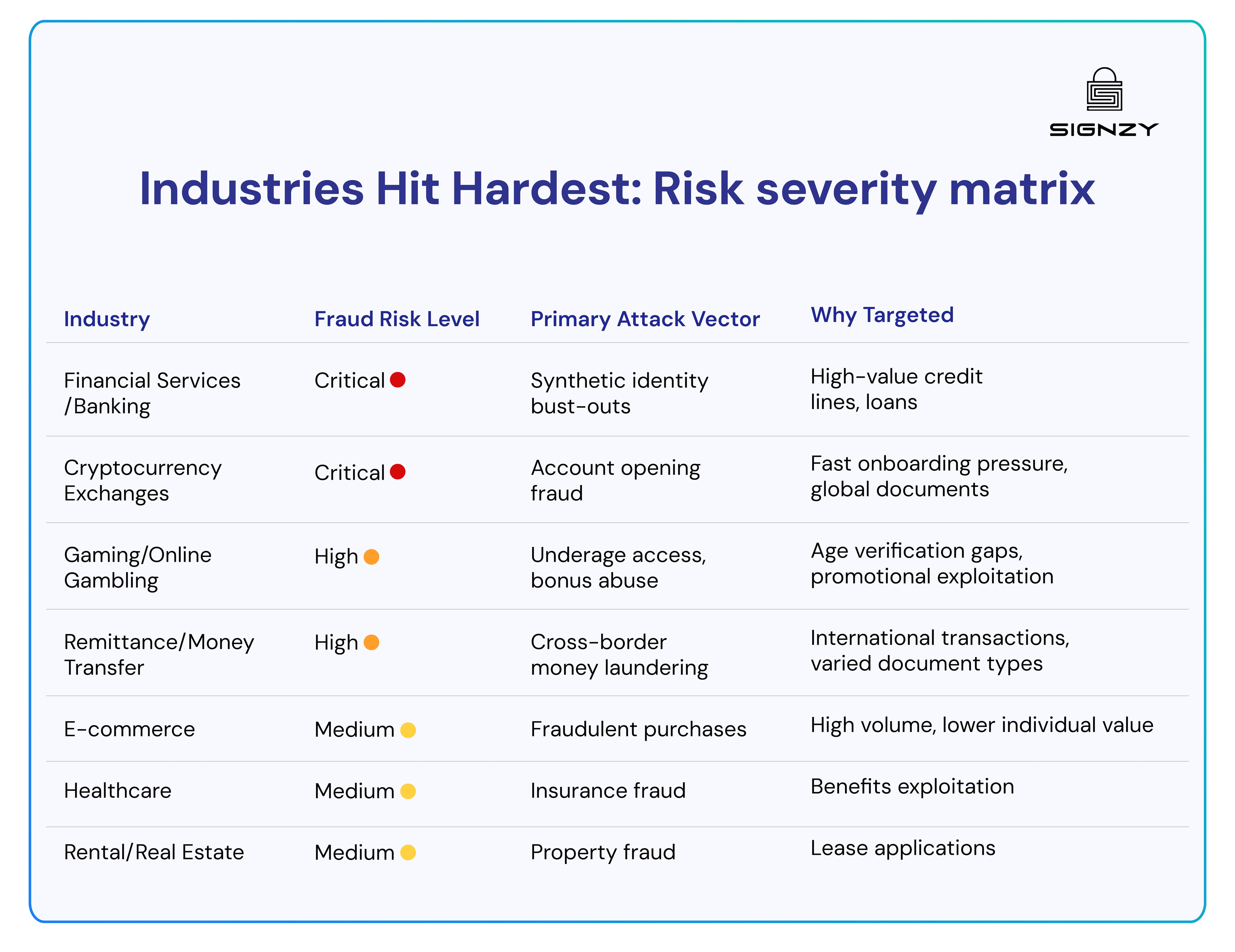
Fake ID fraud doesn't affect all businesses equally. Some industries face disproportionately higher risks due to regulatory requirements, transaction values, or the nature of their verification processes. See if you fall in any of them:
Financial services and banking: The multi-billion dollar target
Financial institutions bear the heaviest burden of fake ID fraud, with US lenders facing $3.3 billion in exposure to synthetic identities by the end of 2024. Banks and credit unions are prime targets because fraudsters can secure loans, open credit card accounts, and build credit histories over months before executing bust-out schemes.
Cryptocurrency exchanges: Where speed meets vulnerability
Many cryptocurrency exchanges prioritize fast onboarding to capture users during volatile market moments, creating pressure to minimize verification friction.
Additionally, the global and often less-regulated nature of crypto markets means exchanges must verify documents from dozens of countries, each with different security features.
Gaming and online gambling: Age verification failures
The gaming industry faces dual pressures from underage users attempting access and professional fraudsters exploiting bonus systems. Beyond age verification, fraudsters create multiple accounts using fake IDs to abuse welcome bonuses, loyalty programs, and promotional offers, a practice known as "bonus abuse" that costs the industry substantially.
Regulatory bodies impose severe penalties on gaming operators who fail to maintain adequate age verification, making this both a financial and compliance concern. Here, dedicated age verification APIs like Signzy can combine document checks with biometric matching can drastically reduce the chances of fraud here.
Remittance and money transfer services: Cross-border fraud amplified
Fraudsters exploit remittance services to move illicitly obtained funds internationally, using fake IDs to both send and receive money across jurisdictions.
The industry experiences heightened risk because transactions are often one-time or infrequent, making it harder to establish behavioral patterns that flag suspicious activity. Remittance providers must verify documents from dozens of countries, each with different formats and security features, while fraudsters strategically use IDs from countries where verification databases are less accessible.
Accepting fake IDs can enable money laundering, terrorist financing, and sanctions evasion, triggering severe regulatory penalties. Major remittance providers have faced multi-million dollar fines for inadequate customer verification programs.
How can Signzy help to detect fake IDs?
Signzy provides comprehensive identity verification tools designed to stop fake IDs at every stage of the customer journey. Our platform combines advanced detection technology with flexible verification modules that adapt to your specific business requirements.
Advanced deepfake detection
At the heart of our offering is proprietary deepfake detection that identifies AI-generated fake IDs, manipulated images, face swaps, and synthetic content in real time.
This technology analyzes pixel patterns, lighting inconsistencies, and biometric anomalies that even sophisticated AI-generated fakes cannot replicate perfectly. With response times under 5 seconds and a track record of verifying over 100 million users, our deepfake detection has been refined through exposure to millions of fraud attempts across our global network.
Liveness checks for real-time verification
Our liveness detection ensures that the person presenting an ID is physically present during verification, not using a photo, video replay, or deepfake. Both active and passive liveness options are available depending on your user experience preferences. This layer blocks fraudsters using static images or pre-recorded videos to bypass verification systems.
Biometric face matching for identity confirmation
Face matching technology compares the photo on the submitted ID with the live selfie, analyzing unchangeable facial features like nose shape, eye spacing, and chin structure. This ensures the person presenting the document is the rightful owner, preventing the use of stolen or borrowed IDs even when the document itself is legitimate.
Signzy's Identity Verification API made our review queue actually digestible. We're not babysitting every alert anymore, which feels unreal considering where we were a few months ago.
— Risk Associate, Payments Company (1000+ employees)
Age verification for regulated industries
For gaming, gambling, and other age-restricted sectors, our dedicated age verification API combines document authentication with biometric checks to confirm users meet legal age requirements. This addresses both underage access attempts and bonus abuse through multiple fake accounts.
The key advantage is flexibility. You start with what you need today and add capabilities as your business grows or fraud patterns evolve. You're not locked into paying for features you don't use, but you have immediate access to enterprise-grade protection when threats emerge.
Signzy delivers this comprehensive verification capabilities at one of the most economical rates in the industry. The technology is sophisticated, but the implementation isn't, making enterprise-grade fraud prevention accessible to businesses of all sizes.
If you're looking to strengthen your identity verification against the growing threat of AI-generated fake IDs, explore Signzy's deepfake detection and identity verification suite to see how our platform adapts to your specific requirements.
About Signzy: Signzy is an end-to-end compliance and identity verification platform trusted by 1,000+ global companies, including Fortune 500 leaders like Microsoft, Meta, FedEx, Citi, and Mastercard.
Operating across 240+ countries, our Gartner-recognized One Touch KYC verifies users in seconds by running document checks, face matching, liveness detection, and AML screening simultaneously, supported by strong US data coverage including SSN validation.


FAQ
Can AI generate ID cards?

Can AI create fake images?
Can AI generate fake human faces?
Can AI-generated fake IDs bypass traditional KYC checks?
What industries are most at risk from AI-generated fake ID attacks?
What technologies help prevent fake ID fraud in digital identity verification?
Roshan Kumar
Roshan leads product strategy for Identity and Fraud Verification at Signzy Technologies, where he oversees the development of secure, scalable ID Verification, Automated CKYC, and AI-powered Video KYC solutions for regulated banks and fintechs. With over five years of hands-on experience in KYC and API banking and a strong engineering background, he focuses on building platforms that ensure seamless and compliant onboarding across the BFSI sector. His expertise spans designing and implementing solutions that address evolving regulatory requirements and industry challenges.

Related Blogs
View all

10 Best Identity Verification Solutions in 2026: Full Breakdown

What is Government ID Verification? Step-by-Step Guide for businesses

How to Extract Information from IDs through OCR

AI-Generated Selfies: What are they and How Your Business can Counter them?
The best in business


The global API marketplace for KYC, KYB, & AML
Explore the end-to-end verification stack trusted by 1,000 businesses.
Get in touch