







10 Best KYB Verification Services in 2026 | Complete Comparison Guide
- Most providers offer API integration options, web-based interfaces, or SDK implementations. API integration provides the most seamless experience but requires development resources, while web interfaces offer quicker setup.
- Most advanced providers offer continuous monitoring that alerts you to changes in business status, ownership, sanctions lists, and adverse media mentions, ensuring compliance throughout the business relationship.
- KYB verification helps meet requirements from regulations like AML5/6 in Europe, FinCEN’s CDD rule in the US, FINTRAC in Canada, and global FATF recommendations, all of which mandate business verification to prevent financial crime.
I honestly didn’t expect to become so fascinated by KYB services, but here we are! What started as basic research for our compliance team turned into a three-week deep dive across G2, Reddit, and countless product pages.
The KYB landscape has changed dramatically since I last looked in 2023. Some tools that weren’t even on my radar are now offering incredible innovations (wait until you see #4 on this list – their approach to beneficial ownership verification is genuinely clever).
While comparing these services, I’ve been taking notes on what actually matters in day-to-day usage rather than just feature-checking. Integration flexibility, update frequency for their database, and how they handle edge cases for international entities turned out to be the real differentiators.
I’m excited to share what I’ve found after all this research!
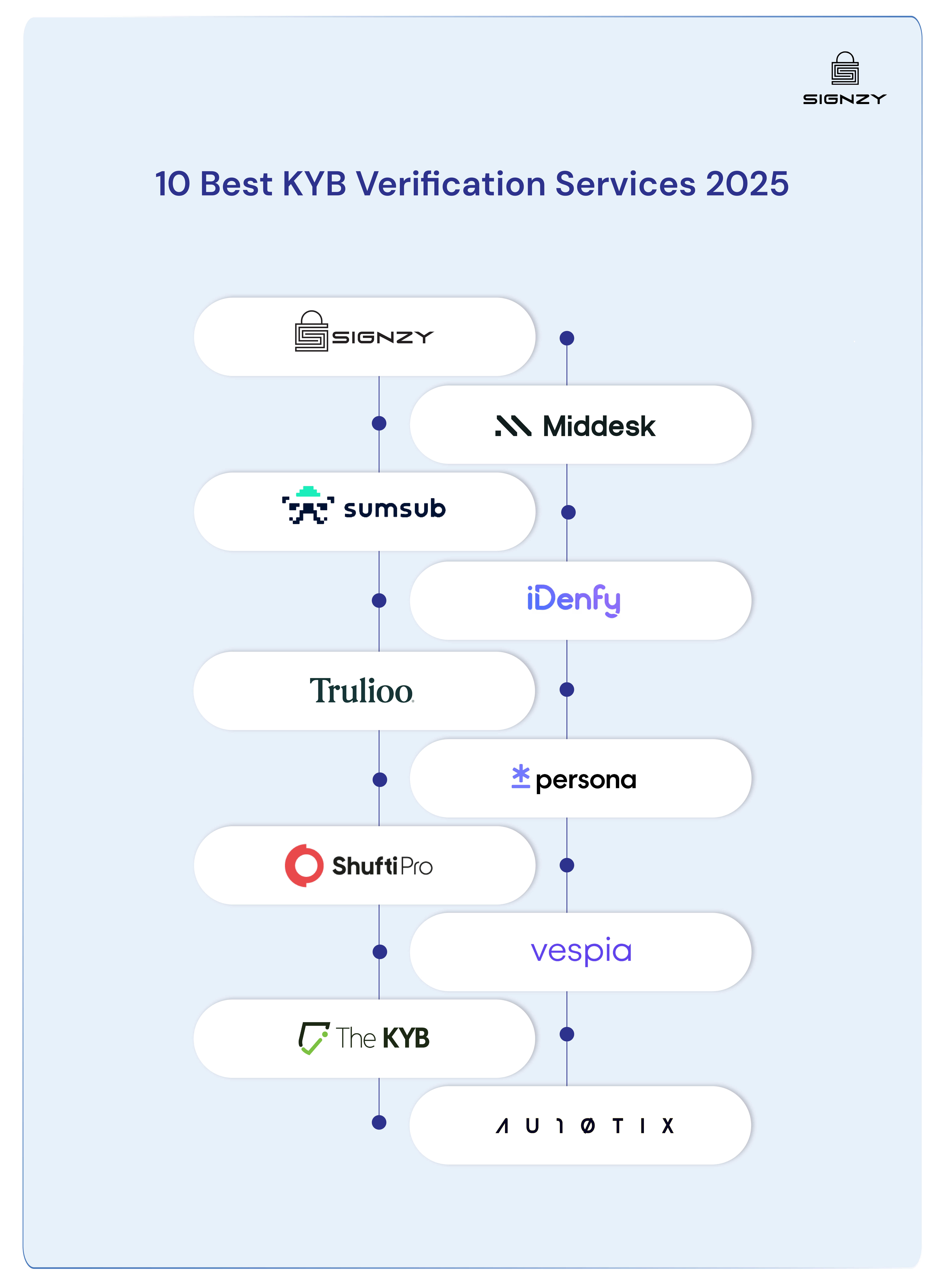
10 Best KYB Verification Services – 2026 Rankings
💡 Related Blog:
These 10 KYB services represent the best options available in 2026, and I’ve tried to highlight exactly why each one earned its spot on this list.
1. Signzy
Signzy has taken the headache out of KYB verification by turning a traditionally painful bureaucratic process into something businesses can actually complete without losing their minds. The platform connects to data sources across 190+ countries, letting you verify business partners in minutes instead of the usual bureaucratic purgatory.
What really makes Signzy stand out is how their AI handles complex documents while keeping you on the right side of regulations no matter where you’re operating.
Signzy – Key Features
- Comprehensive API verification suite covers everything from basic registration checks (EIN verification, TIN validation, company registration numbers) to advanced compliance screening including Ultimate Beneficial Owner (UBO) identification, corporate structure mapping, and sanctions list screening – all through a single integration that won’t make your developers cry
- Smart risk-based verification automatically adjusts verification depth based on risk signals. Basic company info checks and business license verification for low-risk entities, while triggering enhanced due diligence including director background checks, financial standing verification, and PEP (Politically Exposed Person) screening when red flags appear
- Real-time business registry access pulls fresh data directly from official sources to verify company status, registered addresses, and authorized signatories
Signzy pros
✔️ Single API covers EIN, TIN, UBO, sanctions, and corporate structure across 190+ countries: Eliminates the need to manage multiple point solutions for different verification steps globally.
✔️ Risk-based verification auto-adjusts depth based on entity risk signals: Low-risk entities get lightweight checks while high-risk ones trigger EDD and PEP screening automatically.
✔️ No-code workflow builder lets compliance teams modify onboarding logic without developers: Reduces time-to-change from weeks to hours when regulatory requirements shift.
Signzy cons
❌ Pricing not publicly listed: Requires a sales conversation before cost evaluation, creating friction for teams running competitive RFPs.
❌ US credit bureau data depth is thinner than domestic specialists like Middesk: Organizations where credit risk intelligence drives onboarding decisions may need a supplementary data layer.
❌ Manual review SLA not publicly documented: No published guaranteed turnaround time for edge cases that fail automated matching.
Best For: Fintechs and financial institutions needing a unified KYC + KYB + AML stack across multiple geographies without managing separate regional vendors.
Signzy – Company Info
| Information | Details |
|---|---|
| Website | www.signzy.com/us |
| Headquarters | One Liberty Plaza, 165 Broadway 23rd Floor, New York City |
| Founded | 2015 |
2. Vespia
Vespia tackles a problem that most KYB providers ignore: what happens after day one. While most solutions focus only on initial verification, Vespia built their platform around continuous monitoring that catches changes to business status and ownership in real-time. The combination of deep global coverage with practical monitoring tools makes them uniquely equipped for ongoing compliance management.
Vespia – Key Features
- The platform provides commercial register information in under 30 seconds from over 300 jurisdictions, even covering markets that most providers ignore
- Integrate KYC verification directly into the business verification process, supporting over 7,000 document types from 190+ countries with liveness detection for high-risk cases
Vespia pros
✔️ Commercial registry data from 300+ jurisdictions returned in under 30 seconds: Covers markets that most KYB providers deprioritize, including genuinely underserved geographies.
✔️ Integrated KYC within the KYB flow with 7,000+ document types and liveness detection: UBO identity and business entity verification run in a single workflow rather than requiring separate integrations.
✔️ Continuous monitoring alerts compliance teams to real-time ownership and status changes: Addresses the post-onboarding compliance gap that point-in-time verification platforms leave open.
Vespia cons
❌ Newer platform founded in 2021 with a shorter compliance market track record: Regulated institutions with formal vendor due diligence may weigh this against more established providers.
❌ Limited independent user reviews and benchmarks: Less third-party qualitative data available for compliance teams during formal procurement evaluation.
❌ Registry data quality may vary across all 300+ claimed jurisdictions: Coverage breadth does not always equate to consistent accuracy across every listed market.
Best For: Compliance-focused organizations that prioritize ongoing monitoring alongside initial verification, particularly in markets underserved by mainstream KYB platforms.
Vespia – Company Info
| Information | Details |
|---|---|
| Website | www.vespia.io |
| Headquarters | Tallinn, Estonia |
| Founded | 2021 |
3. The KYB
The KYB’s ROI calculator shows exactly how many hours and dollars financial institutions are wasting on manual verification is eye-opening. Their focus on direct registry access rather than third-party aggregators means you’re getting verification straight from the source.
The KYB – Key Features
- Offline registry backups that keep verification running even when government systems crash
- The system centralizes UBO identification, document collection, and AML screening in one platform instead of forcing you to juggle multiple systems for different verification aspects
The KYB pros
✔️ Direct registry access rather than third-party aggregators reduces data latency and inaccuracy risk: Verification results come from authoritative government sources, not intermediary databases.
✔️ Offline registry backups keep verification running when government systems go down: Critical resilience feature for compliance teams that cannot afford verification downtime during onboarding.
✔️ Centralized UBO identification, document collection, and AML screening in one platform: Eliminates the need to juggle separate systems for different compliance steps.
The KYB cons
❌ Founded in 2022, making it among the newest entrants in this comparison: Limited track record for regulated institutions that require proven enterprise-scale deployments.
❌ Pricing and SLA details require direct vendor engagement: No self-serve cost evaluation available during initial vendor shortlisting.
❌ Narrower brand recognition outside the UK market: Less visibility in US and APAC markets where established players have stronger compliance team mindshare.
Best For: Financial institutions and compliance teams that prioritize registry-direct data accuracy and need centralized UBO plus AML workflows in a single integration.
The KYB – Company Info
| Information | Details |
|---|---|
| Website | www.thekyb.com |
| Headquarters | London, UK |
| Founded | 2022 |
4. AU10TIX
AU10TIX launched their KYB solution in February 2024, leveraging two decades of identity verification expertise to solve the growing business fraud problem. In a market full of point solutions that force you to stitch together multiple vendors, they’ve built a system that checks businesses against 200+ jurisdictions and 1000+ government registries through a single API call.
Related Resources
AU10TIX – Key Features
- Unified KYB/KYC solution handles everything from basic business validation to UBO verification through a single API call, eliminating the need for multiple verification vendors
- Continuous monitoring that keeps tracking changes in business status, ownership, and compliance even after initial verification. This is crucial for maintaining ongoing regulatory compliance
AU10TIX pros
✔️ Single API call covers KYB and KYC across 200+ jurisdictions and 1,000+ government registries: Eliminates multi-vendor complexity for organizations needing unified business and individual verification.
✔️ Two decades of identity verification expertise applied to business fraud detection: Deep institutional knowledge of document fraud patterns applied to the growing business identity fraud problem.
✔️ Continuous post-onboarding monitoring tracks ownership and compliance status changes: Maintains regulatory compliance throughout the business relationship, not just at the point of initial onboarding.
AU10TIX cons
❌ KYB product launched only in February 2024, meaning limited real-world scale deployment data: Organizations seeking proven enterprise KYB deployments may prefer providers with longer KYB-specific track records.
❌ Pricing is not publicly available: Custom enterprise quotes required, limiting upfront cost comparison during vendor evaluation.
❌ Primary market reputation is built on identity verification rather than KYB: Compliance teams evaluating purpose-built KYB specialists may perceive AU10TIX as a secondary choice in this category.
Best For: Organizations already using AU10TIX for KYC that want to consolidate business verification into an existing vendor relationship without adding a separate KYB platform.
AU10TIX – Company Info
| Information | Details |
|---|---|
| Website | www.au10tix.com |
| Headquarters | Herzliya, Israel |
| Founded | 2002 |
5. Middesk
Middesk solved the US business verification problem by going straight to the source instead of relying on patchy third-party data. They’ve built direct pipes to government data sources that other providers simply don’t have access to.
Instead of cobbling together business info from a dozen different places and hoping it’s accurate, they pull authoritative data straight from Secretary of State offices and the IRS.
Middesk – Key Features
- System automatically handles all those compliance requirements with weird acronyms (CIP, CDD, EDD) by adapting to each business you’re checking
- They’ve partnered with Socure to extend verification to the actual humans behind businesses, so you get the full picture of who you’re dealing with
Middesk pros
✔️ Direct connections to all 50 US Secretary of State offices and the IRS covers 100% of registered US businesses: Eliminates coverage gaps present in third-party aggregators for domestic business verification.
✔️ Automatic CIP, CDD, and EDD adaptation based on entity type and risk profile: Compliance requirements are handled at the platform level without manual workflow configuration per entity.
✔️ Socure partnership extends verification to the humans behind businesses: UBO and officer identity checks integrate directly into the business verification flow.
Middesk cons
❌ US-only coverage with no international entity verification capability: Organizations onboarding non-US businesses require an entirely separate KYB vendor.
❌ No individual KYC capabilities natively: Beneficial owner and officer verification depends on the Socure partnership rather than being built into the core platform.
❌ Premium enterprise pricing with volume commitments: Cost structure is prohibitive for early-stage platforms or lower-volume compliance programs.
Best For: US-based financial institutions, lenders, and fintechs that exclusively verify domestic businesses and require the deepest, most authoritative American KYB data available.
Middesk – Company Info
| Information | Details |
|---|---|
| Website | www.middesk.com |
| Headquarters | San Francisco, California, USA |
| Founded | 2019 |
6. Sumsub
Sumsub has somehow figured out how to do comprehensive KYB checks in just 15 seconds. They’re not cutting corners either. They’re just leveraging massive data resources (500 M+ records) and smart processing to automate what used to take your compliance team days of manual work.
For businesses that need both rock-solid compliance and conversion rates that don’t make the sales team revolt, Sumsub actually delivers on both.
Sumsub – Key Features
- Verification speed is almost suspiciously fast: 15 seconds for processes that typically take more than 2 minutes. This dramatically cuts down on businesses abandoning your onboarding flow
- Cross-check UBOs against 11,000+ independent data sources, going way deeper than typical verification that just scratches the surface
Sumsub pros
✔️ KYB checks complete in 15 seconds using 500M+ record database: Dramatically reduces business onboarding abandonment compared to providers relying on manual review processes.
✔️ UBO cross-checked against 11,000+ independent data sources: Beneficial ownership verification goes significantly deeper than standard registry-only checks.
✔️ Unified KYC and KYB in one platform with shared risk scoring: Individual and business verification data is correlated in a single compliance view rather than siloed across separate systems.
Sumsub cons
❌ Cross-platform blocklisting can lock legitimate businesses out of unrelated services: A flag on one Sumsub-connected platform can propagate across the network with no transparent appeal mechanism.
❌ Higher pricing than mid-market alternatives: Enterprise-tier add-on structure is less accessible for early-stage or cost-sensitive compliance programs.
❌ Deep customization requires compliance engineering resources: Highly tailored workflows extend go-live timelines for teams without dedicated technical capacity.
Best For: Global fintechs and regulated platforms that need fast, high-depth KYB with integrated KYC in a single platform, particularly where UBO accuracy is a primary compliance requirement.
Sumsub – Company Info
| Information | Details |
|---|---|
| Website | www.sumsub.com |
| Headquarters | London, UK |
| Founded | 2015 |
7. iDenfy
iDenfy has built a verification platform that actually works across the globe, handling 2,500+ document types from 190+ countries. This is crucial if you’re not just operating in the major markets. What makes them different is their flexibility. They let you create verification workflows that make sense for different risk profiles and entity types instead of forcing everyone through the same rigid process.
iDenfy – Key Features
- Support practically every business document under the sun. Even those region-specific registrations that leave other providers scratching their heads
- They’ve found the sweet spot between automation and human expertise. AI handles the heavy lifting, but experts review edge cases to maintain 99.8% accuracy
iDenfy pros
✔️ Supports 2,500+ document types from 190+ countries including region-specific registrations: Handles business documents that leave other providers unable to complete verification in less common markets.
✔️ AI plus in-house human expert review maintains 99.8% accuracy on edge cases: Hybrid processing catches errors that fully automated systems miss, particularly for unusual entity structures.
✔️ Flexible workflow configuration adapts verification depth to different risk profiles and entity types: Compliance teams are not forced to apply uniform friction to all business onboarding scenarios.
iDenfy cons
❌ Smaller company scale with under 200 employees introduces vendor continuity considerations: Regulated institutions applying formal business continuity criteria during vendor due diligence may flag this.
❌ Pricing complexity across subscription tiers, per-verification fees, and add-ons makes cost forecasting difficult: Organizations scaling verification volume may face unpredictable cost increases.
❌ US-specific KYB data depth is thinner than domestic specialists: Secretary of State filing depth and UCC lien data are less comprehensive than platforms with direct US government connections.
Best For: International businesses and platforms needing flexible, multi-country KYB with strong edge case handling for unusual document types and entity structures outside mainstream markets.
iDenfy – Company Info
| Information | Details |
|---|---|
| Website | www.idenfy.com |
| Headquarters | Kaunas, Kauno |
| Founded | 2017 |
8. Trulioo
Trulioo has built what amounts to the world’s largest identity verification network, connecting 450+ disparate data sources to verify people and businesses across 195+ countries. Their 15-second data refresh cycles ensure you’re never working with outdated information.
Trulioo – Key Features
- Single API gives you access to hundreds of business registries worldwide, eliminating the need to juggle multiple verification providers as you expand globally
- Seamlessly merged business and individual verification flows so you can trace entities to their ultimate beneficial owners without creating separate verification journeys
Trulioo pros
✔️ Single API connects 450+ data sources across 195+ countries for business and individual verification: Normalizes global verification infrastructure into one integration, removing the need for regional vendor management.
✔️ 15-second data refresh cycles ensure verification decisions use current information: Reduces stale data risk that causes incorrect status decisions on recently changed business records.
✔️ Unified UBO tracing integrates business and individual verification flows without separate journeys: Beneficial ownership identification is embedded within the business verification workflow rather than requiring a separate process.
Trulioo cons
❌ Verification quality varies significantly across regions, particularly in markets with limited digital infrastructure: User feedback notes inconsistent match rates in lower-priority markets despite being listed as supported.
❌ No built-in ongoing post-onboarding monitoring or continuous AML rescreening: Organizations requiring perpetual KYB compliance after initial verification need additional solutions.
❌ Enterprise pricing without public rate transparency: Custom quotes make upfront cost comparison difficult and costs can escalate when verifying across multiple complex jurisdictions.
Best For: Multinational enterprises and global payment platforms expanding into multiple markets simultaneously where a single normalized API for cross-border KYB reduces integration overhead.
Trulioo – Company Info
| Information | Details |
|---|---|
| Website | www.trulioo.com |
| Headquarters | Vancouver, Canada |
| Founded | 2011 |
9. Persona
Persona has completely reimagined business verification with its breakthrough Contextual Matching technology. Their system actually understands context and variations across different data sources. For businesses struggling with high rejection rates during verification, this technology provides a massive competitive advantage in both compliance and conversion.
Persona – Key Features
- Contextual Matching engine recognizes legitimate businesses even when registry data contains variations that trip up other systems (like differences in address formatting or name abbreviations)
- Solution improves match rates by up to 55%. Instead of demanding perfectly matching data points
Persona pros
✔️ Contextual Matching engine recognizes legitimate businesses despite registry data variations in address formatting and name abbreviations: Improves match rates by up to 55% compared to systems requiring exact data point alignment.
✔️ No-code modular building blocks let compliance teams configure KYB workflows without developer involvement: Rapid iteration on verification logic without engineering sprint backlogs.
✔️ Proven at scale with deployments at OpenAI, Reddit, and Roblox: Infrastructure reliability and API stability are publicly validated at hundreds of millions of users.
Persona cons
❌ Documented verification failures at enterprise scale reported on G2: Multiple team members with multiple IDs unable to complete verification raises reliability concerns for high-volume onboarding flows.
❌ Limited native AML screening and post-onboarding compliance monitoring: Ongoing sanctions rescreening and adverse media monitoring require supplementary vendor integration.
❌ International document coverage is less extensive than KYB specialists like Trulioo or iDenfy: The platform's global registry depth does not match purpose-built KYB platforms in less mainstream markets.
Best For: Technology platforms and digital businesses that need highly customizable KYB workflows and already use Persona for KYC, allowing consolidation onto a single vendor relationship.
Persona – Company Info
| Information | Details |
|---|---|
| Website | www.withpersona.com |
| Headquarters | San Francisco, California, USA |
| Founded | 2018 |
10. Shufti Pro
Shufti Pro has built a verification platform that operates in a staggering 230+ countries and territories. They’re one of the few providers offering transparent public pricing and a 7-day free trial that gives full access to their KYB and KYC features without requiring prepayment.
Shufti Pro – Key Features
- KYB solution screens businesses against 140+ global commercial jurisdictions and registers, providing legitimate verification for markets that most providers ignore
- Comprehensive monitoring includes PEP lists, global sanction watchlists, and adverse media databases with real-time alerts when business information changes
Shufti Pro pros
✔️ KYB screening covers 140+ global commercial jurisdictions and registers including underserved markets: One of the few providers offering meaningful verification coverage in markets that mainstream platforms list but do not serve accurately.
✔️ Transparent public pricing with a 7-day free trial including full KYB and KYC access: Removes the barrier to evaluation that custom enterprise quotes create, enabling genuine self-serve vendor comparison.
✔️ Real-time PEP, sanctions watchlist, and adverse media monitoring bundled into KYB workflow: Continuous compliance monitoring is included rather than being a separately priced add-on.
Shufti Pro cons
❌ Verification speed of 15 to 60 seconds is slower than leaders like Sumsub at 15 seconds flat: The upper range creates onboarding friction risk for high-volume business verification flows
❌ Enterprise compliance track record is thinner than established KYB specialists: Reference customer base and compliance pedigree may not satisfy formal vendor due diligence at large regulated institutions.
❌ US-specific KYB data infrastructure is less deep than domestic specialists: Secretary of State filing accuracy and IRS data connections do not match platforms with direct US government registry relationships.
Best For: Cost-sensitive organizations, SMBs, and platforms requiring transparent pricing and trial access before committing, or businesses needing KYB coverage in markets underserved by mainstream providers.
Shufti Pro – Company Info
| Information | Details |
|---|---|
| Website | www.shuftipro.com |
| Headquarters | London, UK |
| Founded | 2016 |
How to choose a KYB provider without losing your mind
Don’t overthink this. At some point, you need to pick someone and move forward. Perfect compliance doesn’t exist, but “good enough to keep the regulators happy while not driving away your customers” absolutely does.
When vetting potential providers, focus on what actually matters:
- Will it work where you need it? Geographic coverage sounds boring until you’re expanding into Brazil and discover your fancy KYB system only has “limited coverage” there (translation: it barely works). Providers like Signzy and Trulioo have genuinely global reach, while others excel in specific regions.
- Can your team actually use it? The sleekest API doesn’t matter if your implementation requires three developers, four months, and a miracle. Some platforms need serious technical resources to implement, while others offer no-code options anyone can use. Be brutally honest about your team’s bandwidth and technical capabilities before committing.
- What happens when things break? Because they will break. KYB verification involves connecting to government databases that go down, changing formats without warning, and occasionally returning complete gibberish. What matters isn’t that problems happen. It’s how the provider handles them. Do they have offline backups? Manual review options? Actual humans you can reach when everything’s on fire?
- Are you paying for features you’ll never use? Most providers bundle capabilities you don’t need with ones you desperately want. Some force you into enterprise packages for basic features, while others let you pay only for what you use. Figure out what verification elements actually matter for your risk profile before getting dazzled by the full feature list.
Want to see a platform that won’t require sacrificing your firstborn to the implementation gods? Book a demo with Signzy today!
FAQ
How long does the typical KYB verification process take?

What information is typically required for KYB verification?
What's the difference between KYB and KYC verification?
What are UBOs, and why are they important in KYB verification?
Spread the knowledge!
Found this useful ? Share what you learned!



Agrima Dwivedi
Agrima is an Associate Product Marketer at Signzy, currently working in the B2B fintech space. She brings over two years of experience in copywriting and content writing, which laid the foundation for product marketing. Today, she leverages both creative and strategic skills to drive go-to-market efforts and build user-focused marketing strategies.