





How to Obtain a U.S. Social Security Number (SSN)

 Open in ChatGPT
Key Highlights
- A U.S. Social Security Number (SSN) is a nine-digit identifier issued for free by the U.S. Social Security Administration (SSA) to U.S. citizens, lawful permanent residents, and noncitizens with valid work authorization. Applicants must submit Form SS-5 with original (not photocopied) identity, age, and immigration documents at a local SSA office.
- The four eligible applicant categories — citizens, green-card holders, work-visa holders (H-1B, L-1, O-1, TN, E, P, R), and F-1/J-1 students with on-campus, CPT, or OPT authorization — each require a different document set. Mismatched names, expired documents, and photocopies are the three most common reasons applications are delayed.
- Once issued, businesses are legally required under the USA PATRIOT Act and the Fair Credit Reporting Act to verify SSNs collected during onboarding. Signzy's SSN Verification API returns issuance status, name and date-of-birth match, Death Master File checks, and synthetic-identity signals in under two seconds — the controls regulators expect for KYC, employment, and lending workflows.
A Social Security Number (SSN) is the single most important identifier in U.S. financial, tax, and employment systems. The SSA has issued more than 480 million SSNs since the program began in 1936 and now processes roughly 5.5 million new applications every year, including over one million issued to noncitizens authorized to work in the United States.
For individuals, an SSN is required for legal employment, federal tax filing, credit history, banking, and most government services. For regulated businesses, it is the cornerstone identifier in Customer Identification Programs (CIP), IRS taxpayer reporting, and FCRA-aligned background checks.
This guide explains exactly who is eligible for an SSN in 2026, the documents required by visa category, the application steps, the processing timelines, and the verification controls businesses use once an SSN is issued.
What is a Social Security Number (SSN)?
A Social Security Number (SSN) is a nine-digit identification number issued by the U.S. Social Security Administration under Section 205(c)(2) of the Social Security Act. It is formatted as three digits, two digits, and four digits separated by hyphens (XXX-XX-XXXX, for example 123-45-6789).
Originally created in 1936 to track workers' earnings for Social Security retirement benefits, the SSN has become the de-facto national identifier used for filing taxes, opening bank accounts, applying for credit, securing federal student aid, and verifying employment eligibility on Form I-9. Since June 25, 2011 the SSA has assigned numbers randomly, so the first three digits no longer indicate the state where the number was issued.
Three facts every applicant should know:
- The SSA never charges a fee to issue, replace, or correct a Social Security card. Anyone asking for payment to obtain one is operating a scam.
- An SSN is permanent. It is not reused after the holder's death, and the SSA will only assign a new number in extreme, documented cases of ongoing identity theft (POMS RM 10220.085).
- The card is proof of the number, not the identifier itself. Employers, banks, and government agencies record the number, not the card.
If you are not eligible for an SSN, the IRS issues an Individual Taxpayer Identification Number (ITIN) for tax filing only. An ITIN does not authorize work in the U.S. or qualify the holder for Social Security benefits.
Who needs an SSN?
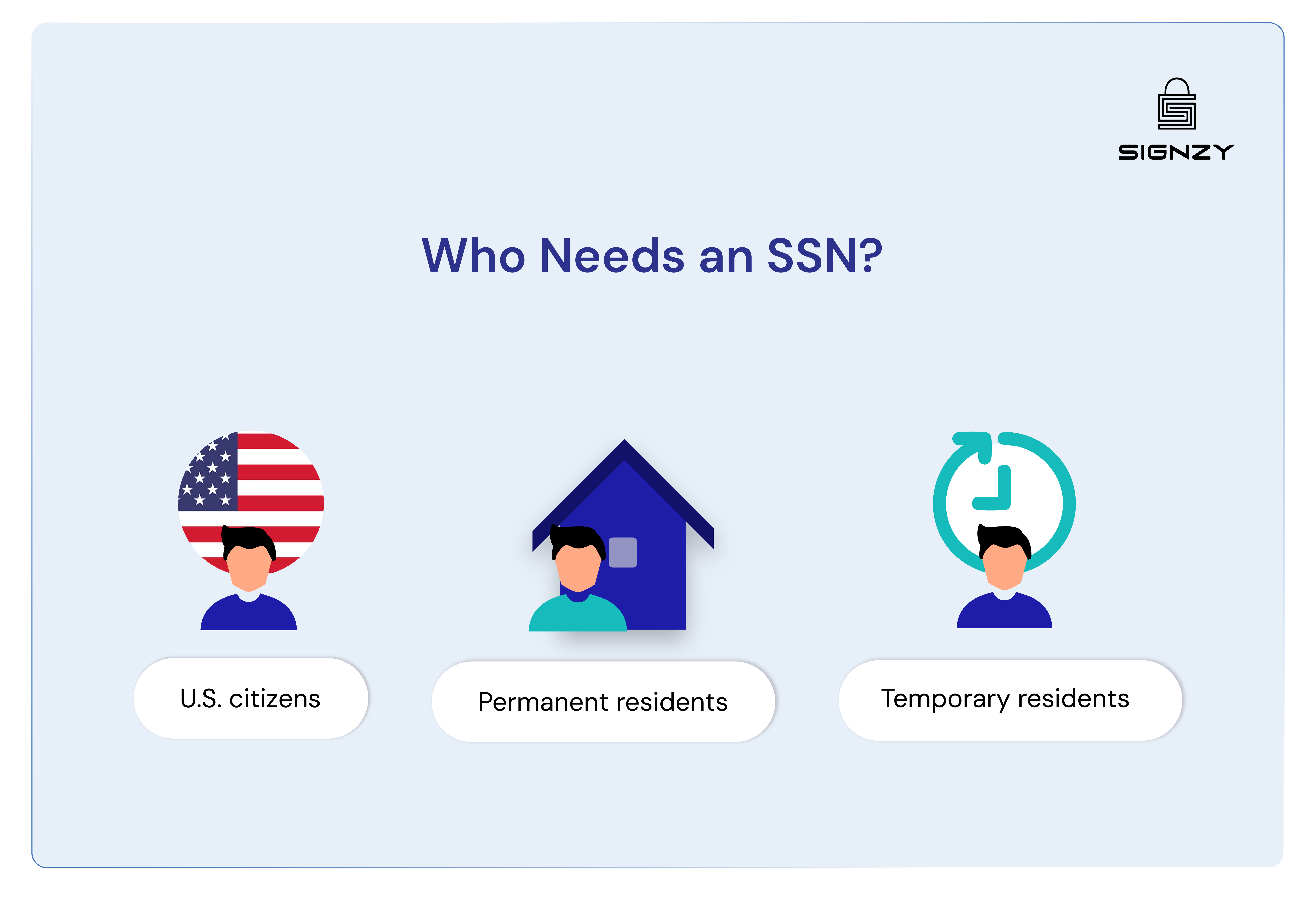
If you live in the U.S. and participate in employment, banking, taxation, or federal benefits, you almost certainly need an SSN. The SSA recognizes the following categories of eligible applicants:
- U.S. citizens. Whether born in the U.S. or abroad, all citizens are eligible. Most parents apply for their newborn's SSN at the hospital using the Enumeration at Birth program, which issues over 4 million SSNs to newborns each year.
- Lawful permanent residents (green-card holders). Anyone admitted under any LPR category needs an SSN for employment, taxes, and most government services.
- Foreign workers with valid work authorization. Holders of H-1B, H-2A, H-2B, L-1, O-1, P, E, R, and TN visas — plus anyone with an Employment Authorization Document (Form I-766) — need an SSN to be legally paid in the United States.
- International students with work authorization. F-1 and J-1 students do not automatically qualify. They become eligible only after securing on-campus employment, Curricular Practical Training (CPT), or Optional Practical Training (OPT) authorization.
- Self-employed individuals and business owners. Anyone earning U.S. income — freelancers, sole proprietors, gig-economy workers — needs an SSN for IRS reporting on Forms 1099, W-9, and Schedule C.
- Anyone filing U.S. taxes. A taxpayer identifier is required on every Form 1040. If you are not eligible for an SSN, file Form W-7 with the IRS to obtain an ITIN.
You can technically operate without an SSN in narrow situations — some banks open accounts using an ITIN, and a handful of credit unions accept alternative IDs. But for most people, living in the U.S. without one means constant friction with employers, lenders, and federal agencies.
Not eligible for an SSN? B-1/B-2 tourists, F-2/J-2 dependents without EADs, and undocumented individuals generally cannot obtain an SSN. The IRS issues ITINs through Form W-7 for tax-filing purposes only.
💡 Related Blog:

What documents do you need to apply for an SSN?
The SSA requires original documents or copies certified by the issuing agency. Photocopies, notarized copies, and laminated documents are not accepted. Each document must be unexpired. Applicants must prove three things: identity, age, and (for noncitizens) immigration or work-authorization status. One document can sometimes prove more than one item — a foreign passport, for example, generally satisfies both identity and age.
1. SSN application documents for U.S. citizens
If you are a U.S. citizen applying for your first SSN or a replacement, you need to prove citizenship and identity:
- Proof of U.S. citizenship. Your U.S. birth certificate is the primary document. If you were born abroad, use a U.S. passport, Certificate of Naturalization (Form N-550 or N-570), Certificate of Citizenship (Form N-560 or N-561), or Consular Report of Birth Abroad (Form FS-240).
- Proof of identity. A valid, unexpired U.S. driver's license or state-issued ID card is preferred. A current U.S. passport or military ID also qualifies.
- Proof of age. A U.S. birth certificate is the strongest proof. If unavailable, the SSA will accept a hospital birth record, religious record made before age 5, or U.S. passport.
If you are applying on behalf of a child under 12, the parent or legal guardian must appear in person and present proof of their own identity in addition to the child's documents.
2. SSN application documents for lawful permanent residents
Green-card holders need to prove both immigration status and identity:
- Proof of immigration status. A current, unexpired Permanent Resident Card (Form I-551 — the green card) is required. Conditional permanent residents on a two-year green card must apply before expiry to avoid status complications.
- Proof of identity. An unexpired foreign passport is preferred. A U.S. driver's license or state ID is also acceptable.
- Proof of age. A foreign passport with a date of birth typically satisfies this; otherwise bring a government-issued document showing your date of birth, such as a birth certificate.
- Proof of work authorization. The green card itself is sufficient — LPR status grants unrestricted work authorization automatically.
3. SSN application documents for foreign workers
Workers on H-1B, L-1, O-1, TN, E, P, R, and similar visas must prove their employment authorization. The SSA will electronically verify your status with the Department of Homeland Security (DHS), so wait at least 10 business days after entering the U.S. before applying so DHS records can update.
- Proof of work authorization. An Employment Authorization Document (EAD, Form I-766), or your visa stamp combined with Form I-94 (Arrival/Departure Record) and your USCIS Form I-797 Approval Notice.
- Proof of immigration status. Current, valid foreign passport with visa stamp and Form I-94. You can print your I-94 from the U.S. Customs and Border Protection (CBP) website at i94.cbp.dhs.gov.
- Proof of identity. Foreign passport (preferred). A U.S. driver's license or state ID is a strong supporting document.
- Proof of age. Foreign passport, or a birth certificate if your passport does not clearly show your date of birth.
For H-1B, L-1, O-1, and similar petitions-based visas, bring your I-797 approval notice plus an employer letter on company letterhead confirming your start date, role, and salary. The SSA does not always require it, but it materially reduces the risk of secondary review.
4. SSN application documents for international students
International students on F-1 or J-1 visas can apply for an SSN only if they hold work authorization. Simply being enrolled at a U.S. school is not sufficient.
- Proof of F-1 or J-1 status. Form I-20 (for F-1 students) or Form DS-2019 (for J-1 students), along with your foreign passport and visa stamp.
- Proof of work authorization. For on-campus employment, a job offer letter from the on-campus employer plus a supporting letter from your Designated School Official (DSO). For CPT, an endorsed I-20 showing CPT authorization. For OPT, your EAD card (Form I-766) — the receipt notice (Form I-797C) is not accepted.
- Form I-94. Print this from the CBP website to confirm your most recent entry date.
- Valid foreign passport. Must be current and unexpired.
- Proof of age and identity. Your passport covers both. A school-issued photo ID strengthens the application.
SSA's official guidance reads: "You must present original documents or copies certified by the agency that issued them. We cannot accept photocopies or notarized copies. All documents must be current (not expired). We cannot accept a receipt showing you applied for the document." — SSA Publication EN-05-10002
How to apply for a Social Security Number?
Applying for an SSN is a six-step, in-person process. There is no online application for first-time applicants. Plan for a 1–2 hour visit to a local SSA office.
Step 1: Determine your eligibility
You are eligible for an SSN if you are a U.S. citizen or hold lawful immigration status with work authorization. The four eligible categories (covered in detail above) are:
- U.S. citizens — automatically eligible, whether born in the U.S. or abroad.
- Lawful permanent residents — eligible with a valid green card.
- Foreign workers — eligible with a valid work visa (H-1B, L-1, O-1, TN, etc.) or EAD.
- International students — eligible only with approved on-campus employment, CPT, or OPT.
Applicants on tourist visas (B-1/B-2), dependent visas without EADs (F-2, J-2), or without lawful status do not qualify. They should file Form W-7 with the IRS for an ITIN if tax filing is required.
Step 2: Gather your documents
All documents must be originals or agency-certified copies. No photocopies. Quick reference:
| Your status | Key documents needed for SSN application |
|---|---|
| U.S. citizen | U.S. birth certificate, government-issued photo ID (driver's license or U.S. passport) |
| Lawful permanent resident | Green card (Form I-551), valid foreign passport |
| Foreign worker (H-1B, L-1, O-1, TN, etc.) | Foreign passport, visa stamp, Form I-94, I-797 approval notice or EAD, employer letter |
| International student (F-1 / J-1) | Foreign passport, Form I-20 or DS-2019, on-campus job letter / CPT endorsement / OPT EAD, Form I-94 |
If your name on your immigration document differs from your birth certificate (for example, after marriage), bring the legal name-change document to avoid manual review.
Step 3: Complete Form SS-5
Form SS-5 is the Application for a Social Security Card and is the only form first-time applicants need. The form is two pages and free to download.
- Download the form. Get it from the official SSA website at ssa.gov/forms/ss-5.pdf or pick up a paper copy at any SSA office.
- Use your full legal name. Match it exactly to the name on your most recent immigration document or birth certificate.
- List place of birth as city and country, not the U.S. state of arrival.
- Provide parents' SSNs only if known. The field is not mandatory for adult applicants.
- Provide immigration details if you are not a U.S. citizen, including visa type and authorization end date.
- Sign in blue or black ink. Do not date the form more than 30 days before submission. Parents or legal guardians must sign for applicants under 18.
You cannot submit Form SS-5 online. The my Social Security portal at ssa.gov/myaccount only accepts online applications for replacement cards from U.S. citizens in 45+ states, with no name change.
Step 4: Locate your nearest social security office
Submit your application in person at your local SSA field office.
- Visit the official SSA office locator at ssa.gov/locator.
- Enter your ZIP code.
The locator returns nearby offices, hours, contact numbers, and appointment availability. Booking ahead by phone (1-800-772-1213) typically reduces wait times by 60–80 minutes compared to walk-ins, especially in high-volume metros like New York, Los Angeles, Chicago, and Houston.
Step 5: Submit your application in person
On the day of your visit, bring your completed Form SS-5 and all original documents. Check in at the front desk or take a number if it is a walk-in office.
When called, an SSA representative will review your application, scan your documents, ask a few verification questions, and return your originals on the spot. They will issue a printed receipt with a control number — keep it; it serves as temporary proof of application until your card arrives.
If your documents are accepted, your application moves to processing immediately. If something is missing or inconsistent, the representative will explain the gap and you may need to return with additional documentation. You will not receive your SSN at the office — the SSA mails the card after processing.
Step 6: Attend the interview (if required)
Most applicants do not need a formal interview. Submission is usually sufficient. However, the SSA may ask additional questions on the spot if there are inconsistencies in your paperwork or questions about eligibility. This is most common for first-time applicants on work visas, F-1 students, and applicants with name changes.
Typical questions cover your job, visa status, school enrollment, or document discrepancies. Answer honestly and provide any supporting documentation requested. As long as your status and documents are legitimate, the application will proceed.
What's the timeline for getting an SSN?
Most applicants receive their Social Security card by U.S. mail within 10 to 14 business days after applying in person, provided documents are accepted on the first visit. The SSA mails the card to the U.S. address listed on Form SS-5, so confirm that address is accurate and that someone can receive mail there.
| Applicant scenario | Typical processing time |
|---|---|
| U.S. citizen applying in person | 10–14 business days |
| Lawful permanent resident applying in person | 10–14 business days |
| Foreign worker / international student (in person) | 2–4 weeks (DHS verification adds 1–2 weeks) |
| Mail-in application (limited cases only) | 4–6 weeks |
| New immigrant who applied via DS-260 | ~3 weeks after U.S. arrival |
Foreign workers and international students may experience longer timelines because the SSA must verify status with the Department of Homeland Security through the SAVE program. If more than two weeks pass without a card, follow up by calling the SSA national hotline at 1-800-772-1213 (TTY 1-800-325-0778) or by visiting your local field office with your application receipt's control number.
What to do after you get your SSN?

Five important steps to protect and use your Social Security Number responsibly. Once your card arrives, you need to handle it properly, understand when and where to use it, and take steps to protect it from fraud or misuse. Whether you are using it for personal purposes or running a business, here is what to do.
🔒 Keep your SSN card safe
The Social Security card is a paper-stock document with no security features. Store it in a locked drawer, fireproof safe, or document box at home — alongside your passport and birth certificate. Do not carry it in your wallet.
You only need the physical card in three situations: starting a new job (Form I-9 verification), applying for federal or state benefits, and certain legal or financial transactions where the original is required. Carrying it daily is the leading preventable cause of SSN-linked identity theft, which the FTC's 2024 Consumer Sentinel Network Data Book identified as the largest single category of identity fraud (over 1.1 million reports).
🤔 Understand when to share your SSN
Not everyone who asks for your SSN actually needs it. You have the right to ask why a number is being requested, how it will be stored, and what happens if you decline.
You should provide your SSN when legally required, including to:
- Employers (for W-2 reporting, Form I-9, and E-Verify) — here's why
- Banks and financial institutions (for account opening, IRS reporting, and CIP under the USA PATRIOT Act)
- The IRS (for federal and state tax filings)
- Credit bureaus and lenders (for credit applications under the Fair Credit Reporting Act)
- Insurance companies (for life, health, and annuity policies)
- Government agencies (for federal benefits, FAFSA, and REAL ID-compliant licenses)
Be cautious giving an SSN to private businesses, doctors' offices, schools, or service providers unless legally required. Always ask if an alternative ID is acceptable, and never provide an SSN in response to unsolicited calls, emails, or text messages — the SSA does not initiate contact this way.
✅ Verify SSNs of employees or contractors
If you are running a business or hiring at scale, U.S. law requires you to verify that your workers are authorized to work and that their SSNs match SSA records. There are two primary options:
- Use the Social Security Number Verification Service (SSNVS) — the SSA's free portal at ssa.gov/employer for verifying employee name and SSN matches. Suitable for small employers processing fewer than 50 verifications a month; the portal supports batch uploads but not real-time integration.
- Use Signzy's SSN Verification API — a programmatic, real-time alternative for businesses verifying SSNs at scale or inside an onboarding flow. Signzy goes beyond name-and-number matching, returning issuance status, Death Master File checks, address-history signals, and synthetic-identity flags in a single API call. Companies pay only per verification, with no upfront fees.
Making SSN verification a standard step protects your business from FCRA exposure, IRS reporting penalties, and synthetic-identity fraud — the fastest-growing fraud vector in U.S. financial services per the Federal Reserve's 2024 Synthetic Identity Fraud Report.
Someone applied with an SSN that wasn't issued until 10 years after their stated birth date. Our manual process would have missed that completely. Signzy's verification caught the discrepancy immediately and we avoided hiring someone with fraudulent credentials.
— Compliance Officer, Financial Services Firm

🏢 Obtain an EIN if starting a business
An SSN alone is not sufficient if you are forming a corporation, LLC, or partnership, hiring employees, or operating anything other than a single-member sole proprietorship. You will also need an Employer Identification Number (EIN), and you should run EIN verification on any business you contract with or onboard.
An EIN is a nine-digit IRS-issued identifier (format XX-XXXXXXX) that functions as the SSN of a business. It is used for federal tax filing, opening a business bank account, applying for state and local licenses, and hiring W-2 employees. Even sole proprietors benefit from getting one because it keeps the personal SSN off vendor forms and tax documents, reducing identity-theft exposure. Apply for free through the IRS at irs.gov/ein — the online application takes 10–15 minutes and the EIN is issued immediately on completion.
🚨 Monitor your SSN for fraud or identity theft
Identity theft involving Social Security numbers is the largest category of consumer fraud in the U.S. Criminals use stolen SSNs to open credit accounts, file fraudulent tax returns, conduct account takeovers, and apply for loans.
Three monitoring habits everyone should adopt:
- Pull your three credit reports annually for free at AnnualCreditReport.com from Experian, Equifax, and TransUnion.
- Review your Social Security earnings statement at ssa.gov/myaccount at least once a year to spot unauthorized employment under your number.
- Place a free credit freeze with all three bureaus if you do not anticipate applying for new credit — it blocks new-account fraud at the source.
If you spot anything suspicious, report it to the SSA Office of the Inspector General (oig.ssa.gov) and the Federal Trade Commission at IdentityTheft.gov, which generates the recovery plan most banks and creditors require.
Automate SSN Verification with Signzy's API
If you are hiring or onboarding regularly, you already know how slow it is to verify SSNs one by one through SSNVS. The SSA portal is fine for two or three checks a week — once you are processing dozens or hundreds of hires a month, the manual workflow becomes a compliance liability and a hiring bottleneck.
That is where Signzy's SSN Verification API comes in. Signzy is rated 4.7 on G2 and is used by 200+ U.S. financial institutions, fintechs, and HR platforms to verify identities at scale.
We process 500+ contractor onboardings quarterly, and address risk assessment wasn't on our radar until Signzy flagged 12 SSNs linked to known fraud addresses. Turned out they were part of a synthetic identity scheme. Blocked them before issuing a single payment.
— Procurement Director, E-commerce Platform
Instead of logging into the SSA portal every time you need to verify an SSN, you build the verification step directly into your hiring platform, payroll system, or onboarding flow. Submit the name and SSN through the API and you get a structured response in under two seconds telling you whether the number is valid, who it matches, and whether it carries fraud signals.
What makes Signzy's SSN API different from basic match services:
- Goes beyond basic validation. The API confirms an SSN was actually issued (not invented), is not associated with a deceased individual via the Death Master File, was not issued before the applicant's stated birth date, and flags multiple identities or addresses linked to the same number — the classic synthetic-identity pattern.
- Built-in compliance support. The verification layers map directly to USA PATRIOT Act CIP, FCRA Section 604, and state-level data-privacy obligations, so you do not need to build compliance infrastructure from scratch. The API is FCRA-aligned and supports consent capture, audit logging, and adverse-action workflows.
- Integrates with your existing systems. REST API plugs directly into HR platforms (Workday, BambooHR, Rippling), applicant tracking systems, and payroll software. Average integration time is under one engineering sprint.
- Pay only for what you use. No upfront cost, no monthly minimum, no seat licenses. You are charged per verification — cost-effective whether you are hiring five people a month or five hundred.
Signzy also bundles EIN verification, KYC/AML screening, background checks, and biometric liveness in the same platform, so you can expand your verification stack as needs grow without switching providers. To see the API in action, book a demo here.


FAQ
Can I get a replacement SSN card if mine is lost or stolen?

Is there a fee to get a Social Security Number?
Can I work while waiting for my SSN to arrive?
What's the difference between an SSN and an ITIN?
How long does it take to get an SSN after applying?
Can I apply for an SSN online?
How can businesses verify whether an SSN is valid?
Saurin Parikh
Saurin is a Sales & Growth Leader at Signzy with deep expertise in digital onboarding, KYC/KYB, crypto compliance, and RegTech. With over a decade of professional experience across sales, strategy, and operations, he’s known for driving global expansions, building strategic partnerships, and leading cross-functional teams to scale secure, AI-powered fintech infrastructure.

Related Blogs
View all

![10 Best SSN Verification Services: Features Compared [2026]](https://cdn.sanity.io/images/blrzl70g/production/48620bfb8e6520ba651a76bd880b2fd9b5400d1e-1366x320.webp)


The best in business


The global API marketplace for KYC, KYB, & AML
Explore the end-to-end verification stack trusted by 1,000 businesses.
Get in touch